Divination
Listening for Pattern. Illuminating Probability. Serving Sovereignty.

Divination is the magical art of orientation. It is how we learn where we are standing in the field of reality—what currents are active, what pressures are building, what doors are opening, and which ones are quietly closing. It is not carnival fortune-telling, and it is not the dictation of an unchanging destiny. Divination is a conversation with pattern: through symbol, through spirit, through intuition, and through the subtle coherence that appears when the mind becomes still enough to notice.
In the Coven of the Veiled Moon, we treat divination as a magic type in its own right: an informational current that can stand alone as a working, but more often functions as the diagnostic and navigational layer beneath nearly every other practice. Spells are how you apply pressure and make change. Divination is how you see what is changing, what is likely to change next, and what kind of change your actions are actually shaping. Put simply: divination illuminates; spellwork influences.
That distinction matters because time itself is not a single straight line in our cosmology. The “present” feels like a rippling surface—alive, unstable, and responsive—where will and circumstance meet. The “future” is not empty; it is crowded with branching possibilities, some fragile and some strangely anchored by momentum, habit, obligation, collective conditions, and the weight of prior choices. The “past,” by contrast, is largely hardened—crystallized into its own layer by what has already happened—yet it is not entirely silent. With training and talent, it is possible to touch information across time in both directions: the future is easier to influence because it has not fully set; the past is far harder to influence because it has already hardened, though it may still be read.
Because divination deals in information, it must begin with clarity. The tools—cards, runes, pendulums, flames, coins, tea leaves, mirrors, stars—do not “lie,” but a reader can mishear. Ego is the most common distortion: bending symbols to flatter, to soothe, to frighten, or to confirm what the reader already wants to believe. For this reason, we teach humility as a core discipline. A diviner is not a ruler issuing decrees; they are a translator, offering coherent counsel from a language most people do not speak fluently.
And that brings us to sovereignty. Divination offers hints—sometimes gentle, sometimes sharp—but it does not override a person’s will. Even the most gifted reader is not entitled to steer someone else’s life. Their skill deserves respect, yes, but the seeker remains the one who must choose, act, and live with consequence. Divination is counsel, not command; a mirror, not a lever.
Divination also fails, and we don’t pretend otherwise. Readings can blur when the future is actively “bubbling” with unresolved possibilities, when the question is poorly formed, when the reader is burnt out, when emotions flood the channel, when fear or desire pulls the interpretation, or when the input data is simply incomplete. Failure does not mean divination is fake; it means the craft is real enough to be affected by conditions, limits, fatigue, and noise—just like any other serious practice.
Within MCC, divination is widely practiced and used to inform our work: timing, preparation, confirmation, spirit discernment, and post-working evaluation. If you’re here primarily for techniques and systems, our full divination hub lives here: Divination. This page is the magic-type foundation: what divination is, how it works in our worldview, and how to practice it with integrity.

The Layered Field of Time
In our practice, time behaves less like a single line and more like a layered field: the past is largely hardened, the present is a rippling surface, and the future is a branching cloud of probabilities—some soft, some strangely anchored by momentum. Divination reads the informational contours of that field; spellwork applies pressure within it.
Past — Hardened Strata
The past is mostly crystallized: what has happened has “set” into its own layer. It is difficult to influence, but it is not silent. With training, a practitioner can sometimes read the past (and the forces that shaped it) with surprising clarity—even when changing it is nearly impossible.
Present — Rippling Surface
The present is where will and circumstance meet. It is lively, unstable, and responsive—like the surface of water under changing wind. This is the layer where choices land, where actions take hold, and where magic most readily translates intention into effect.
Future — Probabilistic Branching
The future is not empty: it is crowded with possibilities. Some branches are fragile and easily redirected; others are more anchored by habit, obligation, collective conditions, and the inertia of ongoing patterns. Divination illuminates which paths are strengthening—and which are thinning.
Will — The Crystallizing Act
When something happens—when a choice is made, when an action is taken—probability collapses into fact. That “collapse” becomes its own layer in the past. This is why divination is most useful before the moment of commitment, and why timing matters so much in serious work.
Information vs Causation
Information can sometimes be contacted across layers more easily than causation can be changed. In other words: reading is easier than rewriting. This is why divination can touch both past and future, while influence is strongest where things have not fully set.
Why Readings Change
Readings shift when the field shifts: new choices, new knowledge, new emotions, new interference. The “future” is a bubbling prism of possibilities—so divination offers coherent hints, not marble tablets. The closer something is to manifestation, the harder it becomes to redirect.
Divination clarifies what is forming and what is fading. Spellwork applies pressure to strengthen, soften, redirect, or stabilize what you choose. The two are partners: one reveals the map; the other moves you through it—without erasing sovereignty or choice.
Note: Some modern models of time in philosophy and physics gesture toward similar ideas (layered time, probabilistic branching, “block” views). We reference them only as loose metaphors. Our work is experiential: we map time by practice, pattern, and repeated outcome—not by equations.
Divination Across Time
Divination is not a modern invention, nor a fringe curiosity. Across cultures and centuries, human beings have sought orientation through symbol, omen, spirit, and pattern. What changes are the tools and metaphors; what remains constant is the impulse to listen for meaning beneath the surface of events.
Ancient Foundations
- Oracle of Delphi — At the sanctuary of Apollo in Greece, the Pythia delivered prophetic counsel that influenced warfare, politics, and personal decisions. Divination here was not spectacle; it was statecraft.
- Roman Augury — Reading the flight patterns of birds and other omens to discern divine will before major actions.
- I Ching — A Chinese divinatory classic using hexagrams to map changing conditions and relational dynamics.
- Norse Runes — Beyond writing, runes carried symbolic and oracular weight in Germanic traditions.
Medieval & Early Modern Practice
- Astrology — Studied as a serious cosmological science in courts and universities, mapping planetary motion to terrestrial events.
- Geomancy — A structured symbolic system using marked dots or lines to generate patterned figures.
- Scrying — Gazing into reflective surfaces (water, mirrors, crystal) to receive visions or impressions.
Modern & Contemporary Revival
- Tarot — Evolving from playing cards into a layered occult system in the 18th–20th centuries, now one of the most widely practiced divinatory forms globally.
- Oracle Cards — Flexible, theme-based systems that have proliferated in modern spiritual communities.
- Digital & Social Media Readings — Collective pulls, livestream readings, algorithm-fed astrology, and online tarot culture reflect contemporary hunger for guidance—though not always depth or discipline.
What changes through history is the symbolic language; what remains is the act of orientation. Divination persists because human beings persist in asking: Where are we? What is forming? What must we prepare for?

Working With the Informational Current
Divination can be its own working—but in mature craft it more often serves as the navigational layer: clarifying conditions, testing assumptions, and revealing which currents are strengthening or thinning. The goal is not certainty. The goal is usable orientation.
Divination as a standalone working
When divination is practiced as a complete working, treat it like ritual—clean space, clear question, grounded body, and a deliberate closing. This is how you turn “a pull” into an oracle instead of a mood-check. A standalone reading is especially useful at thresholds: before big commitments, at the start of a season, after a breakup, before moving, before entering a new spiritual relationship, or when your inner compass feels scrambled.
The art is not in collecting symbols—it is in translating them into coherent counsel. That means you track patterns over time, record outcomes, and learn your own symbolic dialect. Over months, your tool begins to develop a vocabulary with you: certain images, spreads, or casting styles become uniquely precise to your hands.
Tip: End a standalone reading with a simple seal: “I have received what I can receive today.” Then close your tool, cleanse lightly, and step away.
Divination before spellwork: diagnosis & timing
Before you apply influence, get your bearings. Divination can reveal whether the problem is what you think it is, whether there is hidden interference, and whether the timing is supportive. In coven work, this step prevents wasted effort and reduces the risk of “solving the wrong problem” with a powerful working.
- Diagnosis: What forces are active? What is feeding the pattern? What is the real root?
- Timing: Is the field receptive now, or should we wait for a better window?
- Method: What kind of influence fits—pressure, softening, boundaries, repair, or release?
- Consent & agency: Are we respecting sovereignty, or trying to steer someone else’s life?
A mature practitioner uses divination to refine intent. If the reading shows volatility, you might shift from “force an outcome” to “stabilize conditions” first—then proceed when the field is less chaotic.
Divination after spellwork: outcome drift & course-correction
After a working, divination becomes a feedback instrument. Because the future is a branching field, outcomes can drift as choices, emotions, and external conditions change. Post-reading is not “did it work, yes/no”— it’s “what is forming now, and what support does it need?”
- Stabilization: Do we need grounding, protection, or reinforcement?
- Side-effects: What unintended pressures appeared?
- Maintenance: Is this a one-and-done working, or a rhythm that needs repetition?
- Course-correction: Did we aim true—or should we adjust the approach?
Rule of thumb: If you read immediately after casting while emotionally charged, you’ll often get noise. Let the field settle. Read with calm eyes.
The tool is a doorway: systems, symbols, and lived context
Memorization helps you learn a system, but divination is not a lookup table. Symbols mean what they mean in context—within the seeker’s life, the moment’s conditions, and the pattern’s history. A card can be triumph in one reading and a warning in another. A rune can be a blessing or a boundary depending on what it touches.
This is why journaling matters. You are not just learning “definitions.” You are learning how the field speaks through your chosen language. Over time, your readings become less performative and more accurate—not because you know more keywords, but because you recognize patterns.
The Clairs: direct perception (and when to go deeper)
Some practitioners receive information without a formal symbol system: impressions, images, sounds, bodily knowing, or sudden insight. These are often called the clairs—direct channels of perception that can complement (or, for some people, replace) tools like tarot or runes.
In MCC terms, the clairs are still divination—they are simply a different interface with the informational current. They benefit from the same disciplines: grounding, humility, journaling, and ethical restraint.
Go deeper: The Clairs
Divination and mediumship: a respectful distinction
Divination seeks orientation through pattern and information. Mediumship centers on direct spirit communication. The two can overlap—especially when a reading becomes relational—but they are not identical skills, and we treat them with different boundaries.
If your practice is moving toward spirit contact, identity verification, and sustained communication, you may be stepping into mediumship territory. That path deserves its own training, protections, and ethics.
See: Mediumship
Coven usage: permission, care, and shared clarity
In a coven setting, divination is most powerful when it is consensual and clean. We do not read people as a party trick. We read with permission, for a defined purpose, and with respect for the seeker’s agency.
- Permission first: no “surprise readings” that invade privacy.
- Clear scope: what question are we answering—and what is out of bounds?
- Shared sovereignty: we offer counsel, not control.
- Closing: we seal the reading so the group doesn’t spiral into endless interpretation.
Used well, divination keeps the coven honest. It reduces projection, clarifies timing, and helps us choose workings that fit reality rather than fantasies.
Divination is a unified current, but it speaks through many symbolic languages. Choose the doorway that fits your temperament—and then learn it deeply enough that it stops being “a deck” or “a method” and becomes a vocabulary.
Distortions, Misuse, and How Divination Breaks
Divination is powerful—and fragile. It does not break because “nothing is real.” It breaks when the channel is flooded, when the question is dishonest, when ego tries to steer the answer, or when seekers treat counsel as command. If you want divination to stay sharp, you have to practice it like a discipline.
Re-divining until you get the answer you want
One of the most common failures is “fishing”—asking the same question repeatedly until the tool finally tells you what you prefer. This does not make you more accurate. It makes you noisier. Divination is flexible because the future is flexible, but it is not infinitely plastic. If you shake the snow globe until you see the shape you like, you are no longer reading the weather—you are manufacturing it.
- Better practice: Ask once, record it, sit with it, and act—then read again only after something real has changed.
- Clean signal: If you feel desperate for a specific outcome, pause. Ground first. Ask later.
- MCC standard: Divination gives hints, not permission slips.
Social media “collective readings” (a hard warning)
Online tarot and astrology culture has made divination popular—and it has also made it sloppy. “Collective readings” are often designed to be broadly flattering or dramatically frightening. They can become emotional junk food: a loop of dopamine, dread, and vague reassurance that keeps people coming back without ever building skill.
Here is the blunt truth: if a reading is meant for “everyone,” it often lands as meaningful for almost anyone—because the language is intentionally general. That does not mean it is precise. It means it is easy to project into. When a person replaces grounded practice with endless feeds of “messages,” they tend to lose their own discernment.
- Warning sign: You feel worse after watching, but you keep watching “to fix the feeling.”
- Warning sign: The reader claims inevitability, urgency, or “you must do this now.”
- Healthy boundary: Treat online readings as entertainment or inspiration—not as instruction.
- MCC stance: Real divination respects sovereignty. It does not hook you.
Sovereignty: counsel does not override will
Divination offers orientation—not a verdict. Even a highly skilled diviner does not get to steer another person’s life. Their insight deserves respect, but the seeker remains the one who chooses, acts, and bears consequence. This is not just kindness; it is metaphysics. Will crystallizes reality. A reading does not remove that responsibility.
MCC principle: We do not use divination to control, coerce, or “manage” another human being. Divination is a mirror—not a lever.
Projection, confirmation bias, and “ego-reading”
The tool may be honest; the interpreter may not be. Projection happens when a reader pours their fear, desire, or assumptions into the symbols. Confirmation bias happens when the reader notices only what supports the story they already believe. Ego-reading happens when the message is quietly shaped to flatter, to impress, or to win authority.
- Antidote: Ask, “What else could this mean?” before deciding what it means.
- Antidote: Separate interpretation from advice. Name what you see before telling someone what to do.
- Antidote: Track outcomes. Accuracy is earned by reality, not declared by confidence.
When not to divine
Some questions don’t need divination. They need communication, action, or rest. Divining can become avoidance: a way to postpone choice while pretending to seek wisdom.
- Don’t divine when you already know what you must do and you’re looking for escape.
- Don’t divine when you are emotionally flooded and unable to interpret cleanly.
- Don’t divine to invade privacy, “spy,” or force information you have no right to hold.
- Don’t divine as a substitute for medical/legal/professional help when those are clearly needed.
- Don’t divine on repeat as a way to manage anxiety.
Practice note: If you keep asking because you cannot tolerate uncertainty, the work is not divination— it is nervous-system regulation. Ground first. Then read.
Why divination “fails” (and how to repair the signal)
Divination is not broken when it is imprecise. The future is a bubbling field of possibilities, and sometimes the branches are genuinely unresolved. But many failures are practical: burnout, poor grounding, messy questions, emotional contamination, or bad inputs.
- Burnout: Over-reading dulls perception. Rest restores accuracy.
- Bad question: If the question is loaded or dishonest, the answer will be tangled.
- Noise: Fear and desire distort interpretation more than most people admit.
- Overreach: Trying to force certainty where reality is still forming produces static.
Repair is simple and unglamorous: cleanse lightly, ground thoroughly, narrow the question, reduce frequency, and return to a disciplined record. Divination stays sharp when you treat it like a blade—not like a slot machine.
Readings by Roen
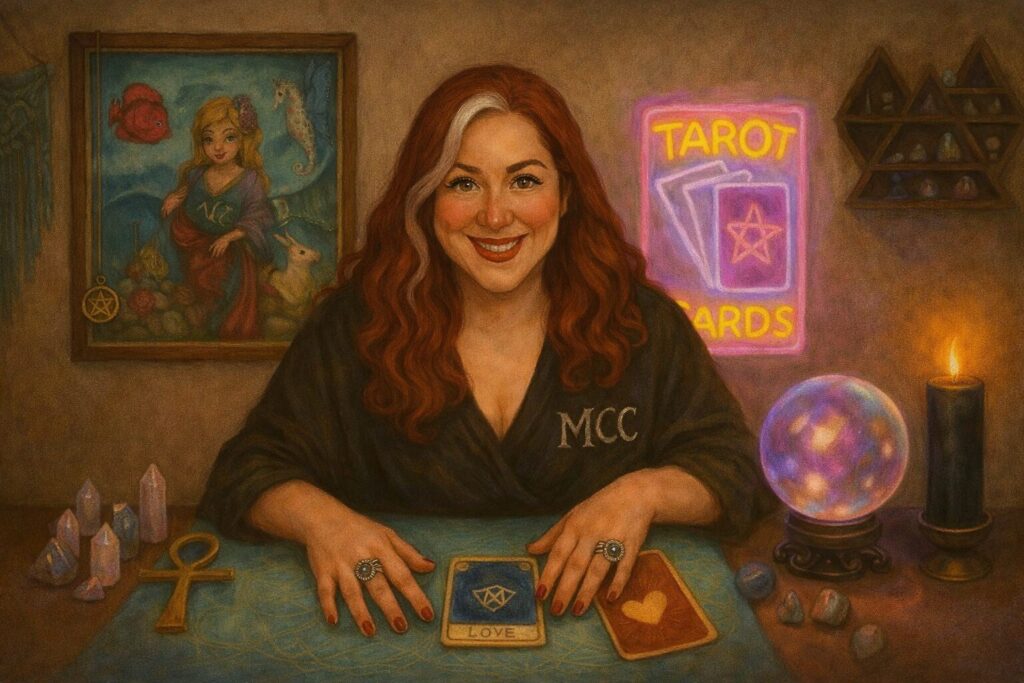
Within the Coven of the Veiled Moon, divination is not treated as spectacle. It is practiced as a discipline of clarity—pattern-reading in service of choice. Roen’s readings are grounded, careful, and respectful of sovereignty: she offers coherent counsel without turning guidance into command. If you want support navigating a threshold, a decision, or a pattern that keeps repeating, this is a steady place to begin.
Reminder: Divination offers orientation and insight. It does not override your will—and it should never be used to replace professional, medical, legal, or mental-health support when those are needed. :contentReference[oaicite:0]{index=0}
How to Ask a Clean Question
The quality of a divination depends less on the tool and more on the clarity of the question. A clean question reduces noise, protects sovereignty, and increases usable insight. Before you shuffle, cast, gaze, or listen—shape the field.
Remove the demanded outcome
Instead of “Will they choose me?” ask, “What is forming in this connection?” Replace control-based wording with clarity-based wording.
Narrow the scope
Ask about one layer at a time—timing, influence, personal role, external conditions. Wide questions create fog. Focus creates signal.
Ground your nervous system
If you are flooded with fear or desire, your interpretation will bend toward it. Breathe. Regulate. Then read.
Receive before reacting
Record what appears. Sit with it. Do not argue with the symbols immediately. Understanding sometimes arrives after the reading ends.
Seal the session
Close your tool deliberately. Say, “This reading is complete.” Clear the space. Do not chase the answer by asking again unless something real has changed.

To practice divination well is to cultivate a particular kind of intelligence: one that listens before acting, observes before judging, and remains steady in the presence of uncertainty. It is not the intelligence of control. It is the intelligence of orientation.
In our tradition, divination and spellwork are partners. Divination illuminates the terrain; spellwork moves through it. One clarifies what is forming. The other applies pressure where pressure is wise. When these two are confused—when illumination is treated as destiny, or influence is applied without understanding—the work becomes clumsy. But when they are aligned, magic becomes precise.
The layered field of time demands humility. The future is not a blank void waiting to be filled, nor is it a fixed script waiting to be discovered. It is structured probability—some paths anchored by momentum, others soft and responsive. Divination does not command that field. It reveals its contours. What you do with that revelation remains your responsibility.
A good diviner does not remove uncertainty from your life. They help you navigate it with clearer sight. They point to strengthening patterns, thinning branches, unseen influences, and timing windows—but they do not live your life for you. Your will is the crystallizing act. Your choices are what harden possibility into history.
This is why divination is not entertainment, and it is not panic management. It is a discipline. It requires clear questions, grounded bodies, ethical restraint, and the willingness to hear something other than what you hoped for. It also requires the maturity to act when action is called for—and to refrain when waiting is wiser.
At its best, divination becomes more than foresight. It becomes a practice of relationship: with time, with pattern, with spirit, with your own interior compass. It teaches patience. It teaches discernment. It teaches that listening is not weakness—it is preparation.
And in that preparation, magic becomes cleaner.