
Mediumship

Mediumship is not a fringe curiosity, nor a simple extension of intuition. It is a practice that has been claimed, tested, defended, exposed, refined, and lived across centuries. It sits at an uneasy intersection—between religion and investigation, between personal experience and public scrutiny, between the deeply sacred and the deeply questioned.
At its most grounded, mediumship is the capacity to perceive, interpret, and sometimes transmit information that appears to originate beyond the ordinary senses. For some, this is framed as communication with spirits—the dead, the ancestral, or other unseen intelligences. For others, it is approached through the lens of expanded cognition, altered states, or anomalous perception. The language shifts. The experience, more often than not, does not.
The 19th-century rise of Spiritualism attempted to formalize this phenomenon, placing mediumship within structured séances, shared protocols, and communal validation. At the same time, early researchers—figures such as William James and Frederic W. H. Myers—approached it not as superstition, but as a subject worthy of serious inquiry. Their work, and that of the Society for Psychical Research, did not resolve the question of mediumship. It made that question more precise.
And that precision matters.
Because mediumship is not simply about whether something is present. It is about what is being perceived, how it is being interpreted, and whether the practitioner has the discipline to tell the difference.
Not every voice is external.
Not every image is received.
Not every presence is what it claims to be.
This is where mediumship diverges from fantasy and enters practice.
Within a modern coven context, mediumship is not treated as performance, nor as passive sensitivity. It is approached as a threshold discipline—one that requires structure, grounding, and the ability to open and close contact deliberately. It overlaps with practices such as Parapsychology, which attempts to observe and categorize anomalous experiences, and with psychological frameworks that examine perception, projection, and altered states. These perspectives do not invalidate mediumship. They sharpen it.
To engage in this work seriously is to accept a tension:
That something meaningful may be occurring—
and that the human mind is fully capable of distorting it.
The medium stands in that tension.
Not as a believer without question.
Not as a skeptic without experience.
But as one who listens, tests, discerns—and decides when, and whether, to answer.
Core Principle
The Medium as Threshold
A medium is not merely a person who “believes in spirits,” nor simply someone who feels unusual things more strongly than others. In the deeper sense, the medium is a threshold figure: a person trained, sensitized, or predisposed to stand at the meeting place between ordinary perception and anomalous contact.
This threshold is not always dramatic. Often it is subtle, interior, and easily confused with memory, intuition, emotion, or imagination. That is why serious mediumship has always required more than sensitivity alone. It requires discernment—the ability to ask whether an impression is symbolic, psychological, environmental, ancestral, or genuinely other.
In this way, mediumship belongs neither to blind belief nor to flat dismissal. It belongs to the difficult discipline of holding openness and evaluation at the same time. The medium does not simply receive. The medium receives, interprets, tests, and decides.
This is part of why mediumship has remained so contested. Spiritual practitioners have long treated it as contact with the dead, with ancestors, or with unseen intelligences. Researchers in psychical inquiry and parapsychology have approached similar experiences as anomalous cognition, telepathic exchange, dissociation, survival evidence, or perception under unusual states. The language differs, but the central problem remains: something is being experienced that does not fit neatly into ordinary categories.
For the practicing witch or medium, that ambiguity is not a reason to abandon the work. It is a reason to become more skillful within it. A true threshold worker does not romanticize every signal, nor explain away every contact. They learn to notice texture, consistency, impact, and pattern. They learn when the room changes. They learn when a message carries intelligence rather than mood. They learn when to proceed—and when to close the door.
Mediumship, then, is not best understood as spectacle. It is better understood as a disciplined relationship to liminal perception: one shaped by receptivity, structure, ethics, and the ongoing labor of interpretation.
“The refusal to believe in any fact and the refusal to investigate it because it is extraordinary are two equally great mistakes.”
— William Crookes

Modes of Practice
Forms of Mediumship and the Clair Channels
Mediumship does not occur in only one way. Different practitioners receive through different channels, and different forms of contact place different demands on the body, mind, and ritual container. The old language of the clairs remains useful here—not as a set of fashionable labels, but as a practical vocabulary for describing how information is perceived.
Mental Mediumship
Mental mediumship is the most widely recognized and, for many practitioners, the most workable form of spirit contact. The medium receives impressions inwardly—through thought, image, emotion, symbolic flash, bodily sensation, or interior hearing—rather than through dramatic outward manifestation. This is the domain in which the clair vocabulary is most useful.
Clairvoyance refers to inner seeing: images, symbolic scenes, flashes of faces, places, objects, or events. Clairaudience refers to inner hearing: words, names, tones, fragments of speech, or the sudden sense of a message “arriving” in language. Clairsentience is often the felt sense of contact: pressure in the body, emotional texture, a shift in atmosphere, or a borrowed sensation that does not seem to originate in one’s own state. Claircognizance is immediate knowing: information present in the mind without a clear sensory pathway, but with unusual specificity or force.
These channels often overlap. A medium may first feel a presence through clairsentience, then receive an image clairvoyantly, and only afterward understand its meaning through claircognizance. In real practice, the lines are rarely clean. What matters is not collecting labels, but learning the texture of one’s own reception with enough honesty to distinguish pattern from fantasy.
Because mental mediumship takes place partly through the interpretive machinery of the psyche, it demands especially strong discernment. Symbol, memory, projection, intuition, and contact can mingle. This does not make the experience false. It makes training necessary.
Trance and Controlled Channeling
Trance mediumship involves a shift in consciousness deep enough that speech, gesture, or message begins to emerge through a more altered state. In some traditions this is described as partial overshadowing; in others, controlled channeling. In either case, serious practice depends on the difference between structured trance and simple overwhelm.
A disciplined trance medium does not collapse into chaos. They enter altered receptivity through ritual form, known signals, boundaries, and methods of return. The strongest practitioners are often not the most flamboyant, but the most stable. They know how to enter, hold, and exit contact without confusing surrender with loss of agency.
This is one reason mediumship must be distinguished from spectacle. The more dramatic a state appears, the more carefully it should be evaluated. Trance can be genuine. It can also be exaggerated, psychologically complicated, or unconsciously performed. A serious coven does not reward intensity for its own sake. It looks for coherence, consistency, aftermath, and truthfulness.
Channeling, at its best, is not a theatrical takeover. It is a managed threshold state in which information, tone, or presence moves through a prepared vessel without erasing the vessel entirely.
Physical Mediumship
Physical mediumship refers to claims of outward phenomena: knocks, object movement, temperature shifts, voices in space, materializations, or other environmental effects associated with spirit presence. Historically, this form attracted enormous fascination within Spiritualism, and just as much controversy.
Some accounts may point toward genuine anomalous events. Many others, however, belong to the long history of fraud, performance, suggestion, and desperate embellishment that has haunted the subject from the beginning. This is where directness matters. Physical mediumship has produced some of the most compelling stories in occult history—and some of the most embarrassing deceptions.
That does not mean all reports should be dismissed. It means they should be approached with more rigor, not less. Repeated pattern, environmental corroboration, group witnessing, and careful note-taking matter here. So does a willingness to say, without shame, that some events remain uncertain.
For most practitioners, physical mediumship is not the best place to begin. It is rare, unstable, easily overstated, and highly vulnerable to distortion. It belongs, if anywhere, inside very strong containers with very strong standards.
Ancestral Mediumship
Ancestral mediumship is often the most relationally grounded form of spirit contact. Rather than opening broadly to unknown presences, the practitioner works through kinship, lineage, memory, and devotional structure. This can include blood ancestors, chosen ancestors, spiritual forebears, or the dead with whom one has an established bond.
For many witches and spirit-workers, this is the most stable entry point into mediumship because it is not built on novelty. It is built on relationship. Photos, offerings, names, altars, inherited objects, prayers, and repeated rites create continuity. Over time, that continuity can become a channel.
Ancestral contact is not automatically simple or sentimental. Lineage can carry grief, silence, rupture, and unresolved history. Yet even here, the work is usually clearer than indiscriminate spirit-seeking. The medium is not merely asking, “Who is there?” but “Who among my dead, my elders, my known ones, is willing to step forward in right relation?”
That question changes everything. It narrows the field, deepens the ethics, and moves mediumship away from curiosity and toward reverence.
The Clair Vocabulary in Practice
The language of the clairs is useful only when it helps a practitioner become more precise. Used well, it allows mediums to describe how information arrives, compare patterns over time, and communicate clearly within a circle. Used poorly, it becomes branding: a way of declaring specialness without doing the harder work of testing signal against desire.
A mature medium learns to ask practical questions. Was that image symbolic or literal? Did that emotion belong to me before the contact began? Did the bodily sensation produce verifiable information, or only intensity? Did the “knowing” remain coherent when written down and reviewed later? These questions do not weaken the gift. They protect it.
In this sense, the clairs function less like fixed spiritual castes and more like instruments in an inner repertoire. Some are naturally louder. Others strengthen with practice. Most reliable mediums develop a mixed reception style over time, learning which channels are strongest, which are unstable, and which require support from divination, ritual structure, or communal witnessing.
A good medium does not merely announce, “I am clairvoyant,” or “I am clairsentient.” A good medium learns how their perception behaves under pressure, in ritual, in grief, in silence, and in company—and becomes accountable to that knowledge.
“When we study the phenomena of mediumship, we are not merely studying abnormal psychology; we are studying the possible extension of human personality beyond the usual range.”
— inspired by the work of Frederic W. H. Myers

Critical Practice
Discernment, Risk, and Misinterpretation
Mediumship is not only a matter of perception. It is a matter of interpretation, boundary, and consequence. The same openness that allows contact also allows confusion, projection, and, at times, genuine harm. This section is not included to discourage the work—but to make it real.
Psychological Overlay and Projection
Not every voice is external. Not every image is received. The human mind is capable of producing vivid, convincing, and emotionally charged experiences—especially in altered or expectant states. Memory, desire, grief, fear, and symbolic thinking can all present themselves as contact if not carefully examined.
This does not invalidate mediumship. It defines its difficulty. A practitioner must learn to distinguish between internally generated material and information that carries a quality of independence, coherence, or verification beyond their own state. This is where overlap with parapsychology and psychological study becomes useful—not as denial, but as calibration.
The most reliable mediums are not those who receive the most impressions, but those who can say, with clarity, “this is mine, and this is not.”
Misidentification and Deceptive Presence
Even when contact is genuine, identification is not guaranteed. A presence may present incomplete information, symbolic fragments, or impressions that are interpreted incorrectly by the medium. In some cases, a presence may actively misrepresent itself, whether through confusion, instability, or more complex intent.
This is one reason experienced mediums avoid making absolute claims too quickly. Names, identities, and roles should be tested over time through pattern, consistency, and corroboration. A single striking impression is not the same as a reliable relationship.
In practice, discernment means allowing uncertainty where uncertainty exists. It also means refusing to build narratives on incomplete data simply because the experience felt powerful.
Emotional Bleed and Empathic Overload
Many who are drawn to mediumship identify as empaths or highly sensitive individuals. While sensitivity can be an entry point, it is not the same as stability. Emotional bleed—taking on sensations, moods, or distress that do not originate from the self—can become overwhelming without strong grounding and boundaries.
This is especially true in cases involving hauntings, distressed environments, or unresolved presences. Some experienced mediums choose not to work in these conditions at all, not out of fear, but out of recognition that the cost of engagement can outweigh the value of the contact.
Sensitivity without structure leads to exhaustion. Structure allows sensitivity to become skill.
Fraud, Performance, and Self-Deception
Mediumship has a long and well-documented history of fraud. From the height of Spiritualism to modern platforms, there have always been individuals who fabricate phenomena, consciously or unconsciously, for attention, validation, or financial gain.
This reality must be faced directly. It does not invalidate genuine experience—but it does require that all claims, including one’s own, be held to a standard. The desire to be seen as gifted can subtly influence perception, memory, and reporting. Over time, this can lead to self-deception as much as deliberate deception.
A serious practitioner develops the ability to question their own experience without collapsing it. Integrity in this work is not proven by intensity. It is proven by consistency, humility, and the willingness to say “I don’t know.”
Boundaries, Closure, and Refusal
Not every presence should be engaged. Not every door should be opened. A foundational skill in mediumship is the ability to refuse contact, to close a session, and to return fully to ordinary awareness without residue.
This includes practices of grounding, clearing, and boundary-setting before and after any work. It also includes the recognition that curiosity is not sufficient reason to engage with the unknown.
The discipline of mediumship is not only in opening. It is in knowing when to stop, when to step back, and when to leave something unanswered.
“The boundary between the psychological and the spiritual is not a wall—it is a line that must be learned, tested, and respected.”
— MCC Teaching Principle
Ritual Context
Solo Work, Circle Work, and the Amplification of Contact
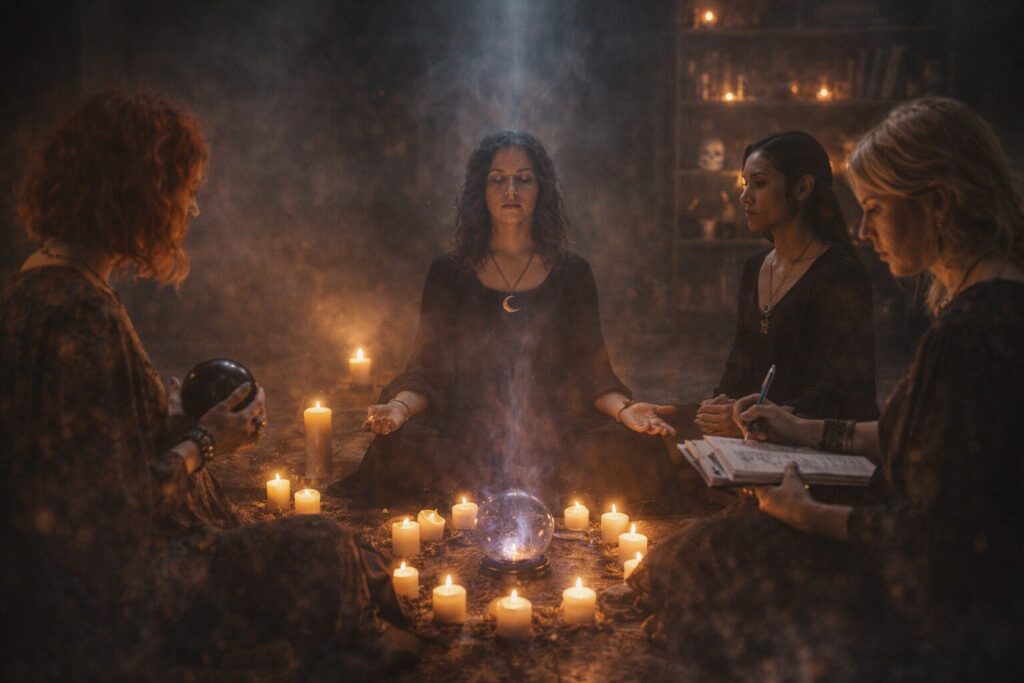
Mediumship does not only change according to the sensitivity of the practitioner. It also changes according to the container. Solitary work and coven work do not produce the same texture of contact, the same depth of manifestation, or the same demands of interpretation. Both have value. Both have risks. Both require different kinds of discipline.
Solitary Mediumship
Quiet Signal, Narrower Field
Solo mediumship often produces subtler contact. The practitioner works in a quieter field with fewer variables, which can make it easier to notice the fine texture of a presence, a shift in atmosphere, or the internal pattern of one’s own clair channels. This is often where a medium first learns the difference between noise and signal.
The strength of solitary work lies in intimacy and control. The altar, the schedule, the boundaries, and the method of closure all remain in the hands of one person. This makes it especially suitable for ancestral work, devotional contact, and the slow cultivation of perception over time.
Its weakness, however, is that the medium may have no immediate witness, no external check, and no second mind in the room to help distinguish contact from emotional state. Solitary practice sharpens perception, but it can also intensify private certainty. For this reason, journaling, repeated pattern, and retrospective review matter deeply.
Coven Mediumship
Shared Field, Stronger Reaction
Mediumship in a circle can produce a very different atmosphere. A group does not merely observe the medium; it can contribute to the conditions that make contact stronger, denser, or more externally perceptible. Attention gathers. intention synchronizes. Sensitivity overlaps. In some cases, this creates a more powerful threshold than a solitary practitioner could generate alone.
This is why coven work has long been associated with stronger manifestations, more pronounced atmosphere, and more complex spirit response. A circle can function like an amplifier. One person receives, another grounds, another records, another watches for pattern, another stabilizes the room. The work becomes collaborative rather than merely individual.
Yet amplification is not automatically wisdom. A stronger field can intensify genuine contact, but it can also intensify suggestion, emotional contagion, and interpretive error. Group mediumship therefore demands stronger leadership, clearer role assignment, stronger opening and closing rites, and more restraint in what is claimed.
The difference is not that solitary mediumship is real and coven mediumship is theatrical, or vice versa. The difference is that a circle changes the energetic and perceptual conditions of the work. It can sharpen, deepen, and externalize contact—but only if the group has the maturity to hold what it awakens.
Best Practice in Circle Work
In serious coven mediumship, roles should be clear. One person may serve as primary receiver, another as recorder, another as boundary-keeper, and another as ritual support. Not everyone in the room should interpret at once. Not every impression should be voiced immediately. Strong circles do not become louder as contact builds. They become more precise.
This is where mediumship begins to overlap again with both Spiritualism and parapsychology: not because the experience becomes less sacred, but because observation, corroboration, note-taking, and controlled method become part of the ritual intelligence of the room.
“A medium may listen alone. A circle can make the unseen answer more loudly.”
— MCC Teaching Principle
Working Pattern
A Simple Mediumship Protocol
Not all mediumship requires elaborate ritual, but it does require structure. A consistent pattern reduces confusion, strengthens perception, and helps prevent emotional or energetic residue. The following sequence is simple, but it forms a reliable foundation for most practitioners.
Prepare by clearing space, setting intention, and stabilizing your own state. Open deliberately—through prayer, invocation, or invitation—rather than passively waiting. ReceiveInterpretCloseGroundRecord
To follow this pattern once is technique. To follow it consistently, without distortion or self-inflation, is practice.
Mediumship endures because it touches one of the oldest and most difficult human questions: whether the boundary between the living and the dead is absolute. Across religion, folklore, Spiritualism, psychical research, and modern occult practice, the answer has rarely been simple. What persists, however, is the repeated testimony that contact sometimes seems to occur—not constantly, not cleanly, and not without risk, but often enough to refuse easy dismissal.
That refusal does not excuse gullibility. If anything, it demands a stronger mind.
To practice mediumship well is not to accept every voice, every shadow, every sensation, or every emotional surge as proof of spirit. Nor is it to flatten every unusual experience into stress, fantasy, or subconscious symbolism simply because those explanations are available. The serious medium stands between those temptations. They cultivate openness without naivety, and skepticism without spiritual deadness.
This is why mediumship belongs not only to mysticism, but to discipline. It asks for receptivity, yes—but also for boundaries, closure, record-keeping, pattern recognition, and ethical restraint. It asks the practitioner to know when they are perceiving, when they are interpreting, when they are assuming, and when they are being changed by what they encounter.
At its best, mediumship is not spectacle. It is relationship across a threshold. Sometimes that threshold opens toward the ancestral dead. Sometimes toward the unfinished, the wandering, or the difficult to classify. Sometimes it reveals less about spirits than about the medium’s own state, limits, and readiness. In all cases, the work is not made nobler by exaggeration. It is made nobler by honesty.
The question is not only whether something is there.
The deeper question is whether one has become skillful enough to meet it without distortion, humble enough to admit uncertainty, and steady enough to close the door when the work is done.