Religion • Mediumship • Psychical Inquiry • Spirit Contact
Spiritualism
The Conversation Across the Veil
Modern Spiritualism emerged in the nineteenth century around a startling proposition: consciousness may continue beyond bodily death, and under some circumstances the living and the dead may communicate. The movement became a religion, a philosophy, a field of mediumistic practice, and eventually one of the great catalysts for psychical research and the modern paranormal tradition. It did not invent humanity’s conversation with spirits—but it changed the way much of the Western world learned to ask whether someone might answer.
What Is Spiritualism?
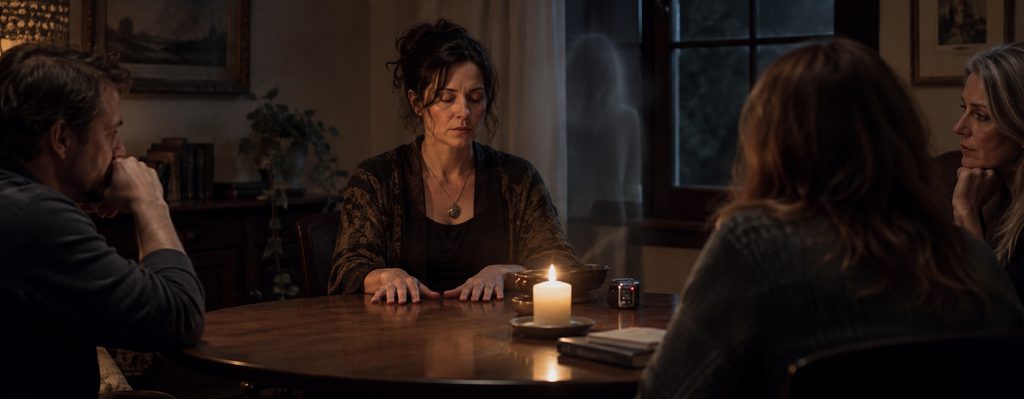
Modern Spiritualism is a religious movement built around a deceptively simple idea: human consciousness can survive bodily death, and communication between the living and the dead is sometimes possible. From that premise grew not only séances and mediumship, but churches, systems of spiritual development, healing traditions, philosophical arguments about the afterlife, and eventually serious attempts to investigate unusual experiences through psychical research.
Spiritualists have historically described their movement as a religion, philosophy, and science. The first two descriptions are straightforward. Spiritualism developed communities, services, teachings, ethics, clergy and distinctive ideas about death and continued existence. Its historical use of the word science requires a little more care. Spiritualists meant that claims of spirit communication should be observed, tested and investigated rather than accepted solely on religious authority. That effort became enormously important to the development of psychical research, although it should not be confused with a modern scientific consensus that communication with the dead has been proven.
At the center of Spiritualism is mediumship: the claimed ability to perceive, receive or communicate information associated with spirits or other nonphysical intelligences. But the two words are not interchangeable. A person can practice mediumship without being a Spiritualist, and membership in a Spiritualist community does not automatically make someone a medium. Today, people who have similar experiences may instead describe themselves as psychic, sensitive, intuitive, channelers, spirit workers, or use no particular label at all. Mediumship & Spirit Channeling looks more closely at how those experiences are understood and developed.
Spiritualism also should not be confused with witchcraft, although the two eventually crossed paths in important ways. Nor is every unexplained presence a dead human being, every recurring spirit a “guide,” or every strange sound evidence of a ghost. Those distinctions become important as we move through this history. Spiritualism gave the Western world one influential framework for understanding contact with the unseen; it did not create the unseen, and it does not hold the only vocabulary for encountering it.
A Few Terms Before We Go Further
The modern religious and philosophical movement centered on survival after death and communication through mediumship.
The related system developed from the work of Allan Kardec, with its own teachings about spirits, moral development and reincarnation. We will return to it later.
Practices or experiences involving communication with spirits or nonphysical intelligences. Mediumship exists both inside and outside Spiritualism. Explore Mediumship
Broader contemporary terms for forms of perception or knowing that people experience as extending beyond ordinary sensory information. They do not necessarily imply communication with the dead.
A much broader category that can include relationships with the dead, recurring spirit allies, spirits of place and other nonhuman presences. It occurs in many religious and magical traditions.
The attempt to document and understand unusual experiences or environmental events. It may overlap with mediumship, but does not require Spiritualist belief.
The World Was Already Listening
Long before the Fox sisters heard mysterious rappings in Hydesville, people were already attempting to communicate with the dead, entering trance, reporting visions, interpreting dreams, consulting oracles, and describing encounters with unseen intelligences. What changed in the nineteenth century was not humanity’s interest in spirits, but the particular language through which many Westerners began to understand such experiences.
One important precursor was the Swedish scientist and religious visionary Emanuel Swedenborg, who in the eighteenth century described an ordered spiritual world populated by recognizable persons who continued beyond death. His writings treated the unseen not as a distant supernatural exception, but as a realm with which human consciousness could sometimes interact. His idea of correspondences—that visible and spiritual realities reflect one another—would influence generations of religious seekers, mystics, and later Spiritualists.
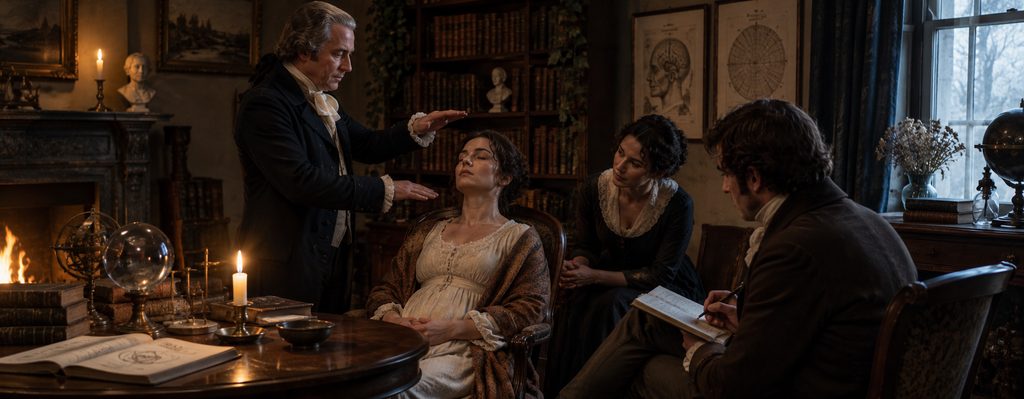
Another current came through mesmerism, or “animal magnetism,” associated with Franz Anton Mesmer. Mesmer himself proposed an invisible natural force flowing through living beings. His original theory did not amount to Spiritualism, but practices that developed around mesmerism produced trance states, clairvoyant claims, unusual forms of perception, and experiments in which the boundary between mind, body, and spirit seemed increasingly uncertain. By the nineteenth century, mesmerism and Spiritualism were becoming deeply entangled in both popular culture and Western esoteric thought.
In the United States, Andrew Jackson Davis—later called the “Poughkeepsie Seer”—became one of the clearest bridges between these worlds. Influenced by mesmerism, Davis entered trance states, reported clairvoyant experiences, and dictated works describing spiritual realities and continued existence before the events at Hydesville made the Fox sisters famous. His career shows why it is misleading to treat 1848 as the moment people suddenly discovered mediumship. The language and expectations were already forming.
What was emerging was a distinctly modern combination: old human experiences of vision and spirit contact meeting newer ideas about natural law, experimentation, electricity, magnetism, psychology, and unseen forces. Instead of asking only whether a miracle had occurred, people increasingly asked whether there might be a process behind it—something observable, repeatable, or even eventually understandable.
That question would become one of Spiritualism’s defining habits.
So when strange knocks were reported in a farmhouse in western New York in 1848, they did not fall into an empty world. The cultural tinder was already dry. Hydesville supplied the spark.
1848: The Fox Sisters and the Birth of Modern Spiritualism
On March 31, 1848, in Hydesville, New York, the Fox family reported a series of unexplained knocks and rappings in their farmhouse. The two youngest daughters, Margaret “Maggie” Fox and Catherine “Kate” Fox, began responding to the sounds and asking for answers through patterns of knocks. Neighbors were invited in. Questions were asked. The sounds appeared to respond intelligently.
That evening did not invent spirit communication, but it became the symbolic beginning of Modern Spiritualism. Within a remarkably short time, the Fox sisters were demonstrating the rappings publicly, first in private gatherings and then before paying audiences. Their older sister Leah became involved, and the sisters became famous representatives of a movement that quickly spread far beyond one farmhouse in western New York.
What made the events compelling was not simply the sound of knocking. It was the apparent exchange of information. The raps could be counted, interpreted, and used to answer questions. To supporters, this suggested that an unseen intelligence was not merely present but capable of deliberate communication. That basic idea—the possibility of establishing a repeatable method of contact—would become central to the séance, mediumship, and later attempts to investigate paranormal claims.
The Fox story is also more complicated than the founding legend sometimes suggests. In 1888, decades after the events at Hydesville, Maggie Fox publicly declared that the famous rappings had been produced fraudulently, including by manipulating joints in the feet and toes. Her confession was widely reported and celebrated by critics of Spiritualism. A year later, however, she repudiated that confession and again affirmed Spiritualism. Her motives, the extent of any fraud, the role of financial hardship and family conflict, and what actually occurred during the earliest Hydesville events have been argued over ever since.
For our purposes, that controversy should neither be hidden nor allowed to swallow the history. Fraud certainly existed within nineteenth-century mediumship, and the growing market for dramatic manifestations created strong incentives for deception. But the movement that followed Hydesville rapidly became far larger than the Fox family. Thousands of people experimented with séances and mediumship, organized churches and circles, reported experiences of their own, and eventually attracted researchers who attempted to distinguish trickery, psychology, misinterpretation, and genuinely unexplained phenomena.
That is why 1848 still matters.
The Fox sisters did not create humanity’s relationship with the dead. They helped ignite a cultural moment in which ordinary people increasingly believed that communication with spirits might be something they could attempt themselves—at home, around a table, without waiting for a priest, prophet, or institution to grant permission.
Modern Spiritualism had found its public voice.
Why Spiritualism Caught Fire
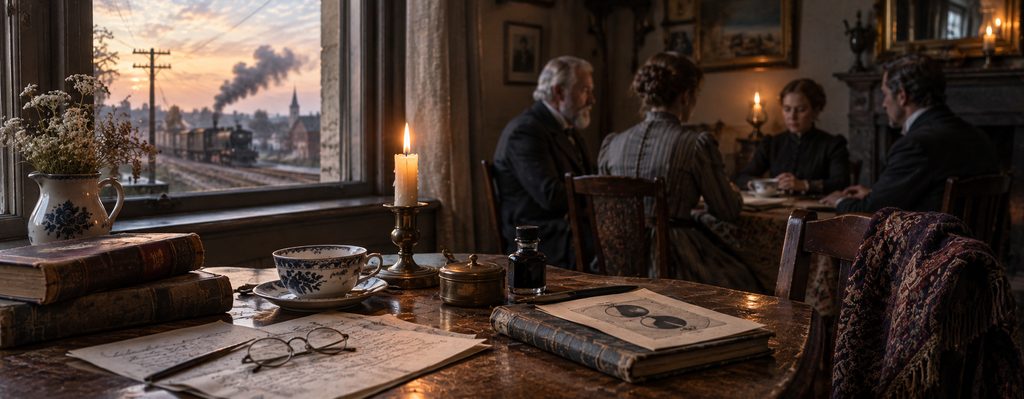
Spiritualism arrived at an unusually receptive moment. The nineteenth century was changing how people understood distance, communication, religion, science, and even the limits of the human body. Railroads were compressing geography. Telegraph wires carried messages invisibly across distances that would once have taken days or weeks to cross. Electricity and magnetism—real forces that could not be seen with the naked eye—were moving from wonder into everyday life. In that atmosphere, the possibility that thought or personality might also travel through an unseen medium did not sound quite as absurd as it may seem in hindsight.
The movement also offered something many established churches could not: direct experience. A Spiritualist did not necessarily have to accept a doctrine about the afterlife because a minister, scripture, or institution said it was true. In principle, a family could gather around its own table and ask for evidence themselves. The séance brought religious experience into parlors and sitting rooms, putting extraordinary claims within reach of ordinary people.
That was a powerful shift in authority. If a medium could receive a message from a deceased relative, teacher, or other spirit, then knowledge of the unseen no longer belonged exclusively to clergy. Spiritualism could be remarkably decentralized. Circles formed in homes, lecturers traveled from town to town, mediums developed through practice, and believers compared experiences with one another. The movement could be organized, but its central claim did not depend upon a grand cathedral or an ancient priesthood.
Grief gave that claim enormous emotional weight. The nineteenth century knew death intimately: disease, childbirth, industrial accidents, epidemics, and war regularly separated families with little warning. The American Civil War intensified that longing on a national scale. For someone mourning a child, spouse, sibling, or friend, the possibility that the dead remained recognizable—and might still be able to communicate—was more than an interesting metaphysical theory. It offered the possibility that relationship itself had survived.
That emotional need did not automatically make every claimed communication genuine, any more than skepticism automatically made every unusual experience fraudulent. But it helps explain why the movement mattered so profoundly. Spiritualism addressed one of humanity’s oldest fears with an unusually immediate answer: perhaps death was not the end of conversation.
Its appeal also reached people dissatisfied with conventional religious authority. Spiritualism could coexist with Christianity, and many early Spiritualists still understood themselves through Christian language, but the movement also created space for people who wanted something less doctrinal, more experiential, and more open to continued revelation. Spirits could disagree with churches. Mediums could challenge ministers. New teachings could arrive from somewhere other than an established religious hierarchy.
This openness would eventually help connect Spiritualism with social reform, alternative religion, psychical research, occultism, and later forms of post-religious spirituality. It also created opportunities for people whose voices were restricted elsewhere—particularly women.
And there the history becomes even more interesting.
Women, Mediumship & a New Religious Authority
From its earliest years, women stood near the center of Modern Spiritualism. They were mediums, trance speakers, lecturers, organizers, writers, healers and eventually ministers. At a time when most established religious institutions allowed women relatively little formal authority, Spiritualism created an unusual opening: a woman could stand before an audience and speak on religion, morality, death, social reform and the nature of the universe—and people might travel considerable distances to hear her.
There was a paradox in this power. The medium was often said to be speaking for someone else. A trance speaker could present ideas as communication from Spirit rather than as a woman publicly asserting religious authority in her own right. Yet whatever explanation the audience accepted, it was still her body at the lectern, her voice filling the hall, and often her reputation that drew the crowd.
[Emma Hardinge Britten] became one of the movement’s most important lecturers, writers and organizers. A formidable public speaker, she traveled widely promoting Spiritualism and later helped articulate principles that continue to influence organized Spiritualist religion. She also founded The Two Worlds, a Spiritualist newspaper that survives today in a different form.
[Cora L. V. Scott], later known under several married names including Cora Richmond, became famous while still very young for trance lectures in which audiences proposed subjects and she responded while reportedly entranced. She eventually served as a Spiritualist pastor, participated in the 1893 Parliament of the World’s Religions, and helped establish the organization that became the National Spiritualist Association.
The relationship between Spiritualism and women’s reform movements could also become explicitly political. [Victoria Woodhull], a Spiritualist as well as a newspaper publisher, stockbroker and advocate for women’s rights, became the first woman to address a congressional committee on woman suffrage in 1871 and later ran for president of the United States. Her politics were controversial even among other reformers, but her career shows how easily Spiritualist, social-reform and women’s-rights worlds could intersect.
This did not mean Spiritualism existed outside the sexism of its age. Female mediums were scrutinized, sexualized, dismissed as hysterical, managed by husbands or promoters, accused of fraud, medically pathologized, and sometimes placed under extraordinary pressure to perform. Even successful mediums could discover that the authority supposedly granted by Spirit remained subject to very earthly ideas about what women were permitted to say and how they were expected to behave.
Yet the opening mattered. A séance circle or trance platform could give a woman access to religious authority without requiring ordination from a traditional church. Spiritualist publications could carry women’s writing. Lecture circuits could give them public audiences. The movement’s emphasis on continuing revelation also made it harder to insist that all legitimate religious authority had already been settled centuries earlier by institutions controlled almost entirely by men.
That helps explain why Spiritualism repeatedly found itself beside movements for women’s rights, abolition, labor reform and other nineteenth-century experiments in reorganizing society. Not every Spiritualist supported every reform, and the movement was never politically uniform. But both Spiritualism and reform culture shared a disruptive question:
Who has the right to speak with authority?
For many women in Spiritualism, the answer was no longer limited to the pulpit, the university, or the men already occupying them.
What Spiritualists Believed Was Happening
At the center of Spiritualism is the conviction that death does not erase the individual. The body dies, but the person continues in another condition of existence, retaining enough identity, memory and personality to remain recognizable and, under some circumstances, to communicate with the living.
That idea remains explicit in organized Spiritualism today. The National Spiritualist Association of Churches teaches that personal identity continues after death and that communication between the living and those in the Spirit World is possible through mediumship. It also teaches continued moral and spiritual development after death rather than a permanently fixed state reached at the moment of dying.
This is important because Spiritualism generally does not treat the afterlife as a distant reward that must simply be believed in. Continued personality is supposed to be experienced through relationship. The dead may be encountered as recognizable people: a parent with familiar mannerisms, a friend whose humor remains intact, or another individual whose communication contains details meaningful to those who knew them.
That is part of the reason evidential mediumship became so important. A vague claim that “someone loves you from the other side” carries very little weight. A specific personality, relationship, memory, phrase, habit or piece of information may appear more significant because it suggests not merely survival in the abstract, but the persistence of an identifiable person.
Spiritualists have never agreed on every detail of what the Spirit World is like. Different churches, mediums and related traditions developed different ideas about spiritual spheres, progress, reincarnation, guides, healing and the nature of consciousness itself. What consistently mattered more was the conviction that death changes the condition of life rather than simply extinguishing it.
MCC overlaps with that idea, though we do not adopt Spiritualism’s entire map of the afterlife. Our practice allows that a deceased person can remain a recognizable individual consciousness, sometimes for a very long time, and that meaningful communication with such a person can occur. We are less certain that individual personality remains permanently separate forever. At some point consciousness may return to a larger process, current, or cycle of existence—but this is not something we pretend to have mapped with precision.
That fits comfortably within MCC’s broader cosmology. Consciousness arises within a living, relational universe rather than appearing as an isolated accident. Death changes the form through which consciousness participates in that system; it does not necessarily imply immediate annihilation of the person who lived.
Just as importantly, continued existence does not make a spirit infallible.
A person who was opinionated, confused, funny, generous, stubborn or mistaken while alive does not necessarily become an all-knowing sage by dying. Spiritualism opened the possibility of continued conversation with the dead. It did not establish that every participant on the other side of that conversation must be wise, truthful, benevolent—or even human.
That raises the next and more difficult question:
Who—or what—is actually communicating?
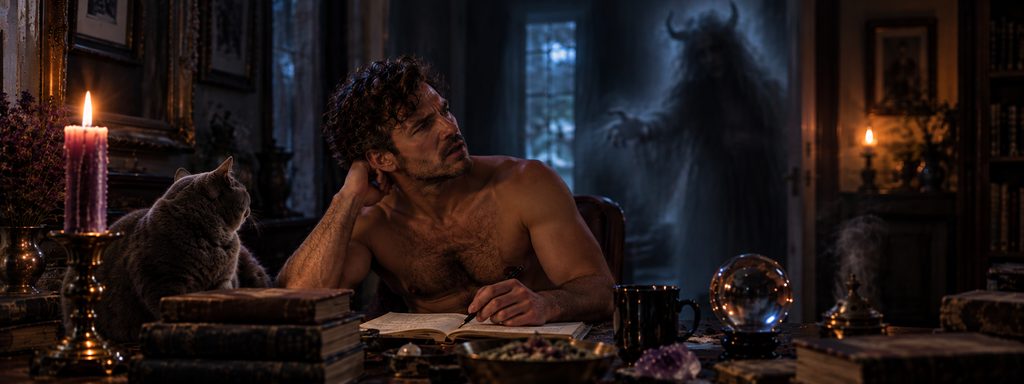
Who—or What—Is Communicating?
One of the easiest mistakes in spirit work is to assume that every unusual presence must be a deceased human being. Spiritualism understandably placed enormous emphasis on communication with the dead, but even within mediumistic traditions the identity of the communicator has never always been simple.
Sometimes the contact seems recognizably human: a deceased relative, friend, former acquaintance, or another person whose memories, mannerisms or relationship make the identification meaningful. These are the experiences most closely associated with traditional Spiritualist mediumship, and they remain an important part of modern Mediumship & Spirit Channeling.
Other encounters are less easily categorized. A presence may return repeatedly without giving a clear human biography. It may communicate through emotion, images, impressions, dreams or a recognizable “feel” rather than through a name and history. Over time, a relationship may develop. At MCC we are comfortable calling such a recurring presence a spirit ally when that relationship has become established. Other traditions may use the more familiar term spirit guide.
The difference matters to us. We do not assume that every person is assigned a private spiritual attendant at birth, nor that an unseen being exists simply to supervise one individual’s life. A spirit ally is better understood as a relationship: contact occurs, recognition develops, trust is tested, and the spirit continues to return because some form of interest, affection, affinity or shared purpose exists.
Not every spirit wants that relationship.
In our experience, many spirits are simply curious. Some seem indifferent. Some are helpful. Some may engage briefly and then disappear. Others have their own priorities and little interest in human concerns. A smaller number may manipulate, exaggerate, mislead or lie. Being dead—or nonhuman—does not automatically make a presence wise, benevolent or truthful.
Nor does every unusual phenomenon necessarily involve a conscious spirit at all. A place may seem to contain a repeating pattern, environmental imprint or residual event rather than an intelligence attempting communication. Our Ghosts page looks more closely at the difference between recognizable human spirits, residual phenomena and other forms of reported presence.
This is one reason careful mediumship requires more than openness. The first question may be “Is someone there?” But the harder questions follow quickly:
Is this an independent presence? Is it communicating intentionally? And is it actually who it claims—or appears—to be?
Those questions are not signs of distrust. They are part of responsible practice.
Receiving a Message Is Not the Same as Trusting It
Mediumship is sometimes described as though the difficult part were simply learning how to receive a message. In practice, receiving is only the beginning. Discernment is what makes mediumship usable.
A practitioner may experience a sudden thought, emotional shift, image, phrase, bodily sensation, memory, dream, or impression that seems to come from somewhere beyond the ordinary flow of their own mind. With training, these patterns can become more recognizable. But recognition does not automatically establish either the source or the truth of what has been received.
This is one reason MCC places so much emphasis on development rather than treating mediumship as a mysterious talent someone either has or does not have. Training helps a practitioner learn their own internal landscape: what anxiety feels like, what expectation feels like, how imagination behaves, how a familiar spirit tends to communicate, and what changes when an unfamiliar presence enters the interaction. Our Mediumship & Spirit Channeling page goes more deeply into that development.
Emotion and intuition are often part of this process. A communication may feel warm, uneasy, distant, familiar, intrusive, affectionate, impatient or strangely neutral. Those responses can provide information, but they are not infallible tests. A comforting presence is not automatically trustworthy, and an unsettling one is not automatically dangerous. Strong emotion can also make a practitioner more suggestible, especially when grief, fear or hope is already involved.
Spirits themselves complicate the picture. Most are not lurking in the dark waiting to deceive someone. In our experience, many are simply curious, indifferent, briefly interested, or occupied with concerns of their own. Some genuinely seem inclined to help. A relationship may deepen over time and become mutually familiar.
Others can be less straightforward.
A spirit may misunderstand. It may exaggerate. It may present an opinion as though it were a fact. It may tell a practitioner what that practitioner wants to hear. And, less commonly, it may deliberately manipulate or lie. A nonphysical communicator does not become automatically truthful simply because it has managed to make contact.
This is why experienced mediums learn not only to ask “What am I receiving?” but also “How much confidence should I place in it?”
Consistency matters. Context matters. Repeated contact matters. Corroboration matters when it is available. Boundaries matter throughout. A practitioner should remain capable of questioning a message without fearing that skepticism itself will somehow offend the spirit world.
The medium is not meant to become a passive receiver for every voice that appears.
At MCC, we approach mediumship as a relationship conducted across a threshold. The practitioner remains responsible for what crosses that threshold, what is entertained, what is challenged, and what is ultimately believed. Good boundaries, grounding, and the ability to close contact are part of the practice, not emergency measures used only after something goes wrong.
For deeper practical work around those boundaries, see our pages on Protection and Banishing.
The same discipline becomes especially important when a communicating presence offers something humans are naturally inclined to value:
a name.
And sometimes, a very impressive one.
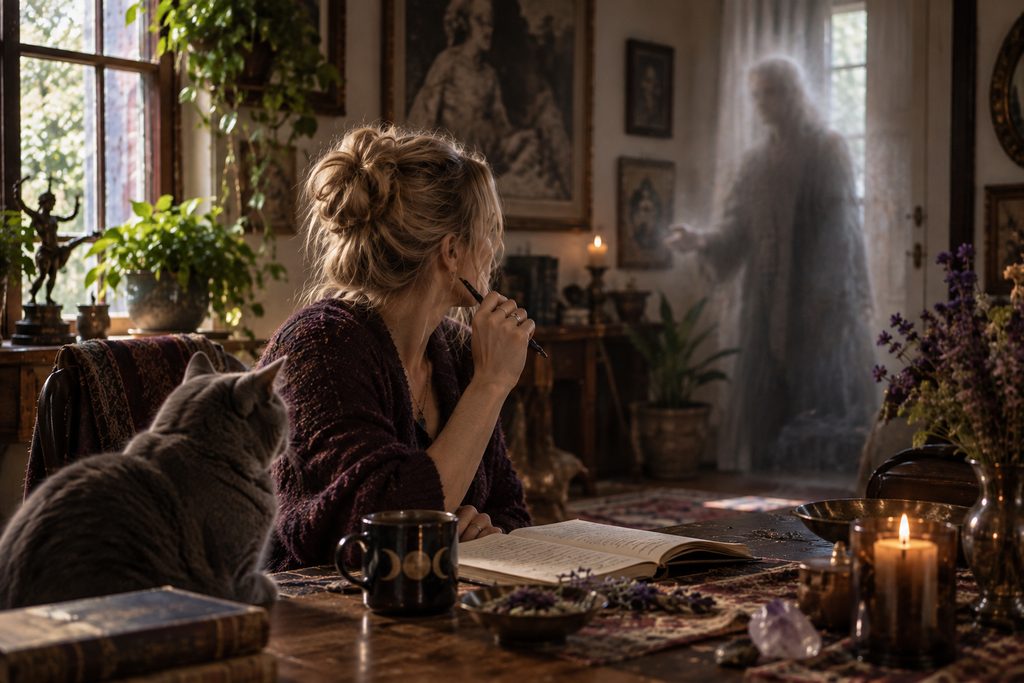
Names, Guides & Claims of Identity
Spiritualist literature has long used words such as guide and control for spirits believed to work repeatedly with a medium. Historically, a control could be understood as the recurring spirit personality who communicated through a trance medium or helped facilitate communication with other spirits. The language has changed over time, but the underlying idea is familiar: some presences return often enough that a relationship develops. (UMBC’s Eileen J. Garrett Collection preserves this older mediumistic terminology.)
MCC generally prefers spirit ally. We are comfortable with guide as common language, especially when a spirit has become a trusted and recurring presence, but we do not assume that every person is assigned a private invisible supervisor at birth. A relationship makes more sense to us. Contact happens. A presence returns. The practitioner learns its manner and patterns. Trust is tested over time. Eventually the relationship may become guide-like because the spirit has chosen to remain involved.
Names are trickier.
Spirit communication does not always arrive like two people meeting at a party and exchanging introductions. A medium may receive images, fragments of language, emotions, memories, associations or an overall sense of personality. Sometimes a name appears clearly. Sometimes it does not. In our experience, a spirit may even tolerate a name or title that the practitioner has given it because the label works well enough for continued communication.
That gives us an important distinction:
A spirit can be real while the name attached to it is wrong.
Even serious historical mediumship presents this problem. Leonora Piper, one of the most intensively investigated mediums of her era, communicated in trance through recurring personalities called controls. Investigators took her mediumship seriously while remaining uncertain whether some of those controls were actually the deceased individuals they claimed to be. In the case of a control called Phinuit, attempts to confirm the personality’s claimed earthly biography were unsuccessful.
This is also why MCC becomes particularly cautious when the name happens to belong to someone extraordinarily famous.
Claims of communication with celebrated historical figures have been part of mediumistic culture for a long time. Famous musicians, religious figures, rulers and other prestigious dead have all appeared in claimed communications. Historical accounts even include mediums reportedly influenced by the spirits of composers such as Mozart, Beethoven, Liszt and Chopin. The phenomenon is therefore much older than social media, even if the internet has given it an impressive new stage.
Could someone encounter a famous deceased person? Within a worldview that accepts spirit communication, we cannot declare it metaphysically impossible. But “Cleopatra is my guide” does not become more convincing because Cleopatra is impressive. If anything, an extraordinary identity deserves unusually strong evidence.
There are countless dead people who were farmers, shopkeepers, laborers, parents, teachers, nurses, cooks, clerks and people whose names never appeared in a history book. Yet grand spiritual claims have a curious habit of producing queens, pharaohs, famous occultists, prophets and celebrated artists. When the identity conveniently makes the practitioner unusually important too, a little skepticism is healthy.
Expectation can also shape interpretation without anyone consciously lying. If a practitioner already believes a presence is Cleopatra, ambiguous images of Egypt, royalty, perfume, gold or the Nile can begin reinforcing that identification. The practitioner may sincerely experience the contact while being mistaken about who is on the other end.
And spirits themselves have agency. A communicator may misunderstand a question, exaggerate, play along with an identity, obscure its identity, or deliberately lie. Others simply may not care very much what humans call them. Receiving the name “Cleopatra” is therefore not the same thing as establishing contact with the historical Cleopatra VII.
For MCC, the more useful question is rarely “How prestigious is this spirit?” It is: What is the relationship like? Is communication consistent? Does the presence respect boundaries? Has information proved reliable? What does it actually do rather than merely claim to be?
A recurring spirit ally does not need an impressive biography to matter.
The relationship should establish the name; the name should not establish the relationship.
Mediumship — From Impression to Trance
Mediumship is not one single experience. It describes a range of ways in which a practitioner may perceive, interpret, or temporarily make themselves available to communication that they understand as coming from a spirit or other independent presence.
At the lighter end, communication may resemble intuition. A medium notices an unexpected thought, image, emotion, physical sensation, word, memory, or sudden certainty that does not feel entirely self-generated. This can be subtle enough that beginning practitioners spend considerable time learning the difference between ordinary imagination, expectation, and something that appears to arrive from elsewhere.
This is one reason intuitive has become such a common modern label. It is broad, relatively nonreligious, and does not necessarily claim direct conversation with the dead. Someone may describe themselves as intuitive without identifying as a medium at all. Others eventually discover that some of what they had been calling intuition behaves more like recurring spirit communication.
Traditional Spiritualism usually places much of this within mental mediumship: communication received through the medium’s awareness rather than through dramatic physical manifestations. Clairvoyant images, sensed emotion, inner hearing, impressions, inspired speech and other forms of perception can all fall somewhere within that territory. We explore those individual forms in much greater depth on our Mediumship & Spirit Channeling page.
Deeper states can involve trance. The practitioner’s ordinary attention becomes quieter or partially withdrawn while communication becomes more pronounced. Some mediums remain fully aware of what is happening. Others describe partial awareness, altered memory, or the sense that another personality is becoming more prominent within the interaction.
Historically, Spiritualists sometimes described a recurring spirit as a medium’s control, particularly when that personality appeared during trance and helped facilitate communication. Contemporary practitioners are more likely to use words such as guide, channel, spirit ally, or simply the name they use for the presence.
These experiences can shade into what is now commonly called channeling, where the practitioner allows communication to come through speech, writing, movement, or another expressive form with less deliberate editing. The language is newer than Spiritualism, but the underlying territory is not.
Deeper still are experiences sometimes described as overshadowing, control, or possession—terms that different traditions define differently. In some accounts, the practitioner remains present but shares awareness or expression with another presence. In others, the spirit is believed to exercise much greater control for a period of time.
MCC does not treat these experiences as a simple ladder in which a “better” medium eventually progresses toward surrendering more control. Greater depth is not automatically greater skill. A quiet impression that can be tested and interpreted clearly may be considerably more useful than a dramatic trance state that leaves the practitioner unable to evaluate what occurred.
Nor do we treat loss of control as a spiritual achievement.
Within witchcraft and ritual practice, related states may also appear in invocation, aspecting, trance, and possession, but the purpose and interpretation can differ substantially from Spiritualist mediumship. Our pages on Invocation & Aspecting and Possession explore those distinctions more fully.
Across all of these forms, one principle remains important: the medium is participating in the communication, not disappearing from it. Training, consent, discernment and the ability to end contact remain relevant whether the experience is a faint impression or a profound trance.
And not all mediumship remains inside the mind or voice of the medium. Historically, some of Spiritualism’s most famous—and most controversial—claims involved the surrounding room itself.
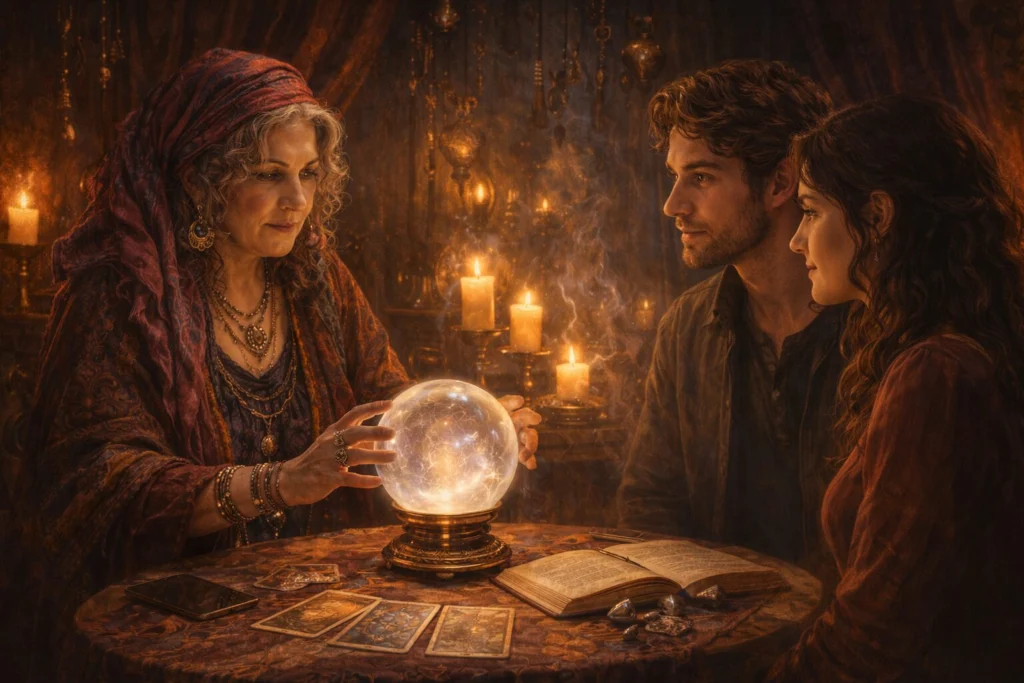
Physical Mediumship
Some of Spiritualism’s most famous claims did not involve messages received quietly within a medium’s mind. They involved things that other people in the room believed they could hear, see, touch, photograph, or watch move.
This became known as physical mediumship.
The earliest Spiritualist phenomena were themselves physical: the rappings associated with the Fox sisters. As the movement expanded, séance reports grew increasingly elaborate. Tables were said to tilt, turn, or rise. Objects moved without an obvious hand. Musical instruments sounded in darkened rooms. Sitters reported mysterious lights, touches, voices apparently coming from somewhere other than the medium, and occasionally the appearance of hands, faces, or even complete human forms.
Some mediums became associated with direct voice, in which a purported spirit voice was heard independently of the medium’s ordinary speech. Others produced automatic writing or slate writing under circumstances meant to demonstrate that the medium could not consciously control the message.
The most spectacular claims involved materialization: the apparent formation of a temporary visible or physical spirit body. By the late nineteenth and early twentieth centuries, this became closely associated with the strange substance Spiritualists called ectoplasm, which was said to emerge from a medium during trance and provide material through which spirits could manifest.
It is difficult to look at some surviving photographs of ectoplasm today without wondering whether a curtain, some cheesecloth, and an unfortunately sacrificed magazine portrait had a very busy evening.
And sometimes that is essentially what happened.
Physical mediumship became one of the areas of Spiritualism most vulnerable to deliberate fraud. Darkened rooms, tightly controlled séance conditions, emotionally invested audiences, and growing public demand for increasingly dramatic manifestations created obvious opportunities for trickery. Investigators exposed hidden mechanisms, substituted photographs, concealed objects, false spirit forms, and mediums physically producing effects themselves.
But stopping the story there would be too easy.
Not every physical-mediumship case was exposed, and not every witness was naïve. Scientists, physicians, journalists, magicians, and experienced investigators attended séances and sometimes reported phenomena they could not readily explain. Some mediums submitted to repeated observation under increasingly controlled conditions. Their claims remained disputed, but they helped turn Spiritualism from purely religious testimony into something people attempted to investigate.
The technology changed too. Photography introduced the possibility of preserving an alleged manifestation after the séance ended. Later came audio recording, film, electronic instruments, and eventually the equipment now familiar in paranormal investigation.
That progression matters:
reported → witnessed → photographed or recorded → instrumentally investigated
Each step can improve documentation. None automatically establishes the cause.
A photograph may show something unusual without telling us what produced it. A recording may preserve a sound without establishing that a deceased person made it. Multiple witnesses may sincerely agree about an experience and still misunderstand what they encountered.
That distinction remains central to both responsible mediumship and paranormal investigation: documenting a phenomenon and explaining a phenomenon are not the same task.
Physical mediumship also created a difficult pressure on legitimate practitioners. Mental impressions and private communications could be meaningful to a sitter, but the public increasingly wanted something visible. A medium whose reputation or livelihood depended on demonstrations could be expected to produce extraordinary phenomena on schedule, whether anything extraordinary happened that evening or not.
Some responded honestly to that pressure.
Some did not.
And that leads directly into one of the most uncomfortable but necessary parts of Spiritualism’s history: fraud, performance, money, and the demand for proof.
Fraud, Performance & the Demand for Proof
Fraud belongs in the history of Spiritualism. It should neither be hidden nor allowed to become the explanation for the entire movement.
From very early on, mediums were accused of producing raps, moving objects, spirit photographs, materializations, and other phenomena through ordinary means. Some exposures were convincing. Physical mediumship in particular attracted suspicion because many of its effects resembled what professional stage magicians could reproduce without invoking spirits at all. Historians of nineteenth-century Spiritualism note that accusations of fraud appeared almost from the movement’s beginning.
Some people were simply grifters.
Others occupied murkier territory. A medium might sincerely believe they had genuine ability, produce meaningful mental mediumship in private settings, and still find themselves under enormous pressure once money, reputation, audiences, promoters, and public demonstrations entered the picture. Physical phenomena were dramatic. Dramatic phenomena sold tickets. And an audience that had paid to see something extraordinary generally expected the extraordinary to happen on schedule.
That does not excuse deception.
But it does help explain how deception could arise even around practitioners who did not begin as deliberate frauds.
The problem was amplified by the conditions of many séances. Dim rooms, tightly controlled seating, restricted movement, emotional expectation, and rules intended to create the “right” atmosphere for manifestation also made ordinary trickery harder to detect. Contemporary critics repeatedly pointed this out, while Spiritualists argued that the same conditions were necessary for delicate phenomena to occur.
Money complicated everything further. Once mediumship became a livelihood, a failed sitting was no longer simply a quiet evening in which nothing happened. It could mean disappointed clients, lost income, damaged reputation, or accusations that the medium had lost their power.
And the people seeking a medium were often grieving.
That creates an ethical imbalance that still matters today. Someone claiming to speak for a dead child, spouse, parent, or friend holds enormous emotional power over the sitter. Whether the medium is sincere, mistaken, or deliberately deceptive, that power carries responsibility.
This is one reason MCC treats mediumistic ethics as seriously as technical skill. A practitioner should never use grief as leverage, certainty as theater, or spiritual authority as a substitute for honesty. Our broader approach to those responsibilities is discussed in About Our Ethics.
It is also important not to let the existence of fraud become a shortcut around every difficult case.
Some mediums were repeatedly investigated. Some sat under controlled conditions. Some produced information or phenomena that researchers found difficult to explain. Others were exposed. Some cases remain ambiguous because the evidence is incomplete, contradictory, or simply too old to resolve cleanly.
That is a far less satisfying answer than either “it was all real” or “it was all fake.”
It is also probably closer to the history.
Spiritualism attracted believers, skeptics, opportunists, sincere practitioners, entertainers, researchers, grieving families, religious seekers, and people who shifted between several of those categories over a lifetime. The movement became large enough to contain both genuine religious experience and genuine fraud.
The task, then and now, is not to choose one story in advance.
It is to learn how to tell the difference.
And some mediums earned enough respect that serious investigators kept returning to them for years.
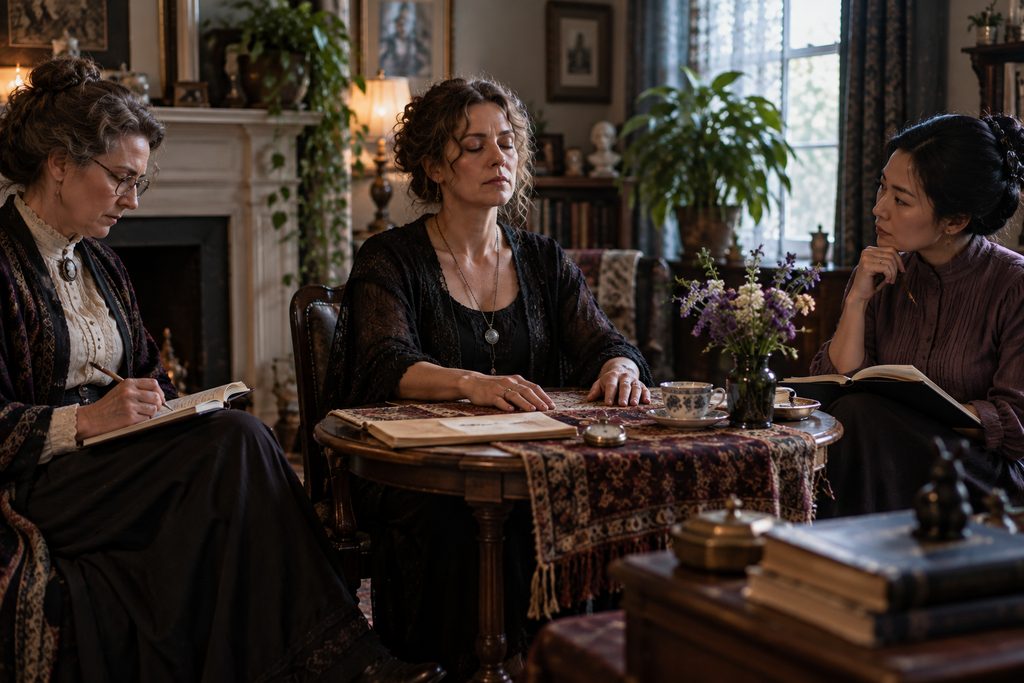
Serious Mediums
The history of Spiritualism becomes much less tidy when we leave spectacular materializations behind and look at mediums who were studied repeatedly, sometimes for years, by investigators who knew perfectly well that fraud was possible.
One of the most important was the American trance medium Leonora Piper. Beginning in the 1880s, Piper attracted the attention of Harvard psychologist and philosopher William James, who arranged sittings for himself, relatives and associates before encouraging more sustained investigation. She was eventually studied for decades by researchers associated with the American and British Societies for Psychical Research.
Piper was not impressive because every sitting produced astonishing information. They did not. Some communications were vague, incorrect or unremarkable. What interested researchers was that other sittings appeared to contain names, memories, relationships and personal details that they found difficult to explain through ordinary access to information. Investigators sometimes introduced anonymous sitters, used pseudonyms, monitored her circumstances and deliberately tried to reduce opportunities for prior knowledge. She was never caught using fraudulent methods during this long period of investigation.
That still did not settle the question of what was happening.
Some researchers came to believe that surviving personalities were communicating through her. Others considered telepathy, unconscious information-gathering, dissociation or other psychological explanations. Even when investigators accepted that something unusual had occurred, “therefore this was a deceased person” remained an additional claim requiring its own evidence.
That distinction is important to us.
Another particularly interesting figure was British trance medium Gladys Osborne Leonard. Beginning during the First World War, Leonard worked extensively with researchers from the Society for Psychical Research. She became known for controlled experiments involving proxy sitters, book tests and newspaper tests—attempts to obtain specific information while reducing the possibility that the person physically sitting with the medium already knew the answer.
Leonard’s recurring trance personality, Feda, is also a useful example of the identity problem we discussed earlier. Feda claimed a particular personal history, but researchers disagreed over whether she should be understood as an independent spirit or as a secondary personality arising from Leonard’s own mind. Leonard herself could therefore be taken seriously as a medium without requiring investigators to accept every explanation attached to the experience.
No substantive allegation of deliberate fraud became attached to Leonard during her long period of work with experienced investigators. That does not prove that every communication was paranormal. It does make the easy explanation—she was simply caught doing tricks—much harder to apply.
These women matter because serious mediumship is often quieter than the popular stereotype. There may be no levitating table, glowing apparition or trumpet floating through a darkened room. Instead there may be a person sitting in a chair, entering trance or receiving impressions while someone else carefully records names, statements, errors and unexpected details.
It is less theatrical.
It is also much harder to dismiss with a photograph of fake ectoplasm.
None of this requires us to declare that psychical research solved the problem of survival after death. It did not. But investigators repeatedly encountered mediums whose work seemed worth testing rather than merely ridiculing, and those investigations produced questions that psychology and psychical research would continue debating for decades.
Perhaps that is the fairest way to approach the strongest historical cases: not “this proves the dead speak,” and not “mediums were all frauds,” but “something interesting enough happened here that careful people kept coming back to investigate it.”
Two famous men would come to represent opposite sides of that argument particularly well.
One believed Spiritualism offered compelling evidence that death was not the end.
The other knew exactly how easily people could be fooled.
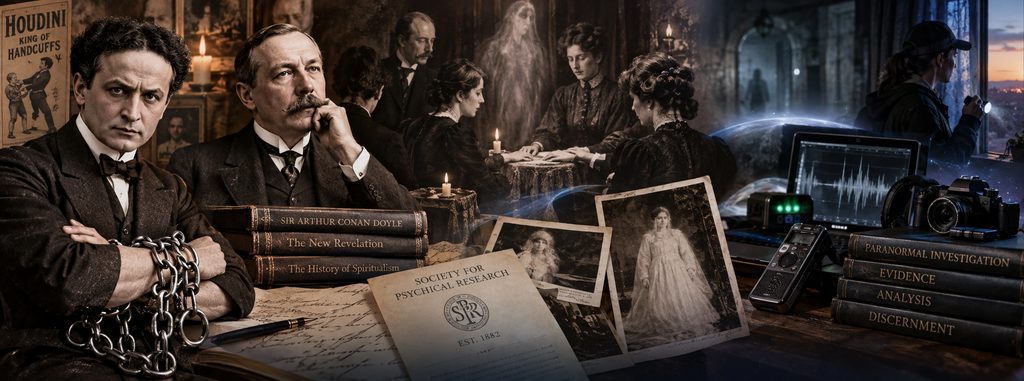
Arthur Conan Doyle and Harry Houdini were also friends—which makes what happened between them considerably more interesting.
Houdini & Conan Doyle — Two Men at the Same Table
Few friendships capture the argument around Spiritualism better than the one between Harry Houdini and Arthur Conan Doyle.
Conan Doyle became one of Spiritualism’s most famous public defenders. After years of personal loss, he increasingly came to believe that communication with the dead offered genuine evidence that personality survived death. He lectured internationally, wrote extensively in support of Spiritualism, and used his public reputation to argue that spirit communication deserved to be taken seriously.
Houdini came from almost the opposite direction. As one of the world’s most accomplished illusionists and escape artists, he knew how easily an apparently impossible event could be produced through skill, misdirection, hidden mechanisms, and the expectations of an audience. He spent years attending séances and exposing mediums whose phenomena he believed could be explained by ordinary trickery.
What makes their story interesting is that they were not simply enemies shouting across a newspaper column. They became friends.
That friendship increasingly strained under the weight of their disagreement. Conan Doyle hoped Houdini would eventually accept spirit communication as genuine. Houdini kept investigating and remained unconvinced. Their conflict became especially personal after a séance in which Conan Doyle’s wife, Jean, produced an automatic-written message said to come from Houdini’s deceased mother. Houdini did not accept the communication as authentic, and the episode became one of the major fractures in their relationship.
The disagreement reveals something deeper than a simple contest between belief and skepticism.
Conan Doyle saw fraud as real but separable from genuine mediumship. A fraudulent medium did not, in his view, disprove every medium any more than a dishonest doctor disproved medicine. Houdini looked at many of the same demonstrations and saw techniques he already understood from stage magic. To him, the burden of proof became greater precisely because he knew how convincingly humans could manufacture the impossible.
Both positions still appear in paranormal culture today.
One side asks: if fraud exists, how do we avoid throwing genuine phenomena away with it?
The other asks: if deception, suggestion, and error can imitate the paranormal so convincingly, what evidence is strong enough to justify a supernatural explanation?
That tension is productive when neither side decides the answer before the investigation begins.
Houdini could also be harsher than MCC would be toward mediumship as a whole. His campaigns increasingly treated fraudulent mediumship as an ethical threat to grieving people, and he publicly pushed for restrictions on professional fortune tellers and mediums. Conan Doyle, meanwhile, could sometimes extend his trust too readily toward extraordinary claims. Their friendship eventually deteriorated into a very public dispute.
Neither man therefore gives us a perfect model.
What they give us is a useful argument.
Houdini reminds us that knowing how deception works is part of discernment. Conan Doyle reminds us that discovering fraud in one room does not automatically explain what happened in every other room.
The question becomes not whether we prefer belief or disbelief, but what methods might allow unusual claims to be examined carefully enough that either conclusion has actually been earned.
That question would help give rise to a more systematic tradition of investigation.
From Séance to Psychical Research
By the late nineteenth century, Spiritualism had produced a problem that neither simple belief nor simple ridicule could quite resolve. There were fraudulent mediums, mistaken witnesses, exaggerated stories, and theatrical séances—but there were also recurring reports from educated observers, physicians, scientists, and experienced investigators who believed some phenomena deserved closer study.
That tension helped give rise to psychical research: the organized attempt to investigate mediumship, apparitions, telepathy, hauntings, trance, automatic writing, and other unusual experiences without deciding in advance what caused them.
The most influential institution was the Society for Psychical Research, founded in London in 1882. Its original aim was to examine disputed “mesmeric, psychical, and Spiritualistic” phenomena systematically and without simply assuming either supernatural explanation or fraud. The Society still describes itself today as holding no corporate position on whether paranormal phenomena exist, emphasizing investigation rather than a required belief.
That distinction mattered.
Spiritualism asked, among other things, “Can the dead communicate?”
Psychical research widened the question:
What actually happened?
Was information obtained that the medium should not ordinarily have known? Could testimony be corroborated? Were there opportunities for deception? Could expectation, suggestion, memory, coincidence, unconscious cueing, or known psychological processes explain the event? If those possibilities were reduced, what remained?
Researchers such as Frederic W. H. Myers, Edmund Gurney, and philosopher Henry Sidgwick became central figures in the early Society. Later presidents included William James, William Crookes, and other prominent intellectual and scientific figures. The presence of respected names did not prove the phenomena they studied, but it did help establish that the subject could be investigated without automatically being treated as foolish.
The early investigators were not uniformly sympathetic to Spiritualism. Some became convinced that certain forms of telepathy, trance communication, or apparitional experience deserved serious consideration. Others remained skeptical, particularly after encountering fraud or unreliable eyewitness testimony. Even within the same organization, researchers disagreed about whether an unusual result pointed toward surviving consciousness, telepathy between living people, an unknown psychological capacity, or something else entirely.
That disagreement was useful.
It separated two questions that are still too often collapsed:
Did something unusual occur?
and
What caused it?
A medium might produce accurate information without automatically proving that a deceased person supplied it. A witness might see an apparition without establishing whether it represented an external spirit, a perceptual event, a psychological experience, or something not yet understood. A house might generate repeated reports of footsteps without immediately earning the label haunted.
Psychical research therefore became an important bridge between Spiritualist experience and what would later be called Parapsychology. The vocabulary changed, methods became more formal, laboratory experiments increasingly supplemented séance-room observation, and researchers began separating different kinds of claims rather than treating “the paranormal” as one single phenomenon.
That history is also part of the ancestry of modern paranormal investigation. Long before handheld recorders, environmental meters, thermal cameras, or digital analysis, investigators were already interviewing witnesses, comparing testimony, controlling access to information, testing mediums, documenting anomalous events, and asking whether ordinary explanations had been adequately ruled out.
The instruments changed.
The methodological problem did not.
Observe first. Explain second.
And depending on who enters the room—a medium, an investigator, or a witch—the next question may be very different.
The Same Room • Different Questions
Three Different Lenses
A medium, a paranormal investigator, and a witch may enter the same reportedly haunted room and notice some of the same things. What separates them is not necessarily what they experience, but the questions they are trained to ask about it.
The Medium
Who is communicating?
The medium listens for personality, relationship, intention, memory, emotion, and recognizable patterns of communication. Their work centers on contact and interpretation rather than environmental measurement. Explore Mediumship .
The Investigator
What happened, and what can we document?
The investigator begins with witnesses, environment, history, recordings, instruments, ordinary explanations, and patterns that can be compared over time. A strange event may be worth documenting without immediately deciding what caused it. Explore Paranormal Investigation .
The Witch
What kind of presence or condition is this?
The witch may consider relationship, place, boundaries, energetic conditions, spirit behavior, previous workings, protections, and whether any response is actually required. Contact does not automatically mean intervention, and an unexplained event does not automatically require a banishing.
From Séance Room to Ghost Hunt
The modern paranormal investigator carrying cameras, recorders, environmental meters, and a flashlight into a reportedly haunted building may seem far removed from a nineteenth-century Spiritualist sitting around a table.
Historically, however, they belong to overlapping stories.
Spiritualists helped make communication with unseen intelligences something that could be attempted, observed, repeated, witnessed, and argued about. Psychical researchers then carried some of those questions beyond the séance room, collecting accounts of apparitions, visiting reportedly haunted locations, comparing witness testimony, testing mediums, and looking for ways to preserve what happened rather than relying entirely on memory.
Modern paranormal investigation inherited much of that impulse.
The technology changed first.
Photography offered a way to preserve an image after an event had ended. Sound recording later made it possible to return repeatedly to an unexplained noise or apparent voice. Film and video preserved movement. Digital recording dramatically increased the amount of material an investigator could collect. Environmental instruments added measurements of temperature, electromagnetic fields, airflow, sound, humidity, vibration, and other physical conditions.
Eventually the séance room acquired batteries.
Yet the basic question remained remarkably familiar:
If something unseen appears to interact with us, can we document the interaction?
This is one reason the history of Spiritualism matters even to paranormal investigators who have little interest in Spiritualist religion. The modern ghost hunt did not suddenly appear with night-vision television. It grew from a much older culture of séances, haunted-house reports, psychical research, witness testimony, experimental mediumship, photography, audio recording, and arguments over what should count as evidence.
Some modern techniques even resemble older practices more closely than they first appear. A medium might once have asked questions and waited for a knock. An investigator may now ask a question and leave an audio recorder running. A séance might use a table, alphabet, slate, or other agreed method through which a presumed communicator could respond. Contemporary investigators experiment with recorders, radios, sensors, trigger objects, and other interfaces intended to detect a response.
The equipment may be electronic.
The hoped-for conversation is not especially new.
That continuity does not mean every paranormal device successfully communicates with spirits. A recorder records sound. An electromagnetic meter measures changes in an electromagnetic field. A thermometer measures temperature. None of them contains a hidden setting labeled ghost. Our Paranormal Tools guide looks more closely at what common instruments actually measure, what they can contribute, and—equally important—what they cannot tell us.
Good investigation therefore requires the same distinction psychical researchers struggled with more than a century ago:
an anomaly is not yet an identity.
A voice-like sound on a recording may deserve examination without immediately becoming a deceased person speaking. A sudden environmental change may be genuine without establishing that a spirit caused it. A photograph may contain something unexpected while leaving its origin unresolved.
MCC’s Paranormal Investigation Field Guide approaches the field from exactly that position: trust the experience, verify the interpretation, and respond to what is actually happening. The guide begins from the premise that an unusual event can be taken seriously without forcing a conclusion onto it.
This is also where mediums and investigators can be particularly useful to one another. A sensitive may notice patterns an instrument was never designed to detect; an investigator may document environmental conditions or competing explanations the sensitive could not know. Neither automatically validates the other. When the two approaches agree, the result becomes interesting. When they disagree, that is information too.
And sometimes the disagreement begins with the simplest word in the field:
ghost.
Because a deceased person, a repeating event, an intelligent presence, and something entirely nonhuman are not necessarily the same thing.
Ghosts Are Not Simply “The Dead”
One of the most persistent problems in paranormal language is that the word ghost gets asked to do far too much work.
A recognizable deceased person who appears to communicate intentionally may be called a ghost. So may a repeating sound in an empty hallway, a figure seen in the same location at the same time, a sudden emotional atmosphere, an unexplained movement, or a presence that does not seem human at all.
Those may not be the same kind of thing.
Within Spiritualism, the central emphasis was generally on surviving personality: the idea that a deceased person continues as an identifiable consciousness and may still communicate with the living. That is quite different from a phenomenon that simply repeats without any apparent awareness of the observer.
Paranormal investigators often use the term residual for this second kind of report: footsteps that seem to follow the same route, a figure that appears without reacting to anyone present, or a sound that recurs under similar conditions. The interpretation varies, but the key distinction is that the phenomenon may behave more like an imprint or repeating event than a person trying to communicate.
Then there are encounters that appear intelligent but do not present as deceased humans at all.
A presence may respond to attention, alter its behavior, communicate symbolically, or establish a recurring relationship without offering any believable human biography. In witchcraft and spirit work, such encounters may be understood as spirits of place, nonhuman presences, recurring spirit allies, or something else entirely. The label matters less than recognizing that “unseen” does not automatically mean “dead person.”
This is one reason MCC tries to identify behavior before assigning identity.
Does the presence respond?
Does it appear aware of people in the room?
Does communication remain consistent over time?
Is there evidence of personality, memory, preference, or intention?
Or is something simply happening repeatedly in the environment?
Those questions help keep very different experiences from being flattened into one category.
Our Ghosts page goes much deeper into these distinctions, including intelligent hauntings, residual phenomena, environmental patterns, and other reported presences. Here, the important point is simpler:
a spirit can be a ghost, but not everything called a ghost is necessarily a spirit—and not every spirit is necessarily dead.
That distinction becomes even more interesting when we look at a branch of nineteenth-century spirit philosophy that tried to classify spirits, moral development, reincarnation, and the structure of the unseen world far more systematically.
That movement was Spiritism.
Spiritism — The Kardec Branch
Spiritualism did not develop in exactly the same way everywhere. In France, one of the most important branches became Spiritism, the system associated with Allan Kardec, the pen name of educator Hippolyte Léon Denizard Rivail.
Kardec encountered the table-turning and mediumistic phenomena spreading through Europe in the 1850s and became convinced that they deserved systematic study. In 1857 he published The Spirits’ Book, the first of several works that attempted to organize spirit communications into a coherent philosophy of life, death, reincarnation, morality, and spiritual development. Spiritism grew directly out of the wider Spiritualist movement, but it became distinct enough that the two terms should not simply be treated as interchangeable.
One of the biggest differences is reincarnation.
Anglo-American Spiritualism has generally centered on continued personal survival and communication with the dead, while individual Spiritualists have differed considerably over reincarnation. Kardec made repeated incarnation a central part of his system. In Spiritism, human beings are spirits temporarily embodied in physical lives, returning through successive incarnations as part of a long process of intellectual and moral development.
Kardec also developed a much more structured way of thinking about spirits themselves. Spirits were not all treated as equally wise simply because they were dead. Some were understood as more developed, benevolent, and reliable; others as ordinary, confused, frivolous, selfish, deceptive, or disruptive.
That part feels surprisingly familiar to MCC.
We would not adopt Kardec’s exact hierarchy, but we strongly agree with the underlying caution: discarnate does not mean enlightened. A spirit can be helpful without being infallible, curious without being benevolent, mistaken without being malicious, or deliberately deceptive. The fact that a voice comes from beyond ordinary perception does not make everything it says true.
Kardec also placed great emphasis on comparing communications rather than simply trusting a single medium or single spirit. The Spirits’ Book was presented as a synthesis of answers gathered through multiple mediums, with Kardec attempting to compare and organize them rather than treating every message as revelation. Whatever one thinks of his conclusions, the method reflects a concern that should sound familiar by now: communication still requires discernment.
Spiritism also developed a stronger moral and religious framework than many people realize. Kardec interpreted the teachings through a largely Christian ethical lens, especially around charity, moral responsibility, spiritual improvement, and the example of Jesus, while rejecting some conventional Christian ideas about a permanently fixed heaven and hell. That Christian inheritance became particularly important in the form Spiritism later took in Brazil.
And Brazil is where this French movement became something much larger.
Spiritism spread there during the nineteenth century and developed into a substantial religious and cultural tradition, with organized centers, study groups, mediumistic practice, charitable work, and healing traditions. The Brazilian Spiritist Federation was founded in Rio de Janeiro in 1884 and remains a major institution devoted to Kardecist Spiritism, religious education, mediumistic study, and charitable activity.
The Brazilian story is especially interesting because Spiritism did not remain merely a European séance philosophy transplanted overseas. It became deeply embedded in Brazilian religious life and developed alongside other traditions concerned with spirits, healing, mediumship, and the dead. Those traditions should not be collapsed into one another, but the resulting religious landscape became far richer than the relatively narrow Victorian image many English-speaking readers associate with Spiritualism.
For MCC, Spiritism is useful partly because it demonstrates how differently the same nineteenth-century question could develop:
If spirits communicate, what does that tell us about what a spirit is, why we incarnate, how consciousness develops, and what responsibilities follow from contact?
Kardec gave one influential answer.
Spiritualism gave others.
Witchcraft, occultism, and later post-religious spirituality would develop still more.
And by the late nineteenth century, these currents were increasingly running into one another.
Spiritualism, Theosophy & the Occult Revival
By the later nineteenth century, Spiritualism was no longer an isolated movement. Its séances, mediums, trance states, claims of unseen intelligences, and insistence that extraordinary experiences could be investigated had become part of a much larger revival of Western esotericism.
One of the clearest intersections came through Helena Petrovna Blavatsky and Henry Steel Olcott, who would become principal founders of the Theosophical Society. Olcott had already become deeply interested in Spiritualism and was reporting on alleged spirit manifestations in Vermont when he met Blavatsky in 1874. Blavatsky herself participated in Spiritualist culture before increasingly arguing that genuine unusual phenomena were being interpreted too narrowly when every communicating presence was assumed to be a deceased human being. Theosophy eventually developed a very different cosmology, but it grew partly from the same nineteenth-century world of séances, mediumship, occult investigation, and dissatisfaction with conventional religious explanations.
That transition is important. The occult revival did not simply accept Spiritualism and add more ritual to it. Occultists borrowed, rejected, reinterpreted, and argued with Spiritualist ideas. Some retained trance and spirit communication while proposing very different explanations for the intelligences encountered. Others became interested in clairvoyance, astral experience, symbolic vision, hidden planes of reality, reincarnation, ancient religious systems, and the deliberate cultivation of altered states.
Organizations such as the Hermetic Order of the Golden Dawn emerged within this wider esoteric environment. Its ceremonial magic drew heavily from older Western magical, Hermetic, Kabbalistic, Masonic, and related sources. It would therefore be misleading to say that the Golden Dawn descended from Spiritualism. What matters is that both belonged to a nineteenth-century culture increasingly willing to experiment with unseen realities, trance, vision, spirit contact, and the possibility that spiritual knowledge could be encountered directly rather than received only through established religion. Historians of modern magic treat Spiritualism as one of several important currents feeding that broader occult revival.
That distinction also matters when we eventually arrive at modern witchcraft.
Modern Wicca did not simply grow out of the séance room. Its formation involved ceremonial magic, folklore, Freemasonry, Romantic ideas about pre-Christian religion, occult orders, ritual experimentation, Pagan revival, and other sources. But Gerald Gardner, the figure most closely associated with Wicca’s public emergence in the twentieth century, had personally explored Spiritualism among several other religious and occult interests. Historian Ronald Hutton places that experience within Gardner’s much wider engagement with supernaturalism, Freemasonry, Buddhism, folklore, and ceremonial occultism.
This is a better way to understand Spiritualism’s influence on modern witchcraft: not as a straight family tree, but as one river in a very crowded watershed.
Spiritualism helped normalize ideas that would become familiar across later alternative spirituality: that unusual perception might be developed rather than feared; that trance could be entered deliberately; that an individual might experience direct contact with unseen intelligences; that spiritual knowledge could continue to unfold; and that personal experience might carry religious importance even when an established church had no place for it.
Those ideas did not belong exclusively to Spiritualism, and many are much older than the nineteenth century. But Spiritualism gave them enormous public visibility.
For people whose mediumistic, intuitive, or visionary experiences were rejected by the religions in which they were raised, the expanding occult world could also provide somewhere else to stand. Some found Theosophy. Some entered ceremonial magic. Later generations found Paganism, New Age spirituality, or witchcraft. The explanation of the experience might change, but the experience itself no longer had to be treated simply as something shameful, forbidden, or impossible.
That history is one reason MCC takes Spiritualism seriously even though we are not Spiritualists. Modern witchcraft developed in conversation with many movements, and Spiritualism was one of the voices in that conversation. Our Witchcraft Traditions material explores the wider landscape through which modern practices developed.
But influence should not be confused with identity.
A séance is not simply an early witches’ circle. A medium is not automatically a witch. And a religion centered on survival after death and mediumistic communication is not the same thing as witchcraft merely because both may involve spirits.
That distinction deserves to be made plainly.
Spiritualism Is Not Witchcraft
Because Spiritualism and witchcraft both deal with spirits, altered states, divination, unseen presences, and forms of direct experience, they are sometimes casually blended together. Historically, though, they are not the same tradition.
Modern Spiritualism developed as a religious movement centered primarily on the survival of consciousness after death and communication with spirits through mediumship. Its churches, philosophy, development circles, healing practices, and mediumistic demonstrations emerged from that specific nineteenth-century movement.
Witchcraft has a much broader and more complicated history. Modern witchcraft draws from folk practice, ceremonial magic, esotericism, Pagan revival, devotional religion, folklore, divination, spirit work, magical technique, and many other sources. Some witches practice mediumship. Some rarely work with the dead at all. Some are religious; others are not. Some work closely with deities, spirits of place, ancestors, familiars, or other nonhuman presences. Others focus primarily on spellcraft, ritual, divination, or personal magical development.
A séance therefore is not simply a witches’ circle with different furniture.
The goals can be quite different. A Spiritualist medium may sit specifically to receive evidence of continued personality or communication from the dead. A witch may enter trance to communicate with a spirit ally, invoke a divine presence, perform divination, negotiate with a spirit of place, conduct ritual work, or simply listen.
The underlying assumptions may differ too. Spiritualism historically developed around the idea that human personality continues beyond death and can sometimes communicate. Witchcraft usually operates within a much wider spiritual ecology. A presence encountered by a witch is not automatically assumed to be deceased, human, morally superior, or even interested in human affairs.
This is one reason MCC does not describe itself as a Spiritualist coven.
We have mediums. We accept spirit communication as part of lived practice. We have learned from Spiritualist history, particularly its development of mediumship, discernment, trance practice, and its insistence that unusual experiences deserve attention rather than automatic dismissal. But MCC’s cosmology, devotional life, magical practice, and understanding of spirits extend well beyond Spiritualism.
The distinction matters because respecting another tradition means allowing it to remain itself.
Spiritualism does not need to become witchcraft in order to matter to witches.
And witchcraft does not need to borrow Spiritualism’s entire theology in order to recognize how deeply its history shaped the modern language of mediumship and spirit contact.
For a broader look at how different magical traditions developed and overlap, see our Witchcraft Traditions material.
The more interesting question, then, is not whether Spiritualism is witchcraft.
It is where the two actually meet.
Where Spiritualism and Witchcraft Meet
Spiritualism and witchcraft are not the same tradition, but they do overlap in several important places—and those overlaps have become increasingly visible in modern practice.
The clearest meeting point is mediumship. Some witches communicate with the dead, work with recurring spirit allies, enter trance, receive impressions, use automatic writing, or incorporate spirit contact into divination and ritual. Spiritualism did not invent those experiences, but it gave Western culture a public language for developing and discussing them in a way that strongly influenced later occult and alternative-spiritual communities.
The overlap becomes especially obvious among practitioners who first encountered unusual perception before they had a religious framework for it. Someone may grow up noticing presences, receiving dreams that seem unusually specific, sensing emotional or environmental shifts, or occasionally experiencing what feels like direct communication. If the tradition they were raised in has no comfortable place for those experiences—or treats them as forbidden—the person may eventually look elsewhere for a vocabulary that makes room for them.
For some, that becomes Spiritualism.
For others, it becomes mediumship, Paganism, occultism, New Age or post-religious spirituality, or witchcraft.
Witchcraft can be particularly attractive because it allows spirit communication to exist inside a much larger practice. A mediumistic experience does not have to become the entire religion. It can sit alongside spellcraft, divination, deity work, ritual, seasonal practice, magical study, spirit relationships, and ordinary life.
That wider framework also changes how contact may be interpreted.
A Spiritualist medium may primarily ask whether a deceased person is communicating and whether the communication provides evidence of continued personality. A witch may ask additional questions: What kind of presence is this? Is there a relationship here? Is the spirit connected to the place, the practitioner, or a working already underway? Is contact appropriate? Does anything need to be done at all?
The witch may therefore use techniques that resemble Spiritualist mediumship while placing them inside a very different cosmology.
Trance is another point of contact. Spiritualists developed sophisticated traditions of trance speaking, mental mediumship, and recurring spirit controls. Witches and occultists also use trance, but may employ it for invocation, divination, spirit contact, magical journeying, aspecting, or other ritual purposes. Similar states do not necessarily imply the same theology.
The same is true of protection and boundaries. Spiritualist development circles historically emphasized preparation, discipline, opening, closing, and learning to recognize different qualities of contact. Witchcraft has its own traditions of grounding, warding, cleansing, banishing, ritual containment, and negotiated spirit relationships. The techniques may differ, but the practical lesson is similar:
openness without discernment is not development.
There is also a social connection that matters to MCC. People with mediumistic, psychic, or intuitive experiences sometimes arrive in witchcraft after leaving religious environments that gave them little room to understand those experiences without fear. Witchcraft can offer a place where unusual perception is neither automatically worshipped nor automatically condemned.
That does not mean every witch is a medium.
It does mean that mediumship and witchcraft often recognize one another.
For MCC, Spiritualism is therefore part of our history without being our religion. We have mediums among us. We work with spirit communication. We recognize trance, discernment, and relationship with unseen presences as legitimate parts of practice. But those experiences sit inside a broader Pagan and magical framework rather than defining the entire path.
We learn from Spiritualism because it helped preserve and develop a serious culture of mediumship.
We remain witches because our questions extend far beyond the séance table.
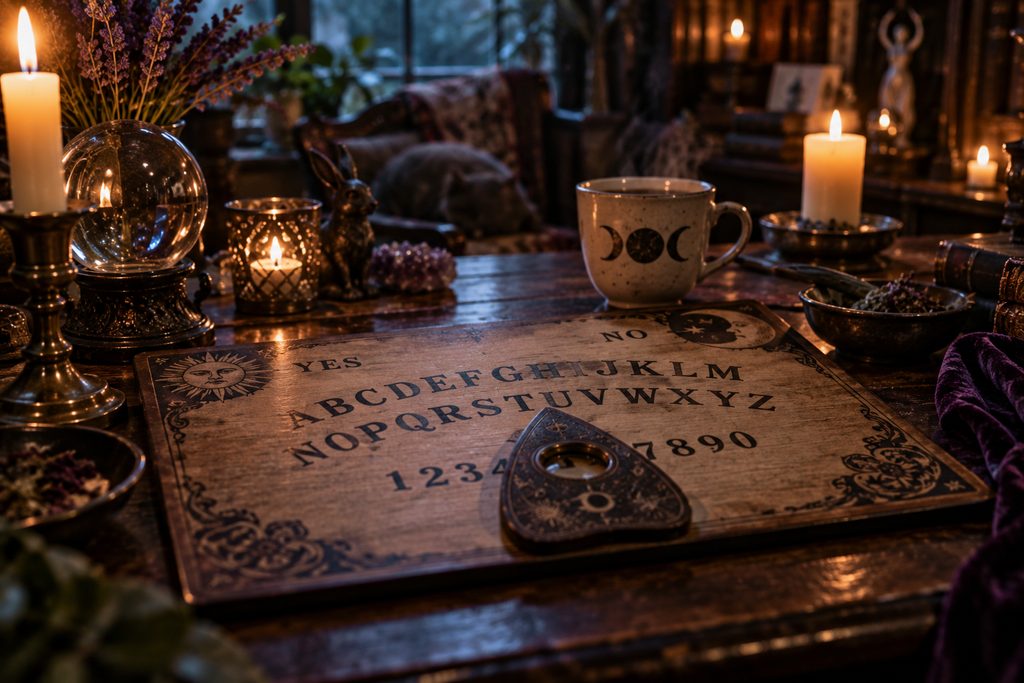
The Ouija Board — A Game That Can Become a Tool
Few objects associated with spirit communication have acquired as much cultural baggage as the Ouija board. Depending on whom you ask, it is a harmless party game, a psychological curiosity, a dangerous portal, a mediumistic instrument, or something that belonged in a sleepover until horror movies got hold of it.
Its actual history is more interesting.
Talking boards developed directly out of the nineteenth-century Spiritualist fascination with creating reliable ways for presumed spirits to communicate. Before the familiar board appeared, Spiritualists experimented with table tipping, alphabet calling, automatic writing, and planchettes—small moving devices that could point, write, or otherwise help translate movement into language. The commercial Ouija board emerged from that environment in the 1890s and was deliberately marketed as both mysterious communication device and entertaining novelty. Parker Brothers acquired the brand in 1966, and after Hasbro acquired Parker Brothers in 1991, Ouija continued as a mass-market game. (Smithsonian Magazine gives a useful history of that transformation.)
That double identity has never really disappeared.
Most casual board sessions can be understood perfectly well through the ideomotor effect: people make small movements without consciously realizing they are producing them, and the shared planchette converts those movements into apparent responses. That explanation should be taken seriously. A moving planchette, by itself, is not evidence that anyone beyond the participants is involved.
MCC nevertheless does not regard that as the end of the subject.
In the hands of a practitioner, a talking board can function as a focusing interface. Attention is sustained. A method of response has been agreed upon. The participants are concentrating on the same communicative act. In that respect, the board is not fundamentally unlike automatic writing, pendulum work, alphabet methods, or other techniques designed to give subtle impressions a structured way to become visible.
Most of the time, a board may simply behave like the game it was sold as.
Occasionally, practitioners believe something more coherent appears to break through.
Some MCC practitioners, including Kael and Roen, first experimented seriously with spirit communication through Ouija boards as teenagers. We no longer consider the board a particularly advanced method, but neither do we consider those early experiences meaningless. They taught us some of the same lessons that later mediumship would reinforce: sustained attention matters, not every response deserves belief, identity can be uncertain, and opening communication is easier than understanding what has answered.
We also make a distinction between the familiar mass-market toy and a board intended for actual practice. The Hasbro version can certainly point to letters; there is nothing magically defective about cardboard. But for repeated practitioner use, we prefer a purpose-made talking board, usually wood, with generous spacing, an exceptionally smooth planchette, a clear layout, and enough working surface that several hands can rest naturally without fighting the board.
A good handmade board feels like a ritual instrument rather than packaging from the game aisle.
That does not make it more supernatural. It simply makes it a better tool.
Craft-made boards also allow practitioners to choose symbols, alphabets, languages, protective marks, or layouts that fit their own practice rather than inheriting the visual vocabulary of a commercial game. As with an athame, tarot deck, pendulum, or scrying mirror, workmanship matters mostly because a tool that behaves well is easier to use well.
Ironically, what makes the Ouija board culturally unsettling is also what made it extraordinarily successful: it disguises a method of spirit communication as a toy.
That is the part MCC takes more seriously than the horror stories.
Someone sitting down to formal mediumship usually knows they are attempting contact and is more likely to think about preparation, boundaries, intention, and how to stop. Someone opening a brightly printed game at midnight with friends may do none of those things because the object itself says game.
We do not believe touching a planchette automatically invites something dangerous, and we do not regard a Ouija board as an inherently malevolent object. But if someone chooses to use one as a spirit-contact tool, we think it should be treated like one.
Know what you are attempting. Establish the limits of the session. Do not assume every answer is true. Do not hand authority to an unknown communicator because it can spell. And when the session is finished, finish it intentionally.
The board is not the danger.
Unstructured openness can be.
That lesson applies far beyond Ouija—and leads directly into boundaries, protection, and knowing how to close the door.
Boundaries, Protection & Closing the Door
Spirit communication is often described in terms of opening: opening awareness, opening a circle, opening to a message, opening to the possibility that someone or something may answer.
Good practice also requires knowing how to close.
At MCC, boundaries are not based on the assumption that every spirit is dangerous. Most are not. Many are curious, indifferent, transient, or genuinely helpful. But any practice that deliberately invites contact should also give the practitioner a clear way to decide when that contact begins, what is welcome, and when it is finished.
That is part of training.
A medium or spirit worker should be able to say not now, that is enough, or you are not welcome here without believing that spiritual openness requires permanent availability. A recurring spirit ally may be trusted, but relationship does not eliminate boundaries. An unfamiliar communicator certainly does not acquire access merely because it has managed to make itself noticed.
Closing also helps separate practice from ordinary life.
A séance, trance session, board session, divination, or deliberate period of listening should have an ending. That may be as simple as acknowledging that the communication is complete, dismissing any invited presence, extinguishing a candle, grounding, and deliberately turning attention back toward the physical room.
Our Protection Magic material treats containment as part of healthy practice: defining the purpose of a working, establishing limits, and ending it clearly rather than allowing attention and energy to remain indefinitely open.
Protection should not become paranoia.
If a practitioner begins treating every strange dream, flickering light, emotional shift, misplaced object, or unexpected thought as evidence that something has invaded the home, protection has stopped providing stability and begun creating anxiety. MCC’s protection work emphasizes boundaries that make life larger and steadier, not systems of constant vigilance that leave the practitioner afraid to relax.
The same restraint applies to banishing.
Not every presence that feels strange needs to be expelled. Some are harmless. Some are part of a place. Some may simply be passing through. Others disappear once attention is withdrawn. Discernment should come before escalation.
But when a presence repeatedly ignores boundaries, behaves deceptively, becomes intrusive, or produces a pattern the practitioner genuinely wishes to end, dismissal should be clear.
Our Banishing practice makes an important distinction: banishing removes what is present; protection helps establish what may return. The deeper closing sequence is therefore not simply “make it go away.” It is closer to release, seal, and return the space to ordinary life.
That principle is especially important after intense trance or channeling. The practitioner should not be left wondering whether a session is still happening hours later. Eat something. Drink water. move around. Open the curtains. Wash your hands. Talk to someone. Let the room become a room again.
The mundane world is not the enemy of spiritual practice.
It is where we live.
For more practical work, our Protection, Warding & Banishing material gathers several approaches to longer-term household and personal boundaries.
The purpose of all of this is not fear.
It is sovereignty.
You should be able to open intentionally, listen carefully, and close completely.
That principle has survived from development circles and séance rooms into modern mediumship, spirit work, and witchcraft.
And although much of this history can sound distinctly Victorian, Spiritualism itself did not disappear with the nineteenth century.
It remains a living religion.
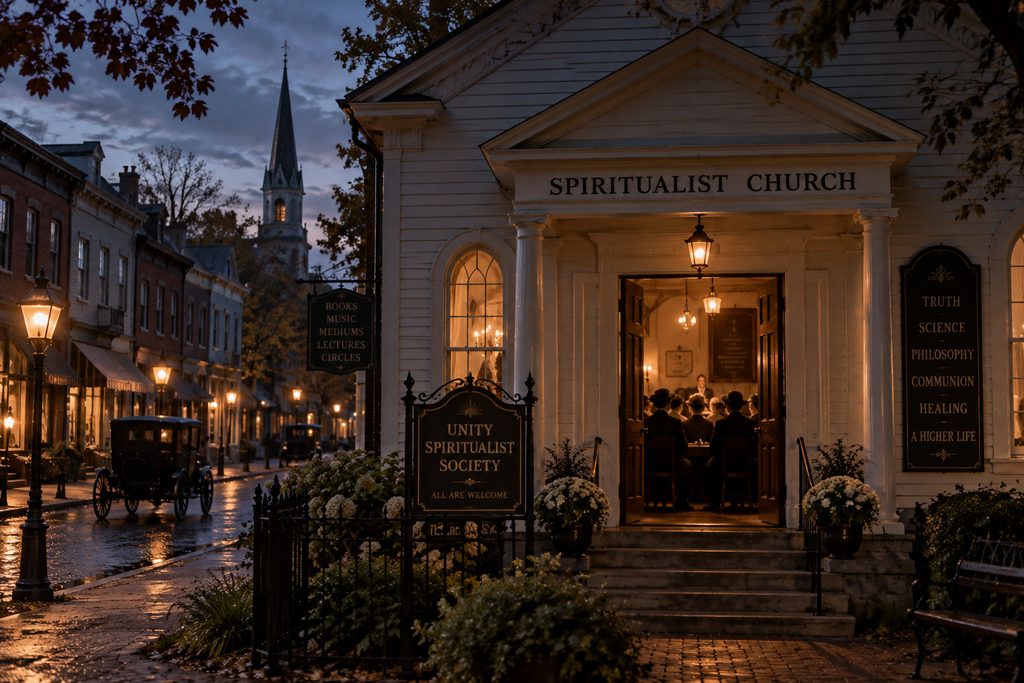
Spiritualism Is Still a Living Religion
It is easy to read the history of Spiritualism as though it belonged entirely to gaslight, parlors, and nineteenth-century mourning culture.
It does not.
Organized Spiritualism is still practiced today through churches, camps, development circles, educational programs, healing ministries, mediumship demonstrations, and religious services. In the United States, the National Spiritualist Association of Churches remains active and continues to describe Spiritualism as the science, philosophy, and religion of continuous life, centered on communication through mediumship. It also maintains affiliated churches and camps, educational programs, publications, and training for ministers, mediums, teachers, and healers.
A modern Spiritualist service may look more ordinary than someone expecting a Victorian séance imagines. There may be prayer, music, readings, philosophy, a sermon or address, healing work, and a demonstration of mediumship in which messages are offered to members of the congregation. The emphasis varies from church to church, but the purpose is religious rather than theatrical.
Mediumship within these communities is generally treated as something that can be developed through training, not merely performed as entertainment. The NSAC, for example, currently certifies mediums, teachers, ministers, and Spiritualist healers through formal educational pathways.
That continuity matters.
Many practices that now appear in psychic fairs, online readings, paranormal media, and loosely defined “intuitive” communities did not simply appear out of nowhere. Spiritualist churches preserved organized forms of development, message work, trance, healing, philosophy, and mediumship across generations while popular culture repeatedly declared the movement dead.
In other words, Spiritualism survived its own funeral.
Its public visibility changed. The great lecture halls and newspaper controversies faded. Séances stopped being fashionable society events. New spiritual movements borrowed some of its language, and modern paranormal culture carried other pieces elsewhere. But congregations continued meeting, mediums continued developing, and Spiritualist organizations continued teaching that communication with the dead could be part of religious life.
That living tradition also complicates the stereotype of the medium as a lone psychic selling readings. Within organized Spiritualism, mediumship can be understood as service: offering evidence of continued life, supporting the bereaved, teaching development, participating in worship, and contributing to a religious community.
MCC does not share every Spiritualist belief, and we do not belong to a Spiritualist church. But we respect the fact that this is not merely an interesting ancestor of modern occultism.
It is still somebody’s religion.
And one of the clearest places to see that continuity in the United States is a small community in western New York that has been associated with Spiritualism for well over a century: Lily Dale.
Lily Dale — A Living Spiritualist Community
If Spiritualism feels like something that belongs to sepia photographs and nineteenth-century parlors, Lily Dale is a useful corrective.
Located in western New York, Lily Dale Assembly has been a center of Spiritualism since 1879. It is not a museum village pretending the religion still exists. It is an active residential Spiritualist community with year-round residents, registered mediums, churches, healing spaces, lectures, workshops, demonstrations, and a large seasonal program. Lily Dale describes itself as a residential community of people who practice the faith of Spiritualism.
The setting itself is part of what makes the place unusual. Lily Dale includes historic buildings, wooded paths, lodging, meeting halls, a museum, churches, and spaces specifically associated with mediumship and healing. During its summer season, visitors attend lectures, classes, public mediumship demonstrations, healing services, and private readings with registered mediums.
Those mediums are not simply anyone who arrives and hangs out a psychic sign. Lily Dale says its registered mediums are affiliated with both the Assembly and the Mediums League and are tested and vetted before being listed for private readings. That does not make every reading infallible, but it does show how seriously mediumship is treated within an organized Spiritualist community.
One of Lily Dale’s best-known locations is Inspiration Stump, a gathering place in the wooded grounds where public demonstrations of mediumship continue a tradition stretching back more than a century. The Assembly currently holds demonstrations there during its season, continuing one of the community’s oldest public practices.
The community also maintains a museum devoted to Spiritualist history, including material related to the Fox family, spirit photography and art, early Spiritualist publications, and women’s suffrage. That last connection is not incidental. Lily Dale’s own history emphasizes the relationship between Spiritualism, women’s public authority, reform movements, and healing traditions.
There is even something pleasantly ordinary about the place.
People stay in guest houses. They walk through the woods. They attend lectures. They drink coffee, browse shops, meet friends, schedule readings, sit through services, and argue about spiritual ideas much as religious communities have always done. The extraordinary claims exist inside an otherwise very human community.
That matters because popular culture often presents mediumship as something done by an isolated psychic in a darkened room. Lily Dale shows another model: mediumship embedded in community, education, religion, history, and ordinary life.
It also resists the idea that Spiritualism simply disappeared and left behind ghost hunting and New Age culture as its descendants. Some of its institutions survived. Some of its communities survived. And some places are still practicing the religion in recognizably continuous ways.
Lily Dale is not evidence that every Spiritualist claim is true, and it should not be treated as though it represents every Spiritualist everywhere.
It is something simpler and historically important:
a place where Spiritualism is still lived.
And alongside mediumship, one practice remains especially prominent in organized Spiritualist communities like Lily Dale: spiritual healing.
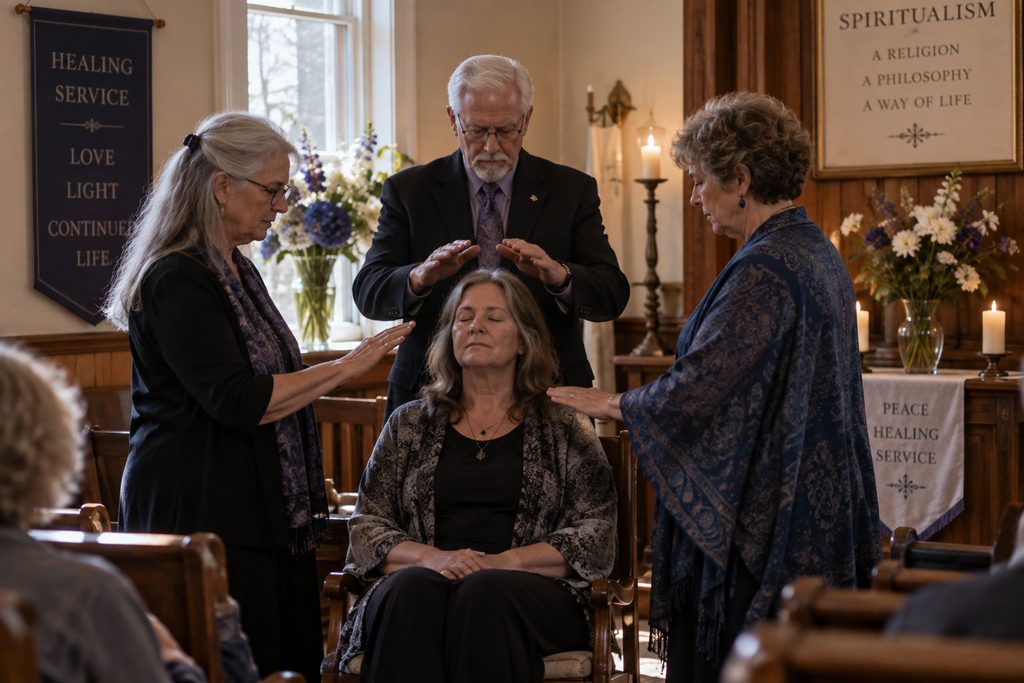
Spiritual Healing
Healing has been part of organized Spiritualism from its early development, although it is not always the part outsiders know best.
Within Spiritualist churches, spiritual healing is generally understood as a form of religious service in which a healer attempts to support another person through prayer, focused intention, mediumship, or what Spiritualists describe as healing energy. The National Spiritualist Association of Churches treats healing as one of Spiritualism’s central practices and even credentials Commissioned Spiritualist Healers alongside certified mediums and ministers.
In a typical healing service, the practice may be very quiet. A person sits while a trained healer places hands nearby or, depending on the tradition, gently upon them. There may be prayer, silence, focused attention, or a sense that the healer is acting as an intermediary for spiritual influence. Some Spiritualists also practice absent healing, in which prayers or healing intentions are directed toward someone who is not physically present.
The language Spiritualists use around this can be quite strong. Their own literature may speak of healing forces, spirit healers, curative energy, or spiritual beings assisting through the medium. MCC does not need to adopt every part of that explanation in order to understand what the practice is trying to do.
At its best, the emphasis is not spectacle.
It is care.
Someone is ill, grieving, exhausted, frightened, or simply in need of support, and the community gathers around them with attention and intention.
There is also an important practical boundary here. Current NSAC materials explicitly describe Spiritualist healing as complementary rather than an alternative to medical treatment and instruct recipients not to abandon medication or professional medical advice. That distinction matters, especially anywhere spiritual authority and vulnerability meet.
MCC would approach the practice somewhat differently in language and theology. We may work with prayer, spirit relationships, energy, blessing, magical support, or devotional practice, but we do not treat spiritual work as a substitute for medicine or claim that illness necessarily has a spiritual cause.
Nor do we assume that a spirit offering healing information is automatically qualified to diagnose someone.
A communicator may be sincere and still wrong.
That is simply another version of the principle we have returned to throughout this page: receiving information is not the same as establishing its authority.
Still, Spiritualist healing tells us something important about the religion itself. Spiritualism was never solely concerned with proving that the dead survived. It also developed ways of asking what continued relationship with Spirit might mean for the living.
Sometimes that meant a message.
Sometimes it meant comfort.
And sometimes it meant sitting quietly beside another person and hoping, in whatever way one understands it, that healing might reach them.
MCC & Spiritualism — Learning Across Traditions
MCC is not a Spiritualist church, and Spiritualism is not the religious system we follow.
But it is part of the history that made modern mediumship possible, and we recognize its importance.
We have mediums among us. We work with spirit communication, trance, divination, spirit allies, protection, and the interpretation of unusual experiences. Some of our practitioners first encountered these things long before they had a mature religious or magical framework for understanding them. Spiritualism is one of the traditions that preserved a serious language for those experiences when many other religious institutions dismissed, feared, or condemned them.
That does not mean we adopt every Spiritualist conclusion.
MCC accepts that genuine spirit contact can occur, but we do not assume that every message is genuine, every genuine contact is correctly identified, or every communicating spirit is truthful. We do not believe that dying automatically makes someone enlightened. A deceased person may remain recognizable, loving, difficult, funny, mistaken, curious, stubborn, helpful, or uninterested—much as people are while living.
Death changes condition. It does not automatically confer wisdom.
The same applies to nonhuman spirits. A presence does not become morally superior simply because it is unseen. Some spirits become trusted allies over time. Others may communicate briefly and disappear. Some are helpful because they care, because a relationship has developed, or because cooperation serves their own interests. Others may have no particular interest in us at all.
This is why discernment remains central.
Receiving a message does not require obeying it.
Feeling a presence does not require inviting it closer.
Recognizing that something unusual has happened does not require immediately deciding what caused it.
Those distinctions are not signs of weak belief. They are part of responsible spirit work.
MCC also differs from some forms of Spiritualism in how broadly we understand the unseen world. Human dead are only one possible category of contact. Our practice also recognizes spirit allies, spirits connected to place, other nonhuman presences, and relationships that do not fit neatly into the Spiritualist model of a deceased personality communicating through a medium.
At the same time, Spiritualism has much to teach modern witches.
Its long traditions of mediumistic development remind us that sensitivity benefits from training. Its history of fraud reminds us why ethics matter. Its serious mediums remind us not to dismiss an experience merely because it is difficult to explain. Its psychical researchers remind us that belief does not eliminate the need for testing. Its churches and communities remind us that mediumship can be understood as service rather than spectacle.
And its mistakes are instructive too.
Prestigious spirit names should not automatically impress us. Dramatic phenomena are not necessarily better evidence than quiet ones. Emotional certainty can be wrong. Commercial pressure can distort sincere practice. And a practitioner who claims access to the unseen still remains accountable in the ordinary world.
For deeper work with these questions, see Mediumship & Spirit Channeling, Ghosts, Parapsychology, and our broader Ethics framework.
We do not need to become Spiritualists in order to respect what Spiritualism preserved.
Traditions learn from one another.
Mediums compare experience. Investigators compare evidence. Witches compare methods. Religious movements borrow language, reject assumptions, rediscover old practices, and carry useful ideas into new settings.
Spiritualism is one of those conversations MCC is glad to remain part of.
Not because we believe every knock at the table.
Because sometimes, someone really does seem to be knocking.
/
The Question Never Went Away
Spiritualism changed the Western conversation about death because it refused to leave the unseen entirely in the hands of theology.
Its central proposition was startlingly direct: perhaps the dead are not simply gone, and perhaps communication with them can sometimes occur. From that idea came séances, development circles, churches, celebrated mediums, spectacular frauds, serious investigations, bitter arguments, healing traditions, and more than a century and a half of people attempting to determine what—if anything—answers when we listen.
The movement also left fingerprints far beyond its own churches.
Mediumship developed into a discipline rather than merely a strange personal experience. Psychical researchers tried to separate testimony from evidence and anomaly from explanation. Occultists absorbed, challenged, and reinterpreted ideas about trance and unseen intelligences. Modern witches inherited a spiritual landscape in which communication with spirits had once again become something Western practitioners could openly discuss and develop.
Paranormal investigators carried the question into supposedly haunted buildings with increasingly sophisticated equipment.
The table became a recorder.
The rap became a waveform.
The darkened parlor became a monitored room.
But technology did not actually change the central problem.
A recorder can preserve a sound without identifying its source. A medium can receive a message without establishing who sent it. A witness can experience something extraordinary without yet knowing what happened. A spirit can communicate without automatically deserving trust.
Those distinctions are not disappointments.
They are where the interesting work begins.
Spiritualism also reminds us that extraordinary claims and ordinary human needs have always existed beside one another. People came to mediums because they were curious, certainly, but also because they were grieving. They wanted to know whether relationships survived death, whether consciousness continued, whether someone they loved was still somewhere rather than nowhere.
That longing made Spiritualism powerful.
It also made ethics necessary.
MCC approaches these questions from a different religious and magical framework, but we recognize the inheritance. We believe meaningful spirit contact can occur. We also believe that discernment, humility, training, boundaries, and the willingness to say “I do not know yet” are signs of mature practice rather than failures of faith.
Sometimes a presence becomes familiar.
Sometimes information proves meaningful.
Sometimes several different approaches point toward the same interpretation.
Sometimes nothing happens at all.
And sometimes something happens that remains stubbornly unexplained.
Spiritualism gave generations of people permission to take that uncertainty seriously.
It taught mediums to listen, investigators to test, skeptics to ask how deception works, believers to consider what evidence means, and later occult practitioners to reconsider the boundary between the living and the unseen.
More than 175 years after the rappings at Hydesville, the language has changed considerably. The people asking have changed. The rooms have changed.
The question has not.
Is anyone there?
Spiritualism’s answer has always been yes.
MCC’s answer is a little more careful:
Sometimes we believe there is. Then the real work is figuring out who—or what—we are speaking with.
For related paths through this subject, continue with Mediumship & Spirit Channeling, Ghosts, Parapsychology, or the Paranormal Investigation Field Guide.
I like this as the ending because it echoes the old page’s “Is anyone there?” without returning to the old absolute “and the answer is Yes.” It feels more like the MCC voice we have developed through the rebuild.
Continue the Conversation
Explore Further
Spiritualism touches several deeper paths through mediumship, hauntings, psychical research, paranormal investigation, and modern magical practice.