
Enter the Field
Paranormal Investigation
Field Guide
A guided course in planning, documenting, testing and closing a careful, responsible paranormal investigation.
Built for careful beginners. Useful to experienced readers.
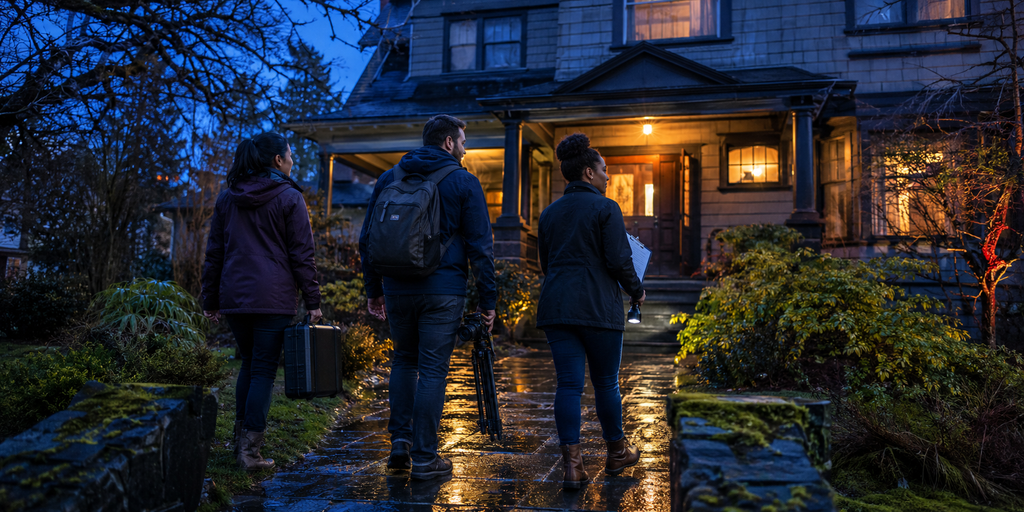
Course Orientation
Welcome to the Field Guide
Paranormal investigation begins long before the lights go out. It begins when someone decides to treat an unusual experience as a question rather than a conclusion.
People usually enter this work because something happened. They heard footsteps in an empty room, watched an object move, recorded a voice they cannot identify or felt a presence that seemed unmistakably real. The experience deserves to be heard—but an experience and its explanation are not automatically the same thing.
This guide will teach you how to move from a report to a useful question, from that question to an investigation plan, and from an unusual event to a record that can be reviewed. The goal is not to manufacture proof or explain everything away. It is to learn enough to respond responsibly to what actually happened.
Who This Course Is For
The Field Guide is written for residents considering an investigation, careful beginners, developing teams and experienced readers who want a grounded review of field practice.
What It Does Not Promise
Completing this course is not professional certification, a guarantee of paranormal activity or permission to enter, record, provoke or publish anything. No field guide replaces emergency services, qualified tradespeople or appropriate medical support.
Using the Guide
Follow the Case, Not the Drama
The Field Guide is designed to be completed in order. Each station teaches one part of the method while the Alder Street case develops alongside you.
Listen, obtain permission and build the right question.
Establish conditions, document events and test what occurs.
Review the record, report honestly and determine what comes next.
The Field Principle
The central idea that should guide this stage of an investigation.
At the Scene
Practical actions to take before moving to the next stage.
Record This
The observations, conditions and decisions that belong in the log.
Challenge the Story
A prompt that tests assumptions without dismissing the experience.
Alder Street Case File
New information from the continuing practice case for you to assess.
Go Deeper
Links to the Tools page and other MCC guides when more detail is useful.
Course Materials
Keep These Nearby
You do not need an expensive collection of paranormal equipment to begin learning the method. For now, the most important tools are a reliable record and enough patience to notice what changes.
What You Will Need
- A notebook, document or dedicated case file that you can return to throughout the course.
- Something that shows accurate time, such as a clock, watch or phone.
- A quiet place to read and approximately 90–120 minutes, divided across as many sittings as you need.
- A willingness to record what you notice before deciding what it means.
If You Practice Along
- Headphones and a phone or simple recorder for learning how ordinary sounds change during playback.
- A flashlight, thermometer or other familiar instrument whose normal behavior you can test.
- Blank paper for sketching a room, marking observation points and noting possible sound or airflow paths.
- A consenting partner who can create an unknown sound or event for you to document and locate.
A good investigation begins before anyone enters the room.
A Longer Tradition
Before Paranormal Television
Organized investigation of apparitions, unusual experiences and apparent communication with the dead did not begin with night-vision cameras or entertainment television.
The Society for Psychical Research was founded in 1882 and developed an organized approach to collecting testimony, studying mediumship, conducting field investigations and comparing reports. Its members did not always agree about what caused the phenomena—and the organization still holds no single corporate position about their ultimate meaning.
Early researchers made mistakes, followed assumptions and worked without many instruments available today. They also established a durable principle: an extraordinary story becomes more useful when witnesses, conditions, timing and competing explanations are recorded. Technology has changed. That responsibility has not.
Organized Inquiry
Researchers began collecting cases, testimony and experimental records within a formal society.
Witnesses and Conditions
Interviews, site visits and comparison of independent accounts became central investigative tools.
New Devices, Same Question
Modern equipment produces more data, but it still cannot decide what that data means.
Three Useful Reminders
I want to be factual and to be useful.
But whether paranormal or not—you need to help these people.
I will never speak in absolutes.
Practice Case • Initial Intake
Case File 07
The House on Alder Street
The Initial Call
Marisol Navarro contacts a small paranormal team about the two-story house she shares with her husband, Daniel, and her mother, Inez. The family has lived there for four years. Until six weeks ago, none of them considered the house unusually active.
Marisol reports that something now appears to cross the upstairs hallway several nights each week. Other incidents have followed, but the residents disagree about whether they are connected. No one has been touched, threatened or injured. The household is frightened primarily because the activity seems to be increasing.
Footsteps Overhead
Heavy steps appear to cross the upstairs hallway when all three residents believe they are downstairs.
The Cold Landing
The top of the stairs sometimes feels markedly colder than the rooms on either side of it.
The Fallen Photograph
A framed family photograph has been found face-down on the hallway table three mornings in two weeks.
A Figure at the Doorway
One resident reports seeing a woman-shaped figure near the unused bedroom for several seconds before it disappeared.
What the Team Does Not Yet Know
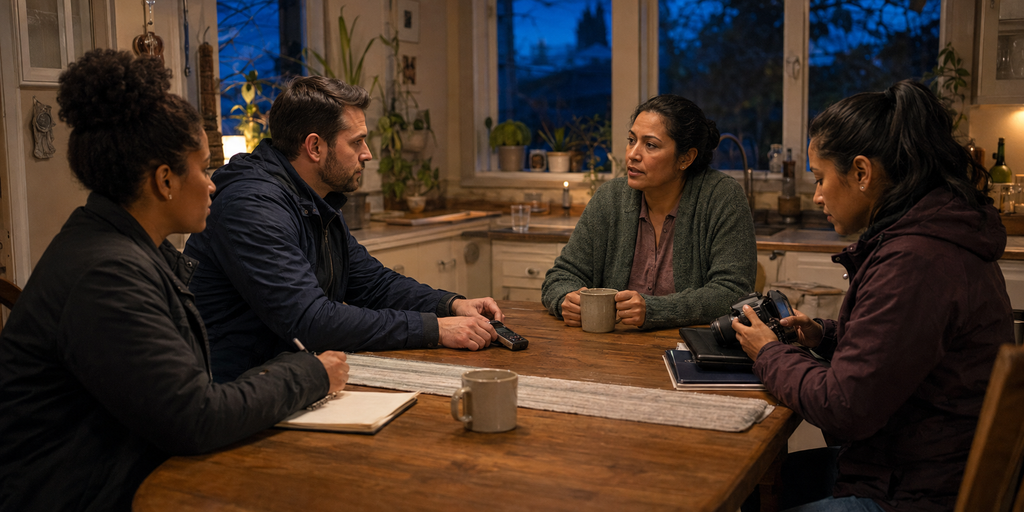
Part One • Field Stations 1–5
Prepare Before You Pursue
The first responsibility of an investigator is not to produce activity. It is to create conditions in which the household, the team and the resulting record can all be treated responsibly.
Field Station 1 • Intake and Triage
Do You Actually Need an Investigation?
Sometimes the most responsible answer is no—or not yet.
An investigation changes a household. Strangers enter private rooms, equipment is placed, ordinary sounds receive new attention and residents may begin watching for activity more closely than before. Even a respectful team can increase expectation, anxiety and disagreement.
The first question is therefore not “What kind of spirit is this?” It is “What does this household need, and is an investigation the right way to provide it?” Sometimes careful observation is enough. Sometimes a building professional or other qualified help should come first. Sometimes the conditions make investigation inappropriate altogether.
When a Log May Be Enough
An isolated, infrequent and nonthreatening event may need only a written record. Note when it happens, who is present, what systems are operating and whether it repeats before inviting a team.
When Another Professional Comes Before You
Gas or burning odors, carbon-monoxide alarms, electrical faults, structural movement, water damage, infestation, sudden health symptoms or an immediate safety concern require appropriate professional attention before paranormal investigation.
When a Pattern Deserves Attention
Investigation becomes more useful when events repeat, appear tied to a time or location, are independently reported, remain after ordinary checks and can be examined with the informed permission of everyone directly affected.
When the Conditions Are Wrong
Do not investigate without legal access, informed resident consent or basic physical safety. Active emergencies, intoxication, coercion, requests for provocation and plans to exploit frightened residents are reasons to stop.
Field Station 3 • Witness Accounts
Hear the Witness Before Hearing the Legend
A careful interview preserves the experience before conversation, expectation and repetition begin reshaping it.
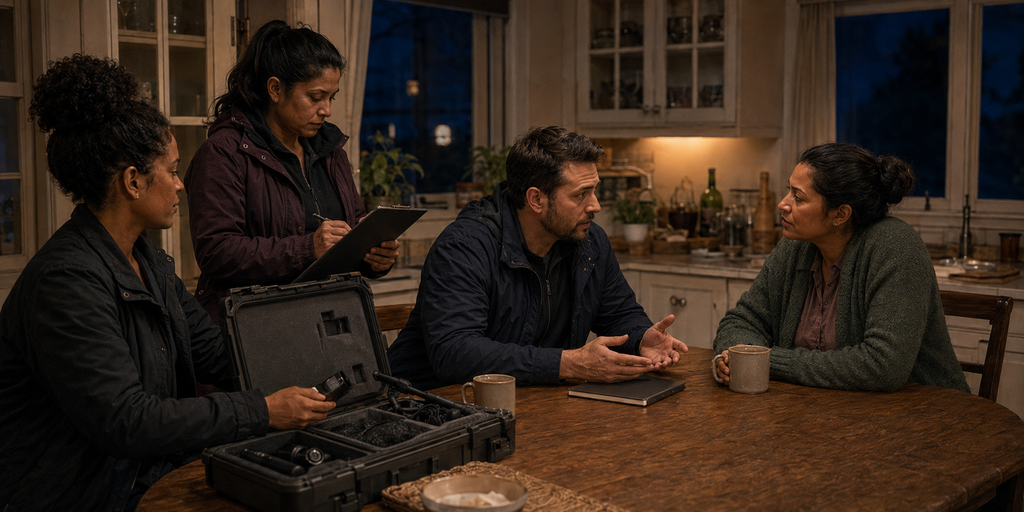
Witnesses should normally be interviewed separately and as soon as practical. This is not because one person is necessarily lying. Human memory is reconstructive: later conversations, questions and familiar stories can influence which details feel certain and how an event is described.
Begin with an uninterrupted account. Let the witness choose their own language before asking for clarification. The investigator’s job is to discover what the person saw, heard, felt or inferred—not to supply the ghost, motive or identity missing from the report.
Free Account
Ask the witness to describe everything from immediately before the event until immediately afterward.
Sensory Detail
Clarify what was heard, seen or felt without supplying descriptive words the witness did not use.
Conditions
Establish time, location, lighting, sound, activity and the witness’s position when the event occurred.
Confidence
Ask which details feel certain, which are estimates and what the witness learned or discussed afterward.
Ask Without Supplying the Answer
“Please tell me everything you remember, beginning just before you noticed something unusual.”
“What did the ghost do when it entered the hallway?”
“What about the sound made you describe it as footsteps?”
“Were they heavy men’s footsteps?”
“Describe the shape, movement, color and edges as separately as you can.”
“Was the woman wearing an old white dress?”
“Who did you speak with afterward, and what did each of you say?”
“Everyone else saw the same thing, correct?”
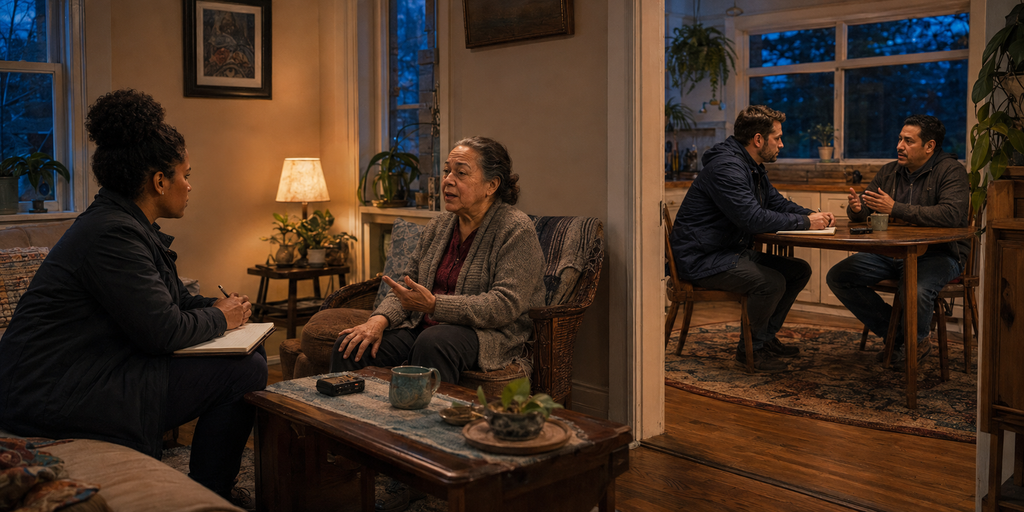
Field Station 4 • Property and Historical Research
Research the Place Without Contaminating the Case
History should help test what happened—not supply a ghost before the investigation begins.
Property records, permits, old newspapers and former occupants can reveal useful conditions: walls that were moved, rooms whose purposes changed, fires, plumbing routes, previous businesses or mechanical systems installed near the reported activity.
History can also distort a case. Once witnesses are told that a woman died on the stairs or a former owner wore a pale dress, later memories may begin fitting that story. Record witness accounts first. Keep verified facts separate from folklore, and delay sharing possible identities until the field record has been preserved.
The Physical Record
Construction date, permits, floor plans, additions, repaired damage and the locations of utilities and mechanical systems.
The Occupancy Record
Deeds, directories, census material and other records showing who occupied the property and when.
The Event Record
Contemporary reporting of fires, accidents, deaths, business use and significant alterations connected with the property.
The Legend Record
Oral history, neighborhood stories, paranormal claims and later retellings—preserved as claims until independently supported.
Not Every Historical Claim Has Equal Weight
Part One · Field Station 5
Turn the Haunting Into a Question
A haunting is a conclusion. An investigation needs questions that can guide observation, comparison and testing without deciding the answer in advance.
A useful question names the event, its conditions and the evidence needed without naming its cause in advance.
“Is this house haunted?” sounds like the obvious question, but it is too large to direct a careful investigation. It combines footsteps, temperature changes, displaced objects and visual experiences into one story—and then asks for a single verdict.
Separate the reports. Each event may have different conditions and a different cause. A heating system might explain one experience while leaving another unresolved. Solving one sound does not automatically explain every event in the house, just as one unusual recording does not establish that every report is paranormal.
From a dramatic story to a workable question
Build a field question from five parts
The question chooses the method. The equipment does not choose the question.
Write the plan
- List each reported event separately.
- Select one primary question and a few secondary questions.
- State what will count as an observation.
- Name ordinary and paranormal possibilities without favoring either.
- Choose baseline and comparison conditions.
- Decide what result would change the plan.
Neutral is not dismissive
Removing the word ghost from a field question does not mean the witness is disbelieved. It protects the investigation from overlooking a surprising ordinary cause—or missing a genuinely unusual event because everyone was watching for the wrong thing.
The investigation now has questions
The team keeps Inez’s lighter 2:00 a.m. sounds separate from the heavier late-evening impacts reported by Marisol and Daniel. They may not be the same event.
What produces the repeated upstairs impacts reported between approximately 10:45 and 11:15 p.m.?
Secondary questions:
- Does the temperature or airflow at the stair landing differ from nearby spaces, and how does operation of the heating system affect it?
- Under what ordinary conditions can the hallway photograph tip or fall?
- Can a visual event near the unused bedroom be independently observed or recorded without first telling team members what they are expected to see?
The team schedules daytime environmental tests first, followed by a quiet evening observation matching Marisol’s usual time window. Communication attempts are not yet part of the plan.
Write your own case questions
Draft one primary question and two secondary questions for Alder Street. For each, name the event, conditions, possible record and comparison. If the question already assumes a ghost, attachment or intention, rewrite it until more than one answer remains possible.
Investigate the event that was reported—not the story growing around it.
Part Two · Field Stations 6–12
Enter the Field
The plan now meets the house. In this part, you will learn how to establish ordinary conditions, choose useful instruments, protect the integrity of the scene and recognize when an unusual event deserves closer attention.
Enter quietly enough to notice the house before the investigation begins changing it.
The household has given limited permission, the witness accounts remain separate, and the team has written neutral field questions. The first visit will begin in daylight with a physical map and ordinary environmental baselines. No communication attempt is planned.
Part Two · Enter the Field
Map the Location and Establish Baselines
Before searching for an anomaly, learn what the location ordinarily sounds like, feels like and measures like. The building is part of the case.
A baseline does not prove that nothing paranormal is present. It defines the conditions against which later changes can be compared.
Begin in daylight whenever possible. Walk the property with a resident or authorized representative before unpacking the full equipment kit. Note the shape of the rooms, entrances, stairs, utility areas and the ordinary systems that move air, produce sound, vibrate walls or alter light.
A useful map does not need to be architectural. It needs consistent room names, marked observation points and enough detail that another investigator could return to the same place and repeat a reading.
Map before you meter
Establish more than one kind of baseline
Doors, windows, loose floorboards, furniture stability, reflective surfaces, pipes, ducts and objects capable of shifting.
Air and surface temperature, humidity, airflow, ambient sound, electromagnetic conditions and available light.
What changes when heating, plumbing, appliances, fans, traffic or neighboring systems begin and stop.
Who is present, where they are standing, which devices they carry and what sounds or movements the team itself produces.
A baseline reading needs context
| Time | Location | Condition | Instrument | Observation | Operator |
|---|---|---|---|---|---|
| 3:18 p.m. | L4 · Landing | Heating off; doors open | Air thermometer | Stable room reading | Investigator A |
| 3:26 p.m. | L4 · Landing | Blower operating | Anemometer and notes | Noticeable airflow across landing | Investigator A |
| 3:31 p.m. | L5 · Hall | Team stationary | Audio recorder | Duct expansion and floor creaks logged | Investigator B |
Air temperature and surface temperature are not the same
An infrared thermometer reads the surface toward which it is pointed; it does not measure the temperature of an invisible pocket of air. Record the instrument and what it actually measures. Otherwise, two very different readings may be treated as though they describe the same condition.
Every baseline should include
- Date, exact time and location code
- Weather and relevant exterior conditions
- Operating appliances and building systems
- Instrument, unit and operator
- People and active devices nearby
- Changes made before the next reading
Do not map the ghost
Mark where an event was reported, but do not draw a presumed path, portal or territory onto the floor plan. A case map should preserve observations and physical relationships—not convert interpretation into geography.
The house begins answering ordinary questions
The daylight walkthrough does not settle the case, but it reveals several conditions the team will need to test during the evening observation.
None of these observations proves that the reports have been explained. They identify ordinary mechanisms that must be compared with the timing, strength and character of the reported events.
Make a baseline map of an ordinary room
Sketch one familiar room and mark its doors, windows, vents, reflective surfaces, electrical devices and major sound sources. Choose three fixed observation points. Record what changes when one ordinary system—such as heating, a fan or nearby plumbing—turns on.
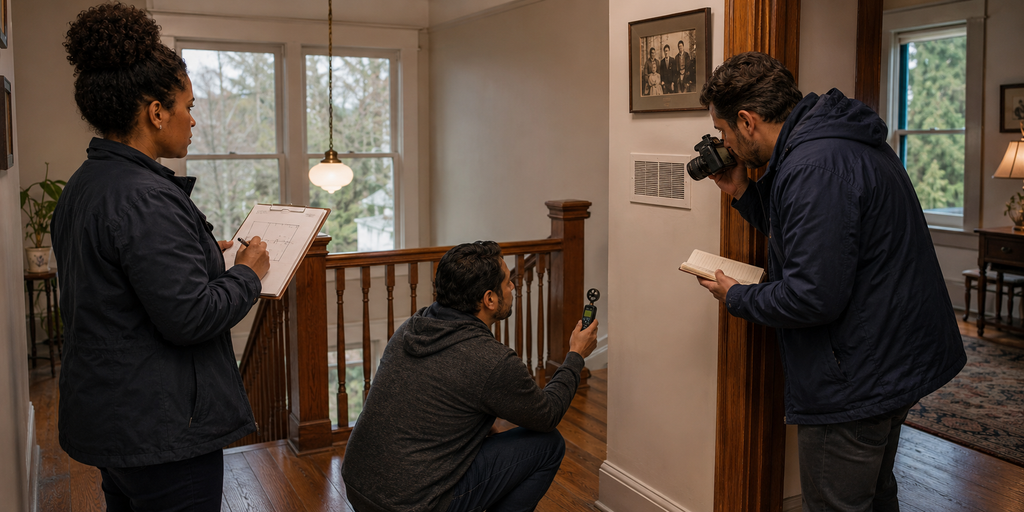
Part Two · Enter the Field
Match the Tool to the Question
The best field kit is not the largest collection of equipment. It is the smallest collection capable of answering the questions of the case reliably.
Every instrument should have a defined job before it is switched on.
An instrument detects, measures, records or helps reproduce a condition. It does not identify the cause of a reading by itself. An electromagnetic meter can document a change in the field around it; it cannot announce that the change was produced by a spirit.
Begin with the field question. Decide what kind of signal or observation could address it, then choose an appropriate tool and record that tool’s limitations. This keeps equipment from becoming a collection of blinking objects waiting for the team to give them meaning.
The question chooses the equipment
Four jobs within a field kit
Field notes, synchronized clocks, audio recorders, still cameras and fixed video preserve what happened and when.
Thermometers, hygrometers, airflow meters, sound meters and EMF meters describe particular physical conditions.
Levels, measuring tape, controlled light sources and marked object positions help test whether an event can occur again.
Headlamps, radios, first-aid supplies, spare batteries and protective gear support safe work. They are essential even though they collect no paranormal evidence.
Match each report to a method
| Reported event | Useful tools | Comparison or test | Important limitation |
|---|---|---|---|
| Upstairs impacts | Fixed audio recorders, synchronized log and structural walkthrough | Compare heating cycles, plumbing, exterior sound and known footsteps | A recording preserves sound but may distort its apparent direction or distance |
| Cold stair landing | Air thermometer, hygrometer, airflow meter and HVAC log | Compare heating on and off, adjacent rooms and different times | An infrared thermometer measures surfaces rather than pockets of air |
| Falling photograph | Level, measuring tape, position marks, fixed camera and vibration tests | Test floor movement, doors, airflow and ordinary household traffic | A camera showing the fall may still fail to reveal the initiating force |
| Figure near doorway | Fixed camera, light map, reflection check and independent observers | Recreate witness angle under changing interior and exterior light | A missing camera image does not prove that the witness saw nothing |
Experimental communication requires a separate decision
Spirit boxes, pendulums, boards, sensory-deprivation experiments and similar methods should not be added merely because the team owns them. They require household permission, a defined protocol and a reason connected to the case question. Responses produced under ambiguous conditions should be documented as experimental results—not automatically treated as messages.
Prepare the instruments
- Label each device with a unique name or number
- Synchronize device clocks as closely as possible
- Record settings, units and storage media
- Test batteries, microphones and camera framing
- Take an initial control recording
- Log where each fixed device is placed
More gear can mean less clarity
Every additional device introduces radio signals, indicator lights, mechanical sounds, heat, handling noise and another clock that may not agree with the others. Equipment should reduce uncertainty. If it creates more unexplained signals than it can interpret, leave it packed.
The team builds a question-led kit
Alder Street does not require every device available to the team. Four reported events produce four modest documentation plans.
The field lead assigns one person to the master time log. Each device is labeled, tested and placed on the location map before the evening observation begins.
Build a three-tool kit
Choose one Alder Street question and select no more than three tools to address it. For each tool, write one sentence explaining its job and one sentence explaining what it cannot establish. If you cannot define both, reconsider whether the instrument belongs in the plan.
Part Two · Enter the Field
Control Contamination
Evidence can be altered by the people collecting it, the devices surrounding it and the expectations brought into the room. Good investigators account for their own presence.
If you cannot account for the investigators, you cannot fully account for the evidence.
Contamination is any known or possible influence that makes an observation harder to interpret. It does not mean that someone lied, acted carelessly or deliberately faked evidence. A whispered conversation, vibrating phone, passing truck or investigator walking outside a camera’s frame can produce a sincere mystery.
The goal is not to create a perfectly sterile building. That is rarely possible in a lived-in home. The goal is to identify influences, reduce the avoidable ones and preserve enough context to evaluate the rest.
Four common sources of contamination
Footsteps, clothing noise, breathing, whispered speech, touching objects, blocking airflow and moving beyond camera coverage.
Phones, radios, smartwatches, wireless cameras, autofocus motors, indicator lights and equipment operating on different clocks.
Traffic, neighbors, animals, plumbing, heating cycles, wind, rain, settling materials and changes in outside light.
Sharing the legend, announcing what others should hear, interpreting vague sensations aloud and allowing one witness to reshape another’s account.
Contaminated does not mean worthless
A contaminated recording may still document that something occurred. It simply cannot support every interpretation someone might place upon it. Mark the uncertainty honestly and keep the material available for comparison.
Use a simple event protocol
Create known controls
- Assign each investigator a position and role
- Keep a master movement and time log
- Record sample voices, footsteps and door sounds
- Place unused phones in airplane mode or outside the scene
- Identify the emergency phone that remains active
- Log residents, pets and occupied rooms
Describe before interpreting
- What sense detected the event?
- Where did it appear to originate?
- How long did it last?
- Who noticed it independently?
- What equipment was operating?
- What known source might resemble it?
Useful field language: “At 10:52 p.m., I heard three dull impacts above the kitchen.” This preserves an observation. “The woman in the bedroom walked down the hall” turns it into a story before the evidence has been compared.
The evening observation begins
Three investigators enter the working area. Marisol remains in the kitchen because that is where she usually hears the late-evening sounds. Daniel and Inez remain downstairs and agree not to enter the mapped observation area without notifying the logger.
Three dull impacts are heard above the kitchen. Marisol and two investigators report hearing them. All three field investigators are stationary and visible on camera. The heating blower began operating shortly before the sounds.
The team does not call the sounds footsteps or declare them explained. They mark the event, check positions, record the heating condition and collect separate descriptions. The audio will later be compared with known footsteps and with the building’s ordinary heating sounds.
Find the contamination
Imagine that one investigator hears a whisper while another is walking outside the room, a phone is receiving notifications and the resident has just said, “She usually calls my name here.” List each possible influence. Then write one neutral sentence describing what can still be claimed about the event.
Account for every person before asking what else may be present.
Part Two · Enter the Field
Observe Without Provoking
An investigation should make room for an event to occur without threatening, insulting or frightening whatever—or whoever—may be present.
If an event must be shouted into existence, you are studying the disturbance created by the investigation—not the household’s ordinary experience.
Paranormal television often treats provocation as a shortcut: challenge the presence, insult it, demand a sign or enter the room declaring what it is. That may create dramatic footage, but it also changes the emotional and physical conditions of the location.
For believers, there is an additional concern. A dead person, household spirit or other presence is not an experimental prop. For skeptics, the same restraint remains useful because agitation, suggestion and uncontrolled movement contaminate observation. Courtesy and good method point in the same direction.
Use the least disruptive method first
Allow the location to settle while the team watches, listens and logs ordinary conditions.
Recreate footsteps, doors, heating cycles, reflections and object movement.
Alter one condition at a time and observe whether the event changes with it.
Attempt only when permission, purpose, protocol and closure have been defined.
The ladder ends before provocation
Threats, insults, dares, declarations of demonic identity and promises that cannot be kept do not become sound methodology because a camera is running. They can distress residents, encourage reckless interpretation and leave the household with consequences after the investigators depart.
Observation language matters
- “We are here to understand what has been happening.”
- “If anyone wishes to make their presence known, you may do so.”
- “A sound occurred near the upstairs doorway.”
- “We will pause and listen before asking another question.”
- “We know a murdered woman is trapped here.”
- “If you are powerful, prove it right now.”
- “The demon just moved behind us.”
- “Knock twice if you want this family gone.”
Use a defined protocol
Communication is an experiment and a relationship-sensitive act. It should not begin casually or continue indefinitely.
- State who is present and why the team is there.
- Use one designated speaker and one question at a time.
- Allow a quiet response interval before speaking again.
- Record each question exactly as asked.
- Avoid supplying names, identities or expected answers.
- End at the agreed time and state clearly that the session is closed.
A possible response grows stronger when it is:
During quiet observation
- Start and end time of the observation period
- Lighting, heating and open-door conditions
- Location and posture of every participant
- Exact words spoken aloud
- Events noticed without interpretation
- Changes made before the next observation
Silence is also a result
A quiet session is not a failed investigation. It establishes conditions under which the reported event did not occur. Do not fill silence with increasingly dramatic techniques simply to produce material.
The team lets the house remain ordinary
Following Event 8A, the investigators maintain a quiet observation period. They do not announce that footsteps have occurred, ask a presumed spirit to repeat them or tell Marisol what the team suspects.
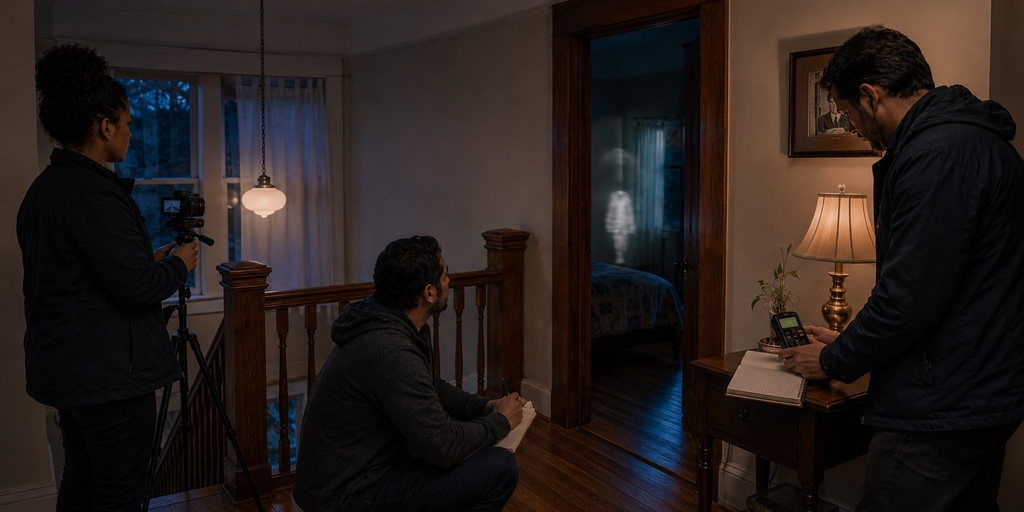
One investigator quietly notes a pale, person-sized shape crossing part of the unused bedroom doorway. The other investigators are not told what to look for until they have recorded their own observations.
Review at the scene shows that passing headlights moved across the pale curtain and reflected picture glass at nearly the same moment. The effect can be seen from the investigator’s position but is weaker from Inez’s reported sightline.
The observation provides a plausible visual mechanism worth testing. It does not prove that Inez’s earlier 2:00 a.m. experience had the same cause. Her account remains open.
Rewrite the provocation
Rewrite this statement as a neutral observation prompt: “If you are the angry woman who haunts this hallway, knock three times.” Remove the assumed identity, emotion and demand for performance while preserving a clear response interval that could be documented.
Part Two · Enter the Field
Document Time and Context
A reading becomes useful when it can be placed beside the people, conditions and other events occurring at the same moment.
Preserve the event’s surroundings as carefully as the event itself.
A recording without a reliable time, location or movement log may be eerie, but it is difficult to investigate. An isolated spike, voice-like sound or sudden temperature change becomes meaningful only after it is compared with what the building, equipment and people were doing.
Exact time does not mean pretending to have precision you do not possess. If a witness remembers that something happened “sometime after midnight,” record it that way. During controlled fieldwork, however, the team can create a shared time reference and document events to the nearest practical second.
Create one shared clock
Build an event bundle
Context creates a timeline
The heating blower begins operating. The logger marks the change.
Three dull impacts are heard above the kitchen. Event 8A is called.
The team confirms positions and checks the mapped observation area.
Marisol and the investigators complete separate brief descriptions.
The blower stops. No additional impacts occur during this cycle.
Correlation gives you a test—not a conclusion
The impacts occurred shortly after the heating blower started. That timing makes the heating system a reasonable mechanism to test. It does not yet establish that the system caused the sounds. The same sequence must be compared across additional cycles and controlled reproductions.
Every event entry needs
- A unique event number
- Master time and mapped location
- Plain sensory description
- Independent observers
- Known people and device activity
- Environmental and building conditions
- Related file names and next test
Keep the originals intact
- Preserve original audio, video and photographs
- Review copies instead of editing source files
- Record any enhancement or conversion performed
- Do not remove “empty” time around an event
- Keep uncertain or contaminated material labeled
- Respect the household’s privacy agreement
Two events become two timelines
The team aligns the master log with its recordings. The hall camera is four seconds slow, while Recorder B is two seconds fast. Those offsets are documented rather than silently corrected.
- Event 8A: The three impacts follow the beginning of a heating cycle by twenty-six seconds and appear on both fixed audio recorders.
- Event 9A: Exterior camera footage shows a vehicle passing immediately before patterned light moves across the bedroom curtain and picture glass.
- The framed photograph remains upright throughout the entire observation period.
Read the timeline without outrunning it
Using the Event 8A timeline, write one statement the record supports and one statement it does not yet support. Then name the next comparison needed before deciding whether the heating system produced the impacts.
Part Two · Enter the Field
Test the Anomaly
Once an unusual event has been documented, change one condition at a time and see what survives comparison.
The purpose of a test is not to make the anomaly disappear. It is to learn which conditions matter.
Field investigations rarely provide laboratory control. People still live in the building, traffic continues outside and the reported event may not occur on command. Even so, a modest comparison can produce valuable information.
Recreate known sources before inventing unknown ones. Compare footsteps with impacts, heating on with heating off, one viewing angle with another and an untouched object with the same object under ordinary household vibration. Keep everything else as consistent as the location reasonably allows.
Change one thing at a time
A practical field-test sequence
Describe exactly what is being tested without naming a presumed cause.
Begin with sources already supported by the map, baseline and timeline.
Record footsteps, heating sounds, reflected light and object vibration for comparison.
Avoid changing the room, equipment, people and procedure simultaneously.
One match may be coincidence. Use several trials when practical and safe.
Unsuccessful reproductions are part of the result, not material to hide.
Failure to reproduce an event does not erase it
It means the event did not recur under the conditions tested. The original report may depend upon a condition the team did not identify, may be too infrequent to reproduce during one visit or may remain genuinely anomalous. “Not reproduced” is more accurate than “did not happen.”
Name the outcome carefully
Every test needs
- The event and mechanism being tested
- Conditions kept consistent
- The single condition changed
- Number and order of trials
- Result of every trial
- Differences from the original report
- Limits and recommended next step
Let another explanation win
A test designed so that only a paranormal answer can succeed is not a meaningful test. Decide in advance what result would support an ordinary mechanism, what would leave the case open and what would genuinely surprise the team.
The team tests four reported events
An HVAC professional is better qualified to identify the precise mechanical source of the impacts. The investigators document the connection and recommend inspection rather than dismantling or altering the homeowner’s heating system themselves.
Design the next comparison
Create a three-trial test for the upstairs impacts. State what will remain consistent, what will change and what outcome would support a heating-related explanation. Then name one result that would require the team to reconsider that explanation.
An anomaly earns attention by surviving comparison.
Part Two · Enter the Field
Close the Session Deliberately
The investigation is not finished when the last recorder is switched off. People, equipment, permissions and open questions all need a clear ending.
Leave the location, its residents and any presence no more disrupted than the investigation required.
A deliberate close separates the active field session from the later work of review and interpretation. It tells everyone when observation has ended, confirms that permissions have not quietly expanded and prevents loose equipment, unfinished experiments or dramatic final statements from following the team out the door.
Closing a session is not automatically a cleansing or banishment. It ends the investigation’s invitation, activity and access. Spiritual intervention is a separate decision requiring its own purpose, permission and qualified person.
Four things must be closed
End tests, stop recordings, remove markers and return moved objects as agreed with the residents.
Account for every device, storage card, battery and original file before leaving the property.
Tell residents what was observed, what remains uncertain and when they should expect follow-up.
End any authorized communication clearly and maintain the limits that were established at the beginning.
Use an end-of-session sweep
Close early when the conditions require it
A scheduled end time is not an obligation to continue. Stop or pause the session when:
- A resident or participant withdraws consent
- Someone becomes physically ill, exhausted or emotionally overwhelmed
- Weather, structural conditions or human behavior creates danger
- Contamination becomes too extensive for useful observation
- An event exceeds the team’s training or agreed boundaries
- Equipment failure prevents responsible documentation
Do not leave the household with a threat
Investigators should not depart by warning residents that the case has been “stirred up,” that something may follow them or that a hostile presence has been angered. Such statements can produce lasting fear without providing a useful course of action.
If communication was authorized, the designated speaker should state that the session is ending, that further responses are not being requested and that the household’s boundaries remain in effect. If a resident wants cleansing, blessing, quieting or banishment, discuss that separately after the evidence and needs have been reviewed.
Confirm with the household
- What the team directly observed
- What has not yet been reviewed
- Any ordinary safety or maintenance concern
- How private recordings will be handled
- Who may contact the household
- When a preliminary report will be provided
Debrief away from the scene
- Check the physical and emotional condition of the team
- Preserve separate impressions before comparing them
- Back up original recordings securely
- Mark damaged, failed or uncertain equipment
- Record unexpected departures from the plan
- Rest before beginning intensive review
The team leaves the house as a home
At 11:30 p.m., the field lead calls the end of active observation. No communication was opened, so no ritual closing is required. The team states that the visit is complete, stops all recordings and collects equipment against the numbered location map.
- The photograph is returned to the position approved by Marisol.
- Temporary location markers are removed.
- No equipment, ritual material or trigger object is left behind.
- The family receives an immediate summary without a haunting diagnosis.
- The team recommends professional inspection of the heating system.
- The family is told that Inez’s reports remain open rather than disproved.
“We documented several events and reproduced some conditions that may be contributing to what you have experienced. We have not reviewed all of the recordings, and we are not making a final conclusion tonight. We will preserve your privacy and return with a written summary.”
Write a responsible departure statement
In four sentences or fewer, tell the Alder Street household what the team observed, what remains unknown, what ordinary follow-up is recommended and when they will hear from the team again. Avoid the words haunted, demonic, attachment and nothing happened.
Part Three · Field Stations 13–15
Resolve the Case
The field visit is over, but the most interpretive work is still ahead. Recordings must be reviewed, findings classified and the household given an answer that distinguishes what is known from what remains possible.
A conclusion should describe the strength and limits of the information—not reward the most dramatic explanation.
Compare recordings with the master timeline, separate observation from interpretation and assign each event an honest result.
Tell the household what the investigation supports, what it does not support and what remains unresolved.
Decide whether the next step is maintenance, observation, specialist help, spiritual work—or no further action at all.
The field visit produced two recorded events and several successful comparisons. Some reported effects now have strong ordinary candidates, while parts of Inez’s account remain open. No final verdict has yet been given to the household.
Part Three · Resolve the Case
Review and Classify the Evidence
Review is the work of reconnecting recordings with the field timeline, testing competing explanations and stating exactly how much each event supports.
Another careful reviewer should be able to trace how you moved from the original record to the final classification.
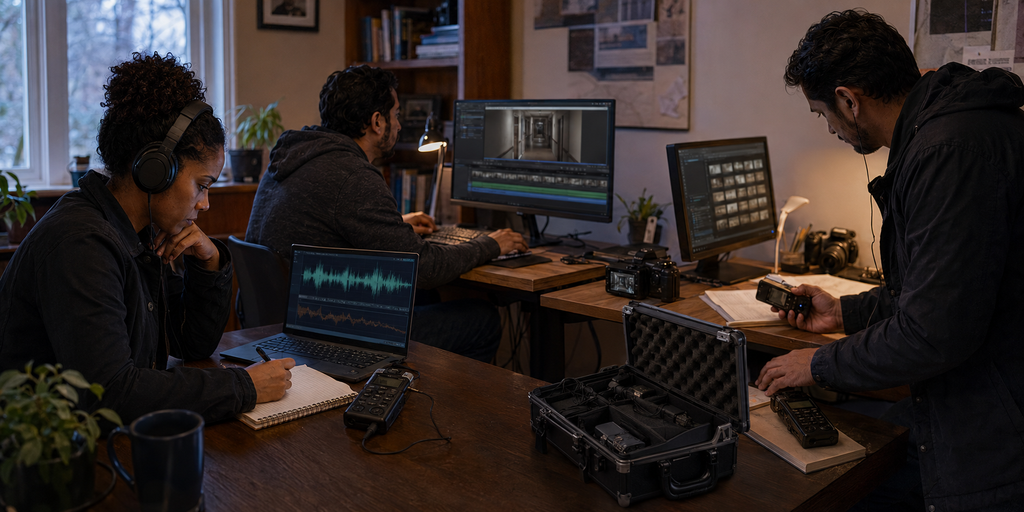
Evidence review should begin after the team has rested and original files have been secured. Work from copies. Preserve the empty minutes around an event, because a sound heard thirty seconds earlier may explain what appears mysterious when clipped into isolation.
Reviewers should know enough to understand the recording, but not so much that they are told what they must hear or see. A useful process combines an initial independent review with a later context-rich comparison against the master log, control recordings and field tests.
A six-step review workflow
Confirm device, location, start time, duration and whether the file is an untouched original or review copy.
Apply documented clock offsets so recordings can be compared against the same master time.
Mark possible events without first being told the expected word, figure or interpretation.
Compare candidate events with people, equipment, heating, traffic and other logged conditions.
Listen to known footsteps, doors, voices and mechanical sounds recorded at the same location.
Record the result, support, limitations and any remaining disagreement among reviewers.
Use two review passes
The reviewer receives the file, device, general location and time range without being told what another person believes it contains.
Each reviewer marks possible events and writes their own description before comparing impressions.
Candidate events are placed beside the master timeline, video, movement log, environmental changes and control recordings.
The question changes from “What does this sound like?” to “What best accounts for this event in its actual setting?”
Enhancement cannot restore information that was never recorded
Amplification, filtering and noise reduction may make a sound easier to examine, but aggressive processing can also create artificial edges, rhythms and voice-like patterns. Preserve the original, document every adjustment and never present an enhanced clip without the unprocessed source and surrounding context.
Classify in layers—not with one dramatic label
Clean, qualified, contaminated, incomplete or unusable.
Reproduced, probable mechanism, unresolved or anomalous.
Single-source, independently observed or instrumentally corroborated.
Ordinary cause supported, no conclusion or possible paranormal relevance.
Useful result language
A known mechanism sufficiently accounts for the observed event under comparable conditions.
A known source closely matches the event, although some conditions or historical details cannot be confirmed.
The available information cannot reliably favor one cause. This does not mean the witness imagined the experience.
The event remains unusual after relevant comparisons and deserves further attention without automatically being labeled paranormal.
Anomalous and paranormal are not synonyms
A possible paranormal interpretation becomes reasonable only after the event itself is well supported, relevant ordinary mechanisms have been considered and the proposed interpretation explains more than it assumes. Even then, “possible” may be the most accurate word available.
The evidence is classified event by event
One reviewer also marks a faint sound as possibly resembling a whispered word. A second reviewer describes it only as a scrape. Video shows a chair being adjusted at that moment, so the clip is retained with its context but is not classified as a voice.
Classify without flattening the case
Choose two Alder Street events and assign each a record-quality label, event result, level of support and interpretation. Then write one sentence explaining why the entire household should not be given a single label such as “haunted” or “debunked.”
Part Three · Resolve the Case
Report Without Overclaiming
The household needs an answer it can use—not a verdict designed to make the investigation sound more dramatic than it was.
A responsible report tells the reader what the investigation supports, what it does not support and what remains unknown.
A report should be understandable to someone who was not present during the investigation. It should explain the scope of the visit, the questions asked, the methods used and the limits of the resulting information. The household should not have to decode equipment jargon to learn what the team found.
Report each event separately before offering an overall case position. A reproduced heating sound does not automatically explain a visual experience, and an unresolved witness report does not make every ordinary mechanism irrelevant.
Build the report in eight parts
State the overall findings, important limits and recommended next steps.
Record where the team worked, what was authorized and what was outside the investigation.
Preserve the household’s accounts without rewriting them into one story.
Describe observation periods, instruments, baselines and relevant environmental conditions.
Give each report its own evidence, classification and limitations.
Explain what pattern, if any, the combined findings reasonably support.
Offer practical maintenance, observation, referral or spiritual options suited to the findings.
State who receives the material, what will be retained and when the case will be revisited.
Use language that matches the evidence
- “The recording supports…”
- “The event is consistent with…”
- “Testing produced a similar effect…”
- “The available information does not establish…”
- “This part of the report remains unresolved…”
- “We proved there is a ghost…”
- “The meter identified a spirit…”
- “This can only be paranormal…”
- “Nothing happened, so the witness was mistaken…”
- “The house is completely clear now…”
A witness may accurately report an experience whose cause was unknown at the time. Finding the mechanism validates the event by making it understandable; it does not accuse the witness of inventing it.
It means the available information cannot decide the cause. The event may require better documentation, different conditions or simply an honest admission that the team does not know.
Do not replace uncertainty with a threat
Fear does not justify telling residents they opened a portal, attracted a demon, received a curse or gained an attachment without serious grounds. Give them the strongest supported information, acknowledge what remains open and provide a practical next step. Words become part of the case.
What strengthens a report
- Exact event classifications
- Independent agreement and disagreement
- Relevant ordinary mechanisms
- Contamination and equipment limitations
- Unsuccessful tests and quiet periods
- Clear recommendations with responsible scope
What weakens a report
- Dramatic identities unsupported by evidence
- Rumors presented as property history
- Edited clips without original context
- Claims made only to reassure or frighten
- Private household details unrelated to findings
- Promises that the activity can never return
The household receives a mixed—but useful—answer
The investigation documented several conditions capable of producing experiences reported in the home. The upstairs impacts are strongly associated with heating operation, airflow accounts for the cold sensation at the landing, and controlled tests reproduce movement of the photograph. Passing light explains the doorway shape observed during the field visit. Inez’s earlier figure sighting and lighter late-night footsteps remain unresolved because they were not independently recorded under comparable conditions.
- Have the heating system and upstairs ductwork inspected professionally.
- Level or secure the photograph and its narrow console.
- Keep a simple thirty-day log of any additional experiences.
- Record exact time, location and household conditions when possible.
- Contact the team if activity becomes frequent, independently observed or disruptive.
The report and recordings remain private under the original agreement. No image, witness statement or audio clip may be published without separate written permission from the household.
Write the executive summary
In approximately 120 words, summarize the Alder Street findings for the family. Include one supported mechanism, one unresolved report, one thing the investigation does not support and one practical next step. Write for the residents—not for an audience looking for a ghost story.
Part Three · Resolve the Case
Follow Up, Refer or Intervene
A completed report should lead to a proportionate next step—even when that next step is simply to observe, repair something ordinary or close the case.
Choose the least disruptive response capable of meeting the household’s actual need.
Investigation and intervention are different kinds of work. Investigation attempts to understand existing conditions. Intervention deliberately changes them. Once a team cleanses, blesses, challenges, removes or invites something, it can no longer treat the location as though it remains untouched.
The next step should be chosen from the findings, the residents’ wishes and the degree of disruption—not from a belief that every unusual experience must end with a banishment.
Move upward only as the case requires
Refer according to the problem—not the label
HVAC technician, electrician, plumber, structural specialist, pest professional or other qualified trade when the physical location needs expert evaluation.
A more experienced team when activity is repeated, independently reported and requires equipment, time or methods beyond the original team.
A witch, medium, clergy member or tradition-specific specialist when the household requests spiritual assessment or intervention and the practitioner is suited to the case.
Appropriate emergency, medical or mental-health help when someone is in immediate danger, unable to function safely or experiencing a health crisis. Referral should address the risk without mocking the person’s interpretation.
Define what the intervention is meant to change
Boundary, cleansing, quieting, severing, banishing and psychopomp work are not interchangeable names for “getting rid of a ghost.” Each acts upon a different relationship or condition.
Agree upon the goal, who has authority to consent, what traditions are acceptable and what will count as improvement. Do not perform ritual in someone’s home merely because an investigator carries the necessary tools.
Return when new information can change the case
Do not create permanent clients from temporary uncertainty
Repeated visits, escalating rituals and constant monitoring can teach residents to inspect every ordinary sound for evidence. A responsible team should be willing to close a stable case, leave clear instructions and return only when new information or changed needs justify it.
The least dramatic response works
The team does not tell Inez that her remaining experience was imaginary. It also does not treat one unresolved event as proof that a presence requires removal. The household understands the findings, feels able to set its own boundaries and knows what information would justify reopening the case.
Choose the proportionate response
Write one recommendation for each possible Alder Street outcome: the heating repair ends all activity; the lighter footsteps become independently recorded; the family remains comfortable with a quiet presence; or the activity becomes disruptive and ignores clearly stated household boundaries. Explain why the same response would not fit all four situations.
The least dramatic response may be the most responsible one.
Case File 07 · Final Result
Alder Street: A Useful Answer
The house was not debunked. The witnesses were not dismissed. The case became more understandable, and the household gained a proportionate way forward.
The Navarro family’s experiences were real experiences regardless of their eventual classifications. Marisol heard heavy impacts. The stair landing felt sharply colder. The photograph repeatedly appeared face-down, and Inez saw something she understood as a person near the unused bedroom.
The investigation did not ask the family to choose between “haunted” and “imagined.” It separated the events, documented their conditions and allowed each report to reach a different result.
The final event record
What changed—and what did not
- The heating system was inspected and adjusted
- The cold landing and heavy impacts became understandable
- The photograph was stabilized
- The family gained a method for documenting future events
- Fear decreased because the case had boundaries and context
- It did not call the family mistaken or suggestible
- It did not declare every question answered
- It did not provoke a presumed presence
- It did not perform an unwanted cleansing or banishment
- It did not turn private experiences into public entertainment
A successful investigation does not require paranormal evidence. Sometimes understanding the house—and giving its residents back their footing—is the result.
What Alder Street teaches
Trust the experience. Verify the interpretation.
Belief does not require certainty about every sound, shadow or reading. Skepticism does not require treating witnesses as unreliable. Careful investigation holds both responsibilities together and responds to what the household actually needs.
You Followed the Case
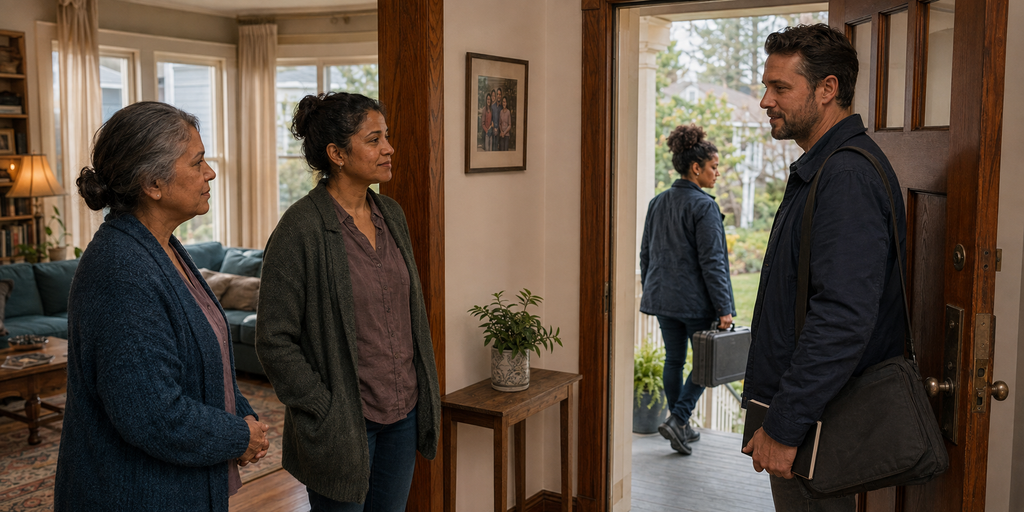
You planned before entering, documented before interpreting, tested before concluding and chose a response suited to the household rather than the story.
Completion does not mean that every future investigation will be simple. It means you now have a repeatable structure for approaching unfamiliar experiences without abandoning belief, evidence, courtesy or good judgment.
You can now build a responsible case
Assess need, obtain permission, hear witnesses separately, research carefully and convert reports into workable questions.
Map the scene, establish baselines, select useful tools and control the contamination introduced by investigators.
Preserve time and context, run meaningful comparisons and distinguish an anomaly from its possible interpretation.
Report without overclaiming, protect the household’s privacy and choose proportionate follow-up, referral or intervention.
Download the MCC Field Packet
The companion packet turns the course into printable worksheets you can use for practice, household intake, field documentation, evidence review and final reporting.
Printable PDF · Designed for practice and responsible field documentation
Completing the guide does not confer investigative, counseling, medical, technical, clergy or spiritual-practitioner credentials. Work within your training, local law, permission and the limits of the case.
Choose Your Next Path
Return to the equipment guide, study paranormal research more deeply or explore MCC’s broader approach to spirits, magic and responsible practice.
This course reflects the perspective of My Cousin’s Coven: practicing witches and researchers who believe paranormal experiences can be real, while recognizing that no reading, recording or interpretation explains itself.