The Turning of the Wheel
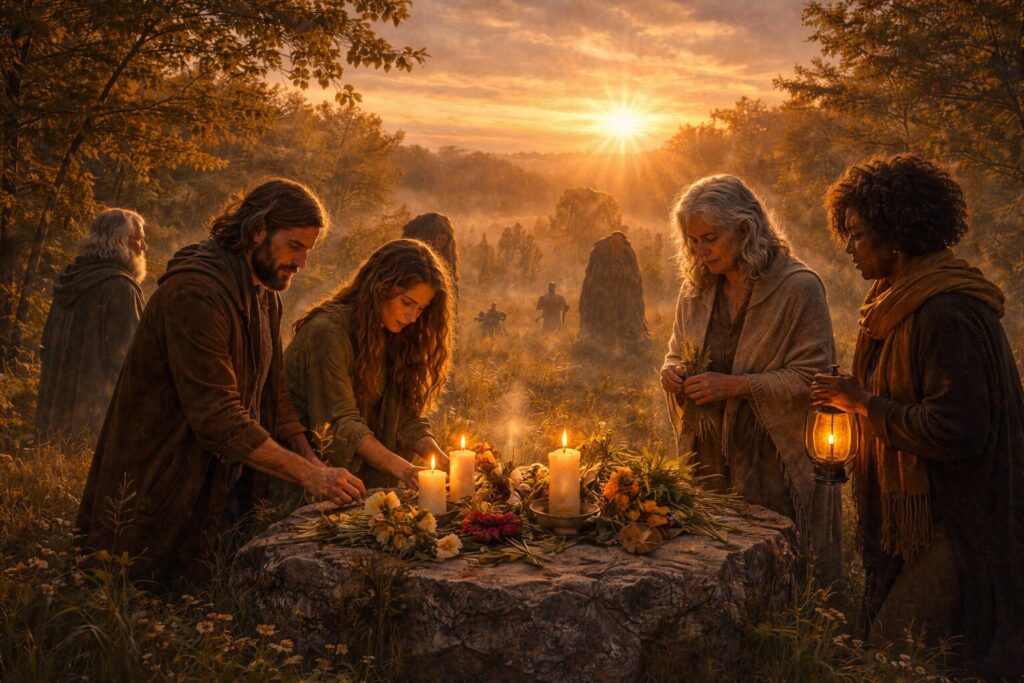
The Wheel of the Year is more than a calendar of festivals. It is a way of understanding time itself — not as a straight line of progress and decline, but as a living cycle of return, transformation, and renewal.
The phrase Wheel of the Year is commonly used in modern Pagan and Witchcraft traditions, and while it emerged most clearly within Wiccan frameworks, it has since been adopted far more broadly. Today, many Pagans use the term as a shared language for seasonal observance, even when their own traditions, cultures, or lineages describe sacred time in different ways.
In the turning of the Wheel, light and dark, growth and rest, birth and death are not opposing forces to be conquered. They are phases of a single rhythm. Each season carries its own wisdom. Each threshold teaches a different way of being in relationship with land, body, memory, and spirit.
At My Cousins Coven, the Wheel is approached as both map and mirror. It reflects the natural world, and it reflects the inner landscape. The waxing and waning of the year shape not only crops and weather, but mood, energy, attention, and the deeper movements of spirit.
The sabbats mark the great gateways of this cycle. But the Wheel does not turn only on holy days. It turns in the spaces between — in daily habits, in seasonal altar shifts, in the quiet changes of light and temperature, in the stories and practices we carry forward.
The year does not simply pass.
It turns.
And in its turning, it teaches us how to move with time, rather than against it.
The Wheel as Sacred Time
When we speak of the “Wheel of the Year,” we are using a modern, widely shared phrase — common in Pagan and Witchcraft communities — to describe an annual cycle of seasonal gateways. Not every tradition uses this terminology, and the language itself carries a history. Still, many Pagans find it useful as a shared map for returning attention to the turning year.
What matters most is not the label, but the underlying insight: time can be approached as sacred pattern, not merely as a sequence of dates. The Wheel offers a way of remembering that life moves in phases — of ripening and release, visibility and inwardness, gathering and rest.
“… by its very nature sacred time is reversible … a primordial mythical time made present.”
Mircea EliadeIn other words: ritual time does not only commemorate. It returns. It reopens a threshold in the present and invites us to step through it with body and attention.
Light and Dark as Sacred Phases
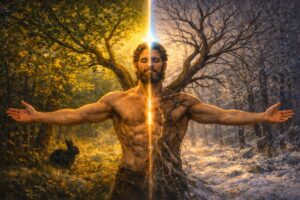
One of the simplest misunderstandings of seasonal spirituality is to treat light and dark as moral categories — “good” and “bad,” “pure” and “corrupt.” The Wheel teaches something older and more useful: polarity is not a war. It is a rhythm.
Light seasons tend to invite outward movement: growth, visibility, action, celebration, expansion. Dark seasons tend to invite inward movement: dreaming, composting, rest, remembrance, refinement. Neither is a failure state. Both are necessary phases of life.
“Ritualisation is a way of acting … designed and orchestrated to distinguish and privilege what is being done…”
Catherine BellIn practice, the Wheel is how many people learn to ritualize the year itself — to “set apart” certain days. Not to escape daily life, but to re-enter it with deeper orientation.
Walking the Wheel in the Body and the Land
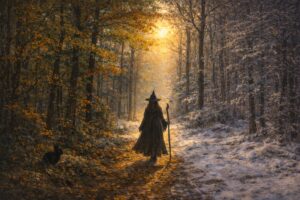
The Wheel is not something we observe from the outside. It is something we inhabit. It turns through weather and harvest, yes — but also through sleep, mood, attention, and the subtle tides of the nervous system.
This is why “exact dates” matter less than honest seasonal contact. In one place, the land may still be frozen at “spring.” In another, the fields may already be green. The Wheel becomes real when it is situated in the land (and sky) where you actually live.
“… what is important is situating oneself in the land (and sky) …”
Ronald HuttonOver time, seasonal practice becomes less about “performing the right festival” and more about learning the year as a living teacher — returning, again and again, to what the season is actually asking of you.
The Sabbats as Gateways (and the Year Between Them)
The sabbats are often described as “the spokes of the Wheel,” but their deeper function is gateway: they mark transitions that are happening anyway — in light, temperature, harvest, and the inner tide of the season.
Yet the Wheel does not turn only on holy days. It turns in the spaces between: in the way your home changes, your altar shifts, your appetite and sleep transform, and your attention leans toward different kinds of work.
If the festivals are thresholds, the weeks between them are the road — and the real apprenticeship of seasonal living happens there.
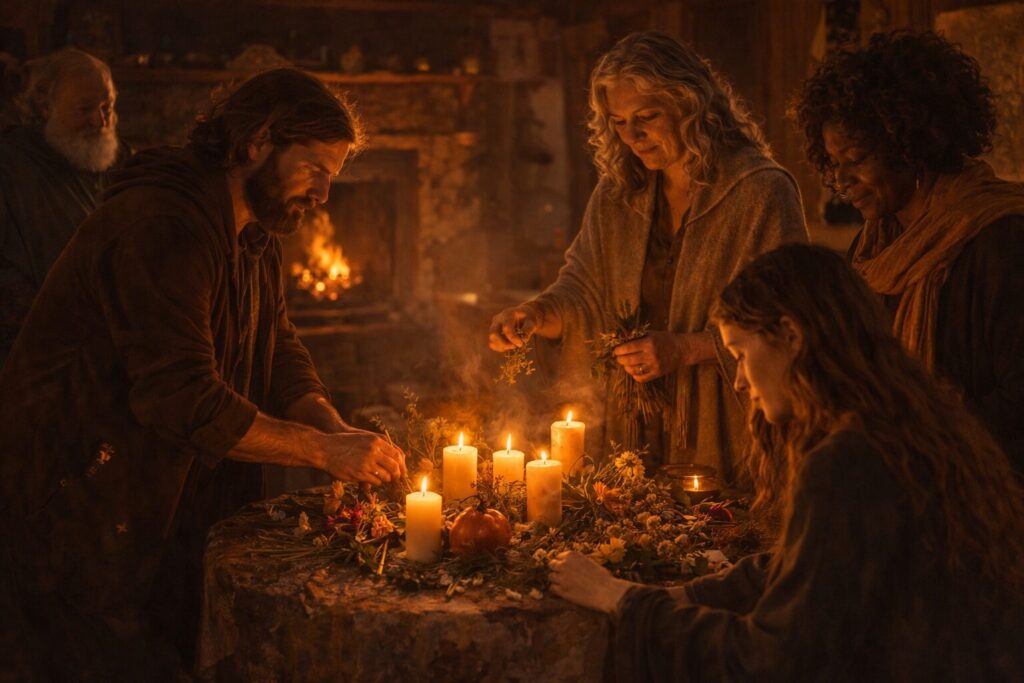
The Wheel is not only a system of dates, symbols, or seasonal names. It is a way of learning to belong to time.
To live with the Wheel is to practice attention: to notice when the light shifts, when the air changes, when the body asks for a different pace. It is to recognize that growth and rest are not opposites, but partners. That descent is not failure. That return is not repetition, but deepening.
Over years of practice, the Wheel becomes less something we “follow” and more something that follows us — shaping memory, ritual, expectation, and identity. The seasons begin to live in the hands, in the breath, in the quiet instincts that know when to gather and when to release.
In this way, the Wheel is not only about the year.
It is about how we learn to move with change itself.
To walk the Wheel is to accept that sacred time is not outside of us.
It is what we are made of.
“Seasonal festivals are not simply survivals of an ancient past, but living structures through which people continue to create meaning, identity, and a sense of belonging within time.” — Ronald Hutton