Understanding the Sabbat
Sabbats are holidays — but they are not only holidays.
Across Pagan and earth-centered traditions, sabbats function as ritualized thresholds in time: moments when ordinary life is set aside and sacred time is entered deliberately. These days do more than mark the calendar. They create pauses in the flow of the year where myth, memory, land, and human community are brought into alignment.
To step into a sabbat is to step into a different mode of time. The workday gives way to ritual time. The ordinary gives way to the intentional. In this sense, sabbats are not simply celebrations. They are technologies of sacred time — structured moments that allow practitioners to re-enter cycles of meaning, remembrance, and renewal.
At My Cousins Coven, sabbats are understood as both inherited and living traditions. They are shaped by history, lineage, and religious development — particularly through modern Pagan movements — but they are also continually re-synchronized through practice. Each generation aligns the sabbats again with land, culture, psychology, and spiritual experience. This ongoing process is not a flaw in tradition. It is how living traditions remain alive.
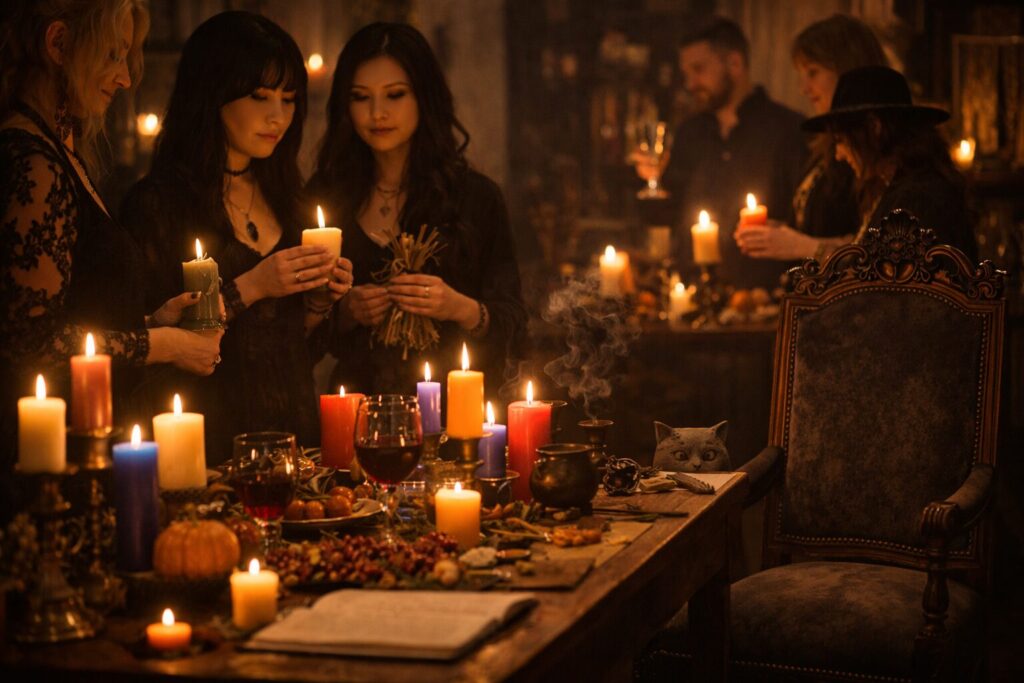
Sabbats therefore hold more than festivity. They hold memory. They hold mythic pattern. They hold collective attention. Over time, repetition makes these days charged — not only symbolically, but spiritually and psychologically. The gathering itself becomes part of the magic. The altar, the circle, the shared meal, the prepared space — all signal to the body and spirit that a threshold has been crossed.
In this way, sabbats operate on multiple levels at once. They are holidays. They are rites. They are communal memory. They are inner alignment. They are spiritual gates.
To understand the sabbat is to understand how humans step out of ordinary time — and into sacred time — together.
“A festival does not simply commemorate a sacred moment — it makes that moment present again. To celebrate is to re-enter sacred time.” — inspired by Mircea Eliade
Sabbats as Holy Days — More Than Holidays
Sabbats are often described as Pagan holidays, but their function extends far beyond celebration alone. In practice, sabbats operate as ritualized interruptions of ordinary time. They mark moments when practitioners collectively step out of everyday rhythms and enter sacred time.
This distinction matters. A holiday can be observed casually. A sabbat is entered deliberately. Through repeated observance, these days become charged with layered memory — personal, communal, mythic, and seasonal. Over time, the sabbat itself becomes a recognizable threshold in the body and psyche.
Ritual theory and anthropology consistently show that holy days are among the primary ways cultures teach people how to recognize sacred time.
Sacred Synchronicity — How Sabbats Are Aligned and Re-Aligned
The modern Wheel of the Year did not descend fully formed from antiquity. It emerged through processes of reconstruction, synthesis, and cultural alignment — drawing on folklore, agricultural rhythms, mythic symbolism, and modern Pagan theology.
At My Cousins Coven, this ongoing alignment is understood as Sacred Synchronicity: the continual process by which living traditions re-synchronize ritual time with land, culture, psychology, and spiritual experience. Calendars become sacred not because they never change, but because communities return to them again and again — refining how the year is understood, named, and lived.
This is explored more deeply in our broader reflections on Paganism and Sacred Synchronicities, where the evolution of ritual calendars is treated as a living, ethical, and spiritual process.
Sacred calendars persist not because they are static, but because communities continually breathe new life into them.
Ritual, Psychology, and Inner Alignment
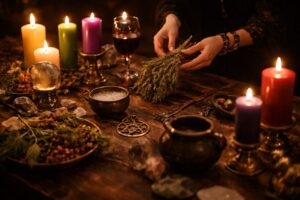
Sabbats operate not only as religious observances, but as powerful psychological and embodied markers. Repetition teaches the nervous system that certain times of year carry specific meanings, moods, and forms of attention.
The physical setup of ritual space — including altar placement, lighting, color, scent, and sound — helps signal the transition into sacred time. This is why practical preparation matters, even when symbolism is well understood: it supports attention, deepens presence, and makes meaning tangible.
You can explore this intersection of ritual and inner experience further through Embrace the Magic, Psychology, and our foundational guide to Altar Setup Basics.
Ritual does not only speak to belief — it speaks directly to the body.
Wicca, Paganism, and the Modern Wheel
The Wheel of the Year is most strongly associated with Wicca, where it was systematized as a central ritual calendar. However, its influence has spread widely across modern Pagan, polytheist, and earth-centered traditions.
Today, many practitioners who do not identify as Wiccan still use the Wheel as a shared symbolic and seasonal language. At MCC, Wicca is honored as an important source tradition, while remaining open to broader Pagan expressions and local variations.
Learn more about these relationships through Wicca and Paganism.
Why Humans Mark Sacred Time
Across cultures, humans mark sacred time because unbroken time erodes meaning. Sabbats provide structured pauses where reflection, gratitude, grief, renewal, and mythic memory can be consciously held.
These pauses allow people to remember who they are in relation to land, community, ancestors, deities, and the unseen. In this way, sabbats become more than seasonal checkpoints — they become ethical and emotional rhythms: times to release, times to gather, times to seed, and times to rest.
Sacred time is not an escape from life. It is how life is given shape.
Traditions, Lineages, and Living Practice
No two covens, households, or practitioners observe sabbats in exactly the same way. Traditions shape practice, but lived experience continues to refine it. Even within a single path, people adapt the sabbats to land, region, community needs, and spiritual relationship.
At MCC, we recognize sabbats as part of a broader web of witchcraft traditions, each with distinct emphases, mythic frameworks, and ritual styles. Diversity is not a problem to be solved — it is often the sign of a living spiritual ecosystem.
Explore this diversity through Witchcraft Traditions.
Living traditions endure because they are practiced, questioned, and renewed.
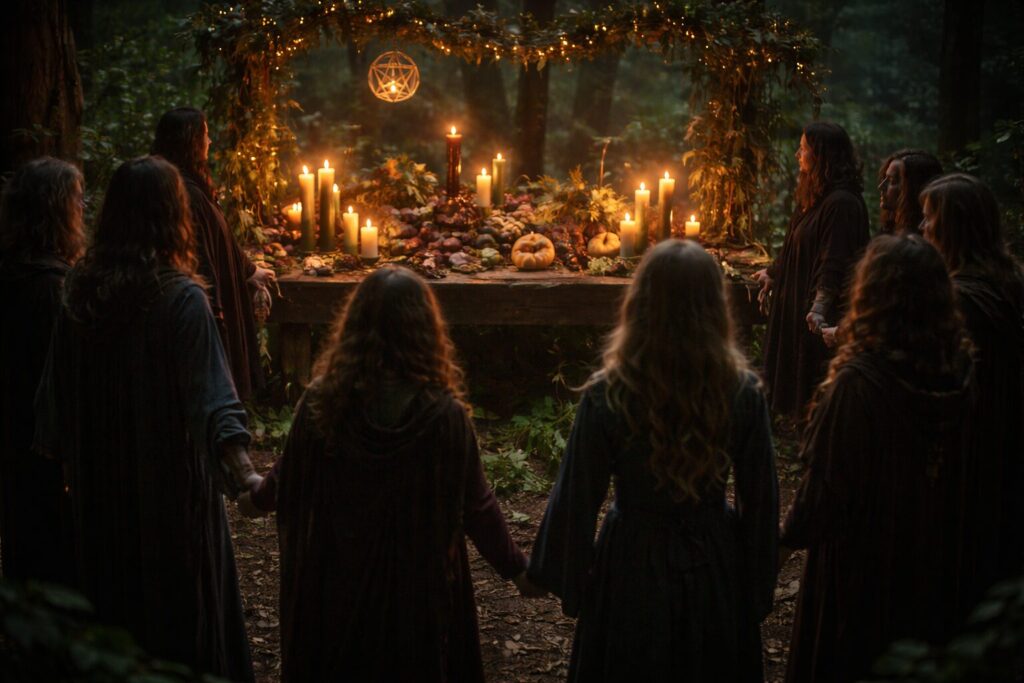
To understand the sabbat is to understand how human beings shape time into something meaningful.
Sabbats are not only dates on a calendar. They are shared acts of remembrance and renewal. Through them, communities step out of ordinary rhythm and into sacred rhythm — where story, season, body, and spirit are consciously brought into alignment. Each sabbat becomes a moment when time itself is treated as holy.
What makes sabbats endure is not their perfection, but their repetition. Each turning of the year layers memory upon memory: past gatherings, past emotions, past intentions, past losses and hopes. Over time, the sabbat becomes a vessel that carries far more than symbolism. It carries continuity. It carries relationship. It carries the accumulated weight of attention.
In this way, sabbats are not static traditions. They are living structures. They change as people change. They shift with land, culture, and spiritual understanding. Yet they remain recognizable because they continue to perform the same essential work: marking thresholds, teaching cycles, and reminding practitioners that time itself is something we enter, shape, and honor.
To observe a sabbat is to say that time matters.
To prepare for it is to say that presence matters.
To gather for it is to say that community matters.
In the turning of the year, sabbats teach us how to step into sacred time — not alone, but together — and how to carry that awareness back into the ordinary days that follow.