Ceremonial & High Magic
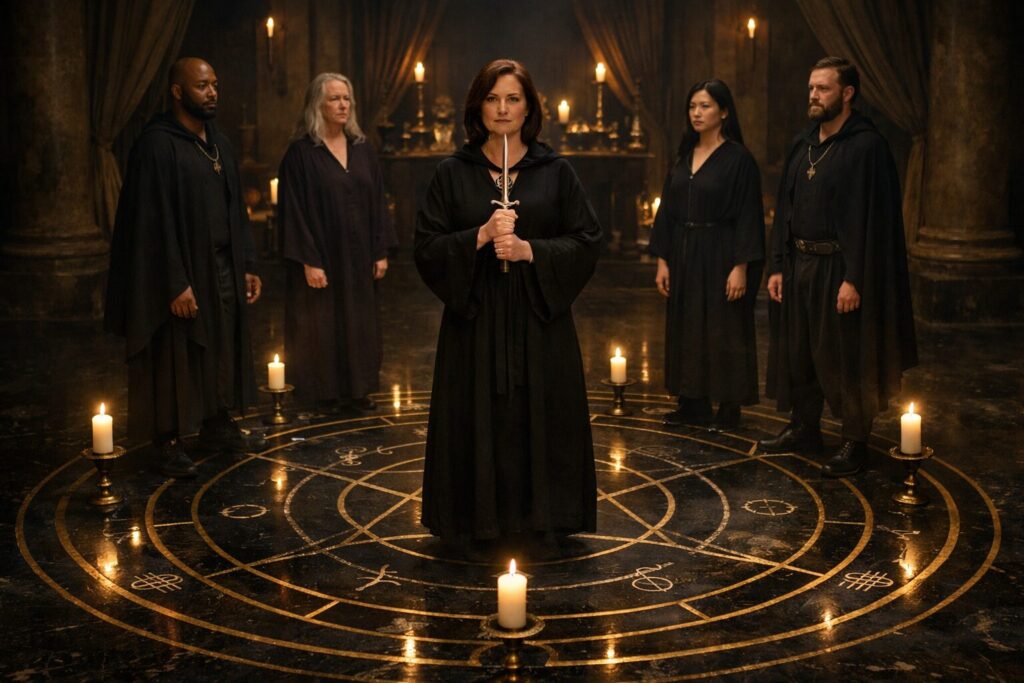
Ceremonial (or “high”) magic is ritual done with deliberate architecture. Every gesture, word, symbol, and timing choice is selected to align the practitioner’s will with larger patterns—elemental structure, planetary rhythm, and the deep grammar of spirit and myth. It isn’t “more real” than folk craft; it’s simply a different engine: slower to build, louder when it turns, and far less forgiving of vagueness.
In MCC terms, ceremonial magic is the point where Ritual Practice Basics becomes a temple craft. The circle is no longer just “protected space,” but a cosmogram: a designed micro-universe where your Personal Power & Will can interface cleanly with Divine / Spiritual Alliance, with Elements acting as the structural language that makes the contact intelligible.
Historically, this current runs through Hermeticism, Renaissance grimoire traditions, and the modern revival streams shaped by groups like the Hermetic Order of the Golden Dawn (including figures such as Samuel Liddell MacGregor Mathers and William Wynn Westcott). It also intersects with Thelema through Aleister Crowley, whose influence—whatever one thinks of him personally—helped push ceremonial technique, initiatory framing, and ritual innovation into the modern occult bloodstream.

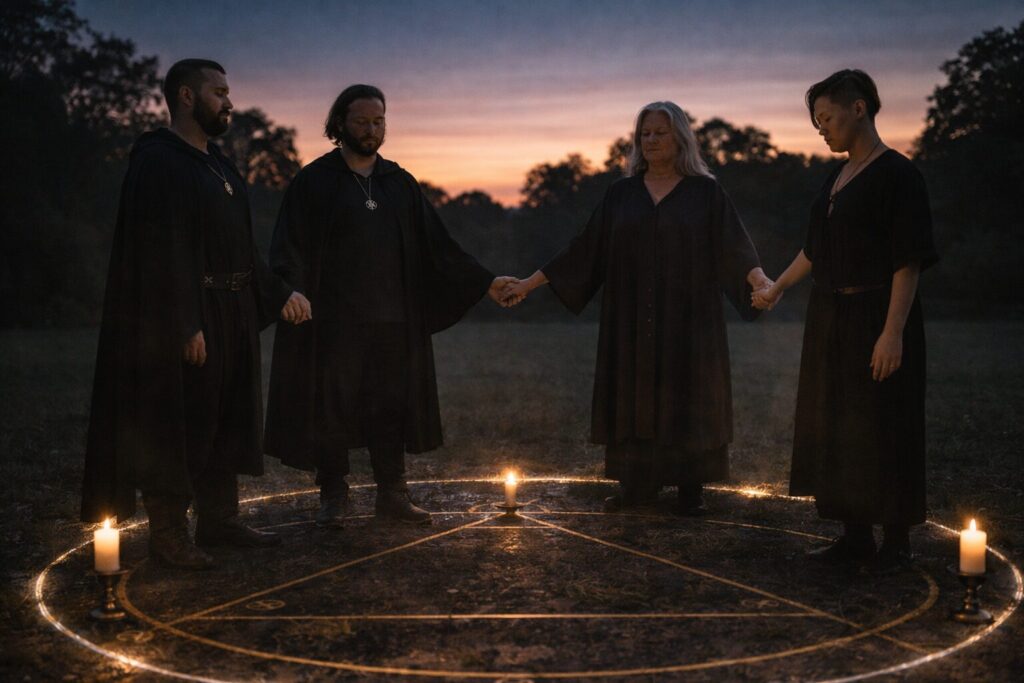
But here’s the part many witches miss: Wicca already carries a ceremonial skeleton. While witchcraft as a folk and magical practice does not descend from ceremonial magic, the modern formation of Wicca emerged in an era deeply influenced by Hermetic and ceremonial revival currents. In that synthesis, elements of ritual structure, symbolic coherence, and formalized circle-craft were braided together with older witchcraft streams—after which Wicca itself became one of the primary shaping forces of contemporary paganism and modern witchcraft more broadly. Circle-craft is not merely “setting a vibe.” It’s a working liturgy—a patterned sequence that changes what the space is and what the participants become inside it. When a coven casts a circle, calls quarters, raises power, speaks charge or oath, and closes with formal release, that is temple logic. It is ritual order—repeatable, transmissible, and designed to hold force without spilling it.
If you trace the modern shape of Wiccan rite, you can see how ceremonial and witchcraft braided together in the 20th century—through Gerald Gardner and Doreen Valiente, alongside adjacent occult currents circulating in the same era. The result is not “witchcraft plus fancy words.” It’s a functional ritual technology: the circle as boundary, the quarters as intelligences of place and element, the altar as axis, the spoken rite as ignition, the raised power as fuel, the blessing as distribution, and the closing as containment and cleanup.
In practice, ceremonial magic tends to intensify three things: structure, timing, and precision. Temporal / Cyclical Power matters more; the choice of hour, lunar condition, and planetary tone becomes part of the spell’s anatomy. Symbol-work becomes less decorative and more operational, especially when you understand how Symbolic / Archetypal Currents behave like living channels rather than static “meanings.” Consecration becomes an actual transformation of tools and space (see Tool Basics), not a quick blessing done on the side.

Ceremonial work also clarifies a set of distinctions that matter for safety and results: Invocation (drawing a power into oneself or the circle) versus Evocation (calling a presence to appear as other within defined boundaries), and the broader family of Summoning / Conjuration techniques that require containment, clear authority, and clean closure. In witchcraft language, this is the difference between being filled with a current and hosting a meeting with it.
Because of that, MCC treats ceremonial magic as both potent and responsibility-heavy. We don’t frame it with fear—but we do insist on standards. “Clearing” is the practical, witch-friendly term for removing clutter and restoring baseline; “banishing” is the more formal ceremonial term for forcing a boundary and commanding what does not belong to depart. Both are valid; the difference is tone, target, and authority—and in high magic, your authority must be explicit, not implied.
Within the Coven of the Veiled Moon, ceremonial workings are rare but significant. We use them when the work needs more than intention—when it needs a vessel: initiations, seasonal rites, coven-wide protections, and transformations that ripple across more than one life. When many practitioners perform the same rite in disciplined synchrony, the circle becomes a shared temple even across distance—an engineered field held by structure, timing, and oath-grade focus.
The Architecture of High Magic
Ceremonial work is not defined by costumes or complexity, but by architecture: a deliberate ritual design that makes power intelligible, containable, and repeatable. It is the craft of building a living temple—through timing, symbolism, consecration, and precise speech—so that enchantment and spirit-contact happen inside a structure that can actually hold what it invites.
Cosmic Alignment
The temple is built as a microcosm of the macrocosm: a patterned space where your will can meet larger orders cleanly. This logic is central to Hermeticism.
Temple Logic in Witchcraft
A well-cast circle is already liturgy: sequence, boundary, invocation, and closure. In this sense, coven rite becomes temple-craft—an advanced expression of Ritual Practice Basics, not a different religion from it.
Timing as Anatomy
In ceremonial work, timing is not decoration—it’s part of the spell’s body. Planetary tone, lunar condition, and threshold hours shape what arrives and how it moves. See Temporal / Cyclical Power.
Consecration Changes the Tool
Tools aren’t merely symbolic; they’re trained vessels. Consecration is a state-change performed through elemental language and disciplined repetition: Tool Basics and Elements.
Symbols as Living Channels
Names, seals, and archetypes behave like pathways, not just “meanings.” The more coherent the symbolic system, the more coherent the power-flow. See Symbolic / Archetypal Currents.
Invocation, Evocation, Containment
High magic distinguishes between drawing power inward and calling presence as other— and it treats boundaries as sacred engineering: Invocation, Evocation, and Summoning / Conjuration.
Enchantment Amplified
Much of ceremonial work is enchantment—charging, sealing, and releasing—surrounded by a temple-grade structure that increases clarity and reduces spillover. See Enchantment.
Clearing and Banishing
“Clearing” restores baseline and removes clutter; “banishing” asserts authority and commands what does not belong to depart. Both are valid; the difference is tone, target, and force— and ceremonial practice insists you name which you are doing.
Ritual Method
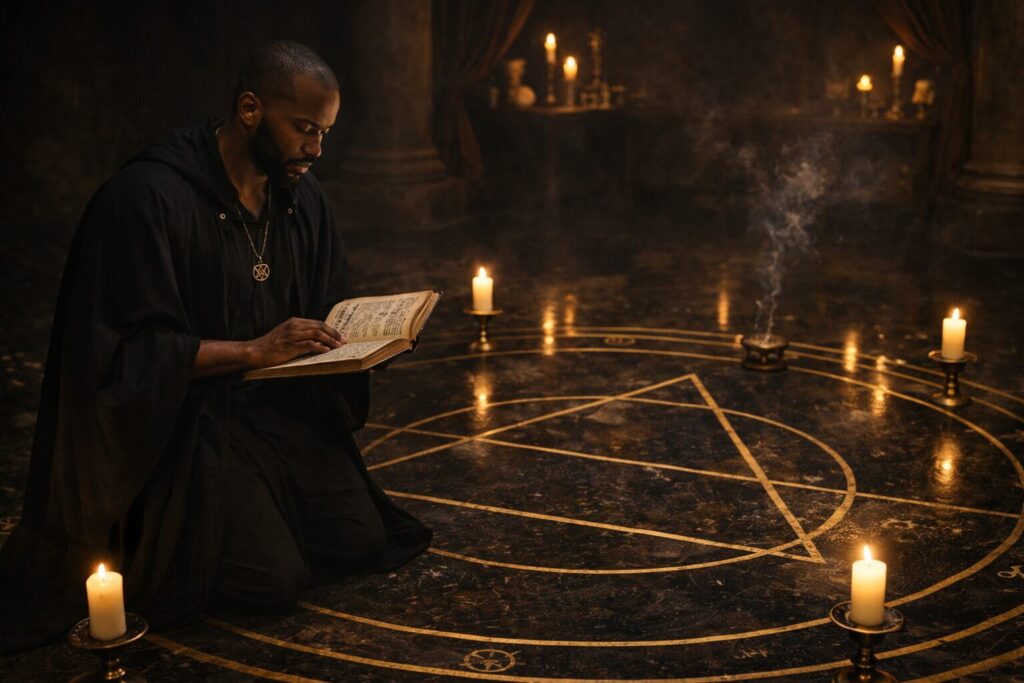
Ceremonial work rewards disciplined sequence. The goal is not to become rigid, but to become coherent—so that enchantment, spirit-contact, and transformation happen inside a structure that holds what it calls. The sections below assume you already have solid circle-craft; we’re refining it into temple-grade practice.
Temple Preparation: Clearing and Banishing
In witchcraft language, clearing removes clutter—psychic residue, emotional static, the “noise” a room collects. In ceremonial language, banishing asserts authority—drawing a boundary and commanding what does not belong to depart. They overlap, but they are not identical: clearing is restorative; banishing is directive.
The advanced move is to decide which you need before the rite begins, and to treat preparation as part of the spell itself. A temple is not merely clean; it is tuned. If you are working with spirit contact, especially Evocation or Summoning / Conjuration, you don’t “wing” the boundary—you engineer it.
Key Moves
- Decide: restorative clearing, directive banishing, or both (in that order).
- Define the boundary out loud: what belongs, what does not, and who has authority.
- Seal the room: doors, thresholds, mirrors/screens, and the circle edge.
- Confirm baseline: breath, posture, and mental clarity before the first invocation.
Circle as Liturgy: Quarters, Direction, and Temple Order
Here is the bridge where witches often underestimate themselves: a well-cast Wiccan circle is already ceremonial structure. It is a repeatable sequence that changes the ontology of the space—turning a room into a ritual microcosm. The quarters are not “vibes”; they are invoked intelligences of element and direction, often aligned to a cosmology you have agreed to enact.
In ceremonial terms, the circle is temple logic: boundary, axis, and order. In MCC practice, we treat the circle like a working liturgy—an enacted pattern that makes other operations safer and clearer, whether you are performing Invocation, Enchantment, or petitionary rite within Divine / Spiritual Alliance.
Key Moves
- Cast the circle as a cosmogram: boundary + center + directional order.
- Call quarters as roles in a rite, not decorations in a room.
- Use consistent language across workings so the temple “learns” the pattern.
- Close formally: release what was called, then unwind the boundary on purpose.
Timing as a Structural Ingredient
Ceremonial magic treats timing as part of the spell’s anatomy. The hour is not simply a convenient moment; it is a tonal field you step into. Lunar phase, planetary day, and threshold times do not “guarantee results,” but they can reduce friction and increase coherence—especially when you’re doing operations that require steadiness, clarity, or containment.
If you already work seasonally, you’re already doing this. Ceremonial practice simply extends the logic: choose a moment whose nature agrees with your intent, and let Temporal / Cyclical Power become part of the ritual’s scaffolding.
Key Moves
- Name the “tone” you’re borrowing (expansion, binding, revelation, purification, etc.).
- Choose timing that supports the tone rather than fighting it.
- Build timing into the rite: opening at the chosen moment, closing with intention.
- Record outcomes over months; let the data train your intuition.
Tools and Consecration: Training the Vessels
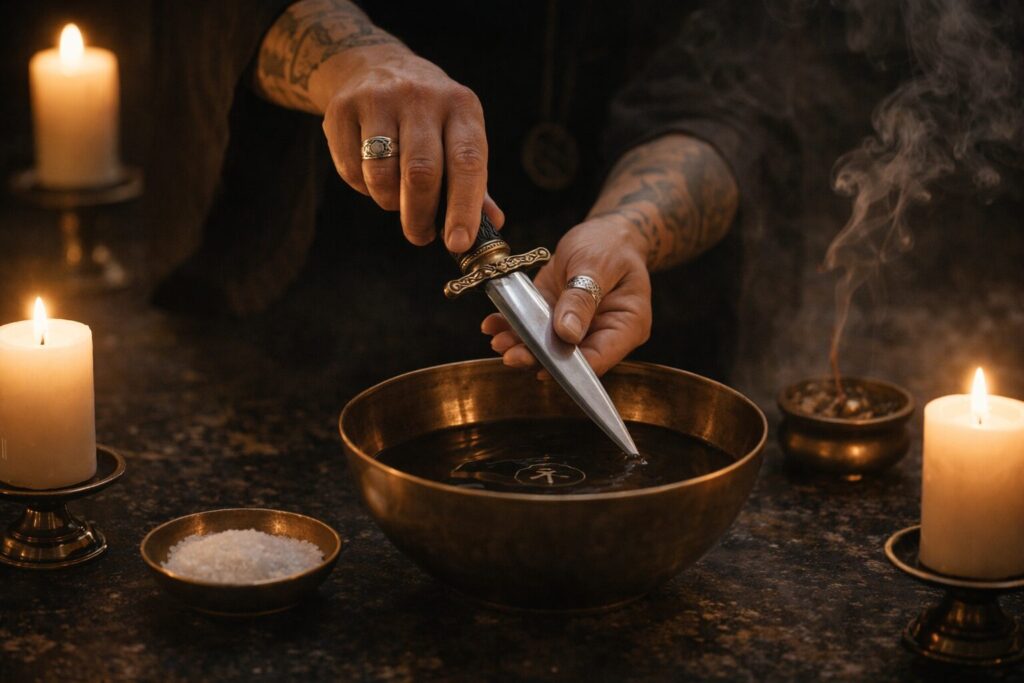
In ceremonial work, tools are not just symbolic props; they are trained vessels. A blade, wand, cup, or pentacle becomes reliable when it is consistently used within an agreed ritual architecture—cleared, consecrated, and handled with the same inner posture each time. This is not superstition; it’s conditioning and coherence.
When consecration is done with elemental intelligence, it becomes a true state-change. See Tool Basics, Elements, and the inner refinement logic of Alchemy.
Key Moves
- Dedicate: define purpose, limits, and what the tool is for (and not for).
- Consecrate elementally: smoke/salt/water/flame (as appropriate) with spoken intention.
- Use consistently: repeated use inside a ritual pattern “trains” the object.
- Store respectfully: containment is part of consecration, not an afterthought.
Invocation and Evocation: Presence, Authority, and Containment
The difference between calling a current into the self and calling a presence to appear as other is not just semantic—it changes the entire safety profile of the rite. In Invocation, the circle becomes a vessel for embodiment; in Evocation, the circle becomes a boundary of governance.
Ceremonial practice insists on explicit authority: clear names, defined limits, and a closure that releases what was called. This is one reason classic grimoires are so procedural. Even when adapted, the principle remains: boundaries must be designed, not merely hoped for.
Key Moves
- State the mode: invocation (inward) or evocation (other) before you begin.
- Define containment: circle edge, triangle/seat, altar boundary, and agreed rules.
- Use a formal release: gratitude, dismissal, and confirmation of departure.
- Do aftercare: grounding, cleansing, and a reality check before journaling.
Enchantment: Charging, Sealing, and Release
Much of ceremonial magic is advanced enchantment: charging an object, a sigil, a candle alignment, or a vow within temple-grade conditions. The “high” part is not that you enchant, but that you do it in a tuned ritual field where timing, symbolism, and consecration cooperate rather than compete.
When enchantment is sealed properly, it becomes quieter and more reliable—less like a flare and more like a long-burning lamp. For the broader enchantment frame, see Enchantment.
Key Moves
- Clarify the intent statement until it can be spoken without wobble.
- Charge with one dominant method (breath, trance, chant, heat, or focused visualization).
- Seal: spoken closure + physical closure (wrap, bind, store, extinguish, bury, carry).
- Release and return: unwind the rite, ground the body, then let the spell work.
Ritual Kit & Readiness
Ceremonial work doesn’t require expensive objects—it requires standards. A small set of tools, trained through consistent use, is more powerful than a crowded altar. What matters most is readiness: clarity of intent, stable boundaries, and a closure plan that returns you cleanly to ordinary life.
Core Foundations
If you can cast clean space, call a coherent circle, and close a rite without drift, you already have the bones. These pages form the working base:
- Ritual Practice Basics
- Elements
- Tool Basics
- Personal Power & Will
- Divine / Spiritual Alliance
- Enchantment
Advanced Study Streams
For practitioners who want the deeper architecture—timing, symbolic channels, and initiatory framing:
Readiness Checklist
Use this as a sober “pre-flight.” Ceremonial magic is safest when your boundaries and intent are explicit.
-
Intent is speakable You can state the goal in one breath without wobble or hidden contradictions.
-
Mode is chosen You know whether this is Invocation (inward), Evocation (other), or something closer to Summoning / Conjuration.
-
Boundaries are engineered You’ve decided: clearing, banishing, or both—and you’ve defined what belongs and what does not.
-
Timing supports the work You’re not fighting the hour. Even a “good enough” alignment reduces friction.
-
Offerings and closure are planned You know what you’ll give, how you’ll dismiss, and how you’ll return to baseline.
-
Aftercare is real You have water/food, grounding, journaling time, and no immediate “high-stakes” obligations after the rite.
This is what we mean by “advanced”: not secrecy, but standards—so power moves cleanly, and you remain sovereign before, during, and after the work.
Lineage & Temple Ethics
Ceremonial magic is best understood as a family of ritual technologies—methods for building coherent space, directing power through symbol and timing, and closing the work cleanly. This section is intentionally scholarly-descriptive: it sketches how modern witchcraft (including Wicca) intersects with older Hermetic and grimoire traditions, and it frames the ethical standards that make high work safer and more sovereign.
Wicca’s Ceremonial Skeleton: Circle-Craft as Liturgy, Coven Rite as Temple
It is easy to talk about “ceremonial magic” as if it were separate from witchcraft, but modern Wicca is one of the clearest examples of ceremonial structure living inside a witchcraft frame. The core Wiccan rite—casting the circle, calling quarters, working the raised power, blessing/charging, and formally closing—is not merely a sequence of customs. It functions like liturgy: a patterned, repeatable ritual order that transforms a normal room into a deliberately constructed cosmos.
In practical terms, circle-craft does four ceremonial jobs at once:
- Boundary (Temple Wall): the circle marks what belongs to the rite and what does not.
- Orientation (Cosmic Map): quarters establish directional order; element becomes the grammar of the space.
- Axis (Altar as Center): the working focus gathers; offerings, oaths, and charges take place at a ritual “heart.”
- Closure (Unwinding & Return): what is called is released; the space returns to ordinary life without residue.
This is why advanced Wiccan work so often feels “temple-grade” even without grimoire language. A coven rite, performed consistently over time, trains the space and the practitioners: the sequence becomes a reliable channel. When Wiccan ritual is done well, it already exhibits the key ceremonial virtues—clarity, containment, repeatability, and clean closure—especially when it is grounded in Ritual Practice Basics and guided by About Our Ethics.
Why this matters
Recognizing Wicca’s ceremonial skeleton is not about “making Wicca more ceremonial.” It’s about naming what is already present: temple logic. Once named, it can be refined—through better containment, cleaner timing, stronger consecration, and clearer distinctions between Invocation, Evocation, and Summoning / Conjuration.
Hermetic and Grimoire Currents: The Older Architecture Behind the Modern Form
The ritual architecture that later becomes “high magic” did not appear fully formed in the nineteenth century. It draws from a long conversation: the Hermetic principle of correspondence (microcosm and macrocosm), the ritual use of divine names and symbolic seals, and the grimoire tradition’s emphasis on clear procedure, authority, and closure. These streams are part of why ceremonial work leans into Hermeticism, structured elemental language (Elements), and timing (Temporal / Cyclical Power).
When witches describe “a circle that holds,” they are pointing to the same underlying concern as the older texts: how do you create a boundary that is stable, intelligible to the powers you address, and capable of being opened and closed without leaving loose ends? In MCC terms, this is simply ritual engineering applied with spiritual literacy.
Golden Dawn: Ritual Codification and the Modern Occult Template
The Hermetic Order of the Golden Dawn is often discussed because it helped codify a modern ceremonial template: standardized rituals, graded instruction, deliberate symbolism, and repeated training practices. Key early figures include William Wynn Westcott, S. L. MacGregor Mathers, and William Robert Woodman. Later interpreters and popularizers—such as A. E. Waite and Israel Regardie—helped circulate ceremonial techniques into broader occult culture.
This mattered for witches because it normalized a way of thinking: ritual as a coherent system rather than a collection of isolated tricks. Even when one does not borrow Golden Dawn rituals directly, the broader cultural effect is visible—more explicit consecration, more formalized openings/closings, and a stronger emphasis on symbolic consistency (see Symbolic / Archetypal Currents).
Scholarly note
“Influence” here does not require direct lineage. Ideas travel through books, groups, friendships, and shared cultural atmospheres; modern ritual practice often reflects a braided history rather than a single line.
Thelema: Modern Ritual Innovation and the Question of Authority
Thelema, associated above all with Aleister Crowley, represents a major modern stream of ritual innovation. Whatever one thinks of Crowley as a person, his work accelerated a set of concerns that remain relevant: explicit statements of intent, the relationship between will and ritual form, and the problem of authority—what it means to speak in a rite as an officiant rather than as a casual petitioner.
For witches, the practical takeaway is not “become Thelemic,” but learn the underlying lesson: a strong ritual voice is a safeguard. When the words of a rite are precise, the circle is coherent, and closure is deliberate, the practitioner is less likely to drift into ambiguity—especially in operations involving direct presence-work (invocation/evocation) or strong enchantment.
Wicca and Modern Witchcraft: How the Currents Interweave
Modern witchcraft is not a single stream; it is a confluence. In the case of Wicca, influential figures such as Gerald Gardner and Doreen Valiente helped shape a ritual form that is recognizably witchcraft and also structurally ceremonial. The result is a practice capable of devotional rite, seasonal liturgy, and operative magic without requiring a lodge identity.
In MCC terms, this is why ceremonial/high magic can be presented as a mode of craft rather than a separate religion: it is a way of increasing clarity and containment so that Enchantment, spirit-contact, and transformation happen inside a stable ritual vessel. It pairs naturally with Personal Power & Will and can be integrated thoughtfully with Divine / Spiritual Alliance.
Temple Ethics: Consent, Containment, and Responsible Power
In high magic, ethics are not an “extra.” They are part of the containment system. The more force a rite can move, the more it requires clarity about consent, scope, and responsibility. That’s why MCC anchors ceremonial practice in our stated framework: About Our Ethics.
At minimum, temple ethics means:
- Clear scope: name what the rite is for, and what it is not for.
- Consent and transparency: if others are affected, the ethical burden increases.
- Non-escalation: do not “upgrade” a working into spirit-contact casually or impulsively.
- Closure and aftercare: clean endings, grounding, and a return to baseline are part of responsibility.
- Humility before force: discipline replaces spectacle; results matter more than performance.
A practical standard
If you can’t state your intent, your boundaries, and your closure plan in plain language, the work isn’t ready. “Advanced” is not secrecy—it is coherence.
MCC Closing Protocol
In the Coven of the Veiled Moon, ceremonial workings are used sparingly and deliberately. We treat “high magic” as a mode of practice: a way of increasing clarity, containment, and coherence so that the work remains sovereign from start to finish. Our standards are not about gatekeeping; they are about ethical power—what we can responsibly hold, direct, and release.
When We Use It
For initiations, seasonal rites, coven-wide protections, and transformations with long reach—especially when timing, structure, and collective focus matter as much as intention. These rites often integrate Enchantment with formal boundary-work and deliberate closure.
How We Prepare
Preparation is part of the operation: clearing and/or banishing, tool readiness, timing choice, rehearsed wording, and an explicit statement of mode (see Invocation and Evocation). We do not escalate into presence-work on impulse.
How We Contain
Containment is engineered: circle integrity, directional order, and clearly named boundaries. If spirits are addressed directly, containment rules are spoken in the rite and upheld in practice. Anything called is addressed with clarity, respect, and firm limits.
How We Close
We close formally: thanksgiving, license to depart, release of quarters/forces, unwinding the circle, and a return to baseline through grounding. If a rite cannot be closed cleanly, it was not ready to open.
Minimum Standards (Sober and Simple)
- Intent: speakable in one breath, with defined scope.
- Boundaries: clearing/banishing chosen intentionally, not “just in case.”
- Mode: invocation vs evocation vs conjuration is decided and named.
- Ethics: aligned to About Our Ethics—consent, restraint, responsibility.
- Closure: planned, performed, and followed by aftercare.

Ceremonial magic is not a performance of complexity; it is a discipline of coherence. At its best, it does not inflate the ego or obscure the will in ornament. It clarifies. It asks the practitioner to speak precisely, to move deliberately, and to build a structure capable of holding what is called. The temple is not a theatrical space—it is a designed environment where intention, timing, and symbol cooperate rather than collide.
For witches, this is not a departure from the craft but a refinement of it. The circle you cast can become a cosmogram. The quarters you call can become intelligences engaged with respect and boundary. The enchantment you charge can burn longer and steadier when supported by clear timing and formal closure. High magic, in this sense, is not separate from witchcraft—it is witchcraft practiced with architectural awareness.
Yet architecture requires responsibility. The stronger the container, the more force it can hold. That is why ceremonial practice insists on ethics, clarity, and clean endings. Power without containment disperses; containment without humility hardens. The balance is discipline joined to reverence—knowing when to act, how to close, and when to leave the temple door shut.
Within the Coven of the Veiled Moon, ceremonial workings are approached neither with fear nor with casual enthusiasm. They are undertaken when structure is required, when the work calls for precision, and when the participants are prepared to hold their part of the pattern. High magic, then, is not about height in a hierarchy. It is about depth in attention. When performed with integrity, it becomes what it was always meant to be: a quiet, ordered conversation between the human will and the wider architecture of the cosmos.