Ancestral Veneration
Ancestral veneration is the practice of honoring those who came before—blood relatives, chosen forebears, and the beloved dead whose lives helped shape the world you now inhabit. It begins with a quiet premise shared across many cultures: the dead do not become nothing. Even when we do not imagine them as “spirits” in a literal sense, they remain present through memory, inheritance, story, and the subtle gravity of love and consequence that continues after a life ends.
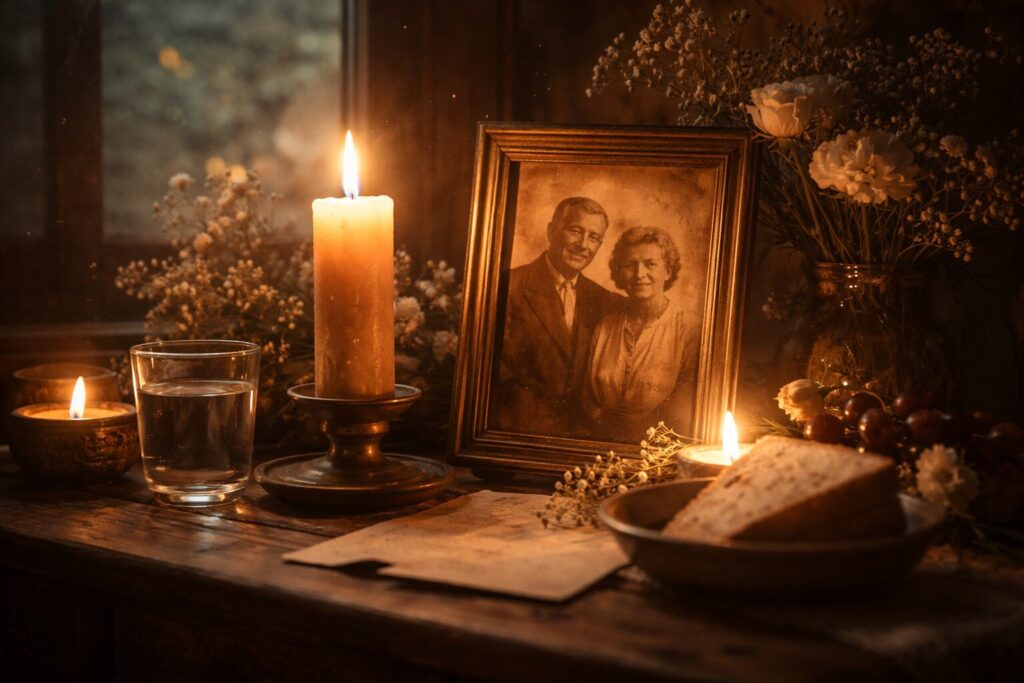
In magic, ancestral veneration becomes a living bridge between worlds. A candle, a cup of water, a photograph, a small offering—these are not props so much as language. They say: you are remembered; you are welcome in peace; you are not forgotten. Sometimes what returns is simple: steadier intuition, a softened grief, a sense of protection or perspective. Sometimes it is sharper: a dream that arrives like a message, a sudden clarity in divination, an internal “yes” that feels older than your own life.
This is also why the work deserves discernment. Veneration is not the same thing as mediumship, and it is not the same thing as evocation. The aim here is relationship and reverence—not to compel contact, chase phenomena, or turn remembrance into summoning. The line between honoring and calling can be thin, especially for sensitive practitioners, which is why this page emphasizes gentle structure: how to honor well, how to set boundaries, and how to keep the dead in their dignity and the living in their stability.
Within the Coven of the Veiled Moon, ancestral veneration is respected but not required. Some practitioners feel deep ancestral bonds and tend them faithfully; others let their forebears rest, turning instead toward chosen family, guiding spirits, or the gods. We hold ancestral work as an individual path—one that can be profoundly healing and spiritually meaningful—so long as it is approached with clarity, ethical boundaries, and the simple skill of knowing how to open a threshold and how to close it again.
Ancestral work exists on a spectrum. Knowing where you are standing on that spectrum is what keeps the practice reverent instead of reckless.
Veneration
Relationship without compulsion. You tend memory, offer gratitude, and create a place of welcome. Presence may be felt, but the dead are not commanded or forced into speech. This is remembrance as practice.
The focus is honor, continuity, and healing.
Mediumship
Direct communication becomes the goal. Messages, impressions, and voices are interpreted and transmitted. This is a skilled discipline with psychological and spiritual demands beyond simple veneration.
Evocation
A spirit is intentionally called into a defined space. Even when performed respectfully, evocation is an act of summoning, not remembrance. It requires formal structure and firm boundaries.
Core Practice: A Living Bridge how-to + foundations
Ancestral veneration works because it is consistent. Not dramatic. Not forced. A small, repeated act becomes a stable meeting point: you return, you remember, you offer, and you release. Over time, the relationship gains clarity—through quiet intuition, steady dreams, and a deepening sense of continuity that anchors your magic.
Set up a simple ancestor space (minimal + effective)
- One anchor: a photo, name card, heirloom, or a small stone for “the beloved dead.”
- One light: a candle (or LED candle if needed).
- One vessel of water: refreshed regularly (water = welcome + clarity).
- One offering dish: for bread, fruit, tea, milk, wine, honey—whatever fits your ethics and home.
You do not need a complicated altar. You need a place that is respectful, steady, and yours.
The 5–7 minute tending (beginner-friendly)
- Ground: feet on the floor, slow breath, shoulders soften. Name the present moment.
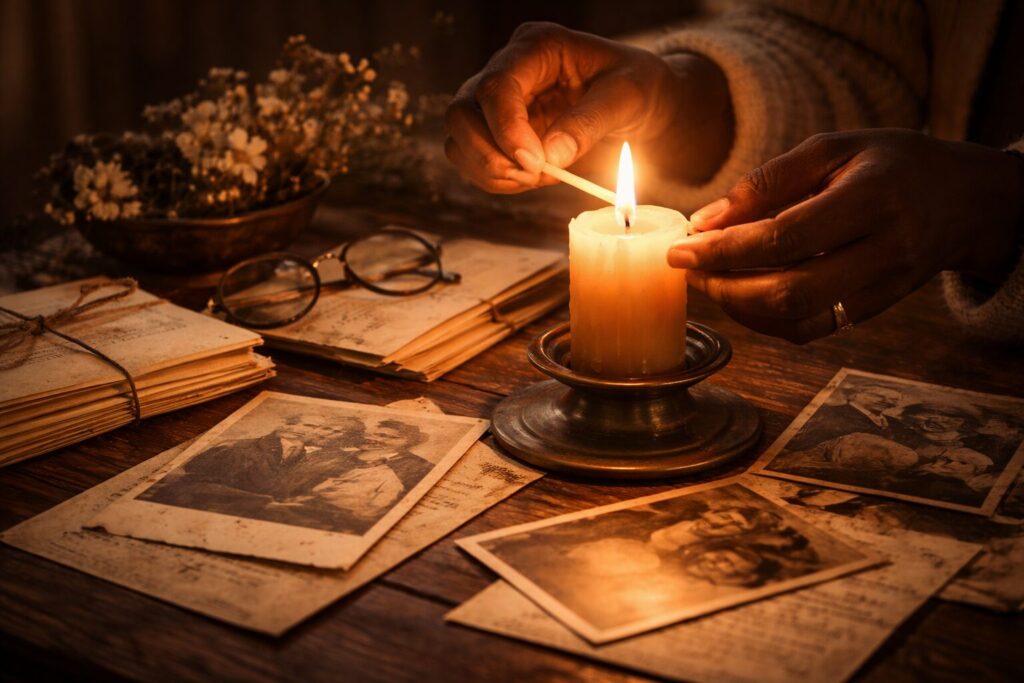
- Light + name: light the candle and speak: “Beloved dead of my blood and spirit, I remember you in peace.”
- Offer: place water or food. Keep it simple. Quality matters more than quantity.
- Speak one truth: a gratitude, a memory, or a request for steady guidance (not spectacle).
- Listen briefly: not “strain for voices,” just notice what settles in—emotion, image, calm, clarity.
- Thank + release: use the closing lines at the bottom of this page (later section) or your own.
- Clean up: remove offerings after a reasonable time. Refresh water. Let the space remain tidy.
Boundaries that keep the work clean
- Invite by category, not by chaos: “beloved and well-intentioned ancestors” is safer than “anyone who wants to come.”
- No obligation to honor harm: if an ancestor was abusive or unsafe, you are not required to open to them.
- Keep it human-sized: if you feel drained, obsessive, fearful, or disrupted for days, pause and cleanse.
- Do not escalate casually: if you want direct messages, that is a move toward mediumship and requires stricter practice.
Offerings are not payment. They are relationship language—a steady way of saying “I remember,” “I honor,” and “I keep the threshold clean.”
| Action | When | Offering | Intention | Notes (boundaries + hygiene) |
|---|---|---|---|---|
| Candle + names | Weekly, or on anniversaries / festivals | Light (candle / LED) + spoken names | Remembrance, continuity, calm presence | Keep it brief and consistent. If emotion spikes hard, pause and return another day. |
| Water refresh | Daily or weekly (your rhythm) | Fresh water in a clean cup | Clarity, welcome, purification | Refresh regularly. Stagnant water = stagnant energy (and also… hygiene). |
| Tea, coffee, milk | When you brew for yourself; grief days; quiet mornings | A small poured portion | Warmth, hospitality, “share the hearth” | Don’t leave dairy out long. Remove offerings within a reasonable time. |
| Bread, fruit, honey | Ancestral dates, seasonal rites, family gatherings | Simple food (small portion) | Gratitude, nourishment, blessing of the line | Offer what you can maintain. Clean removal is part of respect. |
| Incense / smoke prayer | When you need “lift” or release | Incense, smoke cleanse, herbal bundle | Purification, prayer carried upward | Ventilate. Keep it gentle. Smoke is a tool, not a requirement. |
| Grave/threshold libation | Visiting graves; crossroads moments; rites of transition | Water, tea, wine (or ethically aligned substitute) | Honor, release, “I remember you here” | Be discreet and respectful of laws/space. Pour with gratitude, then leave cleanly. |
| Keepsake holding | When you want closeness without contact escalation | Beads, photo, heirloom, letter | Connection through memory and love | This is excellent for beginners. It stays relational without “calling.” |
| One-card / one-rune “check-in” | After offerings, occasionally | A single draw (not an interrogation) | Guidance, perspective, gentle dialogue | Keep it light. If you want sustained messages, study mediumship and practice stronger protocols. |
If you’re unsure what to offer, choose what you can repeat with steadiness. Consistency is more powerful than extravagance.
Deeper Context: Lore, Ethics, and Discernment depth + safety
Across human history, the dead have rarely been treated as irrelevant. Some cultures keep elaborate household shrines; others maintain grave rites; others honor the dead through story, lineage, and communal remembrance. The forms vary, but the underlying logic is consistent: relationship with the dead shapes the living—whether you frame that influence as spiritual presence, ancestral memory, or the long echo of love and consequence.
Three kinds of “ancestors” (and why it matters)
- Ancestors of blood: family lines and inherited stories—whether close or distant, beloved or complicated.
- Ancestors of spirit: chosen forebears—teachers, mentors, initiatory lineages, the “mighty dead” who formed your path.
- Ancestors of place: the remembered dead of the land and community you actually live among—handled with humility and respect, without claiming what is not yours.
Consent and boundaries apply in spirit work
Ancestral veneration can be profoundly healing, but it is not an obligation. No one is required to honor those who caused harm. You may set the terms of your practice with the same clarity you would set in living relationships: access is earned, not automatic.
- Keep invitations specific: “beloved and well-intentioned dead” is safer than “any spirit who wants to come.”
- Choose your circle: you can honor chosen family and spiritual forebears as fully as blood relatives.
- Remember the point: veneration is reverence and continuity, not spectacle and adrenaline.
Discernment: what healthy contact tends to feel like
Healthy ancestral connection usually carries a particular texture: steadiness, dignity, and clarity. It does not demand secrecy, obedience, obsession, or fear. It may stir emotion, but it should not hollow you out or destabilize your daily life.
Veneration vs. calling (where things slip)
The line between honoring and calling becomes thin when the practitioner escalates from “I remember you” into “I need an answer right now.” That shift is where veneration can begin to overlap with practices designed for direct contact.
- If you are attempting sustained two-way messaging, you are moving toward mediumship.
- If you are intentionally calling a presence into a defined space, you are approaching evocation.
- If you want gentle guidance without escalation, keep it to offerings + one-symbol divination: divination as a listening tool, not an interrogation.
In other words: veneration is a candle and a name. Mediumship is a channel. Evocation is a summons. Each has its place—but they are not interchangeable.
Optional further reading (adjacent, not required)
- Spiritualism — historical movements and the cultural shape of spirit contact.
- Ghosts — how “haunting” differs from ancestral relationship.
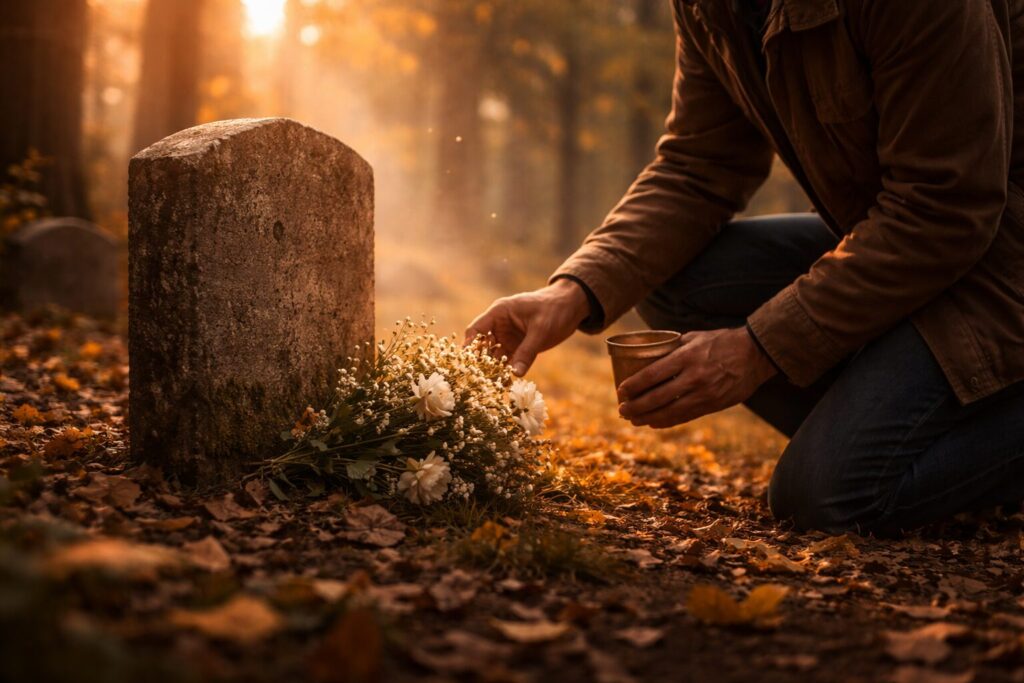
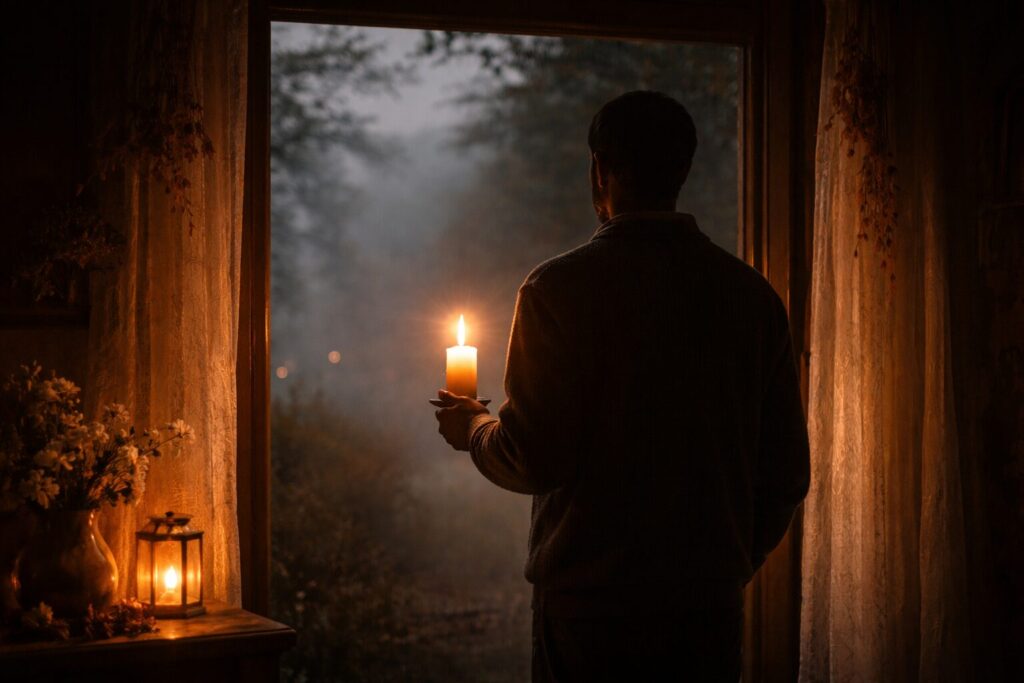
When the tending is complete, do not simply walk away. Closing is what keeps ancestral veneration gentle and sustainable. It tells the psyche and the subtle body that the exchange has ended, that the threshold is returning to ordinary space. A good closing is not dramatic—it is calm, grateful, and final.
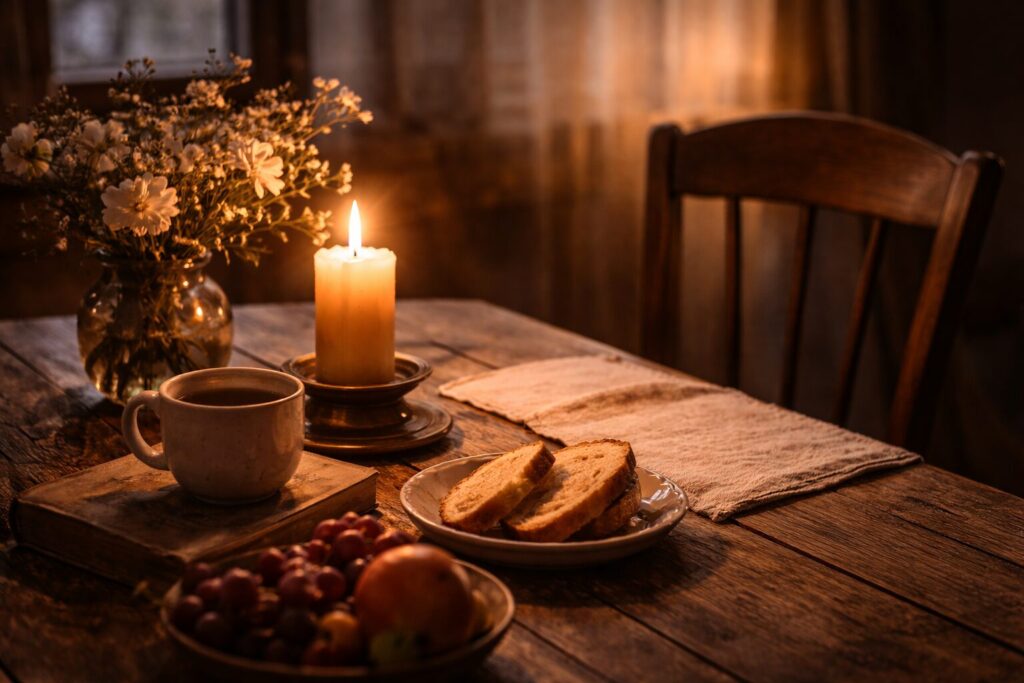
You may use your own words, but a simple structure works well:
Beloved dead, I thank you for your presence and your memory.
Return now to your rest in peace and dignity.
I remain among the living, and this space returns to the living.
Go well, and be remembered with honor.
After speaking, extinguish the candle deliberately. Touch the altar or table with your hand and take one slow breath. Feel the room as it is now—quiet, ordinary, yours again. If you like, wash your hands or rinse the offering cup. This physical gesture reinforces the boundary: the work is complete.
Closing is not rejection. It is respect. Just as we do not keep living guests standing forever at the door, we do not hold the dead in a constant state of invitation. A clean ending protects both sides of the relationship and allows the next meeting to begin fresh, intentional, and welcome.