Tarot Cards
Symbol, Story, and the Art of Seeing
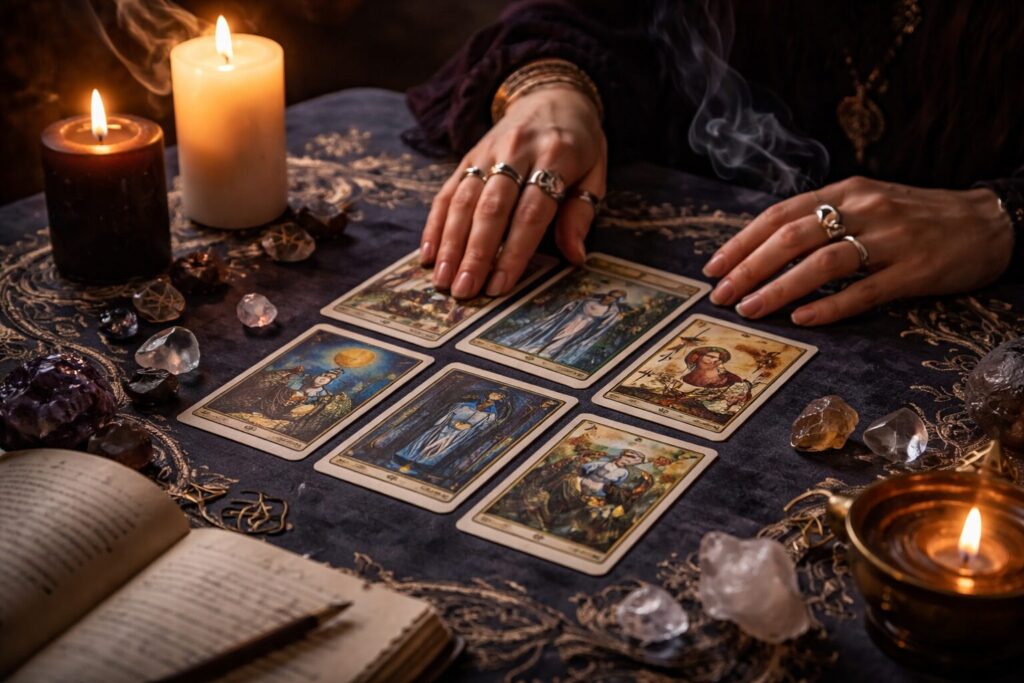
Tarot is a structured symbolic system composed of seventy-eight cards divided into two interlocking bodies: the Major Arcana and the Minor Arcana. Together they form a grammar of experience — a way of describing movement through change, relationship, conflict, growth, loss, and renewal. The Major Arcana traces archetypal stages of transformation: encounters with power, choice, disruption, revelation, and integration. The Minor Arcana grounds these forces in lived reality, expressing how elemental energies — emotion, action, intellect, and material circumstance — play out in daily life.
A tarot deck is not random imagery assembled for decoration. It is a deliberately organized visual philosophy. Each card holds layers of correspondence: number, element, posture, direction, gesture, symbol, color, and narrative placement within the whole. Meaning emerges from the relationship between these layers. A reading is therefore not the extraction of a single fixed definition, but the interpretation of a pattern formed by multiple cards interacting at once.
Practitioners often describe tarot as a bridge between intuition and structure. The deck provides boundaries that prevent interpretation from dissolving into vagueness, while intuition animates the symbols so they speak to the moment at hand. In this sense tarot resembles a language: grammar exists, but fluency grows through practice, not memorization alone. The cards do not dictate a future. They illuminate tendencies, tensions, and possibilities already present in a situation.
Within witchcraft, tarot is valued precisely because it respects agency. The reading does not replace decision-making; it sharpens perception. It allows the practitioner to see forces that might otherwise remain unnamed — emotional currents, repeating patterns, unseen motivations — and to respond consciously rather than react blindly. Tarot does not tell a person what must happen. It shows what is moving.
A Brief History of Tarot
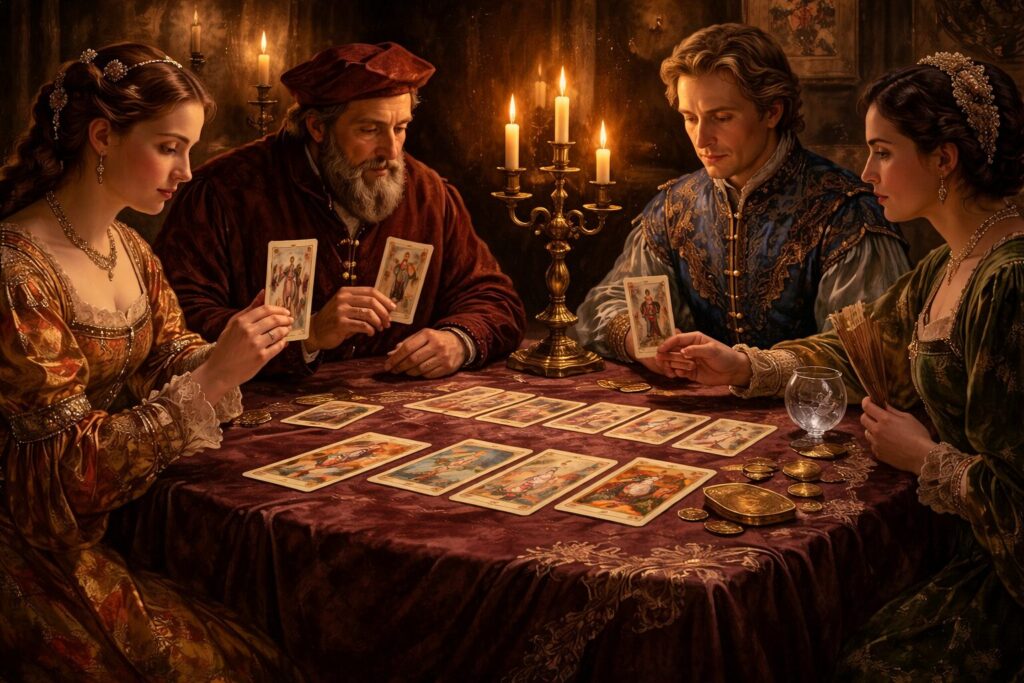
Tarot did not begin as a mystical artifact. Its earliest known form appears in 15th-century northern Italy as a painted card game played among aristocratic families. These early decks — richly illustrated, handmade, and expensive — were cultural objects tied to Renaissance art and courtly symbolism. They were not originally designed for divination. Yet the imagery they carried — allegorical figures, virtues, celestial bodies, scenes of triumph and catastrophe — proved unusually fertile ground for later interpretation.
By the 18th century, European occult thinkers began to read the cards as a hidden symbolic text. Writers such as Etteilla and later Eliphas Lévi reframed tarot as a repository of esoteric knowledge, linking it (often speculatively) to ancient Egypt, Kabbalah, and Hermetic philosophy. While modern historians do not support these origin claims as literal history, their influence is undeniable. These reinterpretations transformed tarot from a social pastime into a spiritual instrument.
The 19th and early 20th centuries solidified tarot’s modern form. The Hermetic Order of the Golden Dawn systematized correspondences between tarot, astrology, alchemy, and ceremonial magic. From this environment emerged the Rider–Waite–Smith deck, illustrated by Pamela Colman Smith under the guidance of Arthur Edward Waite. Its pictorial Minor Arcana made symbolic interpretation accessible to a wider audience and became the template for most modern decks. Shortly after, Aleister Crowley and Lady Frieda Harris produced the Thoth deck, embedding tarot within a dense framework of Thelemic and Hermetic philosophy.
Throughout the 20th century, tarot expanded beyond occult orders into psychology, art, and popular spirituality. Jungian thinkers treated the cards as archetypal mirrors of the psyche. Contemporary practitioners use them for reflection, ritual, counseling, and creative exploration. What began as a Renaissance card game evolved into a symbolic technology that bridges art, mysticism, and introspection. Tarot’s history is therefore not a straight line from antiquity, but a layered conversation between culture, imagination, and belief — a conversation that continues to develop in the present.
Tarot is not a dictionary where each picture has one fixed translation. It behaves more like a language: images act as symbols, symbols combine into phrases, and a spread becomes a sentence about the question. This is why “memorizing meanings” hits a ceiling—because meanings shift with context the way a word shifts in different sentences.
Each card carries multiple “channels” of information at once. Some are obvious (a crown suggests authority; a road suggests movement), while others are quieter but reliable over time: directionality (facing toward or away), number patterns, the balance of sky/earth, contained vs. overflowing containers, weapons vs. tools, stillness vs. motion. When you read well, you’re tracking how these cues cluster and repeat across the layout—what the spread is insisting on.
- Position changes meaning: the same card as “Obstacle” reads differently than as “Advice.”
- Neighbors speak: adjacent cards modify each other like adjectives and verbs.
- Repetition is emphasis: recurring elements (swords, water, towers, moons) are the spread underlining itself.
- Gaps also speak: what’s absent (no Cups, no Majors) can be just as diagnostic as what appears.
Many readers experience tarot as a structured way to externalize what is already active inside the psyche. The cards become a mirror—not because they “make things up,” but because they give the mind a coherent stage on which its concerns can appear in symbolic form. This is similar to how dreams turn emotion into imagery: the images are not literal, but they are not random either.
In this model, tarot is powerful because it bypasses the parts of the mind that prefer tidy narratives. We can rationalize anything; we can excuse anything. But the symbolic mind is less polite. It will show you the overlooked motive, the unspoken fear, the hidden desire for control, the grief you called “fine,” the resentment you disguised as duty. The value is not “prediction.” The value is visibility.
- Projection isn’t a flaw: it’s how meaning surfaces. Your reaction is data.
- Strong emotion is a signal: the card hit a nerve worth investigating.
- Ambivalence is clarity: if two meanings both feel true, you may be holding two conflicting needs.
- “Bad cards” often name boundaries: what must be faced, ended, or restructured.
In a more magical framework, tarot is a ritual interface: a way to translate subtle perception into a legible form. You bring a question, you open attention, and the deck provides images that can hold that attention long enough for intuition to speak clearly. Many readers describe this as “spirit,” “ancestors,” “guides,” “the gods,” or simply “the field.” The vocabulary varies, but the felt experience is similar: the reading becomes a conversation.
This does not have to compete with psychology. In practice, the “spiritual” and the “inner” often braid together. A message can be both a truth you needed to hear and a presence that helped you hear it. What matters is discernment: the ability to distinguish between helpful guidance, fear-based interpretation, and the ego’s hunger for certainty.
- Ritual sets the channel: grounding, cleansing, and intention reduce noise.
- Ethics matter: avoid reading to control others; read to understand choices and consequences.
- Ask better questions: “What do I need to learn?” reads cleaner than “Will they come back?”
- Confirmation is earned: track outcomes over time; let accuracy teach you your own signal.
Tarot often feels “too accurate” because it is usually done at moments of emotional charge: crossroads, uncertainty, longing, decision. In those moments, small details become meaningful—and tarot is a tool built to catch meaning. One way to explain this is synchronicity: the idea that events can align by significance rather than by obvious physical causation. The draw is random in mechanics, but meaningful in pattern.
What tarot gives best is not a rigid prophecy but a picture of tendency: what is ripening, what is resisting, what is likely if nothing changes. Think of it as reading weather, not writing fate. A forecast doesn’t force a storm; it helps you dress for it. Likewise, a spread can show where momentum is building and where a boundary is forming.
- Timing is relational: cards describe readiness, delay, acceleration, and consequence.
- “Outcome” is conditional: change inputs and the output changes.
- Don’t over-read the calendar: tarot is better at phases (“soon,” “after clarity,” “once you commit”) than dates.
- Use follow-up pulls sparingly: repeated asking can turn intuition into anxiety.
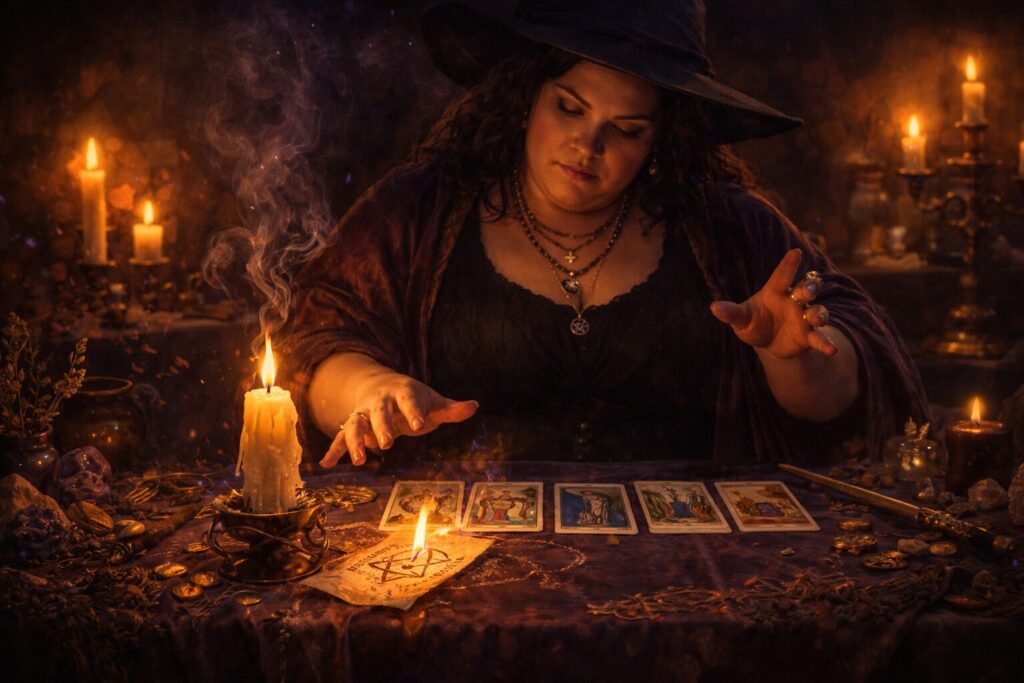
Within witchcraft, tarot is not a separate specialty — it is woven into the rhythm of practice. Many witches treat the deck as a ritual instrument in the same category as candles, herbs, or altar tools: a method of perceiving energetic weather before acting within it. A reading may precede spellwork, mark the opening of a sabbat, clarify intention during a working, or serve as a diagnostic mirror when something feels misaligned. Tarot becomes part of the craft’s decision-making architecture.
One of its most practical functions is timing. Witches often consult tarot to sense whether a situation is stable, volatile, or transitional. This does not replace mundane judgment; it supplements it. A reading can reveal emotional undercurrents, hidden resistance, or supportive momentum that might not yet be obvious. In this way tarot operates as early-warning system and compass combined. It sharpens situational awareness before energy is invested.
Tarot is also deeply compatible with ritual psychology. The cards give symbolic form to forces that ritual attempts to engage: transformation, conflict, healing, desire, grief, initiation. By naming these forces through imagery, the practitioner can approach them deliberately rather than reactively. Many witches use tarot as a tool of shadow work, examining recurring cards or themes as indicators of patterns that require attention. The deck becomes a teacher, not by issuing commands, but by reflecting cycles until they are consciously addressed.
Perhaps most importantly, tarot supports the witchcraft ethic of responsibility. A mature reading does not excuse action or fatalism. Instead, it asks: Given what is moving, how should I respond? The cards illuminate terrain, but the path remains chosen. This is why tarot remains central to modern craft — it reinforces agency while acknowledging that unseen dynamics are always in play.
- Choose art you can emotionally read at a glance.
- Illustrated Minor Arcana accelerate learning dramatically.
- Comfort matters: if the cards fight your hands, you won’t practice.
- Clear the surface. Physical order supports mental order.
- Take three slow breaths before touching the deck.
- Name the question plainly and without drama.
- One card: daily awareness training.
- Three cards: situation / hidden factor / next move.
- Four cards: mind / heart / body / spirit check-in.
- Name visible elements first.
- Connect card to question second.
- Look for repetition across the spread.
- Record the cards and first impressions.
- Write the story the spread is telling.
- Return later and check accuracy.
- Read with consent.
- Avoid fear-based language.
- Do not replace professionals with cards.
- Emphasize agency over fate.
Recommended Further Study
Tarot rewards depth. A beginner can read immediately, but mastery grows through exposure to multiple voices, historical context, and sustained reflection. No single book or website contains the whole system; each offers a lens. The goal of study is not to memorize fixed meanings, but to expand symbolic vocabulary until the cards speak with nuance.
Several modern authors have become enduring reference points for serious practitioners. Rachel Pollack’s Seventy-Eight Degrees of Wisdom remains one of the clearest bridges between symbolism and lived interpretation. Mary K. Greer emphasizes experiential learning and journaling as a path to fluency in Tarot for Your Self. Benebell Wen’s Holistic Tarot is dense but comprehensive, mapping tarot across psychology, ritual, and history. Sallie Nichols situates the deck within archetypal theory in Jung and Tarot, a classic for readers interested in psychological interpretation.
Beyond books, reputable historical archives and tarot study communities can deepen understanding. Essays tracing tarot’s Renaissance origins help correct myths without diminishing the deck’s spiritual role. Comparative tarot archives sharpen symbolic flexibility by showing how imagery evolves across decks. These resources are best treated as libraries rather than authorities: they expand perception, but meaning still arises in practice.
For ongoing study, the most important resource is repetition. Pull cards. Record impressions. Compare outcomes. Tarot literacy grows through cycles of reading and reflection, not passive consumption. The deck becomes articulate when it is engaged consistently.

Tarot endures because it teaches a way of seeing. It does not promise escape from uncertainty; it trains the practitioner to stand inside uncertainty with sharper perception. Each reading is a rehearsal of attention — noticing pattern, naming tension, recognizing possibility. Over time the cards cultivate a habit of awareness that extends beyond the table. Life itself begins to look more legible.
For witches, this is not a minor skill. Craft depends on the ability to read currents before acting, to sense when to advance, when to wait, when to transform. Tarot becomes a discipline of orientation: a reminder that forces are always in motion and that choice matters most when we understand the terrain we are walking through. The deck does not remove responsibility; it clarifies it.
In the end, tarot is less about prediction than participation. It invites the reader into an active relationship with symbol, psyche, and spirit. The cards speak, but they do not command. They illuminate, but they do not imprison. A mature practice recognizes this balance. Insight is offered. Action remains human. And in that space — between vision and decision — tarot continues to prove its worth as one of the craft’s most enduring tools.