Wiccan Roots
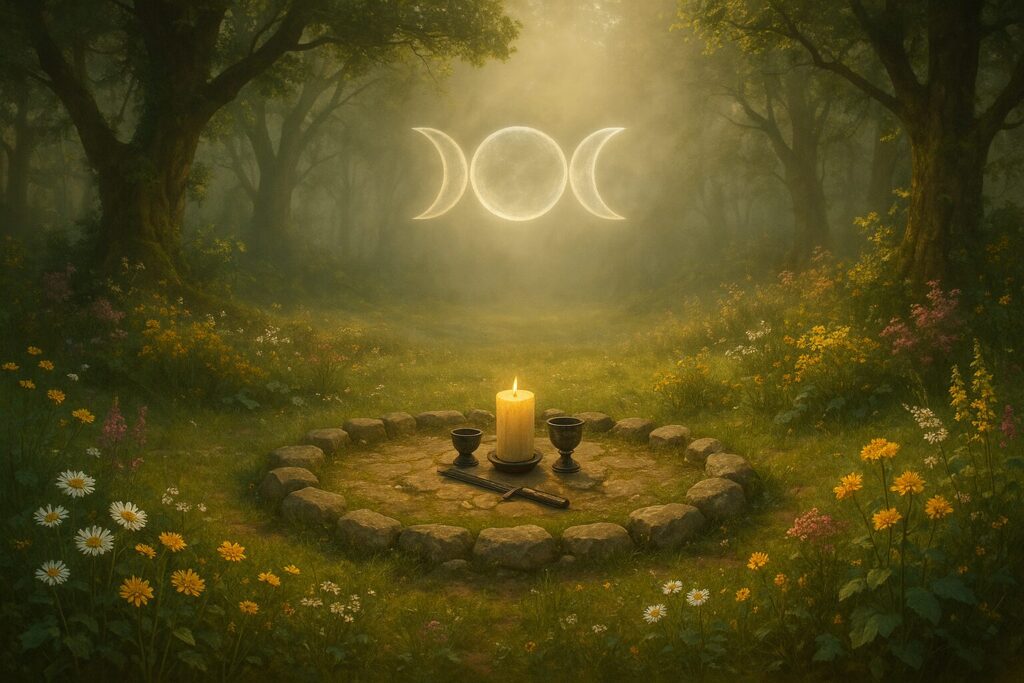
Wicca was born in the shadows of English forests, in a land where the old songs never entirely fell silent. Even under centuries of Christian rule, even with witch laws pressed like iron across the land, something in England continued to hum—a memory, perhaps, or a whisper of older religious sensibilities woven into folklore and seasonal rites. This is where our story begins: not merely in documents, but in that liminal place where folklore, longing, and lived experience blur into something that feels older than it should. The idea that Wicca descended directly from a secret, unbroken “Old Religion” hidden beneath the bracken is not literally true in every detail—yet it reflects something real: not the survival of intact priesthoods, but the survival of an attitude toward the sacred, a sense that magic lives quietly in rural places until someone calls it forward again.
When that moment came, it arrived through an unlikely figure: Gerald Brosseau Gardner, a retired British civil servant with the peculiar blend of curiosity England often cultivates in her eccentrics—folklorist, traveler, amateur anthropologist, and enthusiast of ceremonial magic. In 1939, Gardner claimed he was initiated into a small coven in the New Forest, whose members practiced a fragmentary ritual tradition he believed to be a survival of Britain’s ancient pagan religion. Whether their rites were genuinely ancient or creatively assembled from folklore, occultism, and the esoteric spirit of the early twentieth century has never been the heart of the matter for practitioners. Gardner found in those stories a way to craft something new—something vibrant—and Wicca’s flame took its first visible shape.
If Gardner was the spark, Doreen Valiente was the voice. She entered Gardner’s circle with a poet’s intuition and a priestess’s discerning eye. Recognizing that Gardner’s rituals were uneven—part Golden Dawn, part Crowley, part folk remnants, part Gardner’s own reworkings—she refined them with clarity and beauty. Her rewriting of the liturgy, most famously the Charge of the Goddess, gave Wicca its theological center of gravity. Through Valiente, Gardner’s experimental system blossomed into a religion with an inner pulse.
Wicca grew rapidly after 1951, when England finally repealed its Witchcraft Act. At last, the topic could be spoken of openly, if still with caution. Gardner published Witchcraft Today (1954) and later The Meaning of Witchcraft (1959), presenting Wicca as a surviving pre-Christian faith now stepping bravely into the light. Historians would later dispute the claim of unbroken continuity, but Gardner’s writings captured something true beneath the facts: people longed for a spiritual path rooted in nature, magic, and embodied ritual. The “Old Religion” story, fiercely beloved and sharply debated, became—ironically—the seedbed of a new one.
As the 1960s unfolded, Wicca changed from a secretive grove tradition into a branching river. Gardner initiated several priestesses and priests who would shape the Craft in their own ways. Patricia Crowther, Eleanor Bone, Lois Bourne, and Monique Wilson carried Gardnerian lines forward. Alex Sanders, ever theatrical, founded Alexandrian Wicca—more ceremonial, more dramatic, and more publicly visible. His flair gave the Craft a modern face and accelerated its spread.
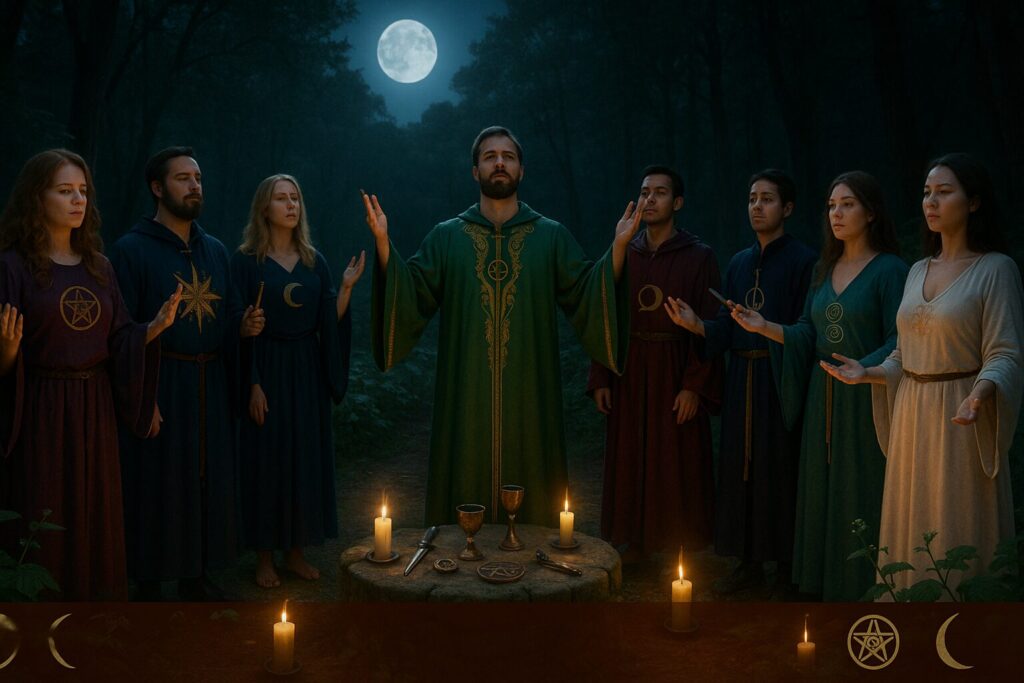
Wicca might have remained primarily British were it not for one pivotal moment: Ray Buckland bringing Gardnerian Wicca to the United States in the 1960s. He and his then-wife, Rosemary, were authorized by Gardner to establish a working coven on Long Island—an event that quietly ignited the globalization of Wicca. Their living-room rites planted the seeds of a movement. Buckland later founded Seax-Wicca and wrote accessible books that helped Wicca adapt seamlessly to American spiritual culture.
As the Craft crossed the Atlantic, it encountered a land already rich with spiritual experimentation. Many sought Wicca not through covens but through books—and here Scott Cunningham became essential. Writing with warmth and clarity, often outdoors in California sunlight, Cunningham reframed Wicca as a sincere, ethical, solitary path. His Guide for the Solitary Practitioner opened the Craft to hundreds of thousands, reshaping Wicca into a religion of personal devotion and everyday enchantment.
Across the ocean, Britain continued to develop its own expressions. Ross Nichols, founder of OBOD and friend to Gardner, helped shape the seasonal structure of the Wiccan Wheel of the Year. Janet and Stewart Farrar wrote some of the most influential guides to coven practice. Sybil Leek, charismatic and unapologetically public, helped shape American perceptions of witchcraft through media appearances and books.
The scholarly landscape around Wicca also deserves attention. Margaret Murray’s controversial witch-cult theory, though rejected by academia, offered early Wiccans a mythic framework that resonated spiritually even when not historically accurate. Frazer influenced ritual logic; Eliade illuminated sacred time and initiation; Ronald Hutton clarified the Craft’s history without diminishing its spiritual integrity.
It is important here to address one of early Wicca’s most misunderstood practices: working skyclad—ritually nude. For Gardner and some successors, nudity symbolized equality, vulnerability, and the shedding of social identity before the gods. It was ritual, not eroticism: a return to elemental selfhood. As Wicca spread, however, traditions diversified. Most modern Wiccans do not practice skyclad, though some continue the custom. The essence of the symbolism endures: all who enter sacred space do so equal and unmasked.
By the 1980s and 1990s, Wicca had become a global religion—one of the very few England has successfully carried into the world. It took root wherever people sought a spirituality grounded in nature, magic, and personal ritual. Alongside it grew related expressions, such as Traditional Witchcraft, which drew from folklore and cunning-craft in parallel to Wicca’s revival.
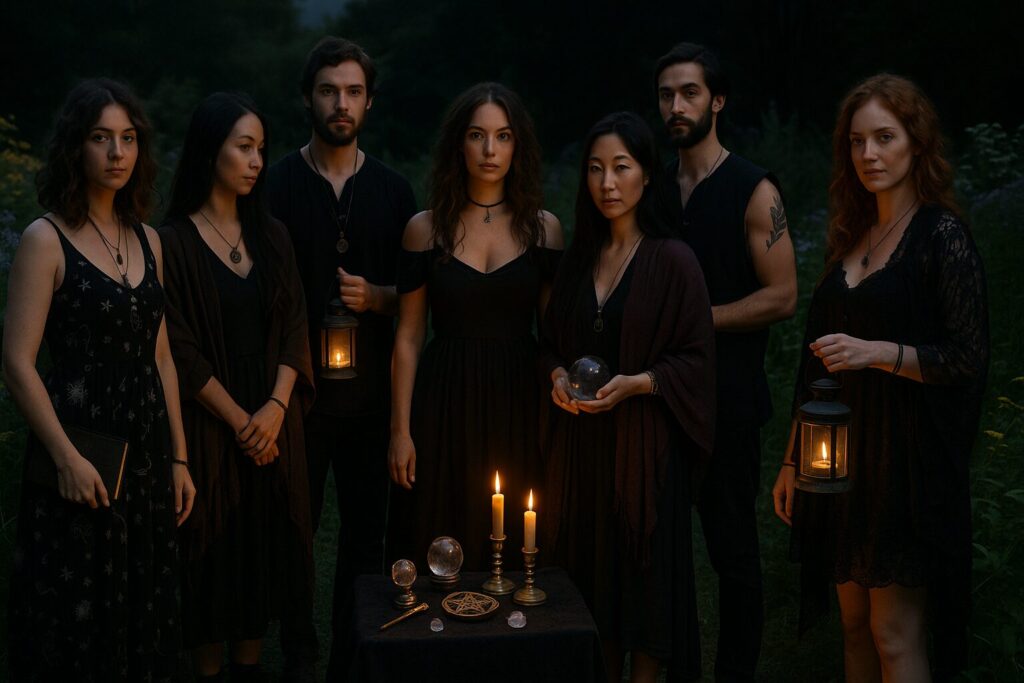
No account of Wicca is complete without addressing the narratives that surround it—both internal and external. Wicca’s internal origin stories, such as the idea of ancient continuity, express symbolic truth even where literal history diverges. They speak to the soul’s longing for an ancestral, sacred thread running across time. Externally, cultural misunderstandings have confused Wicca with devil worship or sensationalized magic. These misconceptions deserve clarity, and so the accordion that follows this essay explores them in more detail.
Today Wicca continues to evolve. It is structured yet fluid, traditional yet adaptive. It honors scholarship but thrives on experience. It carries forward a ritual language shaped by Gardner and Valiente, expanded by Sanders and Buckland, softened by Cunningham, and refined by scholars who placed it in context. It is a religion that understands itself through poetry as much as history, through intuitive truth as much as fact.
Is Wicca an ancient religion that survived hidden for centuries?
Historically, Wicca as we know it took shape in the mid-twentieth century, drawing on older folklore, ceremonial magic, and romantic visions of a “witch religion.” Spiritually, many of us experience it as a reawakening of older pagan currents rather than a simple modern invention. So while the historical continuity is complex, the sense of deep, ancestral resonance is very real for practitioners.
Is Wicca actually a religion?
Yes. Wicca is a modern Pagan religion with its own gods, rituals, ethics, seasonal rites, and living communities of practitioners. It has theology, mystery, and devotion, not just “spells” or techniques. People come to it seeking a sacred relationship with the divine in nature and in themselves.
Do Wiccans worship the Devil?
No. The Christian Devil is not part of Wiccan cosmology, and we do not believe in or venerate such a being. Wiccans honor a Goddess and a God (and often other deities) as expressions of nature, mystery, and consciousness, not as embodiments of evil. The confusion usually arises from long-standing Christian fears about witchcraft, not from what we actually believe or do.
Is Wicca the same thing as witchcraft?
Wicca is a religion; witchcraft is a magical craft or set of practices. Many Wiccans are witches, but not all witches are Wiccan. You can think of Wicca as a spiritual path that happens to include magic, while witchcraft by itself may or may not be tied to any religion.
Are Wiccans required to join a coven?
No. Many Wiccans today are solitary practitioners who honor the gods, keep the Sabbats, and work magic on their own. Covens, circles, and groves exist and can be powerful communities of practice, but they are not a requirement to be Wiccan. Commitment, reverence, and lived practice matter more than membership structure.
Do Wiccans work skyclad (nude)?
Early Wiccan covens sometimes worked skyclad as a symbol of equality, vulnerability, and stepping beyond social masks before the gods. Today, most Wiccans do not practice skyclad, and those who do treat it as entirely consensual and never sexualized in intent. What matters is the inner meaning: entering sacred space as one’s whole, authentic self, in a way that is safe and comfortable for everyone present.
Is Wicca the same as Druidry?
Wicca and Druidry are related but distinct modern Pagan paths. Both honor nature and the cycles of the year, but they differ in theology, ritual style, symbols, and historical inspirations. Some people walk in both traditions, yet each has its own lineage, mysteries, and ways of understanding the sacred.
Do Wiccans believe their gods are literal beings?
Wiccans hold a range of views: some relate to the Goddess and God as literal, personal deities; others experience them as vast presences, archetypes, or faces of a deeper mystery. Many of us work with a kind of sacred dualism, where the divine is encountered through complementary poles—Goddess and God, immanent and transcendent, form and spirit—without reducing that mystery to simple “either/or” answers. What unites us is that we meet the gods in practice and relationship, not just as abstract ideas.
Do Wiccans cast harmful spells or hex people?
Wiccan practice is grounded in the understanding that what we send into the world returns to us in some form, so most of us are very cautious about any working that could cause harm. Our magic tends to focus on healing, protection, justice, and personal transformation rather than revenge. There are debates at the edges, but ethical responsibility and accountability are central to how we approach power.
Is Wicca a closed initiatory tradition?
Some branches of Wicca, such as Gardnerian and Alexandrian, are initiatory and passed through lineaged covens. At the same time, there are open, eclectic, and solitary forms of Wiccan practice that do not require formal initiation to be valid. The gods, as we understand them, are not limited to any one lineage or pedigree.
Wicca did not survive intact from antiquity. Instead, something older—an instinct, a longing, a spiritual memory—survived long enough to become Wicca. A religion new in form but ancient in resonance. A path that treats myth not as error, but as a deeper way of speaking truth.
And so we stand in that lineage: respectful of history, grounded in scholarship, and yet open to the shimmering mythic dimension in which the Craft has always moved. For Wicca was not merely resurrected.
It was reawakened.
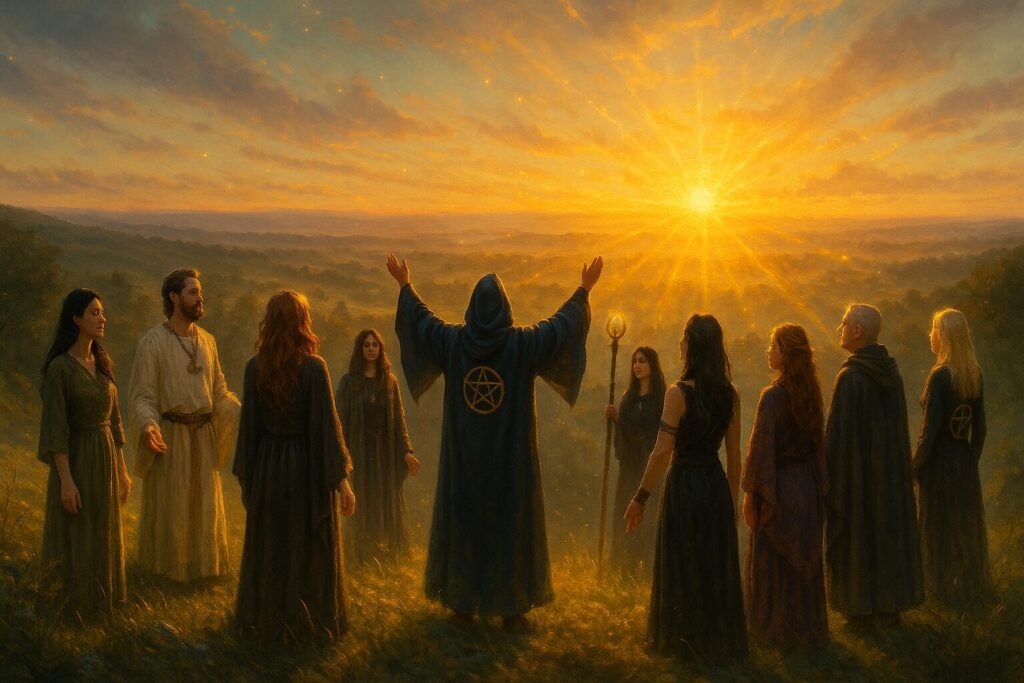
For the Coven of the Veiled Moon, Wicca is more than history—it is the deep root from which our own branches rise. Its teachings shape our ethics, our ritual structure, and the quiet discipline beneath our magic. Not all of our members identify as Wiccan, yet all honor the tradition with respect, for we recognize the lineage that made our work possible. We are Wiccan in our foundation and architecture, eclectic in our practice, and united in our reverence for the Craft that opened these paths.
Wicca offered the modern world something it had forgotten: a vision of the sacred woven into nature, of divinity encountered through lived experience, of magic practiced with responsibility and wonder. It helped bring witches out of the shadows and back into the light of religious freedom—a freedom we do not take lightly. We walk more openly because others walked bravely before us.
Whatever shape our magic takes, whatever gods or mysteries we are called to serve, we carry this gratitude with us. For Wicca did not simply reawaken the Old Ways—it reawakened the right of witches to exist, to practice, to speak, and to belong. And on that enduring flame, our own coven’s light is kindled.
“That perhaps is at the core of Wicca — it is a joyous union with nature. The earth is a manifestation of divine energy. Wicca’s temples are flower-splashed meadows, forests, beaches, and deserts.” -Scott Cunningham