WAYS OF KNOWING
How to Study Witchcraft & Magic
Magic is not one subject learned from one shelf.
Witchcraft is interdisciplinary. Its study may lead through history, religion, folklore, philosophy, language, art, ritual, ecology, psychology, divination, spirit work, healing traditions and practical craft. Each field asks different questions, yet they repeatedly meet around a shared threshold: how human beings understand unseen forces, enter relationship, create meaning and seek change.
To study witchcraft well requires more than collecting facts, repeating inherited claims or memorizing correspondences. It asks us to read closely, practice deliberately, recognize different forms of knowledge and remain open without surrendering judgment.
Witchcraft Is an Interdisciplinary Field
Witchcraft cannot be reduced to a single tradition, theory, method or body of literature. Its study may lead through religious history, folklore, myth, philosophy, language, art, ritual theory, herbal knowledge, material culture, astronomy, psychology, divination, healing traditions, spirit relations and the practical construction of magical work. Some of these fields overlap closely; others retain important differences in purpose, method and evidence.
Yet these are not simply unrelated subjects gathered beneath one dramatic name. They repeatedly return to a shared core of questions. What is magic? How does change occur? What relationships exist between mind, matter, spirit, symbol, place and time? How does ritual carry intention into action? What is inherited from tradition, what is learned through experience, and what may be created through careful synthesis?
Different forms of practice approach these questions through different points of entry. Spellcraft may begin with a desired change. Divination may begin with a question. Devotion begins in relationship. Folk practice may emerge from place, family, custom and necessity. Ceremonial systems may emphasize structure, sequence and symbolic order. Embodied practices may teach through breath, posture, voice, movement and sensation. These are distinct approaches, but they often illuminate one another.
The page currently titled Channels of Access explores these different ways of entering magical practice. No single channel represents the whole of magic, and no practitioner is required to pursue every one. Understanding their differences, however, helps us recognize why one source may speak clearly to a particular question while another appears to be describing an entirely different world.
Connections should also be approached with care. Similar functions, symbols or names can suggest a real historical relationship, a later magical association, a shared human pattern or only a superficial resemblance. Good study does not reject possible connections, but neither does it assume them too quickly. It asks what kind of connection is actually being proposed and what evidence would support it.
No single book, teacher, tradition or personal revelation can therefore represent the entire field. The goal is not to collect every possible answer or force all systems into agreement. It is to learn how different forms of knowledge speak, what each can reasonably tell us, and where their limits begin.
Begin with the Question You Are Actually Asking
Good study begins before the first book is opened. It begins by deciding what kind of question is actually being asked. A reader looking for the documented historical use of an herb needs different evidence from a practitioner developing a contemporary working. Someone exploring a religious tradition needs different guidance from someone comparing symbols, testing a ritual method or trying to understand a personal experience.
Broad questions are useful at the beginning, but they often conceal several smaller inquiries. “What does rosemary mean in magic?” may sound straightforward, yet it could refer to historical use, folklore, medicinal associations, a modern correspondence system, the teaching of a living tradition or the way rosemary behaves within one practitioner’s work. Each version of the question may lead to a different source and a different kind of answer.
The distinction matters because a source can be valuable without being suitable for every purpose. A practical book may offer an effective method while providing weak history. A scholarly work may explain where a custom came from without teaching anyone how to perform it. A family or community tradition may preserve knowledge that was never formally published. A personal account may offer insight into lived practice while remaining specific to the person who experienced it.
Before researching a subject, pause long enough to identify what you are seeking:
- Are you studying history, religion, folklore, symbolism or practical magic?
- Are you trying to understand a particular culture, period or tradition?
- Are you learning a method you intend to use?
- Are you investigating a deity, spirit, image, object or ritual action?
- Are you looking for documented evidence, community teaching, personal guidance or some combination of these?
- What kind of answer would genuinely satisfy the question?
It is also useful to notice when the question changes. Research often begins in one place and opens into another. A search for a practical correspondence may reveal a historical problem; a study of myth may lead toward ritual; a personal experience may send the practitioner back to language, folklore or theology. This is not a failure of focus. It is part of interdisciplinary study, provided the new questions are recognized rather than quietly blended into the original one.
A clear question does not restrict discovery. It gives discovery a shape. It helps the reader choose appropriate sources, recognize when two answers are addressing different problems and avoid forcing certainty where the available material can support only possibility.

What does rosemary mean in magic?
The question looks simple, but each version below asks for a different kind of knowledge. None is automatically more valuable than the others. The important thing is to know which question a source is actually answering.
Study, Practice and Belief
Study, practice and belief continually influence one another, but they are not interchangeable. Confusing them can cause a reader to mistake familiarity for skill, conviction for knowledge or personal experience for universal truth.
Study asks what has been recorded, preserved, taught, debated, interpreted or experienced. It allows us to examine a practice without adopting it and to understand a belief without pretending that we share it. Study broadens the range of questions we are capable of asking and gives us language with which to compare possible answers.
Practice asks what is actually done. It places knowledge into time, place, body, material and relationship. A ritual read silently on a page is not identical to that ritual spoken aloud, repeated over months, adjusted to circumstance or performed within a living devotional or spiritual relationship. Practice reveals qualities that written description may only partially preserve: rhythm, resistance, attention, emotional response, bodily knowledge and the difference between an elegant idea and a workable method.
Belief concerns what a person accepts as true, probable, sacred, meaningful or worthy of trust. It may arise before practice, grow through experience, change because of study or remain unsettled for years. Uncertainty is not necessarily a weakness. It can be an honest stage of learning and a safeguard against claiming more than one knows.
A person can study something deeply without practicing or believing it. A person may practice provisionally while remaining uncertain about the explanation. Someone may also believe very strongly while lacking the knowledge, preparation or technical skill to act effectively. Mature study does not force these three into artificial agreement.
Belief can assist magical practice. It may reduce hesitation, steady the will and help the practitioner commit fully to the operation. Doubt, especially when it becomes constant self-interruption, can divide attention and weaken execution. Yet belief should not be treated as the engine that makes all magic work. A carefully structured working does not become powerless merely because the practitioner retains questions.
This distinction also protects the reader from a common circular argument: that every success proves the method, while every failure proves that the practitioner did not believe strongly enough. Magical work may be affected by skill, preparation, timing, relationships, materials, conflicting conditions, poor construction or forces that remain outside the practitioner’s control. Belief may help, but it does not excuse us from examining how a working was built and carried out.
The deeper task is to develop an informed relationship between knowledge and action: to understand what one is doing, why it is being done, where the method came from and what the experience may genuinely teach.
Learning what is known
Study examines what has been recorded, taught, debated, interpreted or preserved. It asks how we know, whose voice is present, what supports a claim and what remains uncertain.
Learning through action
Practice places knowledge into ritual, relationship, repetition, material, movement and lived experience. It reveals what written description alone may not preserve.
Deciding what we trust
Belief shapes trust, interpretation, confidence and commitment. It may steady the will, but it should not be confused with knowledge, preparation or technical skill.
Reading and Evaluating Sources
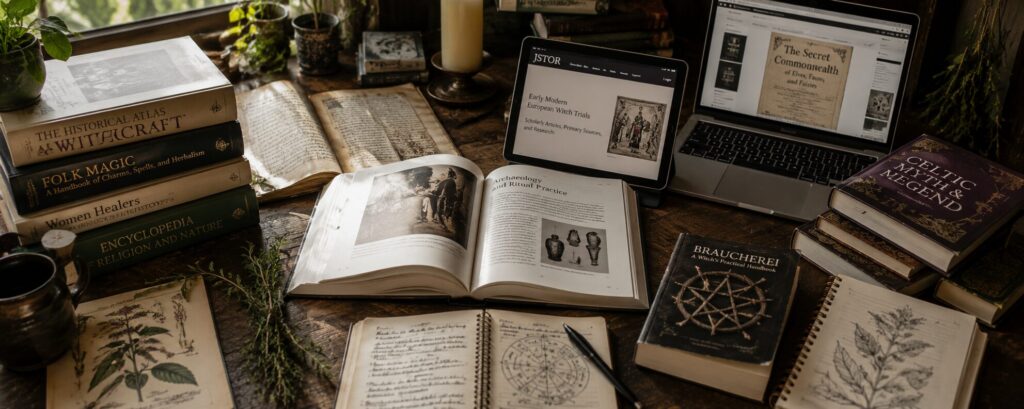
Witchcraft is preserved and discussed through many kinds of sources. A reader may encounter academic histories, practical manuals, ritual texts, folklore collections, translated manuscripts, memoirs, community teachings, oral traditions, podcasts, videos, social media posts and accounts of personal experience. These sources do not all speak with the same voice, follow the same rules or attempt to answer the same questions.
A scholarly history may be carefully cited and still offer little instruction for practice. A practical book may communicate an effective method while repeating doubtful historical claims. A memoir may reveal the texture of lived experience without establishing that the author’s interpretation applies to anyone else. An old ritual text may be historically important while remaining incomplete, deliberately obscure or difficult to understand outside its original religious and cultural setting.
Oral tradition and living testimony deserve particular care. Knowledge passed through families, covens, initiatory groups, regional communities and living cultures may never have been formally published. The absence of a printed source does not make such knowledge meaningless or invented. At the same time, oral teachings can change through memory, retelling, adaptation and community need. They should be identified honestly as inherited, remembered, community-based or experiential rather than being given a false documentary history.
Personal testimony also has real value. Practitioners often learn things through ritual, divination, dreams, bodily response, spirit relationship and repeated experience that cannot be reduced to a quotation or footnote. Such accounts may offer insight, inspiration and practical guidance. Their limits begin when one person’s experience is presented as settled history, universal law or unquestionable authority over the experiences of others.
The goal is not to arrange every source in a rigid hierarchy, with academic writing automatically placed at the top and lived experience at the bottom. Different sources provide different forms of knowledge. The better question is: What is this source trying to do, and is it well suited to that purpose?
A book teaching candle magic does not need to read like an archaeological report. A devotional account does not require proof that a deity exists before it can communicate the character of a relationship. But when a source makes specific historical, linguistic, scientific, medical or cultural claims, it is reasonable to look for evidence appropriate to those claims.
Reading well therefore involves both openness and proportion. We need not reject a useful work because it has limitations, nor accept every statement because part of the work resonates. A source may be insightful in one area, mistaken in another and still worth reading when those distinctions are understood.
The Witchcraft & Pagan Research Library is intended to help readers make those distinctions by identifying what each recommended source offers, where it is strongest, what context it requires and which limitations or controversies should be kept in view.
What kind of source are you reading?
Each source type carries particular strengths and limitations. Open the sections below to consider what kind of knowledge each may reasonably provide.
Scholarship and critical studies
Practical manuals and instructional books
Historical and primary sources
Oral tradition and living community knowledge
Memoir, personal testimony and gnosis
Reference works and introductory summaries
Digital media, podcasts and social platforms
Primary, secondary and tertiary sources
These terms describe a source’s relationship to the subject being studied. They do not create a simple ladder from unreliable to reliable. Each level serves a different purpose.
Material close to the subject
Created within the period, event, community or practice being studied.
Interpretation and analysis
Examines, interprets or compares primary material and earlier research.
Orientation and overview
Condenses established information and directs readers toward deeper study.
Citation, Annotation and Traceability
Citation is not only an academic formality. It gives readers a path back to the source of a claim, quotation, translation or interpretation. In magical study—where history, folklore, personal testimony and modern practice are often woven together—that path can be especially important.
Not every sentence in a practical guide requires a footnote. A writer describing their own ritual method, devotional relationship or personal experience may simply identify it honestly as such. Citation becomes more important when a source makes specific claims about history, language, culture, science, medicine, ancient religion or the practices of a community beyond the author’s own experience.
A useful citation should allow the reader to identify the work being discussed and, when possible, locate the relevant passage. For books, this usually means the author, title, edition and page number. For ancient or frequently translated works, the translator, editor and publication details may be just as important as the original title. Different editions can vary considerably in wording, notes, omissions and interpretation.
Citation establishes traceability, but an annotation provides context. An annotated bibliography does more than list titles. It briefly explains what a source contains, what kind of source it is, where it is strongest, what limitations should be kept in mind and who is most likely to benefit from reading it.
A useful annotation may tell the reader:
- whether the work is introductory, intermediate or specialist;
- whether it is historical scholarship, practical instruction or personal testimony;
- which edition or translation is preferred;
- whether substantial background knowledge is required;
- what controversies, biases or outdated claims affect the work;
- whether it is historically important despite serious limitations;
- what companion reading can help place it in context.
Ancient, medieval and early modern texts often need more than a bare citation. A title may survive through several manuscripts, editorial reconstructions and competing translations. The work may also assume a religious, political or philosophical world that is unfamiliar to modern readers. Without that context, a quotation can appear far more straightforward than it really is.
A citation should not be treated as a magical seal that makes every claim correct. Sources can be cited inaccurately, selectively or in support of conclusions they do not actually establish. The reader still needs to ask whether the cited material says what the author claims it says, whether important context has been omitted and whether the evidence is strong enough for the conclusion being drawn.
The goal is not to make magical writing needlessly formal. It is to preserve a clear distinction between what is documented, what is inherited, what is interpreted and what is personally experienced. Good citation allows knowledge to be examined. Good annotation helps it to be used wisely.
Readers interested in older ritual texts, grimoires and historical editions can continue through Historical & Occult Source Texts, where individual works can be presented with the context that a simple reading list cannot provide.
Citation tells you where. Annotation tells you why it matters.
Creates a trail back to the source
A citation identifies where a quotation, claim, translation or interpretation originated.
Explains how the source should be used
An annotation identifies the source’s strengths, limitations, difficulty, perspective and practical value.
Translation Is Not the Same as Interpretation
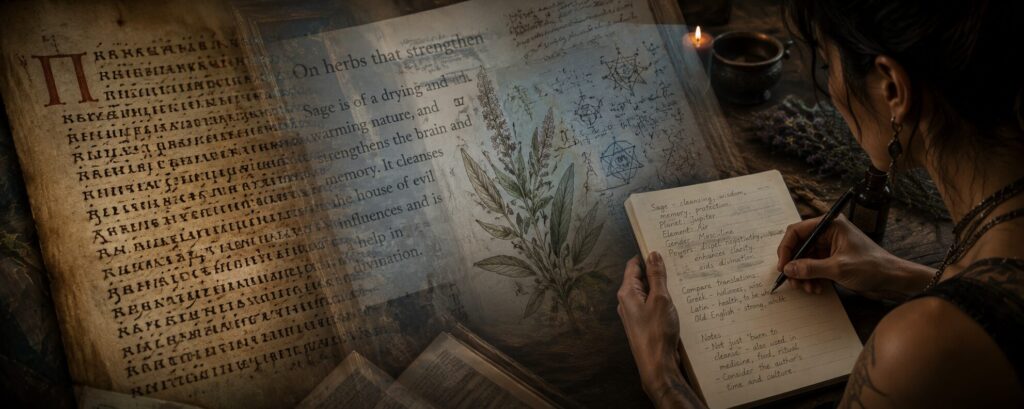
Working with material from another language requires several different acts that are often blended together. Transliteration represents a word from one writing system using the characters of another. Translation attempts to carry its meaning into another language. Interpretation asks what the word, text, image or ritual action signifies. These processes influence one another, but they are not identical.
A translation is never produced by replacing every original word with one perfect English equivalent. Languages organize meaning differently. A term may carry religious, social or philosophical associations that no single English word preserves. The translator must choose among possibilities, and those choices can shape how later readers understand the entire subject.
Interpretation adds another layer. Two translators may produce similar wording yet disagree about what the passage means, what symbolic system it belongs to or how it relates to practice. A reader should therefore notice when an author moves from:
“This word may be translated as…”
“This proves that the text teaches…”
The first is a linguistic judgment. The second is an interpretation that may require additional evidence.
Names can be especially misleading. Similar English spellings do not necessarily reveal a shared origin. The Egyptian term commonly rendered heka refers to magic as a power, practice and personified divine force. Hekate, meanwhile, is a Greek divine name whose precise etymology remains debated, although Greek etymological discussions commonly relate it to Hekatos. There is no established linguistic derivation connecting the two merely because Heka and Hekate resemble one another in modern spelling.
That does not prevent practitioners from comparing them. Heka and Hekate may be brought into conversation through magical function, later association, personal theology or deliberate modern synthesis. Such a connection may become meaningful within practice. It should simply be described as a comparison, association or synthesis, rather than presented as proven etymology or evidence that one name developed from the other.
The same caution applies whenever two gods, spirits, symbols or ritual terms appear similar. The resemblance may indicate:
- a genuine historical relationship;
- contact or exchange between cultures;
- a later syncretic association;
- a shared function expressed independently;
- a translator’s choice;
- or simple coincidence.
Responsible study does not reject connections, but it identifies what kind of connection is being proposed. Linguistic relationship, historical influence, functional similarity and modern magical association are four different claims, and evidence for one does not automatically establish the others.
A useful reading habit is to ask: Am I being shown what the original language says, how a translator has rendered it, or what an author believes it means?
Often, the answer is some combination of all three. Recognizing the layers allows readers to appreciate interpretation without mistaking it for the text itself.
Three related—but different—acts
A word may pass through several layers before reaching the modern reader. Each layer introduces choices, and each may shape the meaning that follows.
How the word is written
Represents a word from one writing system using the characters of another. It aims to preserve form and sound rather than fully explain meaning.
How the meaning is carried
Chooses words in another language that best convey the original. No translation is perfectly neutral because languages divide and organize meaning differently.
What someone believes it means
Explains the significance of the word, passage, image or ritual. Interpretation may be persuasive and useful without being identical to the original text.
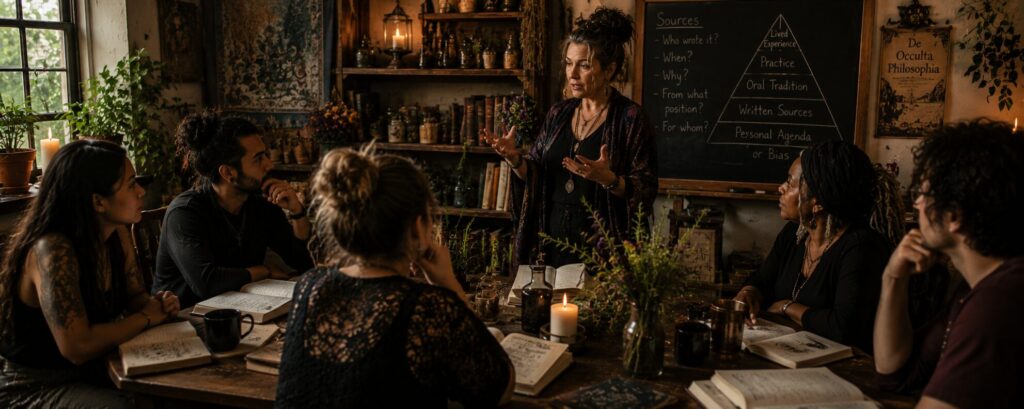
Evaluate the Author—and the Position They Speak From
Every source is written from somewhere. An author may speak as a historian, practitioner, initiate, theologian, journalist, critic, artist, community elder, independent researcher or curious observer. None of these positions automatically guarantees accuracy, and none should be dismissed without consideration. Each provides particular forms of access while also creating particular limits.
Begin by asking what kind of authority the author is claiming. Academic education may demonstrate training in research, language or historical method, but it does not necessarily provide lived knowledge of ritual. Decades of practice may produce deep practical understanding without qualifying someone to make unsupported claims about archaeology or ancient language. Initiation may establish a person’s standing within a particular tradition, but it does not make that tradition representative of all witchcraft.
Some claims can be checked relatively easily. Experience, degrees, publications, public appointments, professional credentials, organizational roles and cited historical evidence often leave an identifiable record. Other claims may be only partly verifiable. Initiation, apprenticeship, lineage, years of private practice or roles within closed communities may sometimes be confirmed through peers, teachers or community recognition, while privacy, oath and circumstance may appropriately limit what can be disclosed.
Experiential and metaphysical claims require a different kind of judgment. Deity contact, spirit communication, visions, psychic perception, past-life memories and magical attainment generally cannot be independently verified in the same manner as a publication record. This does not make such experiences meaningless or dishonest. It means they should be presented as testimony, gnosis, inherited teaching or interpretation—not treated as self-proving credentials that place the speaker beyond question.
A useful principle is:
An author does not need to expose every private spiritual experience to public examination. They should, however, distinguish among documented history, community teaching, personal experience, interpretation and speculation. A reader should not have to guess whether “this tradition teaches” means an identifiable body of teaching, one local group, the author’s mentor or something the author personally concluded.
Good teachers and writers are usually willing to acknowledge the boundaries of their knowledge. They may say that an interpretation is disputed, that a practice varies among communities or that they are speaking only from their own experience. Such qualifications do not weaken authority. They often demonstrate that the author understands its proper limits.
Be more cautious when authority is built through vagueness and exceptionalism: unnamed elders who can never be consulted, secret archives no one else has seen, unverifiable titles, rapidly changing lineage claims or repeated suggestions that the author alone possesses the complete teaching. Secrecy can be legitimate within initiatory, oath-bound and private traditions, but secrecy by itself does not prove authenticity.
It is also important to distinguish responsible boundaries from manipulative gatekeeping. Some practices require preparation, supervision, initiation or a foundation of earlier skills. A teacher may reasonably delay advanced work until a student can approach it safely and competently. A community may also protect private rites, vulnerable members or teachings that belong within a specific relationship.
Likewise, charging for a class, book, consultation or course is not automatically gatekeeping. Teaching requires time, preparation, expertise, materials and labor. Payment becomes concerning when access is deliberately fragmented to create dependence, when basic questions always require another purchase or when students are made to believe that one teacher is their only possible route to magical knowledge.
The warning sign is not simply that information has boundaries or a price. It is that control of information is being used to discourage independent thought, punish questions, manufacture spiritual dependence or make the teacher appear indispensable.
Readers should therefore consider not only what an author knows, but how that knowledge is used. Does the writer clarify difficult material or make it needlessly obscure? Do they direct readers toward further sources or continually return attention to themselves? Do they teach students how to think and practice more independently, or imply that growth is dangerous without continued access to the teacher?
Authority is most trustworthy when it helps knowledge circulate responsibly. The best teachers do not merely demonstrate how much they know. They help others develop the preparation, discernment and confidence to continue learning without remaining permanently dependent upon them.
Not every boundary is gatekeeping
Knowledge given with preparation and care
- Advanced work follows foundational training.
- Safety, maturity or supervision genuinely matter.
- Private or initiatory teachings remain within agreed relationships.
- Questions are welcomed, even when an answer must wait.
- The goal is eventual competence and greater independence.
Knowledge withheld to preserve control
- Access is fragmented to create continuing dependence.
- Questions are treated as disloyalty or spiritual failure.
- The teacher presents themselves as the only safe authority.
- Secrecy protects status, misconduct or weak claims.
- Students are discouraged from consulting other sources.

Examine the Evidence Without Turning Reading into an Inquisition
Evaluating a source does not mean approaching every book, teacher or personal account with suspicion. Magical writing includes scholarship, inherited teaching, practical instruction, theology, symbolism, testimony and creative insight. Not all of these can—or should—be judged by exactly the same standard.
The aim is proportionate awareness. A simple cleansing method does not need to arrive with an academic apparatus before it can be useful. A practitioner describing a dream or encounter does not need to prove that experience in a laboratory before it can be meaningful. But a confident claim about ancient history, language, medicine, cultural ownership or universal magical law reasonably asks for stronger support.
Evidence may take several forms:
- citations to identifiable texts or records;
- material, archaeological or visual evidence;
- comparison among independent sources;
- testimony from people within a living tradition;
- consistency across sustained practice;
- transparent explanation of how a conclusion was reached;
- acknowledgement of disagreement, uncertainty or missing information.
No single form answers every question. A historical document may show that an idea existed without proving that it was widely practiced. Several modern books repeating the same statement may all trace back to one unsupported source. A community’s testimony may establish how its members understand a tradition today without necessarily resolving every question about its ancient development.
Corroboration is useful, but repetition alone is not corroboration. When the same claim appears in many places, look for whether those sources developed independently or simply copied one another. A modern correspondence, invented quotation or mistaken etymology can become widely accepted through repetition long before anyone asks where it began.
The scale of the evidence should also match the scale of the claim. “This technique has helped me” is a modest experiential statement. “This technique always works for everyone” is a universal claim requiring far more support. “Some practitioners associate this symbol with protection” is different from “This symbol has meant protection in every culture since ancient times.”
Good sources make those distinctions visible. They tell readers when something is documented, commonly taught, locally traditional, personally experienced, reconstructed or speculative. They do not disguise uncertainty as certainty merely because a stronger claim sounds more impressive.
It is equally important not to demand impossible proof before allowing any magical knowledge to be discussed. Spirit contact, divination, synchronicity, energetic perception and ritual effects may resist straightforward external verification. That difficulty does not automatically make them false. It does mean that testimony should remain testimony, experience should remain experience, and interpretation should not quietly be promoted into established fact.
A reader can therefore ask several gentle but useful questions:
- What kind of claim is being made?
- What evidence would reasonably apply to that kind of claim?
- Does the source provide it, or explain why it cannot?
- Are alternatives or disagreements acknowledged?
- Is the conclusion stronger than the evidence allows?
- Would the source still be useful if part of its explanation proved mistaken?
That final question matters. A source does not have to be perfect to be worthwhile. A ritual manual may preserve effective technique despite weak historical framing. An older scholarly work may remain important while containing outdated assumptions. A personal account may communicate profound insight without establishing universal truth.
Critical reading is not a hunt for reasons to discard everything. It is the practice of understanding where a source is strong, where it is limited and how much weight it can responsibly carry.
Match the evidence to the claim
The broader and more authoritative a statement becomes, the more support it reasonably requires. A personal observation and a universal law should not be asked to carry the same evidentiary weight.
“This is what I experienced.”
Dreams, ritual impressions, intuition, spirit contact and personal results may be presented honestly as testimony.
“This method is useful.”
A practical claim concerns how a method is performed, what it is meant to accomplish and how it behaves in repeated use.
“This was believed or practiced.”
Historical claims concern particular people, periods, places, texts, institutions or material remains.
“This is always true for everyone.”
Universal claims extend beyond one practitioner, culture, tradition, period or set of circumstances.
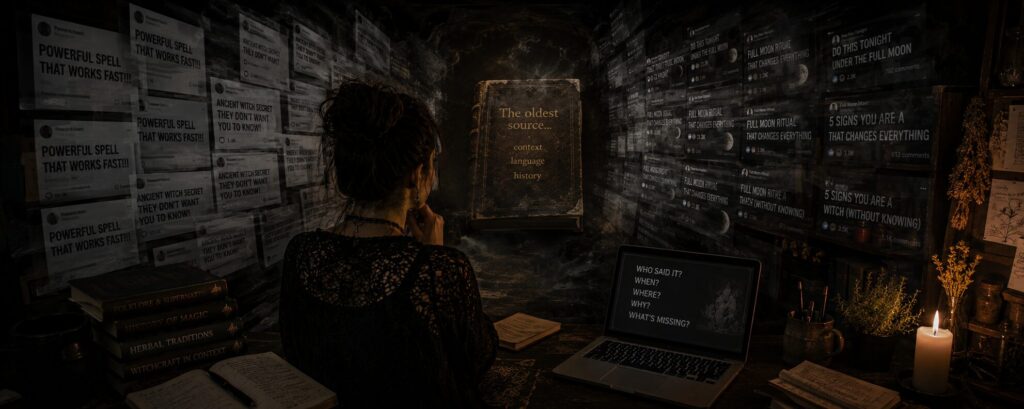
Modern Misinformation, Repetition and AI
Misinformation in magical study is rarely created by one obviously dishonest person. More often, a claim is simplified, copied, detached from its original context and repeated until familiarity begins to feel like evidence. A modern practice becomes “ancient,” a symbolic interpretation becomes a fixed historical meaning, or a speculative connection becomes accepted as established fact.
The internet has made valuable material easier to find, including digitized manuscripts, museum collections, lectures, community testimony and specialist scholarship. It has also made unsupported claims easier to reproduce. A statement may appear across dozens of websites, videos and social posts while every version ultimately traces back to one unsourced book, one misunderstood quotation or one another.
Common forms of misinformation include:
- modern practices presented as unbroken ancient traditions;
- invented or exaggerated lineages;
- false etymologies based on similar-sounding words;
- quotations attributed to people who never wrote or said them;
- correspondence lists copied without their historical or ritual context;
- one culture’s practice described as universal witchcraft;
- fictional material repeated as folklore or religious history;
- scientific language used decoratively rather than accurately;
- personal revelation presented as objective history;
- dramatic warnings designed more to create fear and engagement than understanding.
Some of these claims begin with a meaningful idea. A modern ritual may be powerful. A poetic interpretation may reveal genuine symbolic truth. Two deities may be fruitfully compared in practice. The problem begins when the category changes without being acknowledged—when inspiration becomes history, resemblance becomes etymology or personal gnosis becomes universal law.
Critical thinking does not require the reader to become cold, cynical or permanently suspicious. It means noticing what kind of claim is being made and resisting the pressure to accept it merely because it is familiar, emotionally satisfying or confidently expressed.
One useful question is: Where did this claim enter the conversation?
Tracing a statement backward can reveal whether it comes from a historical document, a scholarly interpretation, a modern occult author, a living community, a work of fiction or a recent social-media trend. That origin does not determine whether the idea has value, but it helps the reader understand what kind of value it may possess.
Artificial intelligence adds another layer to this problem. AI tools can help organize notes, summarize difficult language, suggest search terms, compare explanations and identify questions that deserve further study. They can be useful assistants, particularly when the reader already has enough knowledge to recognize uncertainty and verify important details.
AI can also produce fluent, confident statements that are inaccurate or entirely invented. It may combine several traditions into one seamless account, create plausible-looking citations, misattribute quotations, flatten scholarly disagreement or repeat errors that already circulate widely online. The answer may sound polished precisely because the system is designed to produce coherent language—not because every underlying claim has been checked.
For that reason, AI is best used as a guide toward sources rather than as the final source itself. When an answer makes a specific historical, linguistic, cultural, scientific or bibliographic claim, the reader should follow it back to an identifiable text, institution, author or body of evidence.
A practical rule is:
The same principle applies to search-engine summaries, social-media explainers and short-form videos. They may provide an excellent introduction, but the introduction should open the subject rather than quietly replace it.
Readers should also be alert to information that has been “laundered” through repetition. An unsupported claim may begin in a book, appear on several blogs, be repeated in a video, summarized by AI and then return in a new article as though multiple independent sources now confirm it. The number of repetitions has increased, but the evidence has not.
Whenever possible, look for the earliest identifiable version of the claim and then compare it with later interpretations. Ask whether the wording changed, whether qualifications disappeared and whether later writers added certainty that the original source did not possess.
The goal is not to eliminate myth, poetry, intuition or creative association from magical study. It is to preserve their actual richness by naming them honestly. A modern myth does not become less meaningful because it is modern. A personal correspondence does not become less useful because it is personal. A ritual inspired by several traditions does not require an invented ancient lineage to justify its existence.
Reliable study allows ideas to be valuable for what they truly are.
Pause before you repeat it
A claim does not need to be rejected simply because it is surprising. It does deserve a moment of attention before it becomes part of another book, post, ritual explanation or teaching.
The claim may need tracing
- It is described as ancient but no period or source is named.
- Many sites repeat it using nearly identical wording.
- A dramatic quotation appears without a location or edition.
- A similarity in spelling is treated as proof of shared origin.
- One experience is presented as a rule for everyone.
- Scientific terms appear without a clear scientific meaning.
- The claim becomes more certain each time it is retold.
Ask before passing it onward
- Who appears to have made the claim first?
- Is it history, tradition, interpretation or personal experience?
- Can the quotation, title or source actually be located?
- Does the original source sound as certain as the summary?
- Have important qualifications disappeared?
- Would the idea still be worthwhile if it were modern?
- Can it be shared more accurately with one careful phrase?
Practice, Experience and Record-Keeping
Study Through Practice, Not Reading Alone
Reading can describe a ritual, preserve a teaching and introduce the ideas behind a magical system. It cannot fully reproduce what happens when that knowledge enters the body, the room, the landscape or an ongoing relationship. Magical study becomes more complete when information is accompanied by careful practice.
Practice does not mean attempting every technique encountered in a book. Some material is unsuitable for beginners, requires supervision or belongs within a particular initiatory or cultural setting. Other practices involve toxic plants, fire, altered states, strenuous movement or spirit contact that should not be approached casually. Understanding a method and performing it are separate decisions.
When a practice is appropriate, repetition often teaches more than novelty. Performing one grounding exercise consistently may reveal more than collecting twenty variations. Repeating a ritual across different moods, seasons and circumstances allows the practitioner to notice which elements are structural, which are adaptable and which may have seemed important only because they appeared in the written instructions.
Practice also tests whether an elegant idea can survive contact with ordinary life. A ritual may be beautiful on the page but too complicated to perform coherently. A simple method may prove unexpectedly durable. Materials may behave differently than expected, words may feel awkward when spoken aloud and a symbolic connection that seemed intellectually persuasive may carry little force in actual use.
These discoveries are not necessarily failures. They are part of the knowledge produced through practice.
Magical education is also embodied. Breath, posture, stillness, gesture, rhythm, voice, movement and sensory awareness can all affect how a working is entered and sustained. A practitioner may learn to recognize the bodily difference between concentration and strain, intuition and anxiety, grounded attention and emotional escalation.
The body should not be treated merely as a container that carries the mind into ritual. It receives information, develops habits and remembers sequences. Repeated gestures can become thresholds into particular states of attention. Voice can alter the emotional and energetic shape of a room. Breath may regulate pacing, while movement can give form to an intention that remains abstract when held only as thought.
Embodied practice must also respect actual bodies. Disability, chronic illness, fatigue, pain, age, sensory differences and limited mobility do not make someone less capable of meaningful magical work. A ritual may be performed seated, spoken internally, shortened, translated into gesture or adapted around available energy. Adaptation is not automatically a dilution of the work; it may demonstrate a deeper understanding of what the work truly requires.
Body-based practice can include:
- grounding through posture, breath or contact with a stable surface;
- deliberate walking, turning or movement through ritual space;
- chanting, singing, speaking, humming or controlled silence;
- dance, swaying, drumming or rhythmic repetition;
- hand positions, signs and purposeful gesture;
- sensory attention to light, scent, sound, texture and temperature;
- learning how the body signals fatigue, overstimulation, fear or loss of focus;
- developing an intentional way to enter and leave ritual states.
Practice also occurs through observation and relationship. Watching seasonal change, tending an altar, learning the behavior of a flame, sitting regularly in one landscape, recording dreams or maintaining a devotional routine may produce knowledge gradually. Not every lesson arrives as a dramatic result. Much of magical skill develops through accumulated familiarity.
Personal experience is therefore an important source of magical knowledge, but experience and explanation remain distinct. A practitioner may know that a ritual changed something without yet knowing exactly how or why. They may experience a presence without immediately knowing its identity. They may notice a pattern without knowing whether it is magical, psychological, environmental, coincidental or some combination of these.
There is no need to force a final interpretation too quickly. An honest record can preserve the experience while leaving its explanation open.
The aim is not to reduce magic to mechanical repetition or make every ritual into a formal experiment. It is to become attentive enough that practice can teach rather than merely confirm what the practitioner expected to find.
Ways practice teaches
Practical knowledge often develops gradually. The practitioner learns not only from what happened, but from what changed through repetition, embodiment, relationship, observation and thoughtful adaptation.
Repeated work reveals patterns, inconsistencies and the difference between a single striking event and a dependable method.
Breath, posture, voice, movement and sensation teach aspects of ritual that written instructions can only partially describe.
Attention to timing, environment, mood, materials and later outcomes reveals conditions that memory alone may overlook.
Devotion, spirit work, place-based practice and community participation may deepen through sustained contact rather than isolated attempts.
Thoughtful changes for body, circumstance or purpose can reveal which elements are essential and which are merely customary.
Personal Gnosis, Inspiration and Experience
Some of the most important magical knowledge does not begin in a book. It may arise through ritual, devotion, dreams, trance, divination, bodily response, intuition, spirit contact, artistic inspiration or a pattern observed over many years. These forms of knowing can be profound, practical and transformative.
Personal gnosis is knowledge or understanding received through direct spiritual or magical experience. It may concern a deity, spirit, symbol, ritual method, place, relationship or the practitioner’s own developing path. Such knowledge can carry a sense of certainty that is difficult to communicate to someone who did not share the experience.
That immediacy is part of its value. It is also why personal gnosis requires care.
A powerful experience may reveal something true without revealing the whole truth. A dream may offer genuine guidance while still speaking through the dreamer’s memories, fears, hopes and symbolic language. A spirit encounter may be meaningful even when the identity or interpretation remains uncertain. A ritual result may confirm that something changed without fully explaining how the change occurred.
The first task is not to dismiss the experience or inflate it into doctrine. It is to preserve it accurately.
Record what happened before deciding what it meant. Note the setting, emotional state, physical condition, symbols, words, sensations and later developments. Separate direct observation from interpretation where possible:
Interpretation: “The deity has chosen me for a special role.”
Personal gnosis may be compared with inherited teaching, historical material and the experiences of other practitioners. Sometimes several people report similar insights independently. This is often called shared gnosis or corroborated gnosis. Such overlap may strengthen confidence, reveal a recurring pattern or show that a symbol is active within a particular community.
Shared experience is still not the same as documented history or universal law. Several practitioners may encounter a deity in a similar way without proving that every culture, period or devotee understood that deity identically. Corroboration gives an experience greater context; it does not remove the need for interpretation.
Inspiration deserves similar respect. A phrase, image, melody, ritual structure or magical technique may seem to arrive suddenly and whole. It may emerge through deity work, spirit relationship, artistic practice, dream, intuition or the slow interaction of many earlier influences. Inspiration can become a legitimate source of new magical knowledge.
New knowledge should still be developed responsibly. An inspired method may need to be practiced, refined, recorded and placed in conversation with what already exists. The practitioner should ask whether it is safe, coherent, ethical and suitable for others before presenting it as instruction.
There is also a difference between receiving insight and receiving authority. An experience may give someone a responsibility within their own practice. It does not automatically appoint them as the leader, interpreter or judge of everyone else. Claims of spiritual rank, destiny or exclusive access deserve particular caution when they create pressure, fear or dependence.
A useful progression is:
- Receive the experience.
- Record it faithfully.
- Reflect without rushing.
- Compare it with other forms of knowledge.
- Test or revisit it where appropriate.
- Allow time to reveal what endures.
- Share it in language that reflects its actual status.
This does not diminish revelation. It protects it from being distorted by urgency, ego or the desire to make it sound more impressive than it is.
Some experiences remain private. Others may become personal practices, community teachings, works of art or contributions to a larger magical tradition. The difference often emerges only through time, repetition, relationship and the willingness to revise an early interpretation.
Gnosis may become the beginning of knowledge. It becomes more dependable through reflection, practice, context and responsible expression.
Gnosis without inflation
A profound experience deserves attention. It does not need to become a universal rule before it can have meaning. These stages help preserve what happened while allowing understanding to mature.
What happened?
Record the words, images, sensations, timing and circumstances before deciding what they prove.
What might it mean?
Consider several explanations. Notice where memory, expectation, theology and emotion may shape the reading.
What else speaks to it?
Compare the experience with later events, repeated practice, trusted peers, living tradition and relevant historical material.
How should it be shared?
Describe it accurately as personal gnosis, shared experience, inspired practice or established teaching.
Keep a Working Record
Memory is interpretive. It preserves what felt important, quietly rearranges sequence and often gives successful workings more attention than uneventful ones. A written record does not eliminate those tendencies, but it gives the practitioner something more stable to examine later.
Record-keeping turns isolated experiences into a body of developing knowledge. It allows patterns to emerge across time: which methods remain effective, which conditions seem important, which interpretations changed and which striking impressions never developed into anything further.
A magical record does not need to be ornate. The notebook that receives honest, immediate observations may be more useful than the beautiful grimoire that records only polished conclusions. Decorative work has value, but appearance should not make the practitioner reluctant to include mistakes, doubt, failed attempts or unfinished thoughts.
Different records may serve different purposes.
A research notebook gathers quotations, citations, vocabulary, questions, source comparisons and notes on historical or cultural context. It preserves where information came from and helps separate an author’s claim from the reader’s own response.
A working journal records practices as they are performed. It may include rituals, spells, meditations, divination, dreams, devotional experiences, spirit work, bodily responses and later outcomes. This is where the practitioner can preserve uncertainty rather than rewriting every experience into a tidy explanation.
A grimoire often develops into a more deliberate collection of methods, correspondences, prayers, ritual structures, spirit information, diagrams and material judged useful enough to retain. Historically, the term has referred to books of magical instruction; in modern practice, it may also describe a practitioner’s personal reference work.
A Book of Shadows may contain ritual material, teachings, reflections and records associated with Wiccan or Wiccan-influenced practice. Its meaning varies among traditions and individual practitioners. Some Books of Shadows are inherited or copied within initiatory lines; others are personal working books.
These categories can overlap. One book may serve several functions, or a practitioner may keep separate records for research, private experience and polished material. The useful distinction is not the label on the cover, but whether the record makes it possible to find, examine and develop the knowledge inside.
A working entry may include:
- the date, approximate time and location;
- the purpose of the practice;
- the source, teacher or tradition from which the method came;
- materials, tools and correspondences used;
- the procedure as it was actually performed;
- changes made to the original instructions and the reason for them;
- physical, emotional and environmental conditions;
- immediate sensations, images, messages or impressions;
- the result expected at the time;
- later events that may or may not relate to the working;
- ordinary influences or alternative explanations worth considering;
- mistakes, interruptions and unexpected developments;
- questions to investigate before repeating the work.
Not every entry requires all of these elements. A short devotional practice may need only a few lines. A complicated spirit operation, experimental method or working with meaningful consequences deserves a fuller account. The level of detail should reflect the purpose and possible importance of the practice.
It can help to distinguish observation from interpretation within the entry. Record what happened first, then add what you think it may mean. This protects the original experience from being overwritten as the interpretation changes.
For example:
The later explanation does not necessarily erase the ritual meaning. It provides more information. Magical and material explanations do not always have to compete as though only one can exist.
Return to older entries periodically. A result that seemed obvious the following morning may look different six months later. Repeated symbols may become visible only across several entries. A teaching that once felt difficult may become clear after practice, while an early certainty may prove less durable than expected.
Review should not become an attempt to force every event into a magical pattern. Include unanswered questions, ordinary causes and instances in which nothing recognizable happened. Honest silence is still information.
Privacy also matters. Magical records may contain names, health concerns, divination about other people, community teachings, oath-bound material or intimate spiritual experiences. Consider what should be written, how it should be stored and what should remain separate from material intended for teaching or publication.
The record is not only an archive of what the practitioner has done. Over time, it becomes evidence of how the practitioner has changed: which assumptions were revised, which skills deepened, which methods were abandoned and where personal knowledge began to take coherent form.
The MCC Covenant Reflection offers a guided structure for reviewing practice, responsibility, relationships and developing commitments. It can be used alongside an ordinary journal when a working or period of study calls for deeper reflection.
A useful magical record should help its writer become more honest, more observant and less dependent upon memory alone. It need not make every experience certain. Its purpose is to preserve enough of the path that later understanding can find its way back.
What to record
Not every working requires a full report. Record enough to preserve what was done, what was experienced and what became visible only later.
Where the work began
- Date, time and place
- Purpose or question
- Source or tradition
- Physical and emotional state
- Relevant environmental conditions
What was actually done
- Materials and tools
- Words, gestures and sequence
- Timing and correspondences
- Changes to the original method
- Interruptions or mistakes
What was noticed
- Sensations and emotions
- Images, words or impressions
- Material changes or reactions
- Immediate interpretation
- Questions left unresolved
What became clearer
- Later events or outcomes
- Ordinary contributing factors
- Repeated symbols or patterns
- Changes in interpretation
- What to retain or revise
Test Methods Responsibly
Magical practice does not need to imitate a laboratory in order to benefit from careful observation. Many workings involve relationships, symbols, changing circumstances and experiences that cannot be isolated into neat variables. Still, there is a meaningful difference between attentive experimentation and deciding in advance that every result confirms the method.
A useful approach is closer to a light social-science method: define what is being attempted, preserve the circumstances, observe what occurs, compare experiences over time and remain willing to revise the explanation. The purpose is not to strip magic of mystery. It is to prevent memory, expectation and enthusiasm from quietly rewriting the record.
Begin by identifying what a method is supposed to accomplish. “Protection” may mean preventing a particular event, strengthening boundaries, reducing fear, discouraging unwanted attention or helping a person respond more effectively when trouble occurs. A working becomes easier to assess when its intended function is stated clearly enough to recognize.
It also helps to distinguish the method from the explanation offered for the method. A ritual may prove useful even when the practitioner remains uncertain about why it works. Conversely, a persuasive theory does not guarantee that the method built upon it will be effective in practice.
When trying a new technique:
- Learn enough about its source and context to understand what you are doing.
- Decide what the practice is intended to accomplish.
- Record the procedure as it was actually performed.
- Note relevant physical, emotional, environmental and social conditions.
- Observe immediate effects without treating them as the final outcome.
- Return later to record what developed—or did not develop.
- Repeat the method when repetition is appropriate and safe.
- Compare results before making broad conclusions.
Repetition does not mean performing the same working compulsively until something happens. Some magic is designed for regular practice, while other operations are performed once and then allowed to unfold. Repeating a spell too quickly may alter the working, divide the intention or make it difficult to know which action influenced the outcome. The method itself should help determine whether repetition is useful.
Comparison can occur in several ways. A practitioner may compare one method across several occasions, compare related methods intended for the same purpose or observe how a familiar practice behaves under different circumstances. They may also compare their own experience with the records of trusted practitioners, while remembering that different bodies, relationships, traditions and conditions can produce different results.
Ordinary explanations should be considered without assuming they cancel magical meaning. A prosperity working followed by a new opportunity may have coincided with applications, networking or practical preparation. Those mundane actions may have been the channels through which the working operated rather than evidence that no magic occurred. The point is not to force a choice between magical and material explanations, but to understand the full pattern more clearly.
Practitioners should also watch for confirmation bias: the tendency to notice evidence that supports an expectation while overlooking what contradicts it. This can appear when every pleasant event is counted as a success, every difficulty is reinterpreted as resistance proving that the magic is powerful and every absence of results is blamed on hidden forces.
A method becomes impossible to evaluate when no possible outcome could count against the original explanation.
That does not mean magical work must produce only simple, measurable results. Some practices change perception, relationship, confidence, emotional readiness or the quality of attention. These effects may be subtle, qualitative and difficult to express numerically. They can still be observed through honest reflection, repeated experience and changes that endure beyond the immediate ritual mood.
It is also important to know when experimentation is inappropriate. Do not test poisonous plants on the body, combine substances without reliable safety information, provoke spirits merely to see what happens or use other people as unwitting subjects. Magical curiosity does not remove ethical responsibility.
A working that affects another person, carries physical danger or could interfere with medical, psychological, legal or financial decisions requires more caution than an individual meditation or symbolic exercise. The potential consequence should influence how much preparation, consent and outside knowledge are required.
Results should be interpreted proportionately. One successful experience may justify trying the method again. A repeated pattern may justify cautious confidence. Years of sustained practice may produce dependable personal knowledge. None of these automatically establishes a universal law for every practitioner and circumstance.
Likewise, an apparent failure does not always mean the entire method is worthless. The goal may have been unclear, the timing unsuitable, the execution incomplete or the desired outcome impossible under the existing conditions. The method may also simply be ineffective for that practitioner or purpose. Honest study leaves all of these possibilities available.
Careful testing should make practice more intelligent, not more anxious. The practitioner does not need to scrutinize every candle flicker or maintain a spreadsheet for every prayer. The level of observation should suit the significance of the working.
The central habit is simple:
Over time, that habit produces something more dependable than isolated certainty. It creates a body of lived knowledge that can be questioned, refined and responsibly passed onward.
A gentle method for magical inquiry
The purpose is not to force magic into a laboratory model. It is to preserve enough clarity that experience can teach, surprise and sometimes challenge what the practitioner expected.
Name the purpose
State what the practice is meant to support, change, reveal or strengthen.
Carry out the method
Work deliberately and record what was actually done, including any changes.
Notice without forcing
Preserve sensations, material events, emotional shifts and immediate impressions.
Return after time
Record later outcomes, ordinary influences and changes in interpretation.
Adjust the conclusion
Retain what proved useful, revise what did not and leave genuine uncertainty open.
Traditions, Culture and Ethical Learning
Study a Tradition Before Removing Its Parts
Magical traditions are more than collections of interchangeable symbols and techniques. Each develops within a particular understanding of the world: how power moves, what spirits or deities are, how ritual space is formed, what obligations accompany practice and how knowledge is transmitted. A method removed from that structure may still appear recognizable while functioning very differently from the practice in which it began.
Before adopting an element from a tradition, learn enough to understand what role it plays there. A color, herb, prayer, gesture or offering may carry meaning through theology, local ecology, family custom, historical circumstance or a relationship with a particular spirit. Its significance may depend upon the larger system rather than upon the object alone.
Context does not mean that every practitioner must become a specialist before learning anything new. It means resisting the habit of treating traditions as supply shelves from which attractive pieces can be taken without considering how they relate to one another.
Useful questions include:
- What culture, period, community or magical system does this practice come from?
- What purpose does it serve within that system?
- Is it public, private, initiatory, familial or restricted?
- Does it depend upon a particular deity, spirit relationship or cosmology?
- What preparation normally comes before it?
- What obligations follow from using it?
- Are living practitioners available to explain how it is understood today?
- Is the version being encountered traditional, reconstructed, adapted or newly inspired?
Studying context also protects against assumptions based on superficial resemblance. Two deities may govern similar domains without being versions of one another. Two ritual systems may use comparable gestures while understanding them differently. Two names may look alike in English because of transliteration or coincidence rather than shared origin.
Comparison remains valuable. It can reveal historical contact, common inheritance, parallel development, later association or recurring human concerns. The difficulty begins when resemblance is treated as proof before the nature of the relationship has been established.
Look first for the kind of connection being proposed:
- Historical connection: evidence that people, texts or practices came into contact.
- Linguistic connection: evidence that names or terms share an actual origin.
- Functional comparison: different figures or practices serve comparable roles.
- Symbolic parallel: similar images or patterns appear without proven direct contact.
- Modern magical association: practitioners deliberately bring separate elements into conversation.
- Personal synthesis: an individual develops a meaningful relationship among them within their own work.
These connections may all be useful, but they are not interchangeable. A modern magical association does not become false merely because it is modern. It simply should not be presented as established history or linguistic descent.
Traditions also change. They borrow, adapt, preserve, resist and respond to new circumstances. Religious and magical history contains extensive exchange among neighboring cultures, migrating communities, political powers, merchants, artists, translators and initiatory groups. There has never been a perfectly sealed spiritual world in which every practice developed without outside influence.
That history, however, does not mean that every act of borrowing is automatically respectful. Exchange occurs through relationships and carries consequences. Power matters. So do attribution, consent, community survival and the difference between learning from a tradition and claiming ownership or authority within it.
A respectful student can learn beyond the culture into which they were born. They can study unfamiliar religions, attend public ceremonies when welcomed, read community scholarship, appreciate sacred art and allow another tradition to deepen their understanding. Learning across cultures is part of human knowledge.
The ethical questions become sharper when someone:
- removes a restricted practice from the relationship that governs it;
- claims initiation, lineage or identity they were never given;
- presents a living community’s teaching as their own discovery;
- strips away the original name while profiting from the material;
- treats sacred objects or beings as aesthetic accessories;
- ignores requests or boundaries expressed by living practitioners;
- reduces an entire culture to the few elements useful for personal magic.
Respectful incorporation is not the same as impersonation. A practitioner may be inspired by something without claiming to represent it. They may acknowledge an influence while creating a new practice of their own. They may also decide that admiration does not require personal use.
Eclectic practice can be thoughtful when its elements are understood before being combined. The practitioner should know what each part contributes, whether the underlying systems can coexist and whether the resulting working has a coherent structure. Gathering more symbols does not necessarily make a ritual more powerful. Too many unrelated elements may blur the purpose or create conflicting instructions about what the practitioner is actually doing.
Syncretism is deeper than simply placing practices beside one another. It usually describes a meaningful blending that develops through sustained contact, shared community, history, theology or repeated practice. Syncretic systems become systems of their own: their elements are interpreted through one another rather than merely accumulated.
Chaos magic can offer useful tools for experimentation, symbolic flexibility and the deliberate shifting of magical frameworks. Its emphasis on results and adaptable belief structures has helped many practitioners question rigid assumptions. It can also create problems when flexibility is mistaken for freedom from context.
A beginner may learn that symbols can be used creatively and conclude that understanding their origins is unnecessary. A practitioner may treat every deity, spirit or ritual system as a temporary psychological costume. That may fit some forms of chaos magic, but it does not reflect how all traditions understand their beings, relationships or obligations.
Experimentation is strongest when it follows understanding rather than replacing it. Breaking a structure intentionally is different from never learning what the structure was.
The aim is not to prevent magical synthesis. Much of living magic develops through synthesis, adaptation and inspired creation. The aim is to make those processes conscious enough that the practitioner can say:
Clear language does not weaken the resulting practice. It shows that the practitioner understands what they have received, what they have changed and what they are responsible for carrying forward.

Learn Correspondences as Living Systems
Correspondences are among the first things many people encounter when studying magic: colors associated with particular aims, herbs linked to healing or protection, planets connected with days and hours, stones assigned to powers, directions joined to elements and numbers carrying symbolic qualities. Presented as a chart, they can look like a vocabulary list to be memorized.
A correspondence is more than an arbitrary label attached to an object. It is a relationship through which one thing speaks to, reflects, carries or strengthens another. That relationship may arise from physical qualities, mythology, religious symbolism, historical practice, planetary theory, local ecology, language, sensory resemblance, spirit association or generations of repeated ritual use.
Rose thorns may suggest protection because they physically defend the plant. Honey may carry attraction and sweetening through taste, preservation, nourishment and long cultural association. The Moon may be joined to cycles, tides, dreams, fertility, change and reflection through an interwoven body of observation, mythology and ritual. In each case, the correspondence is not merely a word beside an object. It is a network of meanings that helps explain why the object may serve the work.
Some correspondences are ancient or inherited through long-standing systems. Others are regional, familial, initiatory or relatively modern. Still others arise through personal practice. These categories should not be collapsed into one another, but neither should older correspondences be dismissed as outdated simply because their origins are difficult to reconstruct.
Traditional correspondences often endure for a reason. Generations of practitioners have carried them through ritual, text, teaching and repeated use. Over time, an association can acquire depth through continuity. It becomes connected not only with an object’s physical or symbolic qualities, but with the attention, intention, devotion and magical labor repeatedly directed through it.
From an MCC perspective, this accumulated use matters. A long-standing correspondence may carry what could be called ritual inheritance: a well-worn relationship through which many practitioners have already approached the same symbol, material or force. That does not make every inherited correspondence universal or automatically correct. It does mean that continuity may give it weight beyond one person’s immediate preference.
Old correspondences can therefore be understood as paths that have been walked many times. The path may not be the only way through the landscape, and it may not lead every practitioner to precisely the same place, but its long use has given it shape.
This is one reason that replacing every traditional correspondence with whatever feels personally appealing can weaken a developing practice. Personal resonance matters, but immediate preference is not always the same as established relationship. A practitioner who dislikes the color red may still benefit from understanding why red has been connected with blood, life, danger, passion, heat, conflict and vitality across many contexts.
Understanding an inherited correspondence does not require obeying it mechanically. It requires learning enough to know what is being retained, adapted or rejected.
Ask:
- What qualities of the material support this association?
- Does the correspondence arise from myth, religion, medicine, folklore, astrology or later occult theory?
- Is it shared widely or specific to one tradition?
- Is it ancient, historically traceable, modern, commercial or personal?
- Has repeated ritual use strengthened the association?
- Does it fit the purpose and structure of the current working?
- Are there safety, sourcing, ecological or cultural concerns?
Correspondence lists often conceal disagreement. One book may assign an herb to Venus while another places it under the Moon. A stone may be used for protection in one system, divination in another and mourning somewhere else. This does not necessarily mean that one author is wrong. The writers may be drawing from different symbolic logics, historical sources or practical traditions.
When correspondences differ, look beneath the lists. Ask what quality each system is emphasizing. An herb’s scent may support one association, its medicinal history another, its mythological story a third and its planetary classification a fourth. Understanding the reasoning allows the practitioner to make an informed choice rather than treating conflicting charts as evidence that nothing means anything.
Context also affects how a correspondence functions. Salt may cleanse, preserve, protect, define boundaries, represent the sea or symbolize covenant. Which quality matters depends upon the working. A single material can carry several compatible meanings, but adding every possible association at once may blur the operation.
A correspondence should help the working become more coherent. It should bring material, symbol, will and purpose into clearer relationship. More correspondences do not automatically create more power. Five well-chosen elements that reinforce one another may produce a stronger ritual language than twenty objects selected because they appeared on separate lists.
Personal correspondences have a proper place within this system. A practitioner may develop a strong association through family memory, repeated dreams, place, deity relationship or sustained magical experience. A particular flower may carry protection because it grew outside a childhood home during a time of safety. A stone may become connected with a spirit through repeated offerings and contact.
Such relationships can be powerful precisely because they are personal and lived. They should be recorded and allowed to deepen through use. The practitioner need not pretend that they are ancient or universal in order to justify them.
A useful distinction is:
These forms can support one another. A practitioner may begin with an inherited association, recognize its physical logic, deepen it through personal experience and eventually develop a reliable relationship of their own.
Constructed correspondences require particular care. A symbol can be assigned a new magical role, especially within sigil work, chaos magic, artistic practice or a deliberately designed ritual system. Yet a correspondence becomes stronger when it is reinforced through consistency, repetition and meaningful relationship rather than changed whenever convenience suggests a different use.
This does not mean symbols are frozen. Magical language evolves. New materials enter practice, old associations change and practitioners adapt to the worlds in which they actually live. Electricity, keys, photographs, transit cards, digital objects and everyday household materials may all acquire coherent magical roles.
The question is not whether a correspondence is old enough. It is whether the relationship has enough meaning, structure and consistency to carry the work.
Correspondences should also be studied ethically. An herb may be magically appropriate but medically unsafe. A stone may carry a desirable association while being mined through severe environmental or human exploitation. A plant may be sacred or restricted within a living culture. A traditional animal material may be illegal, endangered or obtainable only through harm.
Symbolic suitability does not erase material consequence. The full meaning of a magical object includes how it entered the practitioner’s hands.
Correspondences are therefore best understood not as rigid commandments or disposable aesthetic choices, but as a living magical language. Some words in that language are ancient and widely shared. Some belong to particular communities. Some are newly coined. Some gain meaning only within the private grammar of one practitioner’s work.
Fluency comes from learning the inherited language before assuming that every word can mean anything. Mastery develops when the practitioner understands the structure well enough to use, adapt and eventually create correspondences with intention.
Learning from Teachers and Communities Without Surrendering Judgment
Witchcraft is often presented as a solitary path, but much magical knowledge has always been carried through relationship. Families, covens, temples, lodges, initiatory orders, devotional communities, local practitioners, teachers and informal circles preserve forms of knowledge that books alone cannot fully transmit.
A written ritual can describe the words and gestures. A teacher may demonstrate pacing, attention, posture, responsibility and the less visible structure that holds the ritual together. A community can preserve memory across generations, correct misunderstandings and show how a practice functions as part of an ongoing way of life.
This makes teachers and communities valuable. It does not make them infallible.
Experience, training, initiation and long service deserve appropriate respect. Someone who has practiced within a tradition for decades may understand its symbols, obligations and internal logic more deeply than a new student encountering it through a summary online. An initiated practitioner may be authorized to teach material that cannot be responsibly reconstructed from public fragments. A community may also have the right to define what counts as participation within its own tradition.
Respecting that knowledge is different from surrendering judgment.
A teacher may be highly skilled in ritual and poorly informed about history. A respected scholar may understand texts without being an experienced magical practitioner. A gifted diviner may not be qualified to provide medical or psychological guidance. A coven leader may preserve an authentic tradition while still making harmful personal decisions.
Authority should therefore be understood as specific rather than absolute. Ask what the person has demonstrated knowledge of, where that knowledge came from and what responsibilities accompany their role.
A good teacher should gradually make the student more capable. They may provide structure, correction and challenge, but the purpose is not to keep the student permanently uncertain without them. Over time, the learner should become better able to study sources, recognize risk, conduct practice, evaluate experience and make responsible decisions.
This does not mean that every lesson must be negotiable or that a student should expect immediate access to everything. Some traditions use progressive training because later practices depend upon earlier skills. Initiatory communities may preserve private material, internal rites or teachings governed by oath. A teacher may reasonably decline to explain something to someone who lacks the preparation, relationship or permission required to receive it.
Boundaries are not automatically gatekeeping. Structure is not automatically authoritarian. Secrecy is not automatically evidence of abuse.
The question is what those boundaries protect and how they are used.
Responsible boundaries protect people, relationships, sacred material and the integrity of the practice. Manipulative boundaries protect the leader from scrutiny, keep students dependent or create fear around leaving and asking questions.
Healthy instruction allows sincere questions, even when the answer must sometimes be, “That comes later,” “That is private,” or “I do not know.” A trustworthy teacher can explain the reason for a boundary without inventing supernatural punishments for curiosity.
Students also carry responsibility. Entering a community requires more than evaluating what it can provide. A learner should consider whether they can respect its agreements, maintain confidentiality, accept correction and participate without treating the group as a source of techniques to collect and leave behind.
Community knowledge depends upon reciprocity. Members may receive teaching, support and belonging while also contributing time, care, attention and responsibility. This exchange should be understandable rather than hidden behind constantly shifting expectations.
Before entering a coven, course, mentorship or sustained magical community, consider asking:
- What tradition or approach does the group practice?
- How is leadership selected, trained or held accountable?
- What is expected of students or members?
- Are there initiation, confidentiality or attendance requirements?
- What financial contributions are required, suggested or optional?
- How are conflicts and complaints handled?
- What happens when someone chooses to leave?
- Are relationships between teachers and students governed by clear boundaries?
- Can members maintain friendships, family ties and spiritual interests outside the group?
- Are health, disability, transportation and financial limitations treated reasonably?
- Is the group honest about what it knows, what it believes and what it cannot prove?
No single answer determines whether a group is trustworthy. Traditions organize themselves differently. Some are formal and hierarchical; others are collaborative. Some require regular dues to maintain a physical temple or purchase communal supplies. Others operate without fees. Some use initiatory grades, while others reject formal rank.
The issue is not whether structure exists, but whether it is transparent, proportionate and connected to a legitimate purpose.
Money deserves particular clarity. Paying for a class, book, reading, ritual service or teacher’s time is not inherently unethical. Skilled labor has value, and teachers should not be expected to provide endless work without compensation simply because the subject is spiritual.
Concern arises when costs are concealed, continually escalated or tied to fear. A practitioner who repeatedly discovers new curses requiring increasingly expensive removal is not operating like a transparent teacher. Nor is a leader who claims that payment proves devotion, that financial hardship reflects spiritual failure or that access to safety depends entirely upon continued purchase.
Sexual and romantic boundaries require equal seriousness. Some magical traditions contain sexual symbolism or consensual adult practices. That does not grant teachers unrestricted access to students. Spiritual rank, initiation, deity messages or claims about healing must never be used to pressure someone into sexual contact.
Consent obtained through fear of spiritual punishment, exclusion or withheld advancement is not meaningful consent.
Privacy should also be protected. Magical communities may learn intimate details about members through ritual, confession, divination, healing work or ordinary friendship. Responsible leaders do not use this information to embarrass, threaten or control people. They should be careful about photographs, public identification, personal histories and information that could expose members to family, employment or social harm.
Disagreement within a community is not automatically abuse. People misunderstand one another. Teachers make ordinary mistakes. Groups may enforce reasonable rules or decide that someone is not a good fit. A student may also react defensively to correction or resist obligations they previously accepted.
Look for patterns rather than treating every uncomfortable moment as proof of danger.
Serious warning signs include:
- claims that one leader possesses the only valid spiritual truth;
- demands that members cut off family, friends or outside teachers;
- threats of curses, divine punishment or spiritual ruin for leaving;
- humiliation presented as necessary initiation;
- pressure to disclose intimate information before trust is established;
- sexual attention tied to rank, healing or advancement;
- financial demands that become larger whenever the student questions them;
- discouraging medical, legal or mental-health care;
- manufactured emergencies that keep members frightened and dependent;
- refusal to permit questions about leadership, money or safety;
- using confidential information to control or silence members;
- treating every criticism as proof that outsiders are spiritually hostile.
The ability to leave safely is one of the clearest measures of a community. A group may be disappointed when someone departs, particularly after deep commitments have been made. It may reasonably require the return of communal property or continued protection of confidential teachings. It should not threaten, stalk, publicly shame or spiritually terrorize former members.
Online communities require the same discernment in a different form. A large audience does not prove expertise. Confident presentation, dramatic stories and professional branding can make a creator appear more authoritative than their work supports. At the same time, some careful and experienced teachers work almost entirely online.
Evaluate what they consistently demonstrate. Do they distinguish personal belief from history? Correct errors openly? Name sources? Respect cultural limits? Avoid diagnosing strangers? Refer people to qualified help when a question exceeds their role?
A healthy community does not require every member to think identically. Shared practice usually requires some common understanding, but serious magical learning benefits from discussion, comparison and the ability to revise. Unity created through fear is not the same as coherence created through trust.
The student should remain capable of saying:
From an MCC perspective, a teacher’s role is not to replace the student’s judgment, but to help develop it. Strong teaching creates practitioners who can eventually stand with knowledge, responsibility and discernment of their own.
The best communities preserve more than information. They model relationship: how knowledge is given, how power is restrained, how mistakes are addressed and how people remain accountable to one another.
A student should leave good teaching with more than additional techniques. They should have a clearer sense of what they are doing, why they are doing it and what responsibilities follow from knowing how.
Healthy teaching and community vs. warning signs
No community is free from disagreement, mistakes or imperfect people. Look for repeated patterns in how knowledge, power, money, privacy and consent are handled.
Knowledge develops capability
- Questions are permitted and answered honestly.
- Teachers distinguish experience, belief and documented history.
- Leadership roles and expectations are understandable.
- Correction is direct without humiliation.
- Financial costs are stated before commitment.
- Consent can be withdrawn without spiritual threats.
- Private information is handled carefully.
- Members may maintain outside relationships and interests.
- Health, disability and practical limitations are treated reasonably.
- People can leave without harassment or retaliation.
- Leaders acknowledge mistakes and limits.
- Students gradually become more capable and independent.
Knowledge becomes control
- One leader claims exclusive access to truth or spiritual authority.
- Questions are treated as betrayal, disrespect or spiritual weakness.
- Rules and expectations change whenever someone resists.
- Humiliation is presented as necessary training.
- Costs escalate through fear, curses or manufactured emergencies.
- Sexual access is linked to healing, initiation or advancement.
- Members are pressured to surrender privacy too quickly.
- Outside friends, family, teachers or sources are discouraged.
- Qualified medical, legal or mental-health help is dismissed.
- Confidential information is used to silence or control people.
- Leaving is met with threats, stalking, public shaming or spiritual terror.
- Dependence upon the leader continually increases.
Ethics, Consent and Consequences
Magical ethics cannot be reduced to a single rule accepted by every witch, tradition or culture. Some practitioners follow formal religious teachings. Others rely upon virtue, reciprocity, community responsibility, natural consequence, personal conscience or a combination of these. Different systems may disagree sharply about healing, divination, spirit work, binding, cursing, secrecy and the limits of influence.
The absence of one universal code does not mean that magical action is ethically empty.
Every working takes place within a web of relationships. It may affect the practitioner, another person, a household, a community, a spirit relationship, the environment or people who never agreed to participate. Ethical study asks not only, “Can this be done?” but also, “What am I entering, who may be affected and what responsibility follows?”
Consent is one of the clearest places to begin.
Consent means more than the absence of refusal. It requires enough information and freedom for someone to make a meaningful choice. Pressure, fear, dependency, deception and spiritual threats can undermine that choice even when a person eventually says yes.
In magical practice, consent may be relevant to:
- healing or energy work directed toward another person;
- divination about private matters;
- spirit communication performed on someone’s behalf;
- love, attraction or influence workings;
- photographs, names, bodily materials or personal possessions used in ritual;
- initiation, oath-taking or group ritual;
- public sharing of another person’s spiritual experiences;
- magical work involving a shared home, altar or communal space.
Not every ethical question can be solved by obtaining permission. Some actions remain questionable even when requested. A client may ask for a working based on fear, misinformation or a desire to control another person. A friend may consent to something without understanding the risks. A practitioner still has responsibility for what they agree to perform.
Consent is therefore necessary in many situations, but it is not the whole of ethics.
There are also circumstances in which prior consent may not be possible or required. A practitioner may protect their own home, establish boundaries, remove unwanted influence or act in response to an immediate threat. They may pray for another person’s well-being without attempting to dictate the form that well-being must take. Traditions differ on where these lines are drawn.
The important distinction is often between supporting someone’s welfare and overriding their agency.
A healing prayer that asks for strength, appropriate care and the best available outcome leaves room for the person’s own path. A working intended to force them into a particular treatment, relationship or decision claims far more authority over their life.
Likewise, attraction magic may be directed toward opening the practitioner to compatible relationships rather than fixing desire upon a particular unwilling person. Prosperity work may seek opportunity and fair exchange rather than arranging another person’s loss. Protection may strengthen boundaries without requiring unnecessary harm.
These distinctions do not make every ethical problem simple, but they help reveal where personal desire begins to turn into control.
Magic directed at another person should be examined particularly carefully. Ask:
- What outcome am I trying to create?
- Does it require changing another person’s will, feelings or choices?
- Have they asked for this help?
- Could the same need be addressed by strengthening my own position?
- Am I acting from immediate anger, fear, jealousy or humiliation?
- What practical action should accompany the magical one?
- What might happen if the working succeeds exactly as requested?
- Who else could be affected?
- Am I prepared to accept responsibility for the result?
That last question matters. Practitioners sometimes speak as though intention removes responsibility: if the motive was love, protection or justice, any result must therefore be justified. Good intentions can still produce harm. Poorly defined protection can become isolation. Love can become possession. Justice can become retaliation without limit.
Ethical responsibility includes foreseeable consequences, not only private motives.
This does not mean that practitioners must remain passive when harmed. Protection, separation, uncrossing, banishing, binding and defensive work have long existed because people sometimes need more than gentle encouragement. A person may reasonably seek to stop harassment, remove an intruding influence or prevent further injury.
The ethical question is not whether all force is forbidden. It is whether the response is proportionate to the danger and directed toward a defensible end.
A boundary says, “You may not continue to harm or enter here.”
Control says, “You must become what I want.”
Punishment says, “You must suffer because I have judged you deserving.”
Those aims can overlap in practice, which is why careful wording and honest self-examination matter.
Binding provides a useful example. A binding may be constructed to limit a specific harmful action rather than dominate an entire person. “May this person be unable to continue stalking me” is narrower than “May this person lose all power and freedom.” The first seeks to stop behavior; the second reaches toward total control.
Narrower workings are often ethically clearer and magically more coherent.
Cursing and harmful magic raise harder questions. Some traditions prohibit them. Others regard them as legitimate responses to abuse, injustice or serious threat. Still others accept them but place strong limits upon when, how and by whom they may be performed.
Studying such practices does not require adopting one absolute answer. It does require refusing casualness.
A working performed in the heat of anger may outlast the emotion that produced it. The practitioner may later learn that the situation was misunderstood, that another person was involved or that the desired punishment reached beyond the actual harm. Delay, divination, counsel and careful definition can create space between injury and action.
Restraint is not always weakness. Sometimes it is the clearest evidence that the practitioner understands the force they are considering.
Consequences are not limited to supernatural punishment. Magical actions can change relationships, reinforce habits and shape the practitioner’s character. Repeatedly approaching conflict through domination may make domination easier the next time. Constant defensive work may train the practitioner to experience every uncertainty as attack. Workings based on secrecy and fear can deepen isolation even when no visible result occurs.
Practice teaches the practitioner how to become the person who performs it.
This is one reason ethics cannot be separated from magical skill. A technically effective working may still be poorly chosen. The ability to influence does not establish the wisdom to decide when influence is appropriate.
Ethics also applies to spirits, deities and ancestors. These beings should not automatically be treated as tools without relationship, preference or boundary. Traditions differ in how they understand spiritual personhood, but respectful practice asks what is being invited, commanded, offered or promised.
Do not make offerings or vows that cannot be kept. Do not casually invoke beings whose nature and expectations have not been studied. Do not assume that every spirit contact exists to affirm the practitioner’s wishes.
Responsibility extends to material choices as well. A ritual may involve unsafe smoke, fire, toxic plants, environmental damage or animal-derived materials. An object may be culturally restricted, illegally obtained or produced through severe exploitation. Magical symbolism does not erase the ordinary consequences of acquiring and using it.
The land, household and living creatures around a working are not merely scenery.
Privacy is another ethical obligation. A practitioner may learn sensitive information through divination, confession, spirit work or shared ritual. The fact that information was received magically does not grant permission to expose it. Nor should uncertain impressions be presented as facts capable of damaging another person’s reputation or relationships.
A divinatory suspicion is not proof. A dream is not evidence of guilt. A spirit message does not remove the need for ordinary verification.
This becomes especially important when practitioners publicly accuse others of curses, possession, betrayal or hidden intentions. Such claims can create real fear and harm even when they cannot be substantiated.
Ethical discernment requires proportional language:
Careful language protects both the recipient and the integrity of the practice.
Communities carry ethical obligations too. A coven or group should establish how consent, confidentiality, conflict, leadership and responsibility are handled. Members should know what participation requires and what happens when agreements are broken. Ethics should not appear only after a problem arises or change according to who holds power.
MCC does not assume that every witch must reach the same moral conclusion. We do believe that magical freedom carries responsibility. A practitioner should be able to examine motive, consent, proportion, possible harm and the likely consequences of success.
Ethical maturity is not demonstrated by never facing difficult choices. It appears in the willingness to slow down, seek perspective, limit unnecessary harm and remain accountable after the working is complete.
Before acting, the central question may not be:
Power does not excuse responsibility. It creates more of it.
Before you act
Ethical reflection does not require perfect certainty. It requires enough honesty to examine what is being attempted, who may be affected and whether the chosen response is proportionate to the actual need.
What is driving me?
Name the real need beneath the working. Notice fear, anger, jealousy, humiliation, care, protection or the desire to control.
Whose agency is involved?
Ask whether another person agreed, whether they understand what is proposed and whether the working overrides choices that belong to them.
Does the response fit?
Direct the work toward the specific harm, boundary or need rather than reaching for the broadest possible control or punishment.
Is there a clearer path?
Consider protection, separation, communication, practical action, outside support or strengthening your own position before directing force at another person.
What follows success?
Imagine the working succeeding exactly as requested. Consider who else may be affected and whether you are prepared to answer for the result.
Read more about the principles that guide MCC’s teaching, services, community relationships and approach to responsible magical practice.
About Our EthicsHidden, Difficult and Restricted Knowledge
Knowledge Does Not Require Immediate Use
Not everything encountered in magical study is meant to be performed, adopted or shared immediately. Some material is historically important but ethically troubling. Some requires skills the reader has not yet developed. Some depends upon initiation, community relationship or preparation. Some is dangerous in ordinary physical ways. Other material may be emotionally or spiritually destabilizing even when no physical danger is present.
A mature student learns to distinguish between knowing that a practice exists, understanding how it functions and being prepared or authorized to perform it.
These are separate levels of engagement.
A person may study historical curse tablets without creating one. They may read descriptions of visionary ordeal without reproducing the ordeal. They may examine a ritual involving toxic plants, bloodletting, sexual practices, sleep deprivation or uncontrolled fire while recognizing that its historical existence does not make it safe or appropriate to enact.
The ability to find instructions is not the same as readiness.
Older occult texts can intensify this problem. A historical manual may assume knowledge that was never written down, materials that were understood differently in its original period or social conditions that no longer exist. It may contain mistranslations, coded language, deliberate omissions or procedures copied from earlier sources without explanation.
Some texts were written for people already trained within a particular system. Others were compilations, commercial publications, theological arguments or literary constructions rather than straightforward records of ordinary practice. A modern reader may therefore possess the words of a ritual without possessing the framework that once made those words intelligible.
This is one reason older material should be approached through reliable editions, historical context and companion scholarship whenever possible. MCC’s Historical & Occult Source Texts guide separates historically important works from ordinary beginner recommendations and considers their difficulty, usefulness, limitations and controversies.
Difficult Knowledge Is Not Necessarily Forbidden Knowledge
Material may be difficult for several different reasons.
It may be intellectually difficult, requiring knowledge of history, language, philosophy, theology, astrology or ritual theory.
It may be emotionally difficult, containing violence, persecution, sacrifice, coercion, death, abuse, degradation or accounts of extreme spiritual experiences.
It may be practically difficult, depending upon advanced concentration, ritual discipline, spirit relationships or skills developed through long repetition.
It may be ethically difficult, presenting practices that conflict with modern standards of consent, equality, animal welfare, environmental responsibility or human dignity.
It may be physically dangerous, involving toxic substances, unsafe smoke, bodily injury, fasting, altered states, isolation, fire or hazardous combinations of materials.
It may be restricted, belonging to an initiatory, oath-bound, familial or culturally protected setting.
It may also be deliberately concealed, whether to protect participants, preserve authority, prevent misuse, create mystique or maintain control.
These categories should not be treated as identical. A practice may be secret without being dangerous. It may be dangerous without being secret. It may be publicly documented and still be culturally restricted in living use. It may be difficult only because the student lacks the necessary foundation.
Understanding the reason for a limit helps determine the responsible response.
Restricted Does Not Always Mean Mysterious
Some knowledge is restricted because it forms part of a living relationship. Initiatory teachings may be given through stages because later material depends upon earlier preparation. Family traditions may include information that members do not consider public. Communities affected by colonization, persecution or commercial exploitation may protect practices that outsiders have repeatedly taken, misrepresented or sold.
Respecting such limits does not require pretending the material has supernatural powers that punish anyone who reads it. It means recognizing that access to information and permission to claim or perform it are not always the same thing.
A scholar may discuss a restricted ceremony historically without becoming a member of the tradition. A student may encounter a description in a book without gaining the right to present themselves as initiated. A practitioner may be inspired by an idea while avoiding the names, titles, ritual forms or claims that belong to someone else’s community.
Sometimes supposedly secret material has already circulated widely. Publication does not automatically erase its history or the wishes of living practitioners. At the same time, public discussion of a subject is not always theft merely because some people would prefer it remain obscure.
These situations require context rather than slogans.
Ask:
- Who considers this material restricted?
- What relationship gives them standing to define that boundary?
- Is the restriction historical, current or disputed?
- Does it concern reading, performance, teaching, identity or public reproduction?
- Was the information published with consent?
- Could the same subject be studied without reproducing protected details?
- What would respectful acknowledgment require?
Responsible study does not depend upon pretending every boundary is simple. It depends upon taking the boundary seriously enough to investigate it.
Physical Danger Remains Physical Danger
Magical framing does not make an unsafe substance safe.
Historical and modern occult sources may recommend herbs, minerals, fumes, oils, bodily practices or ritual conditions that can cause poisoning, burns, allergic reactions, infection, organ damage or dangerous interactions with medication. Traditional use does not guarantee harmlessness, and the word “natural” does not mean safe.
Do not ingest, burn, inhale or apply an unfamiliar substance because it appears in a spell book. Verify its scientific identity rather than relying only upon a folk name. Research toxicity, preparation, dosage, ventilation, interactions, animal safety and environmental effects through qualified sources.
This is especially important when names vary by region. Two plants may share a common name while having very different properties. An old recipe may use a term whose original meaning is uncertain. A symbolic ingredient may have been substituted, mistranslated or misunderstood by later writers.
The same caution applies to fire, blades, cords, smoke, graveyards, abandoned buildings, waterways and outdoor ritual sites. Spiritual intention does not prevent falls, infection, wildfire, legal trespass or harm to wildlife.
A dangerous procedure does not become a test of courage merely because it is described as an initiation or ordeal.
Altered States Require Preparation
Trance, ecstatic movement, fasting, sensory deprivation, breathwork, sleep disruption, repetitive sound and psychoactive substances have all appeared in religious and magical practice. These methods can alter perception, emotion and the sense of self.
They can also cause panic, injury, disorientation or experiences that continue after the ritual has ended.
A beginner may mistake intensity for depth. The strongest sensation is not automatically the most meaningful experience, and losing ordinary orientation is not proof of spiritual advancement.
Altered-state practices should be approached gradually, with attention to physical health, psychological stability, environment, recovery and the presence of trustworthy support where appropriate. A person should know how to stop, ground, seek help and return to ordinary functioning.
No teacher should use altered states to obtain compliance, erase boundaries or convince students that confusion proves the teacher’s power.
Spirit Work Is Relationship, Not Spectacle
Spirit work often attracts students because it seems to promise direct access to hidden knowledge. Contact may occur through prayer, divination, dreams, trance, ritual, place-based relationship or long devotional practice. These experiences can become important parts of magical life.
They can also be misinterpreted.
Not every internal voice is a deity. Not every coincidence is an instruction. Not every frightening dream is an attack. Not every strong emotional response proves that a spirit has chosen, cursed or commanded someone.
Discernment develops through grounding, repetition, records, comparison, boundaries and the willingness to leave an experience unresolved.
Before attempting more demanding spirit work, a practitioner should know how to establish ritual space, close the work, maintain boundaries, recognize their own ordinary thought patterns and seek outside perspective when an experience becomes overwhelming. Protection and banishing are not substitutes for judgment, but they provide useful structure.
A spirit that demands secrecy, isolation, escalating sacrifice, self-harm, financial ruin or obedience contrary to the practitioner’s values should not be trusted merely because the contact feels powerful.
Messages received through spiritual practice remain subject to ethical judgment.
Some Literature Must Be Read Against Its Harm
Occult history contains racism, antisemitism, colonial fantasy, misogyny, homophobia, authoritarian politics, eugenics, fabricated ethnic claims and romanticized abuse. These elements do not appear only at the margins. They can be embedded within influential writers, magical orders, nationalist movements, folk collections and theories of spiritual hierarchy.
Historically important material should not be cleansed until it appears harmless. Nor must every text containing harmful ideas be discarded without examination.
The responsible reader asks:
- What useful knowledge is present?
- What assumptions shaped the work?
- Who is depicted as civilized, primitive, pure, corrupt, chosen or inferior?
- Were communities described by outsiders who misunderstood or exploited them?
- Does the magical theory depend upon racial, gendered or political hierarchy?
- Have later writers repeated these ideas without recognizing their origins?
- Can the useful material be separated from the harmful structure, or is the harm central to it?
Reading critically does not require treating every flawed author as worthless. It does require refusing to pass their prejudices onward as timeless occult wisdom.
Extremist groups have also used runes, pagan imagery, esotericism, traditionalism and invented ancestral claims to recruit members or disguise political ideology as spiritual revelation. A symbol’s misuse does not always erase its broader history, but practitioners should understand the modern associations surrounding what they display, teach or reproduce.
Context protects both the symbol and the people affected by its misuse.
Disturbing Material Can Affect the Reader
A student does not have to complete every book, view every image or expose themselves to every account of violence in order to be serious.
Some historical and magical materials contain graphic descriptions of persecution, torture, animal harm, sexual violence, death, coercion or psychological breakdown. A person may choose to study these subjects gradually, with summaries or scholarly commentary, or not at all.
Emotional limits are not intellectual weakness.
It can help to:
- learn the general content before entering a difficult source;
- use annotated or scholarly editions;
- read in shorter sessions;
- maintain ordinary routines and grounding;
- discuss the material with trusted people;
- pause when attention becomes compulsive or distressing;
- distinguish historical study from the need to imagine every detail;
- stop when the cost of continuing outweighs the present benefit.
The purpose of difficult study is understanding, not self-punishment.
Sudden Knowledge Also Needs Time
Not all hidden knowledge comes from forbidden books or private orders. Sometimes it arrives as a sudden insight, dream, revelation, pattern or spiritual experience.
The sense that something has been revealed can create urgency: the practitioner may feel compelled to announce it, teach it or reorganize their life around it immediately.
Urgency is not proof.
A genuine insight can withstand reflection. Record it. Allow it to remain private. Compare it with experience, tradition and later developments. Consider whether it belongs to personal practice rather than public instruction.
Some knowledge may be true for a particular relationship, ritual or period of life without becoming a universal message for everyone.
Time is one of the most useful forms of discernment.
Study Without Enactment
There is great value in learning how people have imagined, structured and practiced magic—even when the student chooses never to reproduce what they find.
A practitioner may study coercive magic to recognize it, understand history or strengthen ethical thinking. They may read about dangerous plants without handling them. They may examine spirit-conjuration systems while remaining committed to devotional practice. They may study extremist occultism to understand how spiritual language is manipulated.
Knowledge does not automatically contaminate the reader, but repeated immersion can influence thought and behavior. Study should therefore have a purpose.
Ask:
The mature practitioner is not the person who attempts everything they encounter. It is the person who can recognize the difference between curiosity, preparation, permission, capability and wisdom.
Some doors are opened through training. Some through relationship. Some should be observed from the threshold. Some should remain closed.
Knowing that a door exists is still knowledge.
Forms of difficult knowledge
Material may require caution for very different reasons. Identifying the nature of the difficulty helps the student choose an appropriate response rather than treating every limit as superstition, censorship or fear.
Foundation comes first
The material may depend upon earlier training, technical vocabulary, disciplined attention or relationships developed through time.
Harm is materially possible
Toxic substances, uncontrolled fire, bodily injury, destabilizing altered states or unsafe locations require practical restraint.
Relationship governs access
Initiation, oath, family, lineage or living cultural boundaries may determine who may perform, teach, reproduce or claim the material.
Context must remain visible
Coercion, prejudice, exploitation or abusive ideas may be historically important without deserving uncritical repetition.
The reader has limits
Violence, persecution, death, abuse or destabilizing accounts may be approached gradually, with support, or left unread.
Art, Story and Symbolic Knowledge
Not all magical knowledge arrives as argument, instruction or documented fact. Some of it is carried through image, rhythm, character, metaphor, atmosphere and story.
Poetry, fiction, visual art, music, theater, film, television and oral storytelling can reveal dimensions of magical experience that an academic description may struggle to convey. They can express longing, terror, transformation, devotion, estrangement, sacred presence and the sensation of standing at a threshold between ordinary life and something more difficult to name.
This does not make every work of art historically accurate or spiritually authoritative. It means that factual evidence is not the only kind of understanding a work may offer.
A novel may not prove that a magical practice existed, yet it may reveal how a culture imagines witches, power, danger or forbidden knowledge. A painting may not document a ritual exactly as it was performed, yet it may preserve symbolic associations, social fears, theological assumptions or an artist’s attempt to communicate an encounter with the sacred.
A song may teach no formal technique and still become part of ritual because its rhythm, language and emotional structure help a group enter a shared state.
Art should therefore be read according to the kind of truth it can reasonably carry.
Art Is Not Merely Decoration
Within magical practice, art may function as more than an illustration added after the “real” teaching is complete. An image can organize attention. A melody can structure breath and movement. A poem can hold several meanings together without forcing them into one conclusion. A story can allow the reader to encounter an ethical or spiritual problem from within rather than simply receiving a rule about it.
Art may:
- create an atmosphere suitable for ritual or contemplation;
- give form to experiences that resist ordinary description;
- preserve cultural memory and collective emotion;
- reveal how a symbol changes across periods and communities;
- provide language for grief, devotion, fear or transformation;
- allow unfamiliar perspectives to be encountered imaginatively;
- inspire new ritual structures, prayers, myths or magical practices;
- help a practitioner recognize something they had experienced but could not yet articulate.
These functions are not lesser because they are difficult to measure.
A practitioner may understand intellectually that a threshold represents transition. A story in which a character crosses a forbidden doorway may allow them to feel the risk, ambiguity and irreversible change contained within that symbol. The story does not replace analysis. It activates another level of understanding.
Poetry Uses More Than One Kind of Attention
Poetry is sometimes described through the oversimplified claim that it speaks to the “other side” of the brain. Human thought does not divide so neatly into one rational half and one mystical or creative half.
Poetry instead engages several forms of attention at once. It asks the reader to notice sound, rhythm, image, ambiguity, emotion, association, linguistic structure and intellectual meaning. A single line may carry an argument, a sensory impression and a symbolic pattern simultaneously.
This makes poetry particularly suited to magical study.
A spell, invocation or prayer is rarely only a set of instructions. Its cadence may regulate breathing. Repetition may narrow attention. Metaphor may connect the immediate ritual with a larger mythic world. Sound may carry force even before every meaning is consciously analyzed.
Studying poetry can therefore strengthen magical language. It teaches economy, rhythm, image, layered meaning and the deliberate use of silence. It also reminds the practitioner that ambiguity is not always a defect. Some experiences become distorted when forced too quickly into plain explanation.
A poem can hold open what prose might prematurely close.
Story as a Place of Magical Experiment
Fiction allows ideas to be explored without requiring immediate belief or enactment. It can ask what power does to a person, how a magical community might organize itself, what happens when a promise is broken or how a relationship with a deity might transform ordinary life.
In that sense, story becomes a kind of imaginative laboratory.
The reader can examine:
- the cost of power;
- the difference between knowledge and wisdom;
- the ethics of influence;
- the attraction and danger of secrecy;
- the tension between solitary and communal practice;
- the consequences of initiation;
- the role of sacrifice;
- the corruption of spiritual authority;
- the meaning of transformation, death and return.
Fiction does not settle these questions. It gives them bodies, consequences and emotional weight.
This is one reason magical and witch-related fiction should not be judged only by whether its rituals are accurate. A story may invent nearly every practical detail while still offering a serious exploration of responsibility, identity, repression, persecution or the human desire to enter relationship with the unseen.
The opposite is also possible. A story may use recognizable occult details while remaining shallow, sensational or deeply misleading about actual practitioners.
Historical accuracy and symbolic depth are separate qualities.
Myth Is Neither Simple Fact nor “Just a Story”
Myth occupies a particularly complicated place in magical study. It may preserve religious memory, ritual structure, cultural values, social conflict, cosmology, political legitimacy, poetic imagination and later reinterpretation all at once.
Treating myth as straightforward historical reporting usually creates problems. Treating it as meaningless fiction creates different problems.
A myth may reveal how a community understood divine relationships, seasonal change, kingship, death, initiation, sexuality, fate or the origins of a ritual. It may also contain contradictions because it developed through many tellings, places and periods.
There is rarely one final version waiting to be recovered.
A mature approach asks:
- Which version of the story is being used?
- When and where was it recorded?
- Who preserved or translated it?
- What religious or political setting shaped the account?
- Are we reading an ancient source, a later retelling or a modern reconstruction?
- How have artists and practitioners changed the story since then?
- What meanings belong to the source, and what meanings are being created now?
Modern practitioners may build meaningful ritual from ancient myth without claiming to reproduce ancient religion exactly. That work becomes clearer when reconstruction, adaptation and new creation are named honestly.
Visual Art as Evidence and Interpretation
Visual art can preserve valuable information about dress, ritual objects, gestures, divine attributes, sacred spaces and cultural ideals. It can also mislead when viewed without context.
A painted witch may reflect actual folk belief, theological propaganda, erotic fantasy, theatrical convention or the artist’s imagination. A statue of a deity may preserve recognizable attributes while also expressing the artistic style and political needs of a particular period.
An image is created by someone, for someone and within a setting.
When examining magical or religious art, ask:
- Who created it?
- When and where was it made?
- Who was expected to see it?
- Was it devotional, decorative, political, satirical or commercial?
- Was the artist working within the tradition depicted or observing it from outside?
- Which elements are conventional symbols rather than literal records?
- Has the object been restored, rearranged or separated from its original setting?
These questions do not reduce the image to a historical document. They allow its historical, aesthetic and spiritual dimensions to be seen together.
The Roman mystery cult of Mithras provides a useful example. Images of Mithras killing the bull—the tauroctony—appear repeatedly in Mithraic sacred spaces. The scene clearly mattered, but scholars continue to debate precisely how it should be interpreted. Astronomical, cosmological, ritual, Iranian and Roman explanations have all been proposed.
The image gives strong evidence that the scene was central. It does not provide one uncontested explanation of what every initiate believed it meant.
This is an important lesson for magical study: a symbol may be unquestionably significant while its complete interpretation remains uncertain.
Film and Television Shape Modern Magical Imagination
Film and television are among the most influential teachers of modern magical imagery, whether viewers recognize that influence or not. They shape expectations about covens, rituals, possession, spellcasting, spirits, magical objects and what a witch is supposed to look like.
These portrayals may be playful, frightening, beautiful, offensive or unexpectedly perceptive. Even inaccurate representations can become culturally powerful enough to influence real-world practice.
A fictional gesture may be repeated until people assume it is traditional. A costume choice may become part of contemporary ritual aesthetics. A dramatic phrase may enter public magical vocabulary. A screen depiction of a deity or spirit may shape later encounters, especially for people who met the image before studying the tradition.
This does not make media influence illegitimate. Human religious imagination has always interacted with theater, storytelling, visual culture and popular art.
It does mean practitioners should ask where an image entered their understanding.
Was this idea inherited from a tradition, encountered in scholarship, taught by a community, developed through personal experience—or first seen in a film?
The answer need not disqualify it. It helps the practitioner understand the source of the association and decide how consciously to use it.

Music, Voice and Performance
Music carries knowledge through rhythm, memory, emotion and bodily participation. A chant may teach pronunciation and pacing. A song may preserve communal history. Drumming may coordinate movement and alter attention. A repeated refrain may allow a group to participate without every member needing a written script.
Performance also reveals that magical knowledge is often embodied.
The meaning of an invocation may depend partly upon how it is spoken. A ritual gesture may communicate confidence, humility, command, welcome or surrender. The arrangement of people in a room can express hierarchy, equality, protection or relationship before anyone explains it verbally.
Written sources rarely preserve this fully.
Recordings, performances and direct participation can therefore expand understanding, provided the student considers whether the material was created for public teaching, artistic expression, private devotion or entertainment.
A concert inspired by ritual is not necessarily a ritual. A staged ceremony may contain authentic elements while being reorganized for an audience. A reconstruction may be thoughtful without being historically certain.
Again, the question is not whether the work is “real” or “fake.” The question is what kind of work it is and what it can responsibly teach.
Art Can Preserve Harm as Well as Wisdom
Creative works may carry the prejudices of their time or the personal distortions of their creators. Witch imagery has often been used to express misogyny, antisemitism, fear of aging, hostility toward disabled bodies, colonial ideas about “primitive” religion and suspicion of independent women.
Fantasy and occult art have also borrowed from living cultures without attribution, mixed unrelated traditions for atmosphere or transformed sacred beings into decorative monsters and exotic accessories.
A work can be beautiful and harmful. It can be influential and historically false. It can contain a powerful symbol while surrounding that symbol with prejudice.
Critical engagement does not require refusing all imperfect art. It asks the viewer to notice what the work invites them to admire, fear, desire or dismiss.
Ask:
- Who is given agency?
- Who is presented as dangerous, irrational or less human?
- Whose religion becomes scenery?
- What kinds of bodies represent purity, corruption, wisdom or monstrosity?
- Does the story challenge harmful assumptions or reproduce them?
- How might different audiences experience the same image?
This form of analysis belongs within magical study because art helps shape the symbolic world from which practitioners draw.
Inspiration Does Not Erase Attribution
Art frequently inspires new magic. A fictional symbol may become part of a personal practice. A painting may suggest an altar arrangement. A poem may be adapted into an invocation. A song may become associated with a deity or seasonal observance.
Such uses can be meaningful.
The practitioner should still distinguish between material received through a tradition and material inspired by a modern creator. A ritual based on a novel should not be presented as ancient merely because the story uses ancient names. A symbol created for a film should not be assigned to a historical culture without evidence.
Attribution allows new magical art to enter practice honestly.
It also protects creators. Poems, illustrations, music, photographs and fictional worlds remain the work of the people who made them. Magical enthusiasm does not remove copyright, authorship or the need for permission when reproducing substantial creative work.
The difference between influence and copying should remain visible.
Art May Reveal Personal Truth Without Becoming Universal Doctrine
A story, image or song may produce a moment of profound recognition. The practitioner may feel that it has revealed something about their path, deity relationship, grief, identity or magical calling.
That response deserves attention.
It does not require the artist to have consciously intended the same meaning, and it does not prove that every viewer must encounter the work identically.
Art creates a meeting place between the work and the person receiving it. Meaning may arise from the creator’s intention, cultural context, established symbolism, the form of the work and the viewer’s own experience.
Several of these may operate at once.
Record the response. Ask what element produced it. Compare it with other knowledge. Allow the work to become part of personal gnosis without demanding that it function as revelation for everyone.
Read Creatively and Critically at the Same Time
Critical thinking does not require standing outside a work and refusing to be moved. Imagination does not require surrendering every question.
A reader can enter a story deeply and later examine how it was constructed. A viewer can experience a sacred image devotionally while also studying its historical setting. A practitioner can use a modern poem in ritual while clearly naming it as modern.
These are not contradictions. They are forms of layered attention.
The strongest study asks both:
The first question opens symbolic and personal knowledge. The second protects against turning art into false history, borrowed authority or unsupported doctrine.
MCC’s Art, Story & Media for Magical Study guide gathers creative works that can deepen magical understanding through symbolism, narrative, atmosphere, cultural reflection and imaginative engagement.
Art may not tell us precisely what happened. It can show us what people feared, desired, remembered, concealed, transformed and hoped might still be possible.
That is not the whole of magical knowledge.
It is not a lesser part of it either.
What art can reveal—and what it cannot prove
Creative work may communicate symbolic, emotional and cultural truth with extraordinary depth. Its power does not depend upon treating every image, story or performance as literal documentation.
Meaning carried through experience
- How a culture imagined witches, spirits, gods or sacred power
- The emotional atmosphere surrounding ritual, death or transformation
- Recurring symbols, fears, desires and social tensions
- How myths and magical images changed across time
- The bodily importance of voice, rhythm, gesture and performance
- Possibilities that ordinary explanation may overlook
- Questions about authority, sacrifice, belonging and responsibility
- Personal or communal meanings activated through encounter
- Language for experiences that remain difficult to state directly
- Material for new ritual, reflection and inspired creation
Evidence requires another step
- That a depicted ritual was historically performed exactly as shown
- That the artist personally believed everything represented
- That one image preserves the complete meaning of a symbol
- That a fictional practice belongs to an older living tradition
- That resemblance establishes linguistic or historical connection
- That a dramatic portrayal reflects ordinary practitioner experience
- That repeated modern imagery is therefore ancient
- That emotional force confirms a universal spiritual claim
- That every viewer or community interprets the work identically
- That inspiration removes the need for attribution or context
Explore fiction, poetry, visual art, film, television and other creative works selected for their value in magical study.
Art, Story & Media for Magical Study
Build an Understanding of Your Own
From Receiving Knowledge to Creating It
The purpose of magical study is not to collect enough information to repeat other people perfectly. It is to develop the knowledge, practice and judgment required to understand what has been received—and eventually to contribute something responsible of one’s own.
At the beginning, imitation is often useful. A new practitioner follows established instructions, learns familiar correspondences, adopts tested ritual structures and borrows the language of more experienced teachers. This provides form while foundational skills are still developing.
There is no shame in learning through imitation. Every field begins by showing the student how others have worked.
The difficulty begins when imitation becomes permanent.
A practitioner who never moves beyond copying may accumulate hundreds of spells while remaining uncertain about how any of them are constructed. They may know that a green candle is used for prosperity without understanding how color, planetary influence, material symbolism, timing, petition, action and personal relationship might work together.
Study should gradually reveal the structure beneath the example.
The learner begins to ask:
- Why was this method arranged in this order?
- Which elements are essential, and which are customary?
- What theory of magic does the method assume?
- What kind of power or relationship is being engaged?
- What changes when a material, word or timing is altered?
- Which parts belong to a particular tradition?
- Which parts may be adapted without breaking the working?
- What ethical responsibilities accompany its use?
These questions move the learner from reproduction toward understanding.
The Novice Receives and Imitates
A novice needs orientation. They learn vocabulary, safety, basic ritual structure, grounding, cleansing, protection, common correspondences and the broad differences among magical traditions.
At this stage, following a reliable method can be more useful than immediately attempting to reinvent it. Repetition helps develop familiarity. Established forms allow the student to concentrate on attention, timing, embodiment and observation rather than designing every part at once.
The novice should still ask questions and remain aware of sources. Following instructions does not require passive belief. It means learning the shape of the practice before deciding how it should be changed.
A strong beginning includes:
- learning from more than one reliable source;
- distinguishing modern practice from historical evidence;
- establishing basic safety and boundaries;
- keeping a working record;
- practicing consistently rather than collecting endless techniques;
- noticing what remains unclear;
- resisting pressure to claim expertise prematurely.
The novice receives knowledge, but should not be trained into permanent dependence.
The Practitioner Tests and Adapts
With repeated practice, the learner begins to recognize patterns. They notice which methods suit particular purposes, which correspondences feel coherent, where instructions leave gaps and how their own abilities respond under different conditions.
Adaptation becomes possible because there is now something substantial to adapt.
A practitioner may adjust a ritual for disability, available space, local materials, cultural context, personal theology or the needs of a particular working. They may combine compatible methods or remove elements that do not serve the intended structure.
Responsible adaptation asks what function each element performs before changing it.
Replacing an ingredient because the original is toxic, unavailable or ecologically harmful may preserve the working’s purpose. Removing a gesture because it feels inconvenient may alter more than expected. Changing a deity’s name while retaining an incompatible ritual framework may create confusion rather than synthesis.
Adaptation is strongest when it is deliberate enough to explain:
The working record becomes especially valuable here. It allows adaptation to develop through observation rather than memory and enthusiasm alone.
The Adept Synthesizes and Expresses
As knowledge deepens, the practitioner may begin to recognize relationships across different forms of study. History clarifies ritual. Poetry strengthens invocation. Ecology reshapes plant magic. Theology influences spirit work. Ethics changes how protection is constructed. Personal gnosis enters conversation with inherited teaching.
Synthesis is not the accumulation of everything encountered. It is the creation of coherence among elements that have been understood well enough to speak to one another.
A mature synthesis should have an identifiable structure. The practitioner should know:
- what worldview holds the work together;
- which traditions or teachers contributed to it;
- where different systems remain distinct;
- how apparent contradictions are being handled;
- which elements are inherited, adapted or newly created;
- what experience supports the resulting practice;
- where uncertainty remains.
This is more demanding than eclectic collecting. It requires the practitioner to make choices.
Two systems may contain useful material while resting upon incompatible assumptions. One may understand spirits as independent beings; another may treat them primarily as aspects of mind. A practitioner may work meaningfully with both perspectives, but should recognize that shifting between them changes the interpretation of the ritual.
Synthesis does not require resolving every contradiction. It requires becoming conscious of them.
Expression follows synthesis. The practitioner begins to speak in a voice shaped by study and experience rather than merely repeating the vocabulary of a teacher or popular source.
That expression may appear through:
- original rituals or prayers;
- carefully developed spell structures;
- essays, lectures or study guides;
- visual art, music, poetry or fiction;
- reconstructed or adapted observances;
- new correspondence systems;
- community teaching;
- devotional practice;
- ethical frameworks;
- records of sustained experimentation;
- methods designed for accessibility or changing circumstances.
Originality does not require pretending that nothing came before.
Nearly every new work is formed from inherited language, existing symbols, previous teachers, lived experience and the needs of the present. Responsible creators identify those foundations rather than erasing them.
Expertise Means More Than Duration
Time matters, but the number of years someone has called themselves a witch does not by itself establish expertise. A person may repeat the same narrow practice for decades without examining it deeply. Another may develop substantial knowledge within a particular area through disciplined study, repeated work and accountable teaching.
Expertise is usually specific.
Someone may be highly experienced in tarot and new to spirit work. A skilled ritualist may know little about historical research. A scholar of ancient religion may have no practical training in witchcraft. A practitioner may be deeply knowledgeable within one initiatory tradition and unfamiliar with the internal structure of another.
Mature practitioners describe their expertise proportionately.
They can say:
Contribution Requires More Than Visibility
The modern magical world makes publication easy. A new idea can become a post, video, course or product almost immediately. Visibility can create the appearance of authority before an idea has been tested, contextualized or responsibly expressed.
Contribution should not be measured only by audience size.
A practitioner contributes when they preserve a disappearing local history, teach one student carefully, improve accessibility, record a method honestly, correct misinformation, create meaningful art, maintain a community space or provide a thoughtful adaptation for circumstances earlier writers ignored.
Some contributions are public. Others remain within a coven, family, devotional relationship or private archive.
The important question is not, “How many people saw this?” but, “What did this add, preserve, clarify or improve?”
Public teaching carries additional obligations. A person who shares magical instruction should consider:
- whether the method has been practiced enough to teach;
- what risks and limitations need to be stated;
- whether cultural or initiatory boundaries apply;
- which claims require sources;
- where personal gnosis should be named as personal;
- whether the audience has the foundation needed to understand it;
- what consequences might follow from careless use;
- whether correction will be accepted when errors are found.
A teacher need not be perfect before sharing anything. They should be honest about the status of what they share.
Creating New Knowledge
New magical knowledge may emerge through long practice, adaptation, research, artistic insight, spirit relationship, observation of place or the deliberate construction of a new system.
To develop that knowledge responsibly:
- Name its origins. Identify the traditions, sources, experiences and influences involved.
- Define its purpose. Explain what the method is meant to do or understand.
- Build a coherent structure. Make the relationship among symbols, actions and aims intelligible.
- Practice it repeatedly where appropriate. Allow experience to reveal weaknesses and unexpected effects.
- Record changes. Preserve failed versions as well as successful ones.
- Invite informed criticism. Let trusted practitioners examine what may have been overlooked.
- State its limits. Do not present a personal system as universal law.
- Revise without embarrassment. Development is not evidence that the first version was fraudulent.
- Give appropriate credit. Inspiration does not erase influence.
- Consider what the work returns. Knowledge should not flow only toward personal status or profit.
The last point is easily overlooked.
A practitioner may learn from cultures, writers, communities, teachers, spirits, land and generations of unnamed people whose work made the present possible. Contribution includes giving something back: preservation, attribution, support, service, correction, teaching, art or the creation of better conditions for those who follow.
Knowledge that is only extracted and displayed remains incomplete.
Developing a Magical Voice
A magical voice is not a branding exercise or a collection of unusual opinions. It emerges when study, practice, ethics, experience and expression become integrated enough that the practitioner can speak clearly from their actual position.
That voice may be devotional, scholarly, practical, poetic, ceremonial, folk-based, skeptical, mystical or deliberately mixed. It need not sound like anyone else’s voice, but it should remain accountable to what it claims.
A developing magical voice can say:
Allow Understanding to Remain Alive
Building an understanding of one’s own does not mean arriving at a final, sealed system that can never change. Magical knowledge develops through encounter. New evidence appears. Relationships deepen. Earlier interpretations fail. Ethical awareness expands. A practice suited to one stage of life may no longer fit another.
Revision is not betrayal of the path.
A tradition can be respected without being frozen. Personal gnosis can be honored without becoming permanent doctrine. A carefully constructed system can change without losing coherence, provided the changes are understood and recorded.
The aim is not endless uncertainty. It is responsive stability: enough structure to practice meaningfully and enough openness to learn.
MCC encourages practitioners to become more than consumers of magical information. Read broadly. Practice deliberately. Preserve what happens. Question responsibly. Learn from communities without surrendering judgment. Create with attribution. Teach proportionately. Give something back.
The path from novice to experienced practitioner is not simply a movement from knowing little to knowing much.
It is a movement:
They know how it was formed, what supports it, where it belongs, what it asks of them—and how to leave it more useful than they found it.
From learner to contributor
These are not fixed titles or universal ranks. They describe how a practitioner’s relationship with knowledge may deepen as experience, judgment and responsibility develop.
Receive & Imitate
Learn vocabulary, safety, basic structures and reliable methods. Practice established forms before changing them simply for novelty.
What am I being taught, and where did it come from?
Test & Adapt
Repeat methods, keep records, compare outcomes and make deliberate changes for purpose, context, access or safety.
What happens when I practice this carefully?
Synthesize & Express
Connect study, practice, ethics and experience into a coherent understanding that can be expressed in an informed voice.
How do these forms of knowledge belong together?
Preserve, Teach & Give Back
Create, teach, preserve or improve knowledge with attribution, proportionate authority and concern for those who receive it.
What am I adding, and whom does it serve?

Create a Study Path That Can Be Sustained
Magical study can become overwhelming because almost every subject opens into several more. A book on herbs leads to botany, medicine, folklore, planetary correspondences and cultural history. A question about a deity leads to archaeology, poetry, regional religion, translation and modern devotional practice. A simple interest in spellcraft may soon involve ethics, ritual theory, divination, protection, spirit relations and the practical handling of materials.
This richness is part of what makes witchcraft rewarding. It can also leave the learner moving constantly without feeling that anything has been learned deeply.
A sustainable study path does not attempt to absorb the whole field at once. It creates a manageable relationship among curiosity, reading, practice, reflection and rest.
Begin with a central question.
Instead of deciding to “study witchcraft,” choose something narrow enough to guide the next period of work:
A focused question gives study a temporary center. It does not prevent related discoveries, but it helps the learner decide which ones belong to the present inquiry and which should be saved for later.
Keep a list of those later questions. Curiosity does not have to be followed immediately in order to be respected. A questions to return to page in a notebook can prevent every interesting footnote from turning into a new project.
Choose a Manageable Scope
A study period may last a week, a lunar cycle, a season or several months. The timeframe should fit the subject and the practitioner’s actual life.
A narrow practical technique may be explored through several weeks of repetition. A historical or theological subject may require longer reading before any conclusion becomes useful. A devotional relationship cannot always be reduced to a schedule, though a period of focused attention may still support it.
Define what the study period will include.
For example:
- one central question;
- one reliable introductory source;
- one more specialized or contrasting source;
- one practical exercise repeated several times;
- one page of notes after each session;
- one review at the end of the period.
This is enough to produce real understanding. A plan does not become more serious merely because it includes twelve books, six courses and a daily practice the learner cannot realistically maintain.
Set a minimum rhythm rather than an idealized one.
The ideal rhythm is what the practitioner imagines doing when rested, inspired and free from interruption. The minimum rhythm is what can still be maintained during an ordinary week.
That might mean:
- twenty minutes of reading twice a week;
- one practical session every weekend;
- a short daily devotional gesture;
- one journal entry after each working;
- a monthly review of notes;
- one larger study session at the beginning of each lunar cycle.
A modest rhythm that continues is more valuable than an ambitious plan abandoned after ten days.
Balance Reading with Practice
Reading without practice can create the illusion of competence. Practice without study can repeat misunderstanding without recognizing it.
A sustainable path allows the two to correct and deepen one another.
Read enough to understand what is being attempted. Practice enough to discover what the written description leaves out. Return to the source with new questions. Then revise the practice or interpretation where necessary.
This creates a useful cycle:
The balance will not always be equal. Historical research may involve long periods of reading and comparison. A meditation discipline may require repeated practice with relatively little new material. The point is not to divide time perfectly, but to prevent either reading or experience from becoming isolated from the other.
Do Not Confuse Acquisition with Study
Buying a book is not the same as reading it. Saving an article is not the same as evaluating it. Enrolling in a course is not the same as practicing what it teaches.
Modern learners can gather magical material much faster than they can absorb it. Digital libraries, videos, social media, podcasts, online classes and inexpensive books create the feeling that one more source will finally make the subject complete.
Often, the next source delays the more demanding work of reflecting upon the sources already gathered.
Before adding another book or course, ask:
- What question will this help answer?
- Does it offer information I do not already possess?
- Is it more reliable or specialized than what I have?
- Will I have time to read or use it?
- Am I seeking knowledge, reassurance or the pleasure of collecting?
- What existing material should be completed first?
There is nothing wrong with building a library. A personal library can preserve valuable resources and support years of study. The difficulty arises when gathering replaces engagement.
A shelf should become a place from which study begins, not a monument to study indefinitely postponed.
Read in Layers
Not every source needs to be read in the same way.
Some books deserve close reading from beginning to end. Others are best used as references. A historical primary text may require an introductory essay, annotations and companion scholarship before its meaning becomes clear. A practical manual may be read once for its overall system and then revisited during actual work.
A layered approach can include:
- Orientation: Read the introduction, contents, conclusion and author information. Determine what kind of source it is.
- First reading: Follow the central argument or method without stopping for every detail.
- Focused return: Revisit the sections directly related to the study question.
- Comparison: Place the source beside another perspective, edition or account.
- Application: Consider what the material changes in practice or understanding.
- Review: Write what remains useful, uncertain or disputed.
This method prevents difficult books from becoming tests of endurance. It also prevents introductory summaries from being treated as though they contain everything necessary.
MCC’s Beginner Reading Path is designed to help newer practitioners move through foundational material in a deliberate order rather than attempting every subject simultaneously.
Let One Subject Develop Depth
Breadth introduces the landscape. Depth teaches the learner how knowledge is formed.
Studying one subject carefully reveals disagreements among sources, changes across time, the difference between public summaries and specialist work, and the gaps that remain even after substantial research. It also teaches patience.
Depth might mean following one plant through botany, medicine, folklore, ritual use and personal practice. It might mean studying one festival historically before designing a modern observance. It might mean practicing one divinatory method consistently enough to understand its limitations rather than moving among several systems whenever a reading becomes difficult.
A practitioner does not need to specialize permanently. Periods of depth create skills that transfer elsewhere: source evaluation, comparison, note-taking, sustained attention and the ability to remain with uncertainty.
Use Themes Without Creating False Connections
Thematic study can be useful because witchcraft is interdisciplinary. A season devoted to thresholds might include doorways, crossroads, initiation, liminal deities, protective boundaries, myths of descent and the architecture of ritual space.
These subjects can illuminate one another.
The learner should still avoid assuming that every appearance of a similar symbol comes from the same origin. A doorway in one ritual system may not carry precisely the same meaning as a threshold in another. Cross-cultural comparison becomes stronger when differences remain visible.
A theme should create conversation among sources, not force them into artificial agreement.
Build Around Real Life
A study plan that ignores the practitioner’s body, responsibilities and available resources will eventually become another source of failure.
Consider:
- work and caregiving schedules;
- disability, illness, fatigue and concentration;
- access to quiet space;
- financial limitations;
- transportation and library access;
- privacy within the household;
- seasonal changes;
- emotional capacity;
- religious or community commitments.
Adaptation is not a lesser form of practice.
A person who cannot stand through a ritual may sit. Someone who cannot burn incense may work with sound, water, light, gesture or another appropriate medium. A practitioner with limited concentration may study through shorter sessions and audio sources. Someone without private ritual space may develop discreet practices that can be assembled and closed quickly.
The goal is not to reproduce an imagined ideal practitioner. It is to create a path that can be lived.
Include Recovery and Ordinary Life
Study and practice require periods in which nothing new is being added.
The mind integrates material through rest, conversation, sleep, ordinary work, nature, humor and experiences unrelated to witchcraft. A person who consumes magical content constantly may become less discerning because every event begins to appear symbolically charged.
Time away can restore proportion.
A sustainable path includes days when the practitioner does not read occult material, perform ritual or interpret signs. It allows spiritual and magical practice to remain part of life rather than consuming the entire field of attention.
This is especially important after intense ritual, difficult historical study, altered-state work or emotionally demanding material. Integration is part of the practice, not an interruption of it.
Review Before Expanding
At the end of a study period, return to the original question.
Ask:
- What did I learn?
- Which source was most useful, and why?
- What changed through practice?
- Which claims remained unsupported?
- Where did sources disagree?
- What did I misunderstand at the beginning?
- Which questions became more important?
- What should be practiced again?
- What should be set aside?
- What belongs in a polished reference record?
- What is the next reasonable step?
The next step should emerge from what was learned rather than from whatever topic appears most exciting that day.
Sometimes the review will show that the subject needs another cycle. Sometimes it will reveal that a foundation is missing. Sometimes the most responsible conclusion will be that the available evidence does not support a confident answer.
Uncertainty can be a completed result.
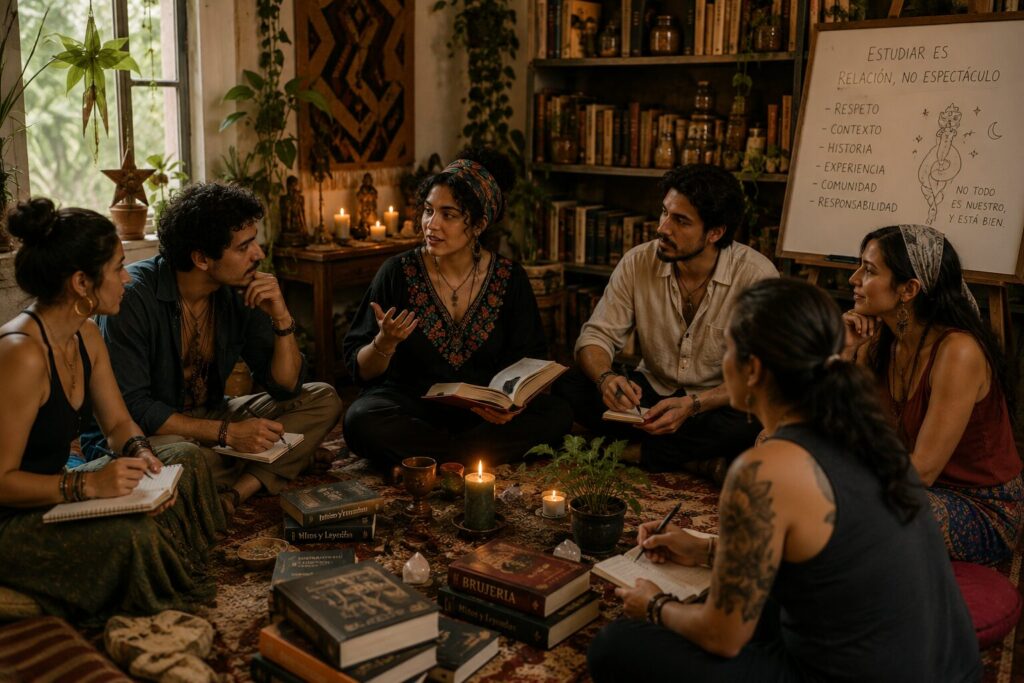
Use Structure Without Becoming Trapped by It
Study plans are tools. They should provide enough structure to protect attention without becoming another rigid standard against which the practitioner constantly fails.
A question may change because the first sources reveal that it was poorly framed. A practice may need to stop for reasons of safety, ethics or personal circumstance. A period of illness may reduce the rhythm. An unexpected insight may deserve more time than originally planned.
Revision does not mean the plan failed. It means the plan remained responsive to what the study actually produced.
The important distinction is between conscious revision and constant abandonment. Conscious revision can explain why the path changed. Constant abandonment moves repeatedly toward novelty whenever sustained attention becomes difficult.
A study path should have both a direction and permission to adapt.
Study in Cycles Rather Than Endless Accumulation
A useful cycle might look like this:
- Choose one central question.
- Gather a limited set of reliable sources.
- Learn the context and vocabulary.
- Select a safe and appropriate practice.
- Record what occurs.
- Compare experience with the sources.
- Review what changed.
- Preserve the useful material.
- Rest before beginning the next cycle.
This structure creates natural points of completion. Without completion, magical study can become an endless opening of doors without ever entering a room.
Finishing a cycle does not mean the subject has been mastered. It means the practitioner has carried one inquiry far enough to retain something coherent from it.
Let the Path Become Yours Gradually
A sustainable study path should not be built only from what a beginner is told they must know. It should also respond to the practitioner’s genuine questions, responsibilities, relationships and developing abilities.
Interest matters because it helps sustain attention. Discipline matters because interest alone moves quickly. Tradition matters because much has already been learned. Experience matters because knowledge must become lived. Ethics matters because every skill enters a world shared with others.
Over time, the study path becomes more personal without becoming careless.
The practitioner may discover recurring concerns: protection, sacred space, healing, divination, folklore, deity relations, household practice, ritual art or the history of magical ideas. These patterns can become areas of depth.
The goal is not to know every branch of witchcraft equally. It is to become broadly literate enough to recognize the landscape, deeply informed where one chooses to work and honest about what remains outside one’s knowledge.
A sustainable path does not demand constant intensity.
It returns.
It allows practice to become familiar, sources to be reconsidered and questions to mature. It gives knowledge enough time to move from information into understanding.
Study should challenge the practitioner, but it should also be capable of accompanying an ordinary human life.
Build a sustainable study cycle
Magical study becomes more useful when it has a beginning, a period of engagement and a point of reflection. Each cycle should produce something that can be retained before the next subject begins.
Choose a clear center
Begin with one question narrow enough to guide the present period of study. Save related curiosities for later rather than following every new path at once.
Select a limited foundation
Choose a few reliable sources that provide orientation, depth and, where useful, a contrasting perspective. More material is not always more understanding.
Let knowledge become lived
Select a safe and appropriate exercise. Repeat it when the method calls for repetition, allowing experience to reveal what written instructions leave unstated.
Preserve what occurred
Note context, method, observations, questions and later developments. Separate what happened from what you presently believe it means.
Decide what can be retained
Return to the original question. Identify what became clearer, what changed through practice, what remains uncertain and what deserves further investigation.
Allow knowledge to settle
Leave space for integration, ordinary life and unforced reflection. Begin the next cycle after something coherent has been gathered from this one.
Begin with a guided reading sequence, search the wider research library or explore MCC’s broader collection of study and practice resources.
Magical study does not end when the practitioner has read the foundational books, learned a ritual structure or developed a practice that reliably works. Greater experience does not remove the need to question, compare, observe and revise. It makes those responsibilities more important.
To remain a student does not mean remaining permanently uncertain or refusing to acknowledge genuine skill. It means recognizing that knowledge stays alive. Sources are rediscovered. Historical interpretations change. Communities recover teachings that were ignored or misrepresented. Relationships with deities, spirits, land and practice deepen in ways that could not have been understood at the beginning.
The practitioner changes as well.
A method learned during one period of life may reveal different dimensions later. A protective practice developed during crisis may eventually become a quieter discipline of boundaries and maintenance. A deity first encountered through mythology may become known through devotion, ritual, place, art or community. A correspondence memorized from a chart may acquire depth through years of repeated use.
Returning is not repetition without progress. The person returning is no longer the person who first encountered the material.
This is why foundational subjects deserve to be revisited. Grounding, cleansing, sacred space, protection, consent, source evaluation and record-keeping are not beginner topics that can be permanently left behind. They are enduring practices whose meaning expands with experience.
An experienced practitioner may perform a simple rite with greater depth than a novice attempting something elaborate. Skill is not always visible through complexity.
Let Confidence and Humility Develop Together
Magical study sometimes encourages two opposing errors.
The first is premature certainty: the belief that one powerful experience, one tradition, one teacher or one set of books has settled every important question.
The second is permanent hesitation: the fear that no conclusion may ever be trusted because absolute proof is unavailable.
Discernment stands between them.
Confidence grows when a practitioner knows why they hold a position. They can identify the source, tradition, repeated experience, reasoning or relationship that supports it. Humility remains because they also understand the limits of that support.
A grounded practitioner can say:
These statements do not all carry the same kind of authority, but each can be spoken honestly.
Humility does not require treating all claims as equally uncertain. Some explanations are better supported than others. Some practices are demonstrably unsafe. Some historical claims are contradicted by available evidence. Some teachers repeatedly manipulate or misrepresent what they know.
Remaining open-minded does not mean refusing to judge.
It means allowing judgment to remain responsive to evidence, experience, ethics and better understanding.
Protect the Ability to Be Corrected
The ability to revise is one of the clearest signs that study has become more than identity defense.
A practitioner may discover that a beloved story is modern rather than ancient, that a correspondence entered popular practice through a recent author or that a deity’s name has been mistranslated. They may realize that a technique they taught confidently has limitations they had not recognized.
Correction can feel personal because magical knowledge often becomes intertwined with community, memory, spiritual experience and the practitioner’s sense of self.
The answer is not to avoid commitment. It is to build commitments strong enough to survive refinement.
Learning that a practice is modern does not automatically make it meaningless. Discovering that a historical claim was mistaken does not erase every experience associated with it. A ritual may remain effective after its origin story has been corrected.
What changes is the language used to describe it.
The practitioner can preserve what remains valuable while releasing what can no longer be responsibly claimed.
This is not loss of authority. It is authority becoming more trustworthy.
Do Not Let Identity Replace Inquiry
The word witch may describe a practice, spirituality, community, inheritance, identity or combination of these. It can carry personal and political meaning. It may connect someone with history, resistance, creativity, land, deity or chosen kinship.
Identity can sustain study. It can also make certain questions feel threatening.
When every correction is experienced as an attack upon identity, inquiry becomes difficult. A person may defend a weak historical claim because it feels central to belonging. They may dismiss unfamiliar traditions because acknowledging them would complicate a preferred story. They may treat disagreement about method as rejection of the practitioner themselves.
A mature magical identity should be capable of learning.
The path does not become less authentic because its history is complicated. Practice does not lose value because another tradition understands power differently. A practitioner does not cease to be a witch because an interpretation changes.
Identity should provide a place from which to learn, not a wall against learning.
Preserve Wonder Without Abandoning Discernment
Critical study is sometimes mistaken for disenchantment. People fear that analyzing myth, checking sources or considering ordinary explanations will remove the mystery from magical life.
Wonder does not depend upon misinformation.
Understanding the astronomy of the Moon does not erase its ritual, poetic or spiritual significance. Knowing that a plant’s medicinal reputation changed across time does not make the plant less remarkable. Learning how a ritual developed historically can reveal layers of human imagination, adaptation and devotion that a simplified origin story concealed.
Discernment does not close the world. It allows the practitioner to meet the world more fully.
Likewise, wonder should not be used to avoid difficult questions. A beautiful experience can still be interpreted incorrectly. A compelling teacher can still misuse authority. A tradition can contain wisdom and harm. A powerful symbol can carry several histories at once.
The student does not have to choose between reverence and inquiry.
Reverence can motivate careful study. Inquiry can protect reverence from fantasy, exploitation and careless repetition.
Allow Mystery to Remain Mystery
Not every experience will yield a final explanation.
A dream may continue to feel significant without becoming a clear instruction. A ritual may produce a striking result that cannot be repeated. A spirit encounter may remain compelling while its identity stays uncertain. A historical symbol may be central to a tradition even though its complete meaning has been lost.
Uncertainty does not make these subjects worthless.
Sometimes the responsible conclusion is:
Magical study should improve the practitioner’s ability to remain with such statements. Mystery does not need to be filled immediately with the most dramatic available answer.
An unanswered question may continue to guide practice more fruitfully than a premature conclusion.
Learn From People Without Turning Them Into Authorities Over Everything
Teachers, authors and communities may profoundly shape a practitioner’s path. Their influence deserves acknowledgment. Their work may preserve techniques, stories, language and structures that would otherwise be difficult to access.
No teacher should become the measure of all knowledge.
Read beyond the writer who first inspired you. Learn how other traditions frame the same subject. Listen to practitioners whose histories and circumstances differ from your own. Compare modern instruction with historical sources and living community knowledge.
This does not require abandoning loyalty or gratitude.
A good teacher should survive comparison. A strong tradition should be capable of explaining its own scope. A reliable author should lead readers toward sources rather than making themselves the final destination.
The student honors teachers most fully by learning what they taught well enough to think responsibly with it.
Let Practice Correct Theory
A beautiful theory may become less convincing when it repeatedly fails to describe lived experience. A simple practice may reveal more than an elaborate explanation suggested it would.
Neither theory nor experience should dominate without conversation.
Theory gives practice structure. It explains why particular materials, actions, times or relationships belong together. Practice reveals where theory is incomplete, misunderstood or poorly suited to present circumstances.
When they differ, investigate.
The method may have been performed incorrectly. The theory may belong to a different tradition or purpose. The result may have been interpreted too quickly. The practitioner’s abilities or circumstances may have changed. The explanation may simply be wrong.
Honest practice should be allowed to challenge what the practitioner hoped to confirm.
At the same time, one unusual experience should not automatically overturn a well-developed body of knowledge. Compare, repeat where appropriate, record and allow a pattern to emerge.
The relationship between theory and practice should remain active enough that each can correct the other.
Continue Giving Something Back
Study often begins through receiving. Someone wrote the book, preserved the manuscript, translated the text, taught the ritual, maintained the community, cared for the sacred place or shared an experience honestly enough that another person could learn from it.
The practitioner eventually becomes part of that chain.
Giving back does not require founding a tradition or publishing a major work. It may mean:
- citing a source accurately;
- preserving local or family knowledge with permission;
- correcting misinformation without humiliating the learner;
- making a practice safer or more accessible;
- supporting teachers, artists, libraries or cultural organizations;
- contributing responsible discussion within a community;
- sharing a failure that prevents someone else from repeating it;
- creating art that gives symbolic language to experience;
- caring for the land or materials that support practice;
- teaching only what one is prepared to teach;
- leaving clear records for those who continue the work.
Contribution is not merely the production of more content. Sometimes the most valuable contribution is clarification, preservation, restraint or care.
Ask not only what the tradition, community or field has given you.
Ask what becomes stronger, clearer or more humane because you participated in it.
The goal is not to remove difference from witchcraft. Its traditions, philosophies and practices are too varied for one final system to contain them all. The goal is to approach that variety with enough care to recognize what is being encountered.
The Work Remains Larger Than the Practitioner
Magic invites participation in forces, relationships, symbols and questions that no single practitioner created and no single lifetime can exhaust.
Books preserve fragments. Traditions preserve structures. Communities preserve memory. Practice produces experience. Art reveals what argument cannot. Personal gnosis brings intimate knowledge. Critical inquiry gives those forms context and proportion.
No one source is sufficient by itself.
A mature understanding develops through their conversation.
From an MCC perspective, serious magical study should make a practitioner more capable without making them more careless, more confident without making them uncorrectable and more creative without making them forget what they received from others.
The strongest student is not the person who has memorized the most information or collected the most impressive titles. It is the person whose knowledge has become visible in the quality of their attention, practice, relationships and choices.
Continue your study
Return to any part of this guide or continue into the wider Liminal Arts collection for reading paths, research tools, historical sources and creative works selected for deeper magical study.
Choose the resource that fits your next question
Each page serves a different kind of learner. Begin with orientation, search by subject, enter older material with context or study the ways art and story carry magical meaning.
The Liminal Arts
Return to the central guide for MCC’s wider collection of study, practice, research and creative resources.
Beginner Reading Path
Follow a manageable sequence through foundational subjects without trying to read the entire field at once.
Witchcraft & Pagan Research Library
Find modern scholarship, practical guides and dependable resources organized for research and continuing study.
Historical & Occult Source Texts
Approach influential primary texts through modern editions, annotations, context, limitations and companion scholarship.
Art, Story & Media
Study fiction, poetry, visual art, film and other creative works as carriers of symbolic, emotional and cultural knowledge.