Crossroads Magic
The Mystery of Choosing: A threshold stands between two worlds. A crossroads stands between many.
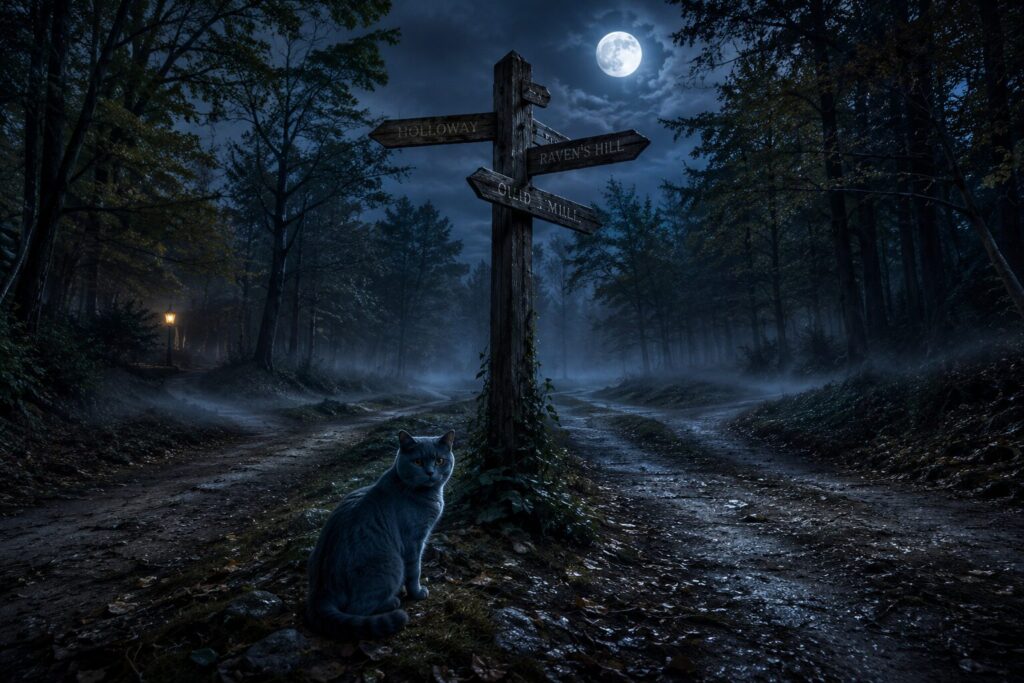
Crossroads have occupied a special place in magic, myth, religion, and folk traditions for thousands of years. More than the simple meeting of roads, a crossroads represents a meeting of possibilities. Travelers pause. Spirits gather. Offerings are left. Choices are made. It is a place where the known path ends and the future remains unwritten.
For many witches, a crossroads is both a physical location and a powerful symbol. It is a place of transition, decision, and transformation. Roads stretch outward in multiple directions, each leading somewhere different, each carrying its own opportunities, lessons, and consequences. Standing at a crossroads reminds us that life is rarely a single straight path.
Across cultures, crossroads have been associated with divine messengers, wandering spirits, ancestors, the Fair Folk, omens, and encounters with the unseen. They appear in stories of fate and free will, in rites of passage, in offerings and petitions, and in magical workings intended to release the old and welcome the new.
A threshold stands between two worlds. A crossroads stands between many. For that reason, witches have long regarded crossroads as places where choices carry power, where the veil may grow thin, and where the roads of the living, the dead, the spirit world, and the future sometimes seem to meet.
The Liminal Crossroads
A crossroads is a liminal place: a place between places. It belongs fully to no single road, yet it touches every road that meets there. Like a doorway, a shoreline, dusk, dawn, or the turning of the year, the crossroads exists in a state of transition.
This is why crossroads have long been treated as spiritually charged locations. They are places of movement, uncertainty, and possibility. The ordinary rules of direction loosen. The path behind us no longer fully holds us, and the path ahead has not yet claimed us.
A threshold stands between two worlds. A crossroads stands between many.
For witches, this makes the crossroads a place of access. The veil may feel thinner here. Spirits, ancestors, the Fair Folk, divine messengers, wandering dead, omens, and intuitive signs are all said to draw near in such in-between places. Not because crossroads are empty, but because they are open.
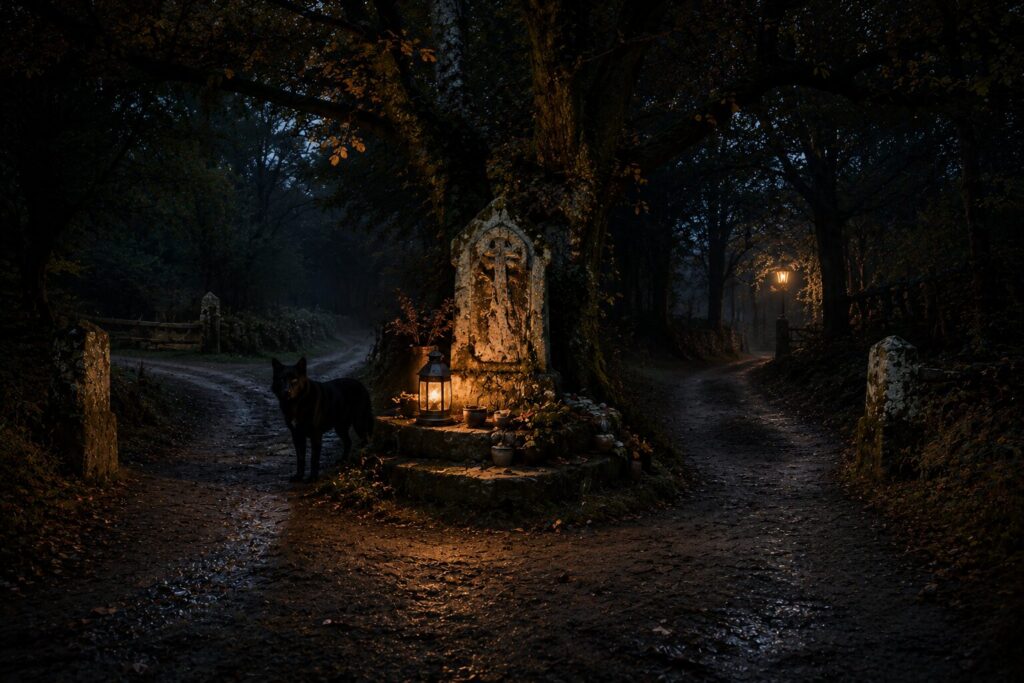
Throughout history, crossroads have been viewed as places where worlds meet. In many magical and folk traditions, they are regarded as points where the boundary between the ordinary and the unseen becomes more permeable. Travelers move through them, but so too are spirits, ancestors, messengers, and otherworldly beings said to pass along these symbolic roads.
Many witches believe crossroads are places where the veil may grow thin. Encounters with the spirit world, unusual omens, meaningful coincidences, and moments of insight are often associated with liminal places, and few locations embody liminality as clearly as a crossroads. Standing between destinations, a crossroads occupies a space that is neither fully here nor fully there.
This association appears in many forms. Some traditions speak of ancestors who linger near roads and boundaries. Others tell stories of the Fair Folk appearing at crossroads, particularly during certain seasons or at liminal hours such as dusk, midnight, and dawn. Spirits of place, wandering dead, divine messengers, and guardians of the road all appear throughout myth, folk belief, and magical practice.
Not every practitioner interprets these experiences in the same way. Some understand crossroads encounters as genuine spirit contact. Others view them as symbolic, psychological, or intuitive experiences. Yet regardless of explanation, crossroads have remained places where people seek guidance, leave offerings, receive signs, and reflect upon important decisions.
Perhaps this is because crossroads remind us that reality itself is layered. Every road leads somewhere. Every choice opens one possibility while closing another. For a brief moment, standing at the meeting of roads, we find ourselves between what has been and what may yet become.
In that sense, every crossroads is a meeting place—not only of roads, but of worlds.
The Keepers of Roads
Throughout history, crossroads have rarely been viewed as empty places. Where roads meet, traditions often imagine guides, guardians, messengers, and spirits who watch the ways between destinations. Some are gods, some are ancestors, some are local spirits, and some remain unnamed. Yet across cultures, the symbolism remains remarkably consistent: the road is never merely a road.
“Where roads meet, traditions often imagine that worlds meet as well.”
Hekate Enodia
Hekate of the Ways
Among the figures most closely associated with crossroads is Hekate, an ancient goddess connected with thresholds, spirits, witchcraft, night journeys, and liminal places. She is often depicted carrying torches that illuminate the unseen road ahead and keys that symbolize access to mysteries, gateways, and hidden knowledge.
As Hekate Enodia, she stands not merely at the crossroads themselves but along the roads that lead to them. She is a guardian of transitions, a watcher at boundaries, and a guide through uncertain places. In many traditions she is accompanied by dogs, whose barking was sometimes interpreted as a sign of her presence or the movement of spirits near the crossroads.
For witches, Hekate often represents the wisdom required when standing before a difficult choice. Her torches do not choose the road for us, but they help reveal what lies before us.
Hekate Trioditis
Hekate of the Three Ways
One of Hekate’s most famous epithets is Trioditis, meaning “of the three ways” or “of the three-road crossroads.” Ancient offerings associated with Hekate were often left at such locations, particularly during the Deipnon, a monthly observance held near the dark moon.
These offerings served many purposes. Some were acts of devotion, while others sought protection, purification, guidance, or the removal of harmful influences. In many folk traditions, the crossroads became a place where burdens could be symbolically left behind and where the old road could be released before stepping onto a new one.
The image of Hekate standing where three roads meet remains one of the most enduring symbols in witchcraft. It speaks to mystery, transformation, and the understanding that every choice carries us toward a different future.
Hermes Enodios
Hermes of the Road
Long before modern roads were paved, travelers encountered stone markers known as herms placed at boundaries, crossroads, and along important routes. These markers honored Hermes, a god associated with travel, communication, commerce, luck, movement, and the spaces between.
As Hermes Enodios, he becomes a patron of roads and travelers. Merchants sought his favor for safe journeys and successful trade, while wanderers looked to him for protection and guidance. His domain was not simply movement, but meaningful movement: messages carried, goods exchanged, and journeys completed.
Hermes also possessed a deeper role. As a psychopomp, he guided souls between worlds and escorted the dead upon their final road. This connection links crossroads not only with travel, but with spiritual passage, transformation, and transition itself.
Road Spirits & Travelers
Those Who Walk Between
Not every presence encountered at a crossroads bears the name of a god. Across many traditions, crossroads are associated with ancestors, wandering spirits, the Fair Folk, land spirits, spirit messengers, and other beings believed to move between worlds.
Some traditions speak of the wandering dead who linger near roads and boundaries. Others tell stories of encounters with the Fair Folk at crossroads during liminal hours such as dusk, midnight, and dawn. Offerings left at crossroads may be intended for ancestors, local spirits, or unnamed powers associated with a place.
Whether these beings are understood as literal spirits, symbolic presences, or expressions of deeper mysteries, crossroads remain places where many practitioners feel the unseen world draws closer than usual.
Long before crossroads became associated with magical workings, they occupied a special place in myth, religion, storytelling, and folk traditions. Across cultures and across centuries, people repeatedly returned to the same image: a traveler standing where roads divide, faced with a choice that may change everything that follows.
In ancient Greece, crossroads were associated with Hekate, whose presence was honored at places where roads met and where offerings were left at the dark moon. These locations were not viewed merely as convenient gathering places but as spiritually significant points where boundaries weakened and the visible world touched the unseen. The crossroads became a place of devotion, petition, release, and encounter.
Crossroads also appear in stories of fate. In Greek mythology, Oedipus encounters a stranger at a crossroads, a seemingly ordinary meeting that ultimately becomes a turning point in his destiny. The symbolism remains powerful: crossroads are places where choices are made, but they are also places where hidden consequences may reveal themselves only much later.
Throughout Europe, folk traditions often regarded crossroads as places where unusual encounters were more likely to occur. Travelers told stories of spirits, wandering lights, mysterious strangers, and the Fair Folk appearing where roads intersected. Certain crossroads were considered fortunate, others dangerous, and many were treated with a mixture of respect and caution. To stand at a crossroads was to stand at the edge of possibility.
Crossroads have also become woven into modern folklore and popular culture. Perhaps the most famous example is the legend of the crossroads bargain, a story most often associated with blues musicians who were said to gain extraordinary talent through a supernatural encounter at a crossroads. While the details vary from telling to telling, the symbolism remains recognizable: the crossroads as a place of transformation, exchange, and life-changing decisions.
Even outside of explicitly magical traditions, the crossroads remains one of humanity’s most enduring symbols. We speak of being “at a crossroads” when facing difficult decisions. Literature, poetry, and art repeatedly return to roads that diverge, paths that branch, and journeys that require a choice. The image resonates because it reflects a truth most people eventually experience: there are moments when more than one future lies before us.
For witches, this symbolism is particularly meaningful. Crossroads remind us that magic is often less about forcing a destination and more about understanding the roads available to us. Every path carries possibilities. Every choice shapes what follows. The crossroads becomes a sacred reminder that transformation begins not when the journey ends, but when the traveler chooses which road to walk.
The Working Crossroads
While crossroads are rich with symbolism, they have also served practical roles in magical and folk traditions for centuries. Offerings, petitions, rites of release, spirit work, and acts of transformation have all found a home where roads meet. Traditions vary widely, but many share a common understanding: crossroads are places of movement, and what is brought there is often intended to change, depart, or continue on its way.
Offerings & Petitions
Crossroads have long been places where offerings are given and requests are made. In some traditions these offerings are devotional, intended to honor spirits, ancestors, deities, or guardians of the road. In others they accompany prayers, petitions, or requests for guidance.
The offering itself is often less important than the act of relationship. A crossroads offering acknowledges that the practitioner stands at a meeting place and approaches that place with respect rather than entitlement.
Leaving Things Behind
One of the most widespread uses of crossroads in folk magic involves release. Petition papers, spell remnants, symbolic burdens, and objects representing unwanted influences may be left behind as part of a working.
The symbolism is simple but powerful. Roads carry movement. What is released at the crossroads is no longer carried home. The practitioner leaves it behind and continues onward.
Ritual Waters & Remains
Many traditions dispose of ritual waters, cleansing waters, floor washes, spell remains, or offerings at crossroads. This practice appears in numerous forms throughout folk magic and regional magical customs.
The underlying idea is often one of transfer and movement. The working is completed, released, and allowed to continue beyond the practitioner’s personal space.
Walking Away
Many crossroads customs focus not on what is left behind, but on how one leaves. Some traditions advise walking away without looking back. Others describe leaving by a different road than the one used to arrive. Still others include walking backward for a short distance before turning away.
The details vary greatly between traditions, but the symbolism remains familiar: the working is complete, and the practitioner releases attachment to the outcome rather than continually pulling it back toward themselves.
“Not everything must be carried home. Some things are meant to be left at the crossroads.”
Modern practitioners approach crossroads work in many different ways. Some focus on offerings and spirit relationships. Others use crossroads symbolism for decision-making, divination, release, or personal transformation. There is no single universal crossroads rite. What unites these practices is the understanding that crossroads represent movement, possibility, and the moment when one road becomes another.
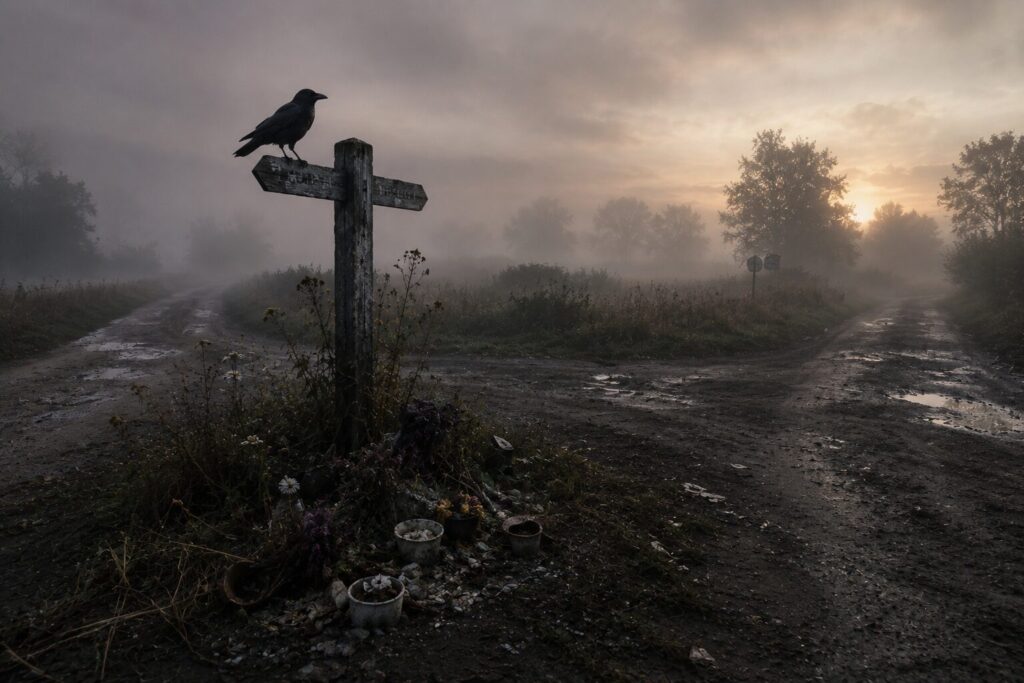
One of the deepest mysteries of crossroads magic is the act of release. Many workings brought to the crossroads are not meant to be kept, carried, or returned to the home. They are brought there because the practitioner is ready to let something move beyond them.
This may be a burden, a fear, a harmful attachment, an old pattern, a spiritual heaviness, or the remains of a completed working. In folk magic, the physical act of leaving something at a crossroads often mirrors an inner act of separation. The practitioner marks a boundary between what was carried before and what will no longer be carried forward.
This is why so many crossroads customs emphasize departure. Walking away without looking back, leaving by another road, or withdrawing carefully from the place are all ways of reinforcing the same spiritual motion: the work has been released. The road now carries it onward.
Not every release requires a physical crossroads. A symbolic crossroads can be created through ritual, visualization, prayer, or spellwork. For modern witches, especially those in cities or places where leaving physical items would be unsafe or disrespectful, the essential act is not littering the land with spell remains. The essential act is choosing to let go.
The crossroads teaches that release is not always destruction. Sometimes it is relocation. Sometimes it is surrender. Sometimes it is the quiet decision to stop carrying what has already reached the end of its road.
Crossroads Safety, Ethics & Respect
Crossroads magic has deep roots in many traditions, but respect for the road begins with respect for the people, spirits, animals, and communities that share it. A meaningful working should never create harm, danger, or unnecessary disruption.
Respect the Land
Avoid leaving trash, non-biodegradable materials, glass, plastics, nails, candles, or anything that could injure wildlife, damage the environment, or create work for others. When possible, choose offerings and practices that leave little or no trace.
Respect the Living
Do not trespass, block roads, create hazards, or interfere with traffic. Public safety takes precedence over ritual convenience. A crossroads working should never place you or others at risk.
Respect the Spirits
If you approach a crossroads as a sacred place, approach it with humility. Offerings and petitions are invitations to relationship, not demands for service. Gratitude, courtesy, and clear intention often matter more than elaborate ritual.
Modern Alternatives
Not every practitioner has access to a safe or appropriate crossroads. Symbolic crossroads can be created within ritual space, through visualization, prayer, meditation, or other forms of magical work. The symbolism remains powerful even when the roads are internal rather than physical.
The crossroads is not separate from the world around it. Respect for the unseen begins with respect for the seen.
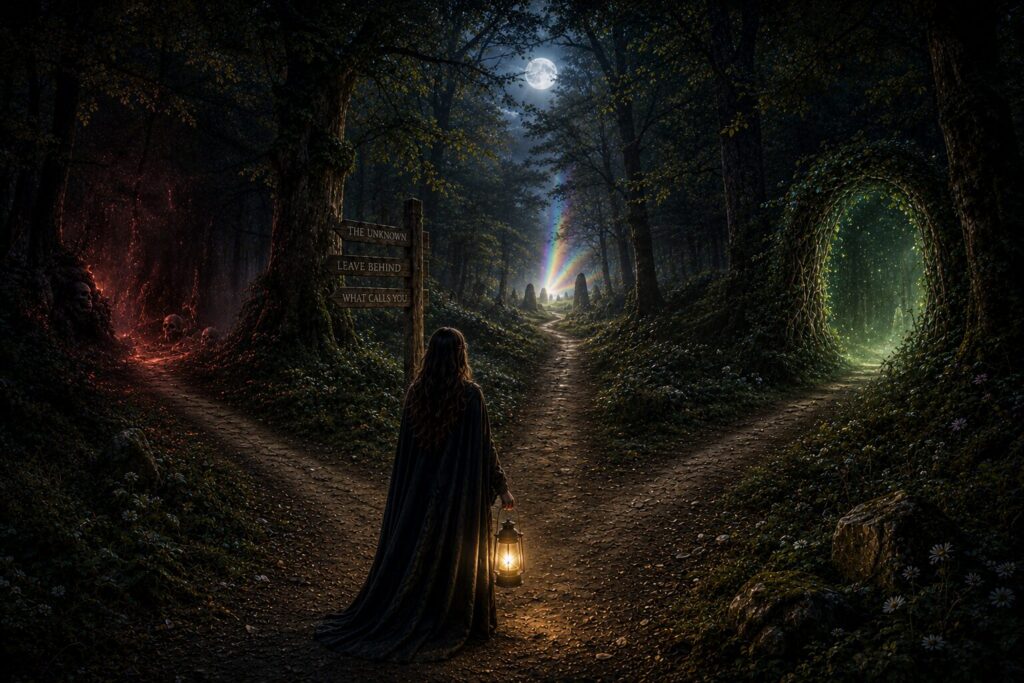
Not all crossroads are found on maps.
Some appear in relationships, careers, beliefs, identities, and moments of personal transformation. Some arrive quietly over time, while others seem to emerge all at once, demanding a choice before we feel ready to make one. Yet regardless of how they appear, crossroads are among the most universal experiences of the human journey.
Every significant choice creates a division between roads. One path is taken while another is left behind. New possibilities open, others close, and the traveler is changed by the decision itself. The crossroads reminds us that transformation rarely begins at the destination. It begins at the moment we choose a direction and take the first step.
This is one reason crossroads have remained powerful symbols in magic, myth, and spiritual traditions. They represent the meeting point between fate and free will. Circumstances may bring us to the crossroads, but they do not always determine which road we walk. The choice remains ours.
For witches, crossroads magic is ultimately about awareness. It asks us to pause long enough to recognize the roads before us, to understand what we are carrying, to consider what must be released, and to choose our direction with intention. The crossroads becomes not merely a place of decision, but a place of becoming.
Perhaps that is why crossroads continue to appear throughout stories, dreams, visions, and spiritual experiences. They reflect something deeply human: the knowledge that life is shaped not only by where we have been, but by the roads we choose when the future stands open before us.
Threshold Magic explores the mystery of being between. Crossroads Magic explores the mystery of choosing. Psychopomp Work explores the mystery of crossing.
Together, they remind us that every journey begins with a threshold, every threshold presents a choice, and every choice eventually becomes a road.