Psychopomp Work
Guiding the Living, Honoring the Dead, Walking the Threshold Between
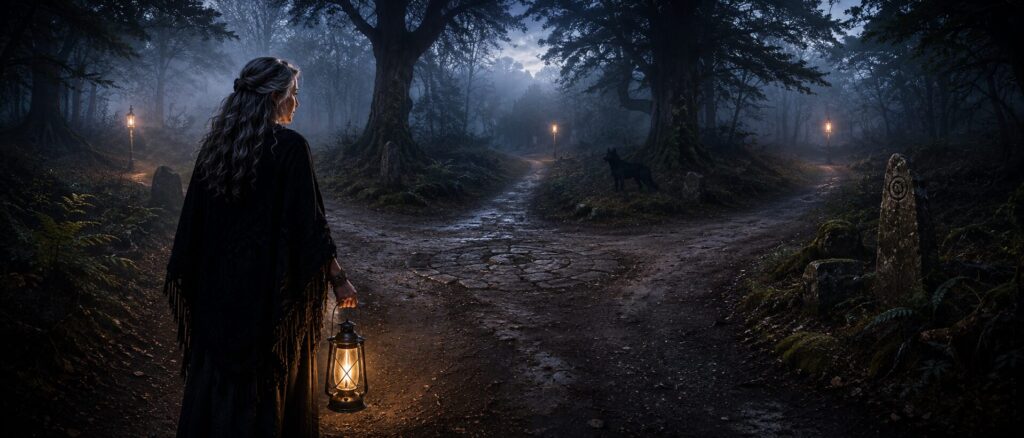
Keeper of the Lantern
There are moments in life when we find ourselves standing at a threshold.
A loved one passes from this world into whatever lies beyond. A family leaves one home and enters another. A marriage begins. A relationship ends. A child becomes an adult. A seeker steps onto a spiritual path for the first time. We cross these boundaries every day, though we do not always recognize them for what they are.
Many magical traditions teach that thresholds are sacred places. They are the spaces between one state of being and another, where certainty gives way to possibility and transformation becomes possible. Doorways, crossroads, shorelines, gates, bridges, dawn, dusk, birth, death, and initiation have all been regarded as liminal places throughout history. They are neither fully one thing nor another. They exist in between.
Psychopomp work is rooted in these spaces.
The word psychopomp comes from the Greek psychopompos, meaning “guide of souls.” Traditionally, a psychopomp is a being, deity, spirit, or practitioner who assists with crossings. In some traditions this means escorting the dead toward their next destination. In others it involves guiding the living through profound transitions, grief, transformation, or spiritual awakening. While the details differ from culture to culture, the central idea remains remarkably consistent: someone carries the lantern while another finds their way through the dark.
At the Coven of the Veiled Moon, we view psychopomp work as a path of service rather than authority. The psychopomp does not command the road, judge the traveler, or determine where the journey leads. Their role is to witness, guide, protect, and assist where appropriate. They are a keeper of the threshold, not its ruler.
This distinction is important. Popular culture often portrays psychopomp work as dramatic spirit rescue, ghost hunting, or confrontation with the dead. While some practitioners believe they occasionally assist spirits who have become confused, lingering, or disconnected from their intended path, authentic psychopomp work is usually quieter than the stories suggest. It is found in bedside vigils, funeral rites, ancestor observances, prayers for the departed, sacred crossings, and the gentle act of helping another being move from one state into another with dignity and care.
Not every psychopomp works with spirits directly. Some are hospice workers who sit with the dying. Some are grief counselors who help the living navigate loss. Some are clergy, death doulas, mediums, caregivers, or spiritual practitioners who find themselves repeatedly called to accompany others through periods of profound change. These individuals may never use the word psychopomp, yet they perform one of its oldest functions: walking beside another during a crossing.
This page explores psychopomp work through a broad lens. We will discuss the symbolism of thresholds, the role of guiding spirits, ethical considerations, discernment, protective practices, and the responsibilities that accompany this path. We will also examine related topics such as mediumship, ancestor work, ghosts, and liminal spaces while recognizing that different traditions understand these subjects in different ways.
Whether you view psychopomp work as a spiritual calling, a symbolic practice, a sacred duty, or simply an area of curiosity, we invite you to approach it with humility, compassion, and respect. The keeper of the lantern does not force the journey. They illuminate the path and walk beside those who must travel it.
At the Threshold
What Is Psychopomp Work?
Psychopomp work is the spiritual practice of guiding, witnessing, and assisting crossings. These crossings may involve the dead, the living, the grieving, the transforming, or anyone standing between what was and what comes next.
A Guide
The psychopomp does not rule the path. They accompany the traveler, offering presence, protection, prayer, and guidance when appropriate.
A Witness
Much of this work is quiet. It may appear as vigil, ritual, prayer, mediumship, grief support, ancestor care, or sacred attention at a moment of transition.
A Threshold Keeper
Psychopomp work belongs to liminal places: doorways, crossroads, dusk, dawn, endings, beginnings, grief, death, initiation, and change.
In this work, the lantern matters more than the command. The practitioner illuminates the crossing, but the journey still belongs to the one who walks it.
Walking the Threshold
Psychopomp work begins with recognition. Before any prayer is spoken, candle is lit, spirit is addressed, or ritual is formed, the practitioner must first understand that a threshold is present.
A threshold is not always dramatic. Sometimes it appears as a deathbed, a funeral, a haunting, or a moment when the veil feels unusually thin. Other times it appears as grief, illness, transition, relocation, spiritual crisis, or the quiet realization that something in a person’s life has ended and something new has not yet begun.
To walk the threshold is to enter that space with care. It asks the practitioner to be calm, grounded, and discerning. Not every crossing requires intervention. Not every spirit needs assistance. Not every silence is a sign. The first task is not to act, but to listen.
In this work, the practitioner becomes less like a commander and more like a lantern bearer. They prepare the space, tend the boundaries, witness what is present, and offer guidance only where it is needed. The crossing itself belongs to the traveler.
The Living Psychopomp
When people hear the word psychopomp, they often imagine a spirit guide, a deity of the dead, or a practitioner helping souls move beyond the veil. While these are valid expressions of the concept, they represent only part of the story.
Throughout history, many of the most important psychopomps have been entirely human.
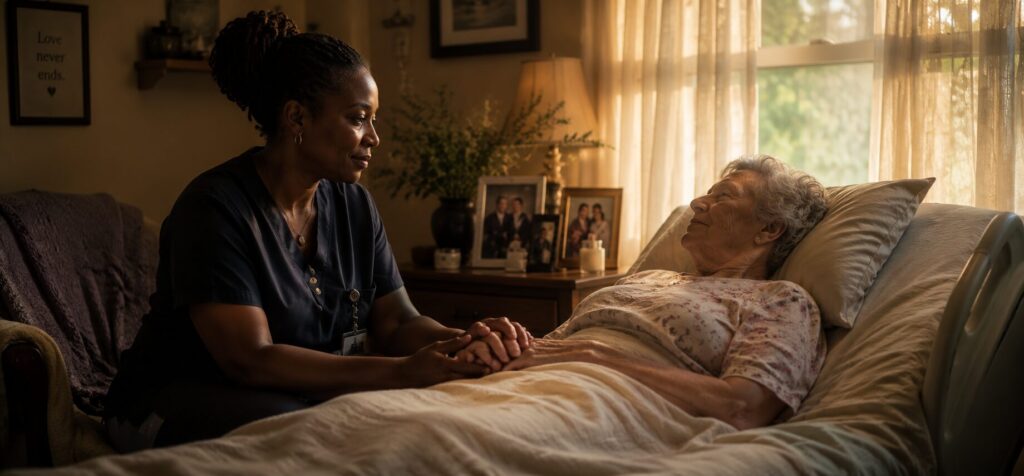
A hospice nurse who sits beside a dying patient during their final hours. A grief counselor helping someone navigate devastating loss. A chaplain offering comfort during tragedy. A death doula guiding a family through the realities of dying. A caregiver who remains present when others have stepped away. These individuals stand at thresholds every day, helping others move from one state of being into another.
The living psychopomp does not necessarily work with spirits. Their role is not to command the crossing but to accompany it. They provide steadiness in uncertain moments, compassion during upheaval, and reassurance when the path ahead is unclear. Their lantern may be practical rather than magical, yet the service they provide remains deeply sacred.
Many spiritual practitioners discover that psychopomp work appears in their lives long before they ever learn the word. Friends seek them out during periods of grief. Strangers confide in them during moments of transition. Family members turn to them when death approaches. Again and again they find themselves standing beside those who are crossing from one chapter of life into the next.
Not every psychopomp works with the dead. Some help people navigate divorce, recovery, spiritual awakening, gender transition, major illness, relocation, retirement, initiation, or profound personal transformation. In each case the pattern is similar: one reality is ending, another has not yet fully begun, and someone is needed to hold the lantern while the traveler finds their footing.
For this reason, psychopomp work is not defined solely by death. It is defined by presence. The willingness to stand at the edge of uncertainty without turning away. The ability to witness change without rushing it. The wisdom to guide when guidance is needed and remain silent when it is not.
Many who walk this path never call themselves psychopomps. Yet their actions embody one of the oldest sacred duties known to humanity: accompanying another being through a crossing with dignity, compassion, and care.

Spirits, Deities & Sacred Companions
Keepers of the Way
In psychopomp work, deities and sacred companions are not simply names attached to death or travel. They represent ways of understanding passage itself: movement, protection, witness, discernment, release, and the mystery of what lies beyond the visible road.
Hermes
Hermes intersects with psychopomp work through movement. He is the road opening, the message carried between worlds, and the intelligence that knows how to cross boundaries without becoming trapped by them. In this magic, Hermes teaches that a crossing is not only an ending; it is also a passage, a translation, and a way forward.
HermesHekate
Hekate intersects with psychopomp work through the threshold itself. She stands where paths divide, where choices become unavoidable, and where the unseen presses close to the visible. In this magic, Hekate teaches that not every door should be opened, not every road should be taken, and not every crossing can be entered without reverence.
HekateAnubis
Anubis intersects with psychopomp work through sacred order. His presence reminds the practitioner that death and transition are not chaos to be conquered, but mysteries to be approached with preparation, dignity, and restraint. In this magic, Anubis teaches that passage requires steadiness, protection, and respect for the soul’s own road.
Odin
Odin intersects with psychopomp work through ordeal, vision, and the cost of wisdom. His path reminds us that some crossings change the one who witnesses them. In this magic, Odin teaches that the mysteries beyond ordinary sight are powerful, but they are never casual. The seeker must know why they are asking to see.
Raven
Raven appears where message, memory, death, and omen meet. In psychopomp work, raven symbolism often speaks to attention: what is being carried, what is being witnessed, and what must not be ignored.
Dog
Dog stands at the gate as companion and guardian. In this work, dog symbolism reminds us that protection is not domination. Sometimes the most sacred guidance is faithful presence.
Owl
Owl belongs to the night road, where truth is sensed before it is seen. In psychopomp work, owl symbolism speaks to silence, perception, hidden movement, and the wisdom of not rushing.
Wolf
Wolf walks the edge between belonging and wilderness. In this magic, wolf symbolism speaks to instinct, guidance through danger, and the need to know when to lead, when to follow, and when to let go.
To work with a psychopomp figure is not merely to borrow a symbol of death or passage. It is to enter relationship with a power that understands thresholds more deeply than we do.
The lantern does not own the road.
It only helps the traveler see where the road begins.
Inner Thresholds
Shadow work teaches us that not every darkness is a haunting. Sometimes the threshold is within.
Shadow WorkCareful Discernment
Parapsychology and psychopomp work may intersect, but they are not the same path. One studies unusual phenomena; the other attends sacred passage.
Parapsychology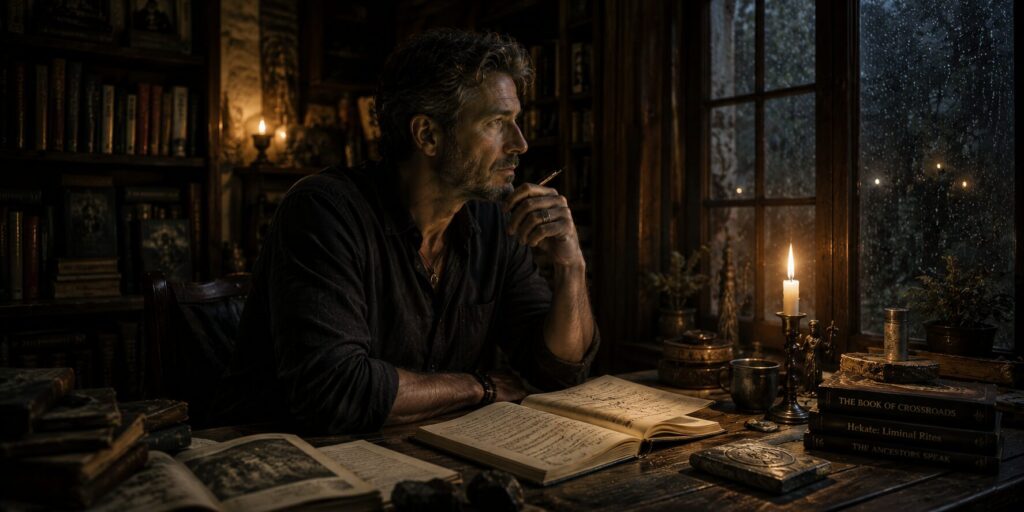
Ethics, Discernment & The Weight of the Work
Psychopomp work carries a spiritual seriousness that should not be romanticized. To stand at a threshold is to stand near grief, fear, memory, mystery, and sometimes death itself. This work can be beautiful, but it is not casual.
The first responsibility of the practitioner is discernment. Not every presence is a ghost. Not every haunting is a soul in need of crossing. Not every emotional impression is a message from the dead. Sometimes what is present is grief. Sometimes it is fear. Sometimes it is memory, environment, imagination, trauma, or symbolism rising from the deep self.
The second responsibility is humility. A practitioner should never assume they know what a spirit needs, what a dying person needs, or what a grieving family needs simply because they feel called to help. Psychopomp work is not spiritual heroism. It is service, and service begins by listening.
The third responsibility is restraint. There are moments when the most ethical choice is not to act, not to open the door, not to attempt contact, and not to force a crossing. Some thresholds are not ours to enter. Some roads are not ours to walk. Some mysteries are meant to be honored from a respectful distance.

Tools of the Lantern Bearer
No single practice creates a psychopomp. There is no universal ritual, secret prayer, or sacred object that grants mastery over thresholds. Instead, psychopomp work draws upon many disciplines, each offering a different way to understand transition, relationship, protection, communication, and spiritual responsibility.
Some practitioners rely heavily on prayer and devotion. Others work through mediumship, ancestor relationships, divination, or ritual protection. Many never engage directly with spirits at all, instead focusing on grief support, spiritual companionship, or guiding others through periods of profound change.
The tools below are not requirements. They are pathways. Each offers a different lens through which the practitioner may approach crossings, liminal spaces, and the responsibilities that accompany them.
Closing the Gate
Every threshold that is opened deserves to be closed with care.
In psychopomp work, closing is not an afterthought. It is part of the work itself. The practitioner must know how to release what has been called, thank what has assisted, ground what has been stirred, and return fully to ordinary life. Without closure, threshold work can linger in the body, the home, the mind, or the emotional field.
A simple closing may include extinguishing candles, offering thanks, speaking a clear release, cleansing the space, touching the ground, eating or drinking something simple, washing the hands, or reaffirming the boundaries of the room or home. More formal work may include prayer, offerings, banishing, ward renewal, or devotional closure with a trusted deity or guide.
The important thing is not complexity. It is completion.
The practitioner should leave the work knowing that the threshold has been honored, the space has been restored, and their attention has returned to the present world. The lantern is not meant to burn forever. It is carried when needed, then set down.
A Simple Closing Practice
✦ Offer thanks to any spirits, deities, ancestors, or powers invited into the work.
✦ Speak a clear statement of release and closure.
✦ Ground yourself through breath, food, water, movement, or touch.
✦ Cleanse or reset the space if your tradition calls for it.
✦ Reaffirm the boundaries of your home, ritual area, or personal practice.
✦ Return your awareness fully to the present moment.
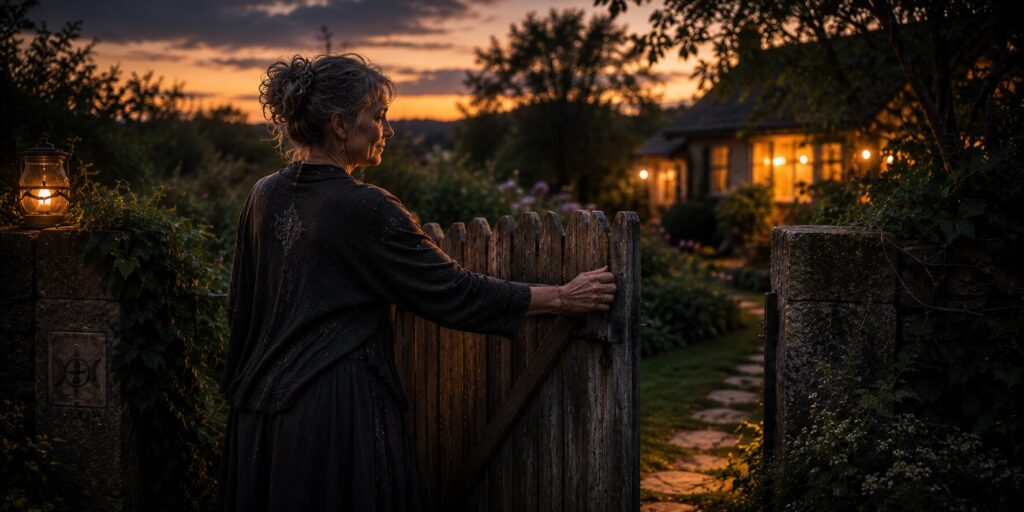
Psychopomp work asks us to become comfortable with thresholds. Not because they are easy, but because they are inevitable.
Every life is shaped by crossings. We leave, arrive, lose, discover, grieve, transform, and begin again. Some thresholds are joyful. Others break the heart. Some are chosen. Others come without invitation. Yet each one reminds us that existence is not fixed. We are always becoming, always releasing, always moving from one state of being into another.
The psychopomp does not remove the mystery from these crossings. They do not claim to know every road or answer every question. Their gift is presence. Their work is to stand near the edge with compassion, discernment, and courage.
For some, this work may involve spirits, ancestors, deities, or the dead. For others, it may appear through caregiving, grief support, ritual, prayer, or simply the willingness to remain present when another person is passing through uncertainty. All of these expressions can carry sacred weight when approached with humility.
At its heart, psychopomp work is not about death alone. It is about passage. It is about honoring the moment when one world loosens its hold and another begins to appear.
The keeper of the lantern does not walk every road. They simply help others find their way when the path grows dark.
Continue Your Journey
Every path eventually leads to another threshold. Explore related teachings, seek guidance, or continue your study of magical practice.