Sacred & Magical Places
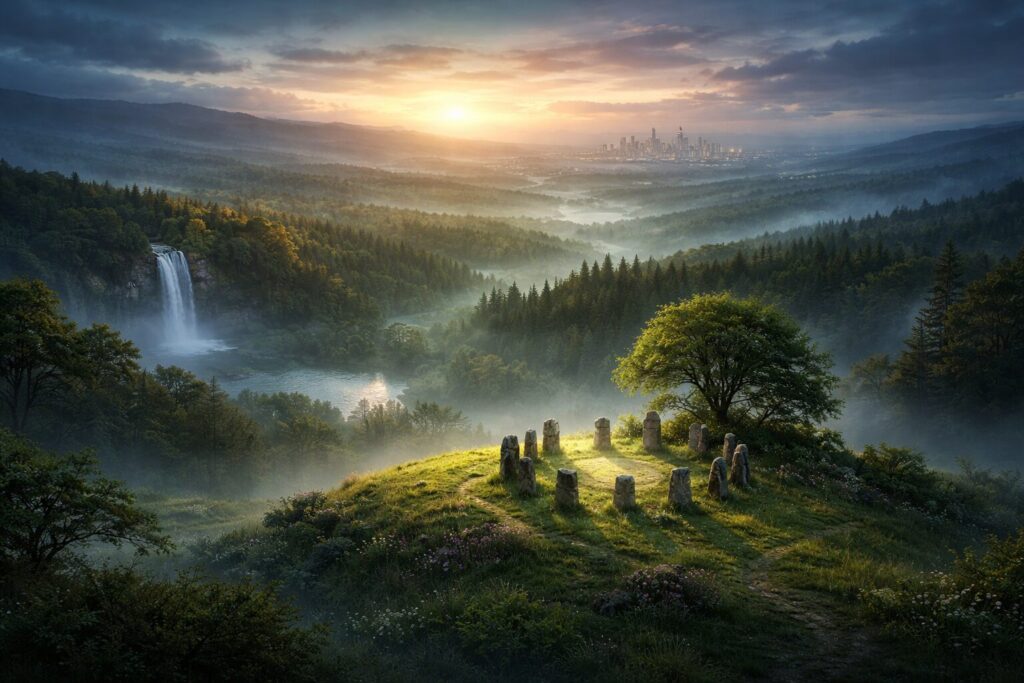
A “place” is never only a backdrop. In the Craft, place is a participant: it remembers, it accumulates, it answers back. Some locations feel alive in the oldest sense—more than scenery, more than atmosphere—because an animating presence is genuinely there (what we would call full animism). Others become powerful through sustained attention: repeated ritual, devotion, grief, celebration, vows, offerings, and simple human return. Over time, the land (or the built environment) develops an emergent field—an energetic and symbolic gravity that begins to shape what happens there.
Within the Coven of the Veiled Moon, we treat sacred places and magical places as related but not identical. A sacred place is often encountered as a seat of manifestation: a site where a deity, high spirit, or enduring intelligences are reverenced, approached, and sometimes felt as “resident” in the sense that the relationship has a home. A magical place may begin with no explicit divinity at all—it becomes enchanted because people repeatedly work there, love there, mourn there, pray there, dream there, and weave meaning into it until the site develops a recognizable charge. A decommissioned temple can retain an echo for years. A grove can hold presence for centuries. Even the “memory of place” can become uncanny—like a kind of environmental haunting, where the residue of repeated events behaves almost like a ghost.
Some places carry their power openly. A waterfall such as Multnomah Falls can be encountered as unmistakably alive, not merely beautiful. Some sites are sacred because people have treated them as sacred for so long that reverence itself becomes infrastructure—pilgrimage and devotion acting as a slow, ongoing ritual. Some become famous in modern pagan imagination— Mount Shasta, for instance, has become a contemporary magnet for mythic projection and genuine seeking alike, and those layers matter. Others are older than our current names for them: Newgrange and the nearby Hill of Tara carry the unmistakable feel of long human relationship with land—monument, story, and current braided together across millennia.
This page holds both sides of the subject: the cosmology of place and the practical methods of working with it. We will map the ways a site becomes sacred or magical, the ways fairy-threshold geography tends to cluster around edges and old boundaries, the ways energetic grids (ley lines and related systems) overlay the landscape, and the ways places can become tainted or “cursed” through trauma, neglect, or deliberate binding. Just as importantly, we’ll cover ethics: how to approach a living land respectfully, how to make offerings without entitlement, how to enchant a place without colonizing it, and how to recognize when the wisest magic is to leave a threshold undisturbed.
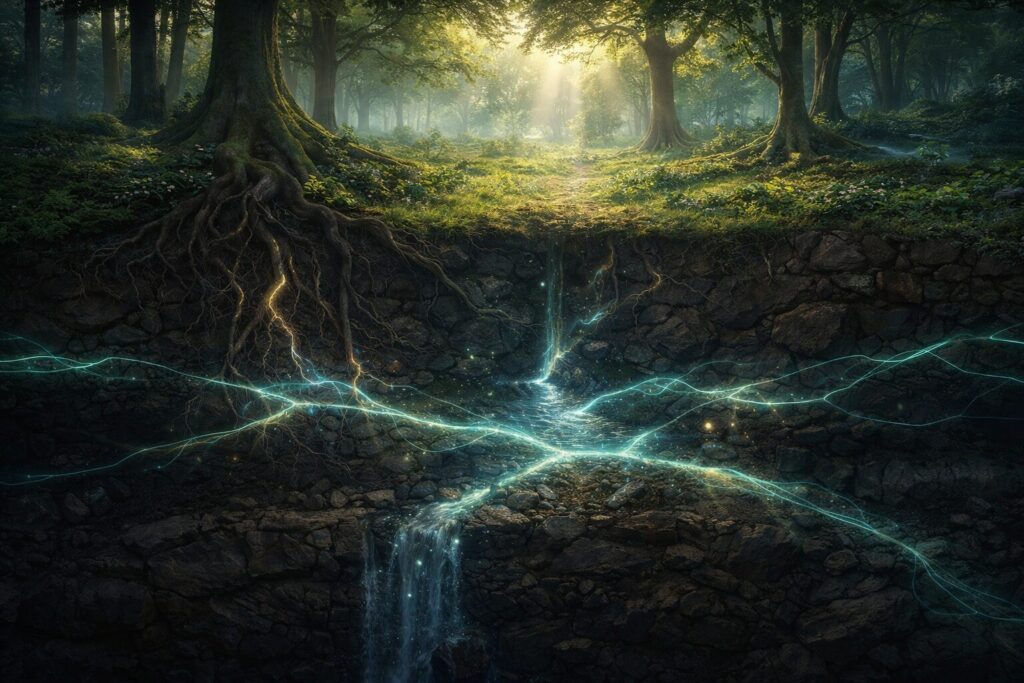
The Five Layers of Place
A location may carry one of these layers — or several at once. Sacred and magical sites often become powerful because these currents overlap and reinforce one another.
Inherent Animism
Some places are alive in their own right. Not metaphorically — but as full intelligences. Ancient groves, waterfalls, volcanic mountains, caves, and springs may carry presences that precede human naming.
Rare. Recognized, not created.
Emergent Field
Repeated attention builds current. Prayer, ritual, grief, celebration, pilgrimage — over time these actions form a layered energetic field that shapes experience.
Grows through sustained relationship.
Spirit Inhabitation
Some sites become seats of deity or high spirit manifestation. Others host land-wights, ancestors, or adjacent intelligences aligned with the local ecology.
Presence chooses to anchor.
Memory & Imprint
Trauma, devotion, vows, betrayal, ritual failure — repeated events can leave psychic residue. At times this behaves like a ghost of place rather than a spirit.
Echo, not always entity.
Ley & Grid Overlay
Subtle earth currents, energetic alignments, and esoteric grid systems can intensify a location. Sacred sites often cluster along these crossings.
Infrastructure beneath the visible.
Sacred Places
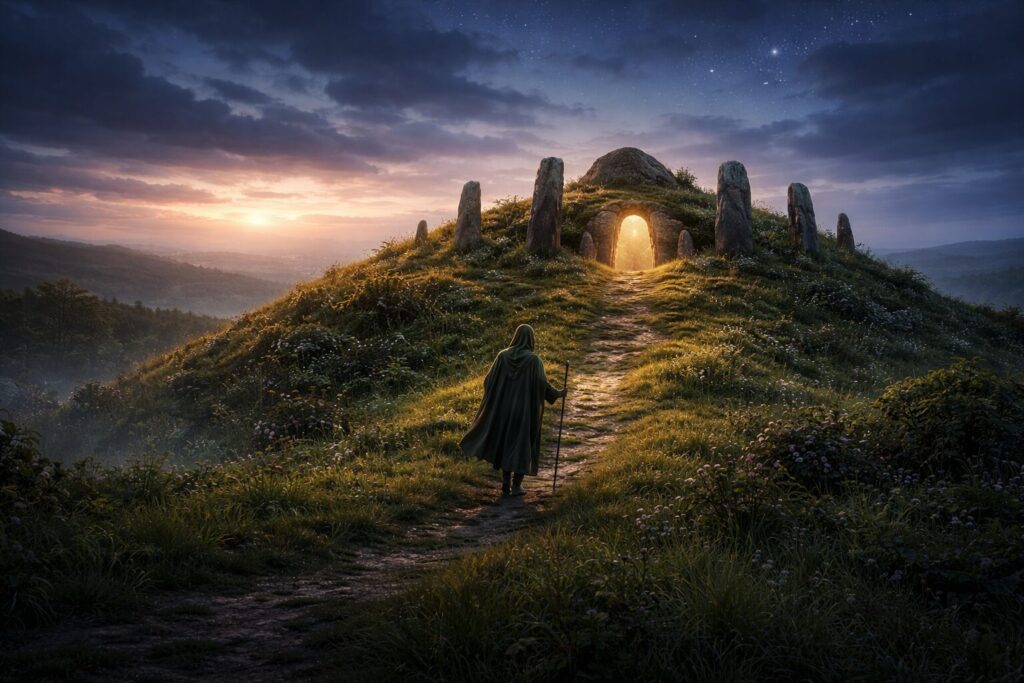
A sacred place is not merely beautiful, nor simply old. It is a site where reverence has substance. In some cases, that substance precedes human arrival: a spring that feels inhabited, a mountain that behaves less like geology and more like presence. In other cases, the sacredness develops through relationship — generations of offerings, pilgrimages, ritual return, and story weaving forming a stable seat for manifestation.
Some sacred sites are encountered as fully animist. A waterfall such as Multnomah Falls can feel less like scenery and more like an intelligence — a place whose vitality is not metaphor but encounter. Certain mountains, such as Mount Shasta, have drawn mystics, seekers, and pilgrims for centuries, not because of tourism alone but because the mountain itself exerts a current that people recognize as numinous. These are places where the line between land and spirit thins, and reverence is a natural response rather than an imposed one.
Other sacred sites are inseparable from long human devotion. Newgrange and the nearby Hill of Tara are not powerful merely because of their age; they are powerful because monument, ritual, myth, and astronomical alignment have braided together across millennia. The land and the people entered into ongoing exchange. The sacred, in such cases, is infrastructural: sustained reverence builds a seat strong enough for gods and high spirits to manifest through it.
Sacred groves may be among the oldest and most universal forms of sanctified space. Across cultures — from Celtic forest enclosures to Mediterranean oak sanctuaries, from Japanese shrine groves to West African sacred forests — trees have marked thresholds between the ordinary and the consecrated. A grove sets boundary without wall. It creates enclosure without architecture. It asks for quiet without signage. Even today, small clusters of trees in urban parks can function as micro-groves, holding a different atmosphere than the surrounding streets.
Pilgrimage deepens sacredness. It is not simply travel; it is extended ritual. The journey itself becomes part of the enchantment. To walk toward a site with intention — whether to Glastonbury Tor, to Lourdes, or to a local hill known only to a few — is to prepare the body and mind for encounter. Pilgrimage is a long spell cast in motion. What the pilgrim brings — grief, vow, gratitude, question — alters what the place becomes for them. And what the place holds may alter the pilgrim in return.
Sacred places are not always remote. A temple, church, shrine, or long-used ritual site becomes sacred through repeated consecration. Even when decommissioned, such spaces often retain an echo. The seat may be empty; the memory remains. Sacredness does not vanish instantly when devotion ceases. It thins, transforms, or shifts layers.
In all cases, sacred places are not stage props for personal drama. They are loci of exchange. To approach one is to enter into relationship — and relationship requires listening as much as invocation.
Magical Places
If sacred places are seats of reverence, magical places are sites of accumulation. They are formed less by divine manifestation and more by sustained human attention. A magical place is one that has been worked—again and again—until the field begins to respond on its own.
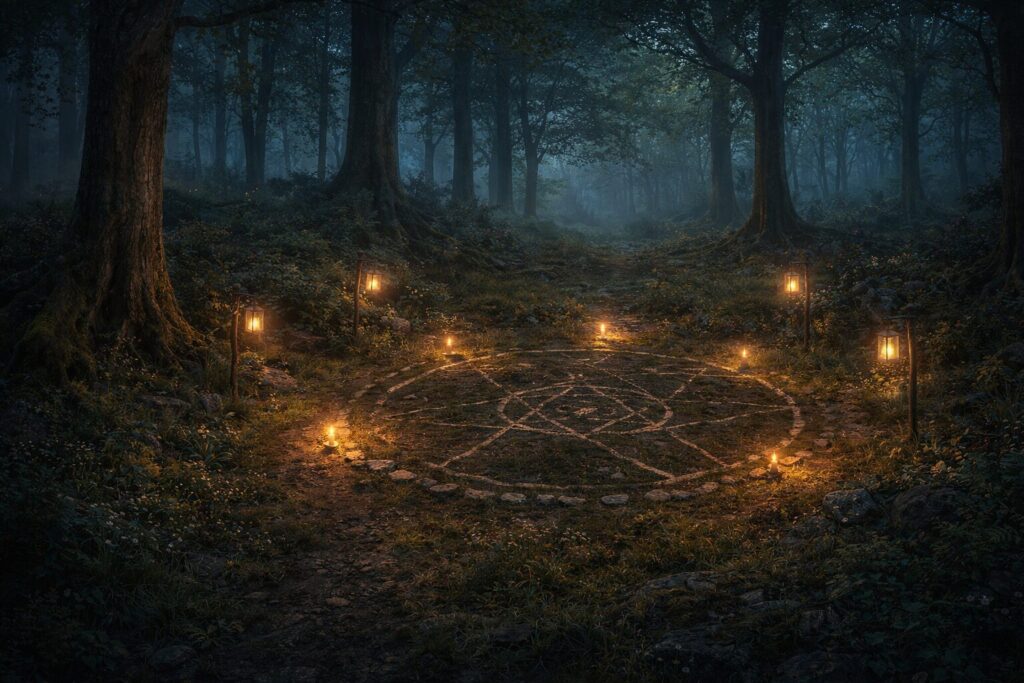
A coven that casts circle in the same clearing year after year will eventually notice that the clearing changes. The air settles more quickly. The boundaries hold more easily. The shift into ritual consciousness requires less effort. What was once neutral ground becomes receptive. The place remembers the pattern. Enchantment, in this sense, is not theatrical—it is cumulative.
Homes can become magical in the same way. A kitchen where blessings are spoken regularly develops a different atmosphere than one where speech is careless. A bedroom used intentionally for dreamwork deepens into a threshold space. An altar corner worked daily becomes more than furniture. The energy does not need to blaze visibly; it stabilizes quietly. Over time, the house itself participates.
Even constructed features—such as a labyrinth—can function as field-builders. A labyrinth walked repeatedly becomes more than stone and path. It becomes a pattern impressed upon land and psyche alike. Each footstep reinforces the previous ones. The geometry holds memory.
Urban environments are not spiritually dead zones; they are louder ecosystems. Cities contain grid crossings, convergences of human will, density of thought, and centuries of layered narrative. A small park can hold the atmosphere of a sacred grove. An alley shrine can pulse with devotion. A bookstore can become a node of shared intention. The scale changes, but the principle does not: repetition builds field.
Abandoned churches and decommissioned temples often illustrate the layered nature of magical place. The deity may no longer be invoked there, but the architecture of devotion remains imprinted. Hymns, vows, baptisms, grief, confession—these do not evaporate instantly. What lingers is not always a spirit; sometimes it is a field of memory. Such places can feel heavy, resonant, or suspended in time.
Magical places can also shift category. A neutral hillside becomes magical through coven work. A magical site may become sacred if a high spirit anchors there. A sacred grove may lose active reverence yet retain a quiet charge. A place encountered in one way can become something else entirely through relationship.
Unlike sacred places, magical places are often made rather than discovered. They are built through pattern and intention. But once built, they begin to build back. The field influences the practitioner as much as the practitioner influences the field.
The wise witch recognizes this and chooses where to work with care.
The Living Land
Not all places are equally animate — but all places participate in life.
Within our understanding, full animism is real, though rare. Some landscapes do not merely host energy; they are intelligences. A mountain may behave less like matter and more like presence. A spring may feel not only refreshing but aware. In such cases, the land does not simply respond to ritual — it has its own continuity of being. These sites are not created by devotion, though devotion may deepen the exchange. They are encountered.
More commonly, what we experience is emergent field: the accumulated current of ecology, history, human interaction, and subtle phenomena layering together until the place behaves as though it were conscious. The distinction matters. A waterfall that is inherently alive differs from a temple courtyard that has become charged through centuries of prayer. Both may feel powerful; their origins are different.
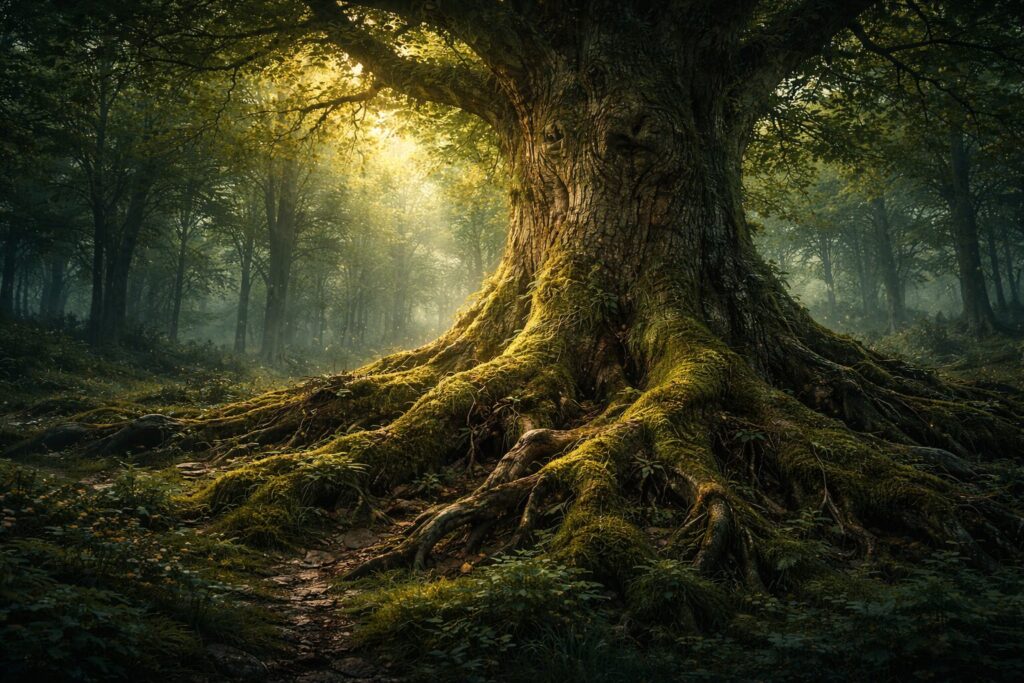
Sacred groves illustrate this beautifully. Across cultures and continents, clusters of trees have functioned as sanctuaries long before walls and stone enclosures became common. The grove creates boundary without severing itself from the land. It is neither fully wild nor fully constructed. It marks threshold. In many traditions, groves were set aside precisely because the trees themselves were regarded as participants in sacred life. Even now, small stands of old trees in cities can hold a quiet coherence that feels older than the surrounding streets.
The land also remembers.
Repeated joy, repeated grief, violence, vows, ritual, celebration — these events impress upon a site. Sometimes that imprint behaves like atmosphere. Sometimes it condenses into something more persistent. What people call hauntings are not always spirits; they are sometimes concentrated memory. A battlefield can hold sorrow without hosting an entity. A decommissioned sanctuary can feel heavy without a resident presence. The difference between spirit habitation and environmental imprint is subtle, but discernible through practice and study — a distinction explored more deeply in our work on Parapsychology.
The living land is layered, not simplistic. It may contain inherent animism, emergent field, spirit alignment, memory residue, and grid intersection simultaneously. A sacred grove may be both inhabited and imprinted. A mountain may be inherently alive and also reinforced by pilgrimage. A city square may be layered with centuries of devotion, protest, celebration, and sorrow, forming a complex energetic ecology.
To work with place is to learn to read these layers. Not every charged location is sacred. Not every heavy atmosphere is cursed. Not every quiet grove is inert. The practitioner who listens carefully discovers that land has texture — and that texture shifts depending on what has passed through it and what currently resides within it.
When approached with attention, the land answers. Not always in words. Often in subtle shifts of mood, pressure, intuition, or dream. The relationship deepens slowly. And in that deepening, the witch ceases to see place as stage and begins to recognize it as collaborator.
Some places do not merely feel alive — they feel adjacent.
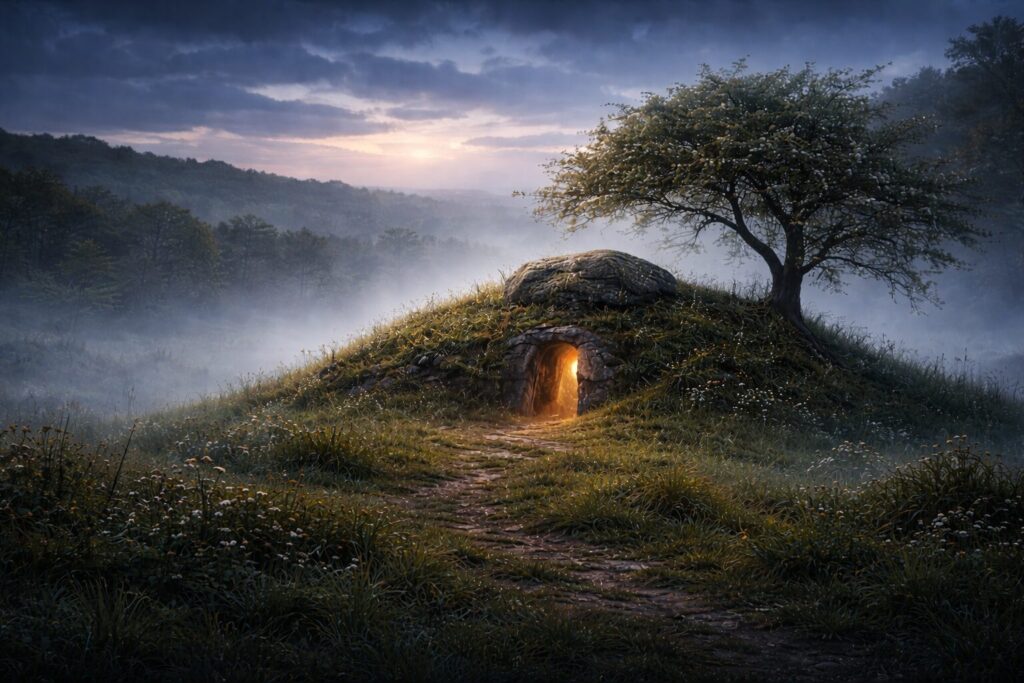
Across cultures, there are recurring patterns of land associated with what folklore calls the Fair Folk: mounds, old hills, boundary hedges, marshes, river bends, fog valleys, crossroads, standing stones, and solitary hawthorn trees. These are not random selections. They are thresholds — places where categories blur. Dry land becomes wet. Forest becomes field. Village becomes wilderness. One jurisdiction ends and another begins.
In Irish tradition, the aos sí were said to dwell in hollow hills and ancient barrows. Fairy mounds were not decorative myths but warnings about territory. To disturb certain earthworks was to risk offense. Across Northern Europe, bridges and liminal waterways carried similar reputations. In parts of Britain and Ireland, solitary hawthorn trees still command caution, not because of superstition alone but because they function as living boundary markers — ecological, symbolic, and energetic.
We treat these accounts neither as childish fantasy nor as literalist folklore to be swallowed whole. Instead, we understand “fairy” as a term pointing toward nature-adjacent intelligences — diverse, not always benevolent, rarely interested in human drama for its own sake. They are not demons, nor are they glittering mascots. They are local.
Threshold geography tends to host them.
Marshlands, for instance, are transitional ecosystems — neither fully water nor fully earth. Fog valleys obscure sight and disorient perception. Crossroads intersect directional currents. Ancient burial mounds concentrate memory, ancestry, and boundary all at once. These environments produce ambiguity, and ambiguity is fertile ground for encounter.
This is why sacred groves, mounds, and liminal crossings appear so often in pre-modern spiritual maps. They are not arbitrary; they are structural weak points in ordinary perception. The veil is not uniformly thin everywhere. It thins at edges.
Caution is appropriate. Not fear — caution. Offerings are not bribes; they are acknowledgments of presence. Trespass is not only physical but energetic. To enter a threshold site is to enter territory that may already have relationship patterns in place. Listening precedes invocation.
We will explore the beings themselves in greater depth on our dedicated Fae page. Here, it is enough to recognize that certain geographies function as gateways, and that those gateways tend to cluster where land changes character.
The wise practitioner learns to identify thresholds not by aesthetic alone, but by subtle shifts in atmosphere — pressure behind the eyes, sound dampening, time distortion, sudden alertness in the body. These are not theatrical phenomena. They are environmental cues.
Some places ask to be entered. Others ask to be acknowledged from a respectful distance.
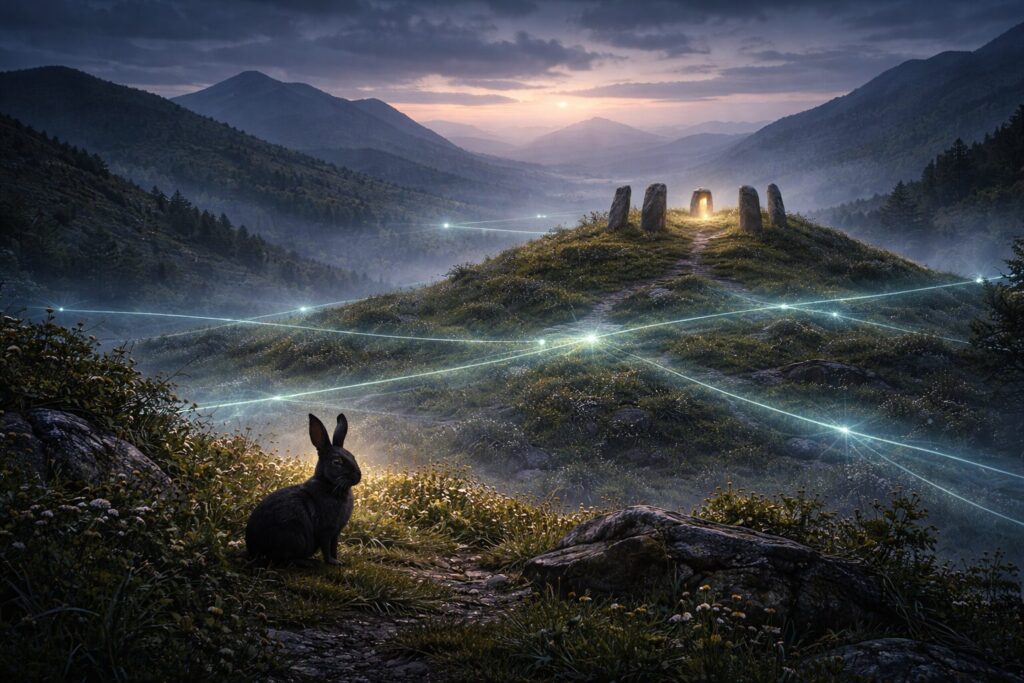
Let Lines & Energetic Grids
The land is not inert beneath its surface. It is structured.
In the early twentieth century, Alfred Watkins observed that many ancient sites in Britain appeared to align in straight lines across the landscape. He proposed that these “leys” were old trackways—practical navigation routes linking standing stones, mounds, churches, and hilltops. Later esoteric traditions expanded this idea, suggesting that these alignments were not merely geographic but energetic: subtle currents running through the land, intensifying where they intersect.
Within modern magical cosmology, ley lines are often understood not as visible beams but as convergences—places where geological formation, magnetism, water flow, human construction, and repeated ritual overlay into coherent channels. Sacred sites cluster along these lines not by coincidence alone but because the infrastructure beneath the visible landscape supports manifestation.
Across cultures, similar concepts appear. In Chinese geomancy, “dragon lines” describe currents of earth energy flowing through mountains and terrain. In Western esoteric traditions, earth meridians are sometimes likened to acupuncture lines in the body. Some speak of planetary grids; others of subtle magnetic matrices. The terminology varies. The pattern recurs.
The Hartmann grid and related models attempt to map more localized energetic intersections—fine mesh structures overlaying the land, where certain points are considered more intense or unstable. Whether interpreted geophysically, psychically, or symbolically, these systems describe a reality many practitioners experience directly: some locations amplify intention; others scatter it.
We do not treat these grid models as rigid cartography. They are frameworks for perceiving patterns. A ley crossing does not glow visibly; it reveals itself through effect. Ritual stabilizes more easily. Meditation deepens faster. Dreams intensify. Offerings feel answered. These are experiential markers.
Not every sacred place sits on a major ley, and not every ley crossing is sacred. But when inherent animism, emergent field, and grid intersection coincide, the result can be profound. Newgrange’s astronomical alignment is not separate from its energetic charge. Glastonbury Tor’s mythic density does not exclude geomantic convergence. The layers reinforce one another.
Urban centers, too, can sit upon crossings. Grid systems do not vanish beneath concrete. They may become louder, distorted, or rerouted—but the underlying patterns remain. In some cases, skyscrapers and cathedrals alike are unconsciously built along lines of subtle intensity because humans tend to place important structures where the land already supports coherence.
We lean mystical in our interpretation because experience supports it. The grid is not a conspiracy map. It is a subtle architecture—one that interacts with geology, history, and consciousness alike.
To work with ley currents is not to control them. It is to recognize alignment. The practitioner listens first. If the field supports the work, one proceeds. If the current resists, one adjusts.
The land has its own geometry. Magic flows more cleanly when we cooperate with it.
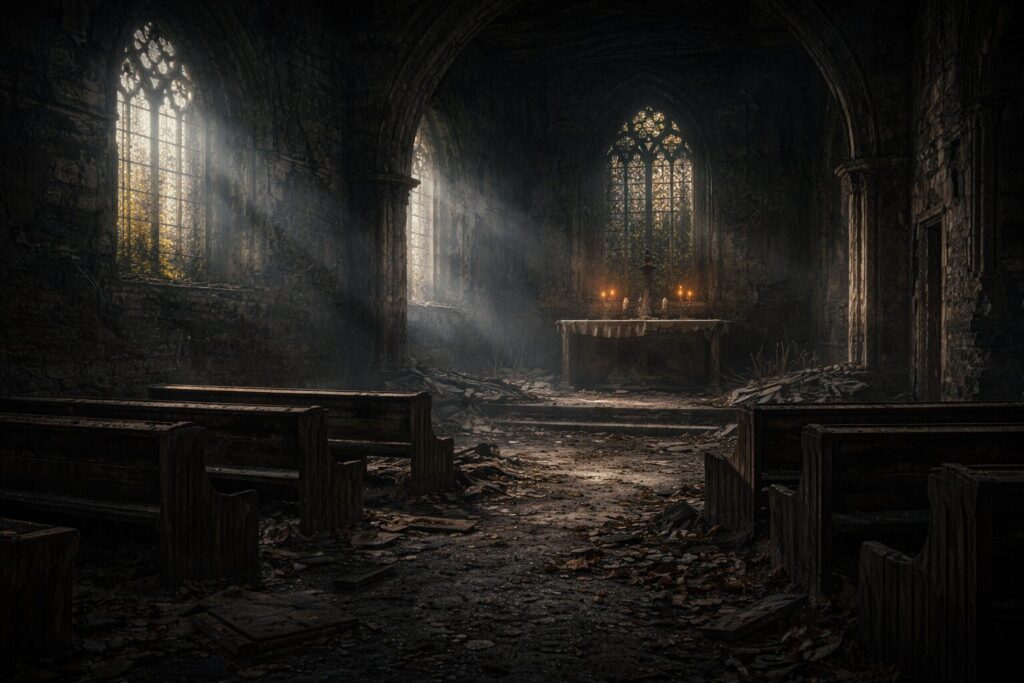
Cursed & Tainted Places
Not all charged places are sacred. Some hold distortion rather than coherence. Some carry trauma so concentrated it behaves like gravity. Others have been intentionally bound, damaged, or neglected until the field warps.
Trauma-Held Land
Sites of violence, betrayal, mass grief, or prolonged suffering can retain dense psychic residue. This is not always a spirit — it may be environmental imprint condensed into atmosphere.
Parasitic Accumulation
Repeated chaotic ritual, addiction, emotional volatility, or reckless invocation can destabilize a site. Over time the field begins to drain rather than nourish.
Intentional Binding
Some locations are deliberately anchored for baneful or restrictive purposes. Bindings, wards, seals, or spiritual containment can persist long after their creators have gone.
Ritual Failure Residue
Incomplete workings, broken vows, improperly closed circles — these can leave energetic fractures. The place feels unsettled, unfinished, or volatile.
Haunted vs. Cursed
A haunted place hosts presence. A cursed place exhibits distortion. The difference matters. Presence may be negotiated. Distortion must be stabilized — or avoided.
When to Cleanse — When to Walk Away
- Cleanse when the land requests relief and you are properly prepared.
- Do not cleanse what is not yours to alter.
- Some trauma sites require witness, not interference.
- If your body signals danger repeatedly, leave.
- Protection precedes investigation.
Not every heavy place is evil. Not every dark site is malicious. But distortion ignored becomes entanglement. The wise practitioner discerns layer, source, and permission before acting.
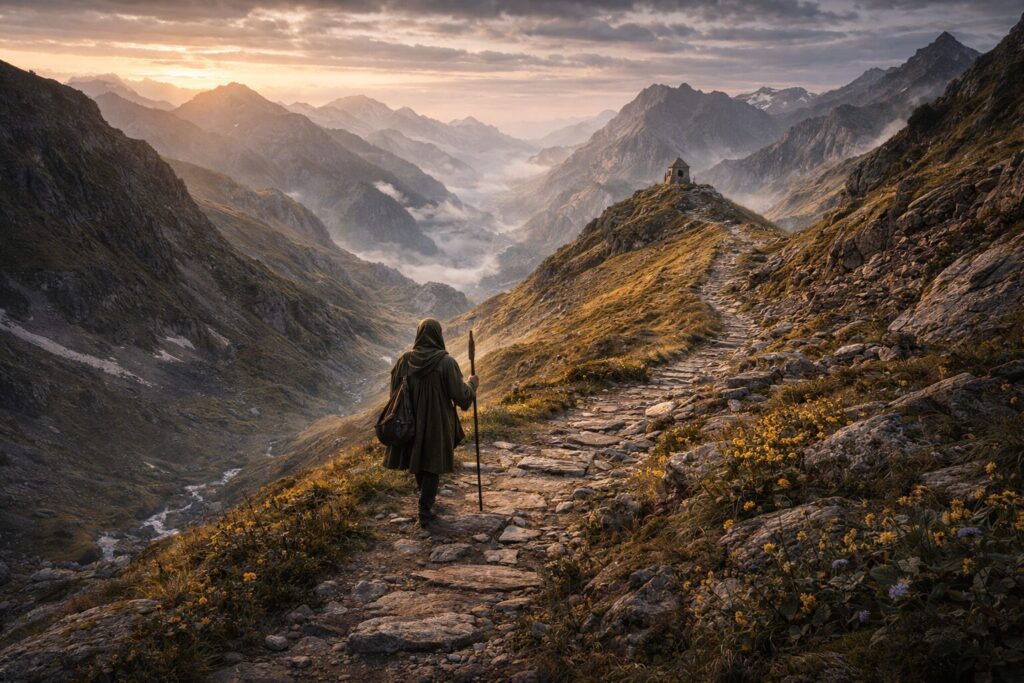
Pilgrimage & the Long Ritual
Pilgrimage is not tourism. It is ritual extended across distance.
To undertake pilgrimage is to enter into a spell that unfolds step by step. The body moves through terrain; the mind loosens from routine; the intention ripens through repetition. The journey is not incidental to the destination—it is part of the working. Walking, traveling, preparing, fasting, studying, carrying a token or vow: these are components of enchantment. By the time the pilgrim reaches the site, they are not the same person who began.
Sacred geography intensifies this process because certain locations function as anchors within larger energetic patterns. To approach Glastonbury Tor on foot, to stand within Newgrange at solstice alignment, or to circle the slopes of Mount Shasta with intention is to synchronize with something older than the individual. The place is not conquered; it is encountered. The pilgrim does not extract power; they attune to it.
Pilgrimage serves different purposes depending on need. It may be devotional—a gesture of reverence toward deity or high spirit. It may be initiatory—a threshold crossed deliberately. It may be reparative—a journey undertaken to release grief or seek healing. It may be investigative—testing one’s sensitivity to field and grid. Often it is all of these at once.
The journey teaches as much as the arrival. Fatigue clarifies motivation. Silence surfaces doubt. Unexpected obstacles test sincerity. Long travel compresses identity, leaving only the essential question: Why am I going? In this way, pilgrimage becomes shadow work in motion. It strips distraction and reveals what truly drives the seeker.
Urban pilgrimage exists as well. Walking deliberately to a shrine tucked into a city park, visiting a long-used sacred grove in the middle of concrete, or tracing a perceived grid line through old architecture can function as modern equivalents of ancient routes.
The principle remains: intention + movement + threshold = transformation.
Some sites change people not because they override free will, but because they amplify what is already present. A pilgrim arrives carrying grief; the place magnifies release. Another arrives with ambition; the place intensifies clarity. Sacred geography does not erase the self—it reveals it.
Pilgrimage, then, is reciprocal. The land offers current. The pilgrim offers presence. The exchange leaves both subtly altered. The site gains another layer of devotion. The traveler carries a piece of the field home.
A journey made consciously becomes part of the place’s ongoing enchantment.
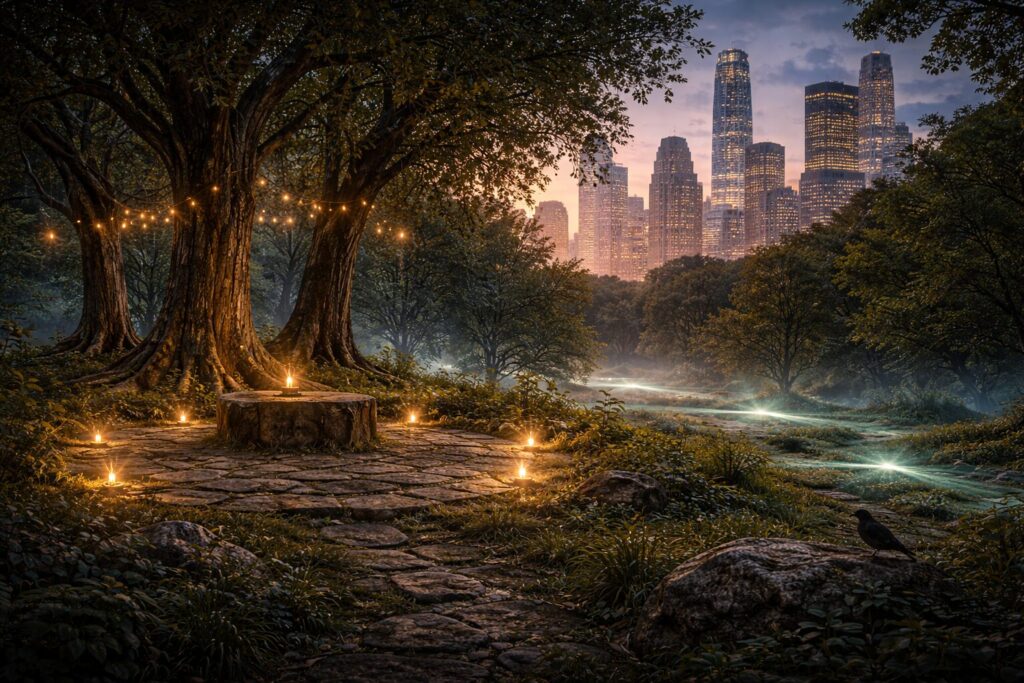
Sacred geography does not end where concrete begins.
Cities are not spiritually barren; they are amplified. Human intention accumulates densely in urban environments—belief, conflict, commerce, art, devotion, despair, invention. The energetic volume increases. This can feel chaotic, but chaos is not the same as absence. It is compression.
Grid systems beneath cities do not vanish when streets are laid. Subtle currents run through stone as easily as through meadow. In some cases, major cathedrals, government buildings, or monuments were constructed precisely where older sacred sites stood—intentionally or intuitively aligning with preexisting current. The layering becomes visible in architecture: pagan foundations beneath churches, shrines built over springs, civic centers placed atop ancient crossings.
Even within dense urban centers, micro-sacred spaces form. A small grove in a public park can hold a quiet coherence that resists the surrounding noise. A long-used meditation room accumulates calm. A community shrine tucked beside a storefront may pulse with devotion out of proportion to its size. What matters is not acreage but repetition.
Cities also generate magical places quickly. Performance halls charged with shared emotion, libraries saturated with concentrated thought, protest sites layered with collective will—these can become temporary but potent fields. A site of national trauma may hold sorrow so dense it behaves like gravity. A memorial may stabilize that grief into reverence. The distinction between wound and sanctification depends on how the field is tended.
Urban practitioners must develop sharper discernment because signal and interference coexist. Grid crossings in cities can intensify quickly, but so can distortion. Loudness does not equal power; it simply requires stronger grounding.
Digital environments complicate the map further. At present, they function primarily as extensions of human projection—shared fields built through communication and intention. Online ritual space, when approached seriously, can accumulate coherence much like a physical room. Whether such environments will someday host independent consciousness is an open philosophical question. If awareness can arise in organic systems, there is no inherent metaphysical reason it could not emerge elsewhere. But that remains speculative. For now, digital sacredness reflects the intention and structure of its participants.
Modern sacred geography asks the practitioner to expand perception rather than retreat into nostalgia. The forest grove and the city park are not opposites; they are variations of context. The ley crossing beneath a meadow does not disappear under pavement. The question is not whether modernity has erased the sacred. It is whether we have trained ourselves to perceive it where it now stands.
Sacred and magical places continue to form wherever attention, intention, and structure converge.
Working With Place
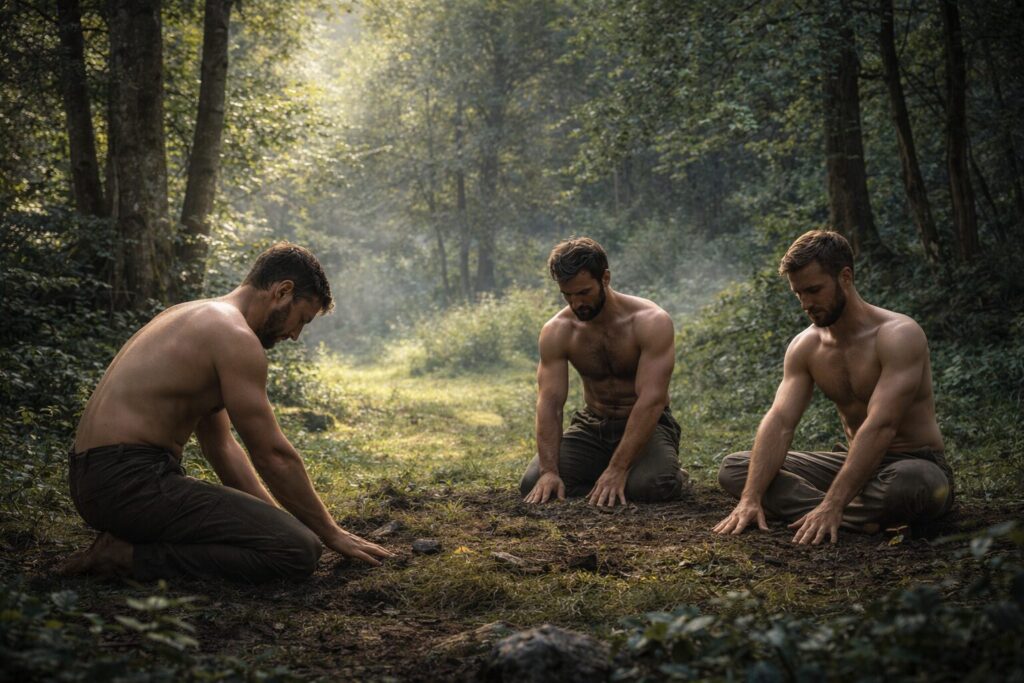
To work with a location is to enter relationship. Whether sacred, magical, neutral, or layered, the land responds best to clarity, reciprocity, and restraint.
Arrive Quietly
Pause before acting. Slow the breath. Notice sound, temperature, subtle pressure in the body. Do not immediately invoke. Listen.
Discern the Layer
Is the field coherent or chaotic? Does it feel inhabited, imprinted, emergent, or neutral? Identify before engaging.
Offer Before Asking
A small libation, a word of acknowledgment, a gesture of gratitude. Relationship precedes request.
Anchor Intention
If building a magical place, return consistently. Repetition stabilizes field. Geometry, boundary, and rhythm matter.
Cleanse With Permission
Do not cleanse reflexively. Some heavy places require witness, not interference. If distortion is present and the work is yours, close what you open and ground what you raise.
Close & Depart Intentionally
Thank the land. Release invocation. Withdraw cleanly. Leaving properly maintains long-term relationship.
Core Ethic
The land is not a battery. It is not raw material. It is participant. Magic flows more cleanly when the practitioner acts as collaborator, not extractor.
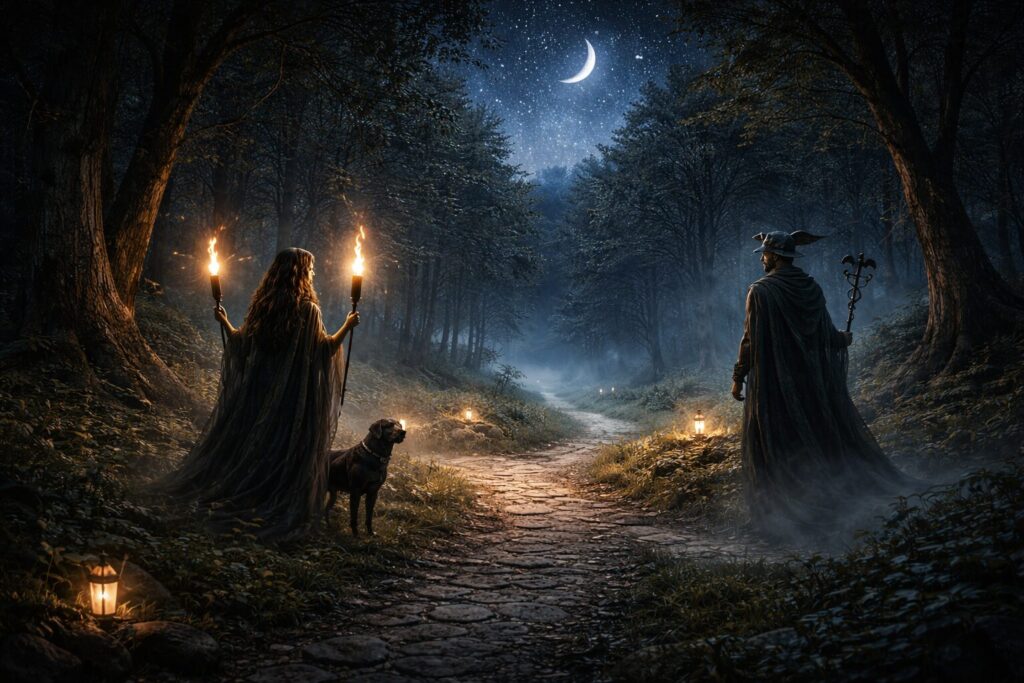
Places are not props for ritual. They are not aesthetic backdrops for personal mythology. They are not batteries waiting to be drained. They are participants.
A sacred grove does not exist for spectacle; it exists in relationship. A mountain does not radiate presence in order to validate belief; it radiates because presence is part of its being. A city shrine does not hold charge because it is picturesque, but because devotion has condensed there. Even a cursed site, heavy with distortion, reflects accumulated interaction rather than arbitrary malice.
To understand sacred and magical places is to understand reciprocity.
When humans return repeatedly to a site with reverence, the place strengthens. When we act carelessly, distortion accumulates. When we listen before acting, we enter into cooperation. When we impose without discernment, we create imbalance. The land responds, not emotionally, but structurally.
Over time, the practitioner learns that magic flows most cleanly when aligned with geography rather than imposed upon it. Ley currents, animist presences, emergent fields, pilgrimage paths, threshold sites—these are not abstractions. They are infrastructures of relationship. The witch who understands place no longer seeks power in isolation. They seek alignment.
Sacred geography is not nostalgia for a pre-modern world. It is awareness of the world as layered and alive now. The forest grove and the urban park, the ancient mound and the abandoned church, the river bend and the stone labyrinth—each can become a site of exchange when approached with clarity and respect.
We do not choose places in the sense of ownership. We recognize them. We tend them. We participate in them. And sometimes, if we are fortunate, we are invited into deeper relationship.
In the Coven of the Veiled Moon, we treat the land not as stage but as elder. Sacred and magical places remind us that magic is not merely what we cast. It is where we stand.