Astrology and the Practice of Magic
Working with Planetary Powers, Zodiacal Correspondences, and Celestial Timing

For thousands of years, practitioners have looked to the heavens for more than predictions. The movements of the Sun, Moon, and planets offered ways to recognize patterns, select favorable moments, and shape magical operations. From ancient omen rituals to Renaissance talismans and modern witchcraft, astrology has served not only as a means of interpretation, but as a method of magical action.
In witchcraft, astrology provides another way of understanding the conditions under which magic is performed. A planetary hour may be chosen to support a particular intention, a zodiacal sign may help refine the character of a working, or an astrological chart may reveal considerations relevant to a person, relationship, or undertaking. These correspondences can influence the timing, materials, construction, and direction of an operation.
Yet favorable conditions do not perform the magic themselves. A well-chosen hour cannot replace preparation, and a difficult planetary configuration does not necessarily prevent a working from succeeding. The practitioner brings Will, knowledge, method, and judgment to the operation. Sometimes that means working with favorable conditions. At other times, it means addressing an unfavorable influence, altering the approach, or proceeding despite imperfect circumstances.
Astrology also offers ways to make magical practice more particular. Rather than applying the same working to every situation, a witch may consider the planetary associations of a goal, the qualities of the zodiacal signs involved, or the individual circumstances of someone receiving or participating in the magic. Such considerations can help distinguish what is appropriate for one undertaking from what might serve another.
This is where astrology becomes especially interesting as a magical discipline. Its value lies not merely in knowing which planet rules Wednesday or which sign the Sun occupies, but in understanding how celestial relationships may inform meaningful choices.
What follows explores the historical foundations, planetary correspondences, zodiacal relationships, timing methods, and practical workings through which astrology becomes part of the witch’s craft. The purpose is not simply to read the heavens, but to understand how their patterns may be brought into the deliberate practice of magic.
Find Your Starting Point
Astrology begins with observation. The Sun rises and sets, the Moon changes phase, and the planets move through relationships that can be measured and calculated. These movements form an observable celestial order, one that human beings have studied for thousands of years. Astrology takes those observations further, interpreting their relationships and applying them to human affairs, spiritual practice, and magic.
The distinction matters. Astronomy establishes where a planet appears in the heavens, when an eclipse will occur, or what angle separates two celestial bodies. Astrology assigns significance to those relationships through an inherited body of principles, correspondences, and methods. A measurable configuration and its magical interpretation are related, but they are not the same thing.
Conditions, Currents, and Possibility
Within C.VM.’s Cosmology of Becoming, reality is neither entirely fixed nor without structure. Magic operates through Will, method, relationship, and the possibilities available within existing conditions. Those conditions may encourage an operation, resist it, or influence the direction through which a result can develop. Astrology provides one method of examining those conditions before choosing how to act.
Consider a working intended to improve communication. Mercury has long been associated with speech, learning, exchange, and movement. A practitioner might choose a Mercury hour, examine Mercury’s condition in an astrological chart, or select correspondences appropriate to the undertaking. These choices bring the operation into relationship with a particular planetary tradition and, in C.VM.’s understanding, may help the practitioner engage conditions favorable to the intended work.
But the correspondence does not perform the operation. A favorable Mercury placement cannot write a persuasive letter, overcome every obstacle, or compel another person’s cooperation. The practitioner’s intention, preparation, magical method, and subsequent actions remain important. Astrology informs those choices rather than replacing them.
The Sky as a Measure of Conditions
An important question has occupied astrologers and philosophers for centuries: do celestial bodies cause events, reveal conditions, or participate in a deeper order connecting them?
Plotinus questioned whether the stars should be understood as direct causes of human behavior, proposing that celestial configurations might instead signify events within an interconnected cosmos. Ptolemy developed a different account, treating celestial influences as operating through the natural qualities understood in his time. Their explanations were not identical, and neither establishes the mechanism of magical action as C.VM. understands it today.
For our practice, celestial configurations can serve as indicators of recurring magical conditions without requiring every planet to exert a direct physical force upon the operation. Some celestial relationships have observable physical effects, such as the seasonal changes associated with sunlight and the tidal influence of the Sun and Moon. Other astrological correspondences belong to an operative magical tradition whose claimed effects are not established by astronomical measurement alone.
Planetary days and hours illustrate the difference. Wednesday’s association with Mercury follows an inherited seven-planet sequence. A Mercury hour is calculated from local sunrise and the traditional planetary order, not from Mercury necessarily being overhead or especially strong in the sky. It is a ritual timing method, while an electional chart makes a more particular judgment about celestial configurations. Both may inform practice, but they answer different questions.
Interpretation Becomes Magical Action
A practitioner must decide what a celestial condition means for the operation at hand. A planetary association might suggest an appropriate purpose, a zodiacal placement might refine its character, and an electional chart might help select a beginning. Materials, words, gestures, consecration, and the direction of Will then bring those judgments into the construction of the working.
Not every condition will be favorable. A difficult placement may suggest postponement, but it may also call for a different method, additional protection, or astrological remediation: magical measures intended to address or mitigate an unfavorable influence. A challenging configuration is not an absolute prohibition, nor does it remove the practitioner’s ability to act.
We must also distinguish planetary correspondences from independent spiritual beings. A planetary current, the physical body associated with it, and a deity traditionally connected to that planet need not be identical. Invoking or petitioning an intelligence introduces relationship and another Will into the operation. Favorable timing may support that approach, but it does not command cooperation.
Astrological judgment is therefore more than finding an auspicious date. It is the process of examining available conditions, selecting what serves the purpose, recognizing limitations, and constructing an appropriate response. The results of that response can then be observed, recorded, and considered in light of both the magical choices and the ordinary circumstances involved.
The heavens may help us recognize an opportunity. What we make of that opportunity remains a matter of knowledge, Will, method, and judgment.
From the Heavens to the Working
Four stages connect celestial observation with the practice and evaluation of magic.
-
01
Measure
Establish planetary positions, phases, angles, sunrise, and other observable conditions.
-
02
Classify
Apply the chosen astrological system: signs, houses, planetary rulerships, and traditional timing rules.
-
03
Judge and Act
Interpret the conditions for a particular purpose. Choose the method, prepare, and perform the working.
-
04
Review
Observe the outcome, record ordinary actions and magical choices, and consider what can reasonably be learned.
Remember: Accurate celestial measurements do not determine the meaning or success of a magical operation. Interpretation and practical judgment connect observation with action.
The relationship between the heavens and magic is considerably older than the horoscope. Long before astrology became associated with personality or individual destiny, celestial observations informed religious ceremonies, protective rites, political decisions, and attempts to influence events. The sky was not simply something to be interpreted. Its signs could call for action, and its recurring patterns could help determine when that action should take place.
Reading Signs and Responding to Them
In ancient Mesopotamia, priests and scholars recorded celestial phenomena, including eclipses, planetary appearances, and unusual movements. Such observations could be interpreted as omens concerning rulers, communities, or particular circumstances. Yet an unfavorable omen was not necessarily treated as an unavoidable fate.
Rituals known as namburbi were performed to avert misfortune indicated by ominous signs. These rites were not exclusively concerned with celestial events, but they demonstrate an important principle: recognizing a threatening condition could lead to a deliberate magical or religious response. The practitioner was not merely a passive observer of destiny.
This distinction remains relevant to astrological magic. A difficult configuration might call for protection, remediation, a change of approach, or a more favorable time. The information provides grounds for judgment rather than an absolute command.
Choosing Moments and Constructing Magic
As astrological systems developed across the Hellenistic world, choosing an appropriate beginning became an increasingly elaborate practice. What is now called electional astrology involves judging celestial conditions to select a suitable time for an undertaking.
Writers such as Dorotheus of Sidon and Hephaestio of Thebes preserved methods for evaluating beginnings. These techniques were subsequently transmitted, translated, and developed through exchanges involving Greek, Indian, Persian, and Arabic-language scholarship. Different traditions contributed their own systems, particularly concerning lunar stations, zodiacal positions, and the judgment of complete charts.
The distinction between predicting an event and choosing its beginning is central. A practitioner might consult astrology not to ask what will happen, but to determine when to undertake an action. When applied to magical operations, the chosen moment becomes part of the working’s construction.
The Greek Magical Papyri, a collection of magical texts from Roman Egypt, preserve examples of celestial timing in practical ritual. One manuscript, PGM VII, includes lists of favorable days for divination and operations associated with the Moon’s position in the zodiac. These are concrete examples of astrology informing magical instructions, rather than merely describing character or forecasting events.
Medieval astral magic developed additional methods of combining celestial conditions with prepared objects, images, materials, and invocations. The Arabic Ghāyat al-Ḥakīm, later transmitted into Latin as the Picatrix, is particularly important. Its operations draw together astrological selection, material correspondences, and ritual procedures intended to engage celestial powers.
This tradition was neither uniform nor exclusively benevolent. Historical astral magic included operations for protection, influence, attraction, advantage, and harm. Its methods and purposes must be understood in their historical settings rather than treated as a ready-made manual for contemporary witchcraft.
Renaissance Magic and the Modern Craft
Renaissance thinkers continued to examine the relationship between celestial conditions and magical action. Marsilio Ficino explored natural sympathy, celestial harmony, and spiritual participation. Heinrich Cornelius Agrippa assembled an extensive account of planetary correspondences, astrological elections, images, and magical preparations in his Three Books of Occult Philosophy.
For Agrippa, timing and preparation could belong to the same operation. A planetary image was not simply an attractive object decorated with an astrological sign. Its materials, purpose, celestial conditions, and preparation contributed to its intended function. His treatment of planetary hours also shows that historical practitioners did not always agree on how those hours should be calculated.
These learned magical traditions eventually became part of the wider body of esoteric knowledge available to later practitioners, including ceremonial magicians, occult revivalists, and modern witches. Modern witchcraft developed through several overlapping influences, including folklore, traditional magical practices, ritual magic, and newer religious movements. Its use of astrology reflects both inheritance and adaptation, not an uninterrupted survival of one ancient system.
Consequently, contemporary witches may use planetary days, zodiacal correspondences, lunar observances, or elaborate electional charts without following the entire philosophy or ritual system of their historical sources. The methods can be studied, adapted, and incorporated according to the purpose of the working.
Across these different periods, several practical approaches recur: observing a sign, responding to an unfavorable condition, choosing a beginning, preparing an object under selected circumstances, and establishing a relationship with a planetary power or intelligence.
They are not identical methods, and they do not all require the same understanding of how magic works. Together, however, they provide a historical foundation for the many ways astrology can inform the practice of witchcraft.
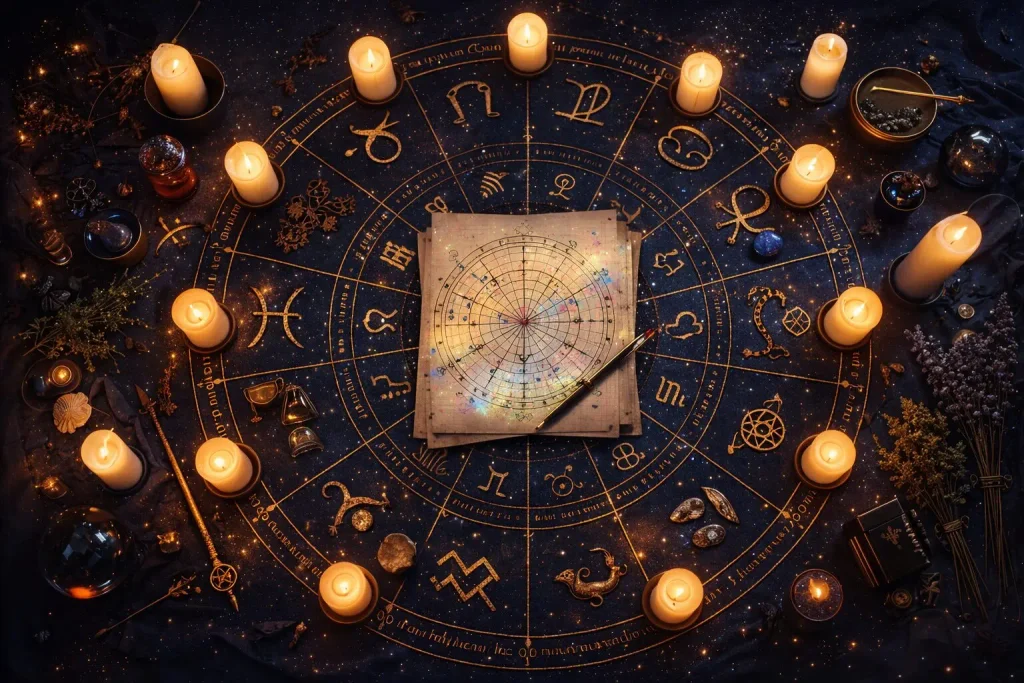
Traditional Western astrological magic works with seven celestial bodies: the Sun, Moon, Mercury, Venus, Mars, Jupiter, and Saturn. Although modern astronomy distinguishes the Sun and Moon from the planets, classical astrology includes both among its seven planetary powers. Together, they form the foundation of planetary weekdays, planetary hours, and many of the correspondences inherited by Western magical traditions.
Each planet governs a range of qualities and activities. Mercury concerns communication, learning, movement, and exchange. Venus is associated with affection, attraction, harmony, and beauty. Mars governs courage, conflict, defense, and decisive action. Jupiter concerns growth, prosperity, generosity, and authority, while Saturn is associated with boundaries, endurance, discipline, and time. The Sun brings questions of vitality, visibility, and personal authority, while the Moon concerns change, receptivity, cycles, and the domestic sphere.
These associations are more flexible than a division between beneficial and harmful powers. Mars may be useful for defending a boundary, while Venus may be better suited to repairing a relationship. Saturn can restrict, but restriction is precisely what certain protective workings require. Jupiter may encourage expansion, though expansion is not always desirable. The appropriate planet depends upon what the practitioner intends to accomplish.
The planetary correspondences below provide a working reference. Their traditional metal associations come from the history of astrology and alchemy, while the practical applications illustrate contemporary magical uses. Historical sources do not always assign materials identically, and no particular metal is necessary for the workings described here.
| Planet & Day | Magical Focus | Traditional Metal | Example Application |
|---|---|---|---|
| Sun Sunday | Vitality, confidence, visibility, authority, recognition | Gold | Strengthening personal authority before presenting important work |
| Moon Monday | Cycles, change, receptivity, dreams, household matters | Silver | Supporting reflection, household harmony, or renewal |
| Mars Tuesday | Courage, defense, conflict, separation, decisive action | Iron | Establishing protection or confronting a persistent obstacle |
| Mercury Wednesday | Communication, learning, exchange, movement, skill | Quicksilver (mercury) | Opening communication or supporting an educational opportunity |
| Jupiter Thursday | Growth, prosperity, generosity, justice, leadership | Tin | Encouraging a viable opportunity or supporting expansion |
| Venus Friday | Affection, attraction, beauty, pleasure, reconciliation | Copper | Encouraging concord or strengthening a welcome connection |
| Saturn Saturday | Boundaries, discipline, endurance, restriction, time | Lead | Establishing a lasting boundary or sustaining a commitment |
Using this reference: Metal associations are historical correspondences, not required ritual ingredients. Mercury and lead are toxic and should not be handled for these purposes. Drawn planetary glyphs, paper, and other safe materials can serve contemporary workings. Other correspondence systems may differ.
Choosing a Planetary Focus
A practitioner begins with the purpose of the operation rather than with the planet itself. A working intended to prevent further interference might draw upon Saturn’s restrictive qualities, Mars’s defensive strength, or a combination of the two. A working for professional recognition might emphasize the Sun, while one concerned with securing financial backing might call for Jupiter. These are different magical approaches to problems that may initially appear similar.
More elaborate workings may combine planetary correspondences, but adding more influences does not necessarily make an operation stronger. The practitioner must consider whether the chosen qualities support one another, introduce competing purposes, or belong to different stages of the undertaking.
The planet’s actual condition may also matter. A traditional electional astrologer would distinguish choosing Mercury because it is Wednesday from judging Mercury’s position, dignity, and relationships in a particular chart. The first is a relatively accessible form of planetary timing. The second involves a more detailed assessment of celestial conditions, which we will examine in the section on electional magic.
A planetary association also need not involve the direct participation of a deity. Working with a correspondence or magical current is different from petitioning an independent intelligence. Both approaches have places within witchcraft, but they should not be confused.
Beyond the Seven: Uranus, Neptune, and Pluto
The traditional planetary system was established before the discovery of Uranus, Neptune, and Pluto. Modern astrologers have developed additional correspondences for these bodies, and some practitioners incorporate them into magical work.
Uranus is commonly associated with disruption, innovation, independence, awakening, and radical change. In contemporary magic, it may be considered for workings involving liberation from established patterns or the introduction of an unconventional approach.
Neptune is associated with dreams, imagination, enchantment, intuition, and dissolution of boundaries. Its contemporary applications may include visionary practice, inspiration, and exploration of subtle experience. Confusion and illusion are also part of its astrological character.
Pluto, classified astronomically as a dwarf planet, is associated in modern astrology with profound transformation, hidden power, exposure, destruction, and regeneration. Practitioners may apply these correspondences to deep change or the ending of entrenched patterns.
These are modern interpretive associations, not additions to the historical seven-planet system. They do not have universally inherited weekdays, metals, or positions within the traditional planetary-hour sequence. Other modern approaches may also work with asteroids or additional celestial points.

The twelve signs of the zodiac are frequently encountered through horoscopes and personality descriptions, but their place in magical practice is considerably broader. Within Western astrology, the zodiac provides a system of qualities, relationships, and planetary rulerships through which practitioners can refine the construction and timing of a working.
A planet describes a particular field of powers and associations, while its zodiacal position helps characterize how those qualities are expressed. Mercury remains associated with communication and learning whether it occupies Gemini or Virgo, but the two signs suggest different approaches. Gemini emphasizes exchange, connection, and the movement of ideas, while Virgo favors analysis, careful preparation, and practical application. Either might be appropriate for a Mercury working, depending upon its purpose.
This relationship between planet and sign is one of astrology’s more useful contributions to witchcraft. Rather than choosing correspondences solely by general association, the practitioner can examine the particular qualities needed for the intended operation.
Elements and Modalities: The Character of a Working
Each zodiacal sign belongs to one of four elements and one of three modalities. Together, these classifications describe different forms of activity and expression.
Fire concerns energy, courage, assertion, inspiration, and transformation. It may suit workings intended to awaken determination, overcome hesitation, or initiate bold action.
Earth concerns stability, material conditions, cultivation, endurance, and practical results. Its qualities may be useful when a working needs to establish something lasting or bring an intention into concrete form.
Air concerns thought, communication, understanding, movement, and intellectual exchange. It is particularly relevant to workings involving learning, negotiation, persuasion, and the circulation of information.
Water concerns emotion, intuition, receptivity, healing, and the deeper currents of experience. Its qualities may inform workings involving emotional relationships, inner change, dreams, and spiritual attunement.
The modalities introduce a different distinction.
Cardinal signs emphasize initiation and movement toward change. Fixed signs favor preservation, concentration, and continuity. Mutable signs concern adaptation, transition, and the ability to respond to changing circumstances.
These qualities can help distinguish magical approaches that might otherwise appear identical. A protective working intended to establish a new boundary may benefit from cardinal qualities, while one intended to maintain that boundary over time may draw upon fixed qualities. A working concerned with adjusting to unfamiliar circumstances might make greater use of mutable qualities.
The elements describe the general character of the operation, while the modalities help distinguish how that character is expressed. Neither acts as an absolute rule. The planetary ruler, the purpose of the working, and the other conditions involved must also be considered.
Planetary Rulership and Zodiacal Condition
Every zodiacal sign has a traditional planetary ruler. Mars rules Aries and Scorpio, Venus rules Taurus and Libra, and Mercury rules Gemini and Virgo. Jupiter rules Sagittarius and Pisces, Saturn rules Capricorn and Aquarius, the Moon rules Cancer, and the Sun rules Leo.
A planet occupying one of its own signs is said to be in its domicile, an important form of traditional astrological dignity. Dignity describes a planet’s standing within the zodiacal system, but it is not a simple measurement of magical power or a guarantee of a favorable result.
Consider a Venus working intended to repair an invited relationship. Venus in Libra may suggest an emphasis on fairness, communication, and restoring mutual understanding. Venus in Taurus may instead favor stability, physical expressions of care, and rebuilding trust through consistency. Both are Venusian approaches, but their character differs.
The distinction becomes more important when constructing a talisman or selecting an election. The practitioner is not merely identifying a planet associated with the desired result, but examining how that planet is situated and whether its circumstances suit the operation.
Astrological houses add another consideration. While signs describe qualities and modes of expression, houses identify areas of life represented within a chart. A working concerning someone’s livelihood, home, education, or relationships may involve different houses and planetary rulers. The first house is not automatically Aries, nor is the seventh always Libra. Houses and signs are separate parts of the system, even where their meanings overlap.
The Individual as Part of the Working
One of the more sophisticated applications of astrology involves understanding the person for whom, or concerning whom, a working is undertaken.
A natal chart records the celestial configuration at birth and provides an astrological framework for examining individual tendencies, motivations, relationships, and areas of experience. Practitioners may use this information to choose correspondences and approaches suited to a particular individual rather than applying precisely the same operation to everyone.
A Sun sign alone offers relatively little information. Depending on the working, the practitioner might examine Mercury for communication, Venus for affection and attraction, Mars for conflict or assertion, or the planets governing relevant houses. The Ascendant and its ruler may also be important. Without a reliable birth time, however, the Ascendant and house placements generally cannot be established confidently.
This approach can be useful in workings intended to assist another person. A working for confidence, for example, might be constructed differently for someone whose astrological circumstances suggest difficulties with self-expression than for someone whose concerns center on maintaining discipline or overcoming conflict.
Astrological information may also enter workings involving another person’s response or participation. Traditional and contemporary magic include operations for persuasion, reconciliation, attracting attention, resolving disputes, and altering the conditions of relationships. A practitioner may use astrological correspondences to select the form, timing, and direction of such an operation.
Yet a chart is not a complete description of an individual, nor does it establish that a person will respond in a predetermined manner. Within C.VM.’s understanding, another person possesses their own Will and sovereignty. Astrological knowledge may inform an attempt at influence, but it does not erase that independence or settle the ethical questions involved. A person’s actual behavior, circumstances, and expressed wishes remain relevant to the practitioner’s judgment.
This distinction is particularly important when working with relationships. Encouraging communication, opening an opportunity for reconciliation, and attempting to compel another person’s affection are different magical purposes, even if they involve some of the same planetary correspondences.
Zodiacal Signs and Magical Timing
The zodiac also influences when an operation may be undertaken.
A practitioner might consider the sign occupied by the planet associated with a working, the sign rising at the chosen moment, or the condition of the ruler governing the relevant area of life. The Moon’s zodiacal position is also important in many electional traditions, though lunar practice has its own broader methods and purposes.
For example, a working intended to begin a new undertaking may call for different conditions from one meant to preserve an existing arrangement. A fixed sign might appear desirable for durability, while a cardinal sign may better suit an operation whose immediate purpose is to initiate change.
These are starting considerations rather than complete elections. A favorable sign cannot compensate automatically for every difficult planetary relationship, and the most appropriate configuration depends upon the specific operation. Detailed electional judgment considers several factors together.
Zodiacal knowledge therefore gives the practitioner more than a collection of twelve correspondences. It provides a vocabulary for distinguishing purposes, refining methods, considering individual circumstances, and evaluating the conditions under which magical action may unfold.
The sign is one consideration among several. Its value emerges through the choices the practitioner makes with it.
Beyond the Tropical Zodiac: Other Systems
The tropical zodiac is the principal system used in much of Western astrology. It divides the ecliptic into twelve equal signs beginning at the March equinox. Its reference points are tied to the equinoxes and solstices, not the present boundaries of the astronomical constellations.
Sidereal zodiacs use stellar reference points. Because Earth’s axis undergoes precession, tropical and sidereal sign positions gradually differ. Sidereal systems also vary in their precise reference conventions.
Indian astrology, or Jyotisha, commonly uses sidereal calculations, but its techniques, lunar mansions, interpretive methods, and ritual settings form a distinct tradition. It should not be treated simply as Western astrology with different sign dates.
Chinese astrological traditions developed other systems of celestial cycles, calendars, and correspondences. Their familiar animal signs are not direct equivalents of the twelve Western zodiacal signs.
For magical practice, the important consideration is consistency. A practitioner should understand which system supplies the timing rules, rulers, and correspondences being used rather than combining incompatible conventions without examining their underlying methods.
Seasonal ritual also depends upon the practitioner’s actual surroundings. A tropical sign’s traditional association with Northern Hemisphere spring does not make the physical season spring everywhere.
Working with Celestial Time
Time has always played an important role in magical practice. Certain hours, days, seasons, and celestial configurations have traditionally been regarded as more suitable for particular operations than others. A practitioner may choose a moment to strengthen a working’s intended character, avoid an undesirable condition, or coordinate several magical correspondences.
Not all systems of magical timing operate in the same way. Planetary days and hours follow an inherited ritual sequence. Lunar phases and solar cycles describe observable celestial changes to which practitioners assign different purposes. Electional astrology goes further, examining the relationships among planets, signs, and houses at a particular moment.
These approaches can be used independently or combined, depending upon the complexity of the working.
Planetary Days and Their Uses
Each weekday belongs to one of the seven traditional planetary powers. Sunday is governed by the Sun, Monday by the Moon, Tuesday by Mars, Wednesday by Mercury, Thursday by Jupiter, Friday by Venus, and Saturday by Saturn.
A practitioner might choose Wednesday for a communication working, Thursday for an undertaking involving prosperity or expansion, or Saturday for protection that emphasizes restriction and durable boundaries. The association provides a general starting point, not a complete judgment of the day’s astrological conditions.
The planetary day traditionally begins at sunrise rather than at civil midnight. Consequently, a working performed before sunrise on Wednesday still falls within Tuesday’s planetary day. This distinction becomes particularly important when calculating planetary hours.
Calculating Planetary Hours
Planetary hours divide the time between one sunrise and the next into twenty-four periods: twelve during daylight and twelve during the night.
These are not necessarily sixty-minute hours. Daylight is divided into twelve equal portions, while the interval from sunset to the following sunrise is divided separately into twelve. Their lengths change with the seasons and the practitioner’s location.
Each period is assigned a planetary ruler according to a repeating traditional order:
The Chaldean Order
↻ The sequence repeats continuously
Each planetary hour follows this order. At sunrise, the first hour belongs to the planet ruling that weekday.
Select a planet to explore its astrological meanings in Astrodienst AstroWiki.
The first hour after sunrise belongs to the planet ruling that weekday. The remaining hours follow the sequence, returning to Saturn after the Moon.
Consider an illustrative Wednesday with sunrise at 6:00 a.m., sunset at 6:48 p.m., and the following sunrise at 6:00 a.m.
Daylight lasts twelve hours and forty-eight minutes, or 768 minutes. Dividing by twelve gives daytime planetary hours of 64 minutes each. The night lasts eleven hours and twelve minutes, or 672 minutes, producing nighttime planetary hours of 56 minutes each.
Because Wednesday belongs to Mercury, the first hour, from 6:00 to 7:04 a.m., is Mercury’s. Continuing through the planetary sequence, Mercury rules again during the eighth hour, from 1:28 to 2:32 p.m.
The same sequence continues after sunset, with nighttime hours calculated using their shorter duration. A practitioner seeking a Mercury hour therefore has several opportunities within the complete planetary day.
These times are constructed for teaching, not calculated for an actual date or location. In practice, sunrise and sunset must be established locally. A planetary-hour calculator can simplify the work, but its location, date, time zone, and daylight-saving settings should be checked.
Traditional authors did not always agree on the calculation. Agrippa records both the familiar division of daylight and darkness into twelve portions and another approach based on ecliptic ascensions. The method presented here is the commonly used unequal-hour system.
Lunar Conditions in Magical Practice
Lunar phases provide another familiar method of timing. Waxing phases are frequently chosen for growth, accumulation, and development, while waning phases are often associated with reduction, release, and removal. The new and full moons may serve as points of beginning, culmination, observance, or transition, depending upon the practice.
These are magical conventions rather than direct consequences of lunar physics. The Moon’s actual gravitational relationship with Earth contributes to tidal changes, but this does not establish that a waxing Moon physically attracts prosperity or a waning Moon removes unwanted influences.
The Moon’s zodiacal position, condition, and relationships with other planets are also important in more technical electional work. A lunar phase alone does not describe all the conditions surrounding an operation.
Our Lunar Practice page explores broader lunar observances, attunement, and their place within witchcraft.
Solar Cycles, Seasons, and Local Conditions
Solar timing offers another dimension of magical practice. Sunrise, midday, sunset, and nightfall may be selected for operations involving emergence, manifestation, transition, or withdrawal. Their meanings can be developed through the practitioner’s purpose, tradition, and relationship with the surrounding environment.
The tropical zodiac is organized around the equinoxes and solstices, but its inherited sign associations should not be confused with identical seasonal conditions everywhere. March brings spring to much of the Northern Hemisphere and autumn to the Southern Hemisphere. Latitude, climate, and local ecology also influence the actual seasonal experience.
A practitioner may use the conventional tropical zodiac for astrological calculation while adapting seasonal ritual to the land and its observable cycles. The astronomical coordinate system and the local experience of the seasons serve different purposes.
The broader relationships among recurring cycles, observances, and magical practice are explored in Temporal & Cyclical Power.
Retrogrades, Eclipses, and Difficult Timing
Not every celestial condition is traditionally considered favorable. Retrograde planets and eclipses are frequently approached with caution, although their meanings depend upon the method and operation involved.
Retrograde motion occurs when a planet appears, from Earth’s perspective, to move backward against the zodiac. The planet does not actually reverse its orbital direction. Astrologically, retrograde periods are often associated with reconsideration, delay, return, or revision, particularly in matters governed by the planet concerned.
A Mercury retrograde, for example, might be judged poorly suited to initiating certain communications under a traditional electional method, while another practitioner could deliberately choose it for revisiting an unfinished matter. Neither interpretation establishes that communication must fail during retrograde periods.
Eclipses likewise carry different historical and contemporary meanings. They have been treated as omens, disruptions of ordinary celestial order, and occasions for ritual response. Some practitioners avoid initiating important workings during eclipses, while others incorporate them into operations concerned with endings, transitions, or profound change.
There is no single rule requiring every witch to avoid or exploit these events. Their relevance must be judged within the chosen method and the actual purpose of the operation.
Timing as Part of the Method
The most useful question is not simply whether a particular hour is favorable, but favorable for what.
A working for reconciliation, one for separation, and another for maintaining an established boundary may require different planetary qualities, even when they concern the same relationship. Timing can support the chosen method, but it cannot resolve contradictions in the operation’s purpose.
There are also occasions when waiting is unreasonable. A protective working may be needed immediately, a communication may have a deadline, or a practical opportunity may disappear while the practitioner searches for an ideal configuration. In such circumstances, the method can be adapted, the working strengthened, or an imperfect time accepted.
Planetary days and hours offer an accessible starting point. More elaborate decisions require examination of the actual celestial configuration, including planetary condition, zodiacal placements, and the relationships among them.
That is the purpose of electional magic: not merely finding a favorable hour, but choosing a suitable beginning for a particular undertaking.
One Day, Unequal Hours
An illustrative Wednesday beginning at sunrise. The twenty-four planetary periods change length between daylight and night. Gold marks the four hours assigned to Mercury.
06:00 to 18:48 = 768 minutes
768 ÷ 12 = 64 minutes per hour
18:48 to next 06:00 = 672 minutes
672 ÷ 12 = 56 minutes per hour
| Hour | Period | Local Clock Time |
|---|---|---|
| 1st | Daylight | 06:00–07:04 Wednesday |
| 8th | Daylight | 13:28–14:32 Wednesday |
| 15th | Night | 20:40–21:36 Wednesday |
| 22nd | Night | 03:12–04:08 Thursday |
Important: These are constructed times, not a calendar for a real location. Thursday before sunrise still belongs to Wednesday’s planetary day. On nights with daylight-saving clock changes, calculate actual elapsed time rather than subtracting displayed clock readings. In polar regions without a sunrise or sunset, this method requires an explicitly chosen alternative convention.

Electional Magic: Choosing a Suitable Beginning
Electional astrology is the practice of choosing an appropriate moment to begin an undertaking by examining the celestial conditions surrounding it. Unlike predictive astrology, which attempts to understand what may happen, electional astrology asks when a particular action might best be initiated.
Within magical practice, this may involve selecting the moment to consecrate a talisman, begin a protective operation, make a petition, or undertake a working intended to influence an unfolding situation. The practitioner considers the character of the operation and seeks conditions judged suitable to its purpose.
A favorable planetary day or hour can contribute to that decision, but a complete astrological election involves considerably more.
Establishing the Purpose and Beginning
Before examining a chart, the practitioner must determine exactly what the operation is intended to accomplish and what action will constitute its beginning.
Consider a working intended to support the establishment of a study group. Does the undertaking begin when the organizer first prepares its materials, when the magical operation is performed, when invitations are sent, or when the group meets for the first time?
These are distinct moments. The practitioner must identify the beginning relevant to the intended purpose, particularly when magical preparation and ordinary action occur at different times. A talisman may similarly be constructed over several days but consecrated at a deliberately elected moment.
The practical window must also be established. An undertaking may have deadlines, depend upon other people, or require conditions that no astrological chart can provide. The purpose of an election is to choose intelligently among genuine opportunities, not to invent an ideal moment that cannot be used.
Planetary Rulers and Significators
The next consideration is the planet most relevant to the undertaking. In traditional astrology, a significator is a planet or chart factor selected to represent a person, subject, or activity.
Mercury may be important for communication and study, Venus for affection and reconciliation, Mars for protection or confrontation, and Jupiter for growth or prosperity. Yet these general associations are only a beginning.
The chart’s houses and their planetary rulers help distinguish the particular area of life involved. The third house may be relevant to communication, the seventh to partnerships, and the tenth to public standing or professional responsibilities. A working may involve several houses, but the practitioner should identify which actually govern the undertaking rather than attempt to strengthen everything at once.
The Ascendant, the zodiacal degree rising on the eastern horizon, and its ruler are also important in many traditional elections. Together with the planet governing the undertaking, they help establish the principal factors to examine.
Dignity, Houses, and Planetary Condition
A planet’s condition involves more than whether it appears in a familiar sign or on a favorable weekday.
Traditional astrologers distinguish essential dignity, describing a planet’s standing within the zodiac, from accidental dignity, concerning circumstances such as its placement in the chart.
A planet in its own sign, or domicile, is traditionally considered well situated. Exaltation provides another form of favorable standing, while detriment and fall describe contrasting conditions. These classifications help the practitioner evaluate how appropriately a planet is placed for the operation.
Angularity is another consideration. Planets located near the principal angles of the chart, particularly the Ascendant and Midheaven, are traditionally regarded as more prominent or capable of acting. A planet’s zodiacal dignity and its angular placement describe different features, and one does not automatically resolve difficulties involving the other.
The practitioner must also consider whether the relevant planets are moving directly or apparently retrograde, their relationships to other planets, and whether the chart presents significant impediments to the undertaking.
These judgments belong to a particular astrological method. They are not interchangeable measurements of a planet’s physical strength, and no single favorable condition guarantees success.
Aspects and the Moon
An aspect is an angular relationship between celestial bodies, measured through their zodiacal positions.
The principal traditional aspects are the conjunction, when bodies occupy approximately the same zodiacal longitude; sextile, approximately 60 degrees; square, 90 degrees; trine, 120 degrees; and opposition, 180 degrees.
Sextiles and trines are commonly regarded as supportive relationships, while squares and oppositions may indicate tension or competing demands. But interpreting every trine as beneficial and every square as harmful is insufficient. The planets involved, their condition, and the purpose of the operation all affect the judgment.
An applying aspect occurs when the relevant planetary relationship is moving toward exactness. A separating aspect has already passed exactness. This distinction can matter when an astrologer evaluates what is developing rather than what has already occurred.
The Moon receives particular attention in many electional methods, even when the working itself is not lunar in character. Its condition, zodiacal placement, and approaching relationships can contribute to the judgment of how an undertaking may unfold.
A suitable election therefore examines the principal planetary ruler and the Moon together, while considering the chart as a whole.
Choosing Between Imperfect Conditions
An important skill in electional magic is recognizing that a perfect configuration may not exist within the available time.
A Wednesday Mercury hour might appear attractive for a communication working, yet Mercury’s actual condition or the Moon’s approaching aspects might be poorly suited to the undertaking. Another day may lack the matching planetary hour but offer a more favorable combination of relevant chart factors.
Which should take precedence?
The answer depends upon the method being used and the requirements of the operation. A traditional election may give greater importance to the condition of the undertaking’s ruler and the Moon than to a weekday association alone. A simpler planetary working may reasonably employ the weekday or hour without attempting a complete election.
The practitioner must weigh competing considerations, identify what can be improved, and determine which imperfections can be accepted.
A difficult configuration may also invite astrological remediation, such as strengthening a correspondence, choosing a different form of operation, or constructing an additional protective measure. Such adjustments are part of magical judgment, not a guarantee that unfavorable conditions have been neutralized.
Nor does a difficult chart remove the practitioner’s sovereignty. Where an operation is necessary, the choice may be to work under imperfect conditions rather than allow timing to determine whether action can be taken at all.
Making the Election Meaningful
Once a time has been selected, the practitioner should record the intended purpose, chosen beginning, relevant planetary conditions, and reasons for accepting that moment.
For a calculated election, the date, location, time zone, zodiacal system, and chart conventions must also be clear. These details allow the calculation to be examined or reproduced rather than relying upon an impression that the chart was favorable.
The operation must then be carried out. If the chosen beginning is the consecration of an object, perform that consecration at the selected time. If it is the sending of an important petition, prepare the petition beforehand and act when intended.
The subsequent outcome should be considered alongside the practical circumstances and other actions involved. A favorable election does not eliminate uncertainty, and an unfavorable outcome does not automatically establish which astrological factor was responsible.
Electional magic is ultimately an exercise in informed choice. It brings timing, purpose, correspondence, and judgment together so that a magical undertaking can begin under conditions deliberately selected rather than accepted without consideration.
Choosing a Suitable Beginning
A practical sequence for comparing available moments. Each decision narrows the possibilities according to the purpose of the working.
-
Define the purpose
What must the operation accomplish? What specific action marks its beginning?
-
Establish the window
Identify realistic dates, responsibilities, deadlines, and unavoidable constraints.
-
Identify the rulers
Select relevant planetary significators, houses, and the Ascendant ruler under the chosen method.
-
Examine the conditions
Consider planetary dignity, angularity, the Moon, and applying or separating aspects.
-
Weigh competing factors
Decide which conditions matter most. Identify impediments and possible adjustments or remediation.
-
Choose and record
Select the most suitable workable moment and document the reasons for that judgment.
The Final Decision
Prepare the operation, begin at the selected moment, and review the outcome afterward.
Reconsider the available window, modify the method, apply remediation, or proceed when necessity requires.
An election is a reasoned judgment, not a numerical score. No individual factor determines the outcome of every working.
Correspondences, Consecration, and Talismans
Astrological correspondences can influence far more than the timing of a spell. They may determine the materials selected, the images or inscriptions used, the preparation of a magical object, and the conditions under which an operation is consecrated.
In the traditions of Western astral magic, planets and zodiacal signs were associated with metals, stones, plants, colors, images, and other materials. These relationships formed systems through which practitioners sought to bring celestial qualities into an earthly operation. The Picatrix and Agrippa’s Three Books of Occult Philosophy preserve elaborate examples of this approach, joining astrological calculations with the preparation of images and objects intended to carry particular powers.
The principle remains useful in contemporary witchcraft, although the methods need not be reproduced exactly. A practitioner may choose a planetary glyph, a particular material, an inscription, or a suitable moment according to the purpose of the working. The important consideration is how those choices contribute to the operation as a whole.
Choosing Correspondences with Purpose
Correspondences are most useful when the practitioner understands why they have been selected.
Consider a working intended to strengthen a person’s resolve in confronting an ongoing problem. Mars might be appropriate when the purpose is to develop courage and decisive action. Saturn might be preferred when the goal is endurance, restraint, or establishing a lasting boundary. The Sun could contribute confidence and personal authority.
All three might appear suitable, but they suggest different operations. Their materials and associations should follow the intended method rather than substitute for deciding what the working is meant to accomplish.
The same reasoning applies to zodiacal correspondences. A fixed sign may contribute qualities of stability and persistence, while a cardinal sign might better suit initiating a change. The practitioner may also consider whether the relevant planet is well situated in an actual electional chart.
An accumulation of colors, stones, herbs, and planetary symbols does not necessarily strengthen a working. Correspondences should reinforce its purpose, and materials must be appropriate to their intended use.
Historical sources sometimes prescribe substances that are toxic, difficult to obtain, or unsuitable for contemporary practice. Mercury, lead, poisonous plants, and hazardous preparations are not required to engage planetary correspondences. A drawn glyph, a paper image, or an appropriately chosen safe object may serve the working without reproducing those dangers.
From Planetary Charm to Astrological Talisman
A planetary charm is an object prepared with correspondences associated with a particular planet or magical purpose. It might contain a symbol of Jupiter for prosperity, Saturn for protection, or Mercury for learning and communication.
An astrological talisman, in the more technically demanding traditions of astral magic, involves an additional consideration: its creation or consecration is deliberately connected to a selected celestial configuration.
That distinction is important. Placing a Mercury glyph on a pendant does not establish that the object was created under suitable Mercury conditions. A Wednesday Mercury hour may provide an elementary form of planetary timing, while a more rigorous talismanic election considers the planet’s zodiacal dignity, its relationships with other planets, relevant houses, the Moon, and the precise moment chosen for the operation.
Historical traditions differ in how images are constructed, when their creation is considered complete, and what additional ritual procedures accompany them. Some involve inscriptions, prayers, invocations, or other forms of spiritual address.
A contemporary witch may adapt these principles without claiming to reproduce a particular historical operation. What matters is understanding which method is being used and what gives the object its intended magical function.
Consecration and Continued Use
Consecration establishes an object for a deliberate magical purpose. Within C.VM.’s practice, this is more than decoration or an expression of personal preference. It is an act through which the practitioner prepares, dedicates, and directs the object for its intended work.
The chosen astrological conditions may contribute to that process. A practitioner might prepare the physical object beforehand, then perform the dedication or activation during a selected planetary hour or election.
The act itself may involve cleansing, an inscription, a statement of purpose, the direction of Will, and a deliberate closing. More elaborate operations may incorporate additional ritual methods or a relationship with a spiritual intelligence, but neither is required by the presence of a planetary correspondence.
The object’s subsequent use should also agree with its function. A protective charm may be placed at a threshold or carried where protection is needed. A talisman for study might be kept with books or brought into a regular learning practice. An object intended to support a temporary undertaking may be retired once its purpose has ended.
The timing of consecration is one part of the operation. How the object is prepared, directed, maintained, and eventually released also belongs to its magical construction.
Astrological Remediation: Working with Difficult Conditions
Astrological remediation concerns the measures a practitioner may take when celestial conditions are judged unfavorable or when a difficult planetary influence is considered relevant to a person or undertaking.
The idea is not that every difficult condition must be endured until the heavens change. Historical and contemporary astrological traditions contain different approaches to addressing challenging circumstances, including protective rites, plane
A Mercury Charm for Sustained Study
A contemporary illustrative working using ordinary paper, a planetary correspondence, and deliberate consecration.
-
Establish the purpose
The charm is intended to support clear thinking, consistent study, and effective communication of what has been learned. This determines the choice of Mercury.
-
Prepare the object
Select a small piece of suitable paper. Draw the Mercury glyph (☿) and add a short inscription expressing the working’s purpose. Prepare the object without rushing.
-
Choose the conditions
A convenient Wednesday Mercury hour provides elementary planetary timing. A more technical astrological talisman would require examining and recording the actual chart conditions.
-
Consecrate and direct
At the chosen moment, hold the paper, establish the intended purpose, and direct Will through a deliberate act of dedication. State what the charm is to sustain, then close the operation.
-
Use, review, and retire
Keep the charm with the study materials and use it as part of the continuing practice. Record the working and review its purpose after an agreed period. Retire the charm deliberately when its work is complete.
The distinction: This example is a planetary charm using simple astrological timing. It is not presented as a reconstruction of a historically elected astral talisman.
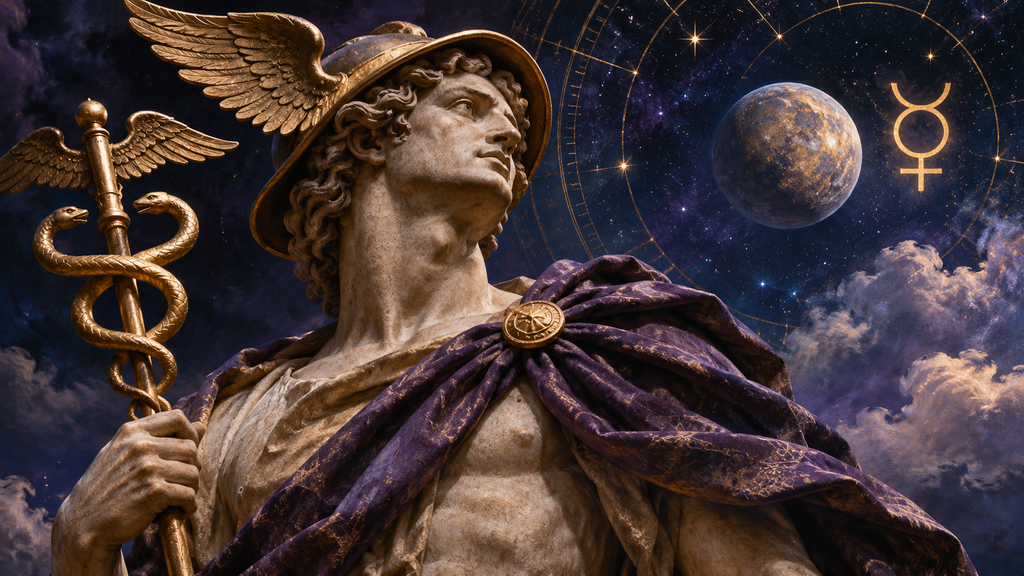
Planetary Powers and Independent Wills
The relationship between astrology and spiritual beings has occupied an important place in Western magical traditions. Planets have been associated with gods, intelligences, spirits, and powers, sometimes through systems in which celestial influences and spiritual agency are closely connected. Yet these relationships deserve careful distinction.
The physical planet Mercury, its traditional associations with communication and exchange, the magical current approached through those correspondences, and the god Hermes are not simply different names for the same thing. They may be related within a magical tradition, but their relationship does not make them identical.
Within C.VM.’s Cosmology of Becoming, gods are self-sustaining centers of agency and personality emerging within the deeper currents of reality. They possess their own Will, interests, and capacity for relationship. Their participation cannot be assumed merely because a practitioner has selected an associated planetary hour or prepared the appropriate materials.
When Relationship Enters the Working
Consider a Mercury working intended to open communication. A practitioner might select Wednesday, use Mercury’s glyph, and construct an operation through the planet’s traditional correspondences. That working need not involve a spiritual being.
Another practitioner might approach Hermes, whose associations with communication, movement, exchange, and the crossing of boundaries overlap considerably with Mercury’s magical character. The operation now includes a relationship with an independent intelligence, rather than relying upon planetary correspondence alone.
Such participation may involve petition, offerings, invocation, or an established devotional relationship. The quality of that relationship, the attention given to it, and the willingness of the intelligence to participate become relevant considerations. A favorable astrological configuration might be chosen to support the approach, but it does not guarantee cooperation.
Nor should a difficult planetary condition be interpreted automatically as a deity’s weakness, absence, or refusal. Astrological judgment and spiritual relationship are different matters. A deity with whom a practitioner has developed a meaningful alliance may offer more appropriate assistance than an unfamiliar intelligence whose planetary associations appear especially favorable.
Historical systems of planetary intelligences introduce further distinctions. A spirit assigned to a planet within a particular grimoire or ceremonial tradition should not automatically be equated with every deity associated with that planet. Their identities, functions, and methods of approach belong to the traditions in which they are understood.
These distinctions also matter in astrological remediation. A practitioner may respond to unfavorable conditions through planetary correspondences, protective workings, or a change of method. Alternatively, an established spiritual ally may be approached for assistance. Such assistance is a matter of relationship and independent Will, not a resource automatically released by the proper astrological calculation.
Astrology can help establish the circumstances of a working, but the presence of an independent intelligence changes the nature of the operation. The practitioner must consider not only celestial conditions and magical technique, but also attention, relationship, reciprocity, and the possibility that another Will may choose a different course.
Our Divine & Spiritual Alliance page explores these relationships, their development, and their place within magical practice in greater depth.
Five Distinct Relationships
Related associations do not necessarily describe the same kind of reality or magical participation.
| Category | What It Describes | Magical Consideration |
|---|---|---|
| Celestial body | The physical Sun, Moon, or planet whose position and motion can be measured. | Astronomical conditions used in timing and chart calculation. |
| Correspondence | Traditional associations among planetary qualities, purposes, materials, and images. | Choosing and constructing a coherent magical operation. |
| Magical current | A deeper pattern or condition approached through the planetary relationship. | Engaging conditions considered suitable for the working. |
| Deity | An independent center of agency and personality, such as Hermes, associated with particular powers. | Relationship, petition, reciprocity, and independent Will. |
| Planetary intelligence | A spiritual being assigned a planetary role within a specific magical or ceremonial tradition. | Identity, traditional methods of approach, and possible cooperation or refusal. |
These categories may overlap in a particular magical tradition, but they should not be treated as automatically interchangeable. An associated celestial hour does not compel an independent spiritual being to participate.

Three Workings Examined
The following examples demonstrate three different ways astrology can inform magical practice. Each has a particular purpose, method, and relationship to celestial conditions. They are contemporary instructional constructions, not historical ritual reconstructions or accounts of operations actually performed.
Working One · Mercury Communication and Opportunity Planetary timing, correspondence, directed Will, and an actual request
To open communication concerning an educational or professional opportunity, seeking clear expression and a fair hearing without attempting to compel the recipient.
Understanding the Astrological Choice
Mercury governs speech, writing, learning, exchange, and the movement of information. It is therefore an appropriate planetary focus for a request that depends upon being understood and receiving consideration.
The practitioner chooses a convenient Wednesday Mercury hour, calculated from local sunrise. This is an elementary form of planetary timing, not a complete electional chart judgment. If a useful opportunity requires an earlier response, the deadline takes precedence over the preferred hour.
Where reliable natal information is available, the practitioner’s Mercury placement may offer further considerations concerning the intended manner of expression. Such information can refine the operation without becoming a requirement.
Preparation
- Write the actual request, making sure its purpose and intended recipient are clear.
- Confirm practical details such as deadlines, required information, and attachments.
- Prepare a clean sheet of paper, a pen, and a small piece of paper bearing the Mercury glyph (☿).
- Choose a short statement defining the magical purpose: communication that reaches its destination clearly and receives fair consideration.
The Magical Operation
At the chosen time, clear the working space and place the completed request before you. Position the Mercury glyph above it. Establish the purpose of the operation and direct your attention toward the communication that is about to take place.
Hold the written request or rest your hand upon it. Concentrate Will upon the intended opening, imagining the communication reaching its recipient without distortion, confusion, or unnecessary obstruction.
Trace the Mercury glyph once over the request while stating the intention. Words may be chosen by the practitioner. For example:
Let these words travel clearly. Let their purpose be understood, and let the way open to fair consideration.
Hold the intention deliberately for a moment, then release the operation. Send the prepared request as the practical act joined to the magical working. Close the rite and record its date, timing, and purpose.
Responsibility and Review
The practitioner remains responsible for communicating appropriately, responding to questions, and following up when reasonable. The working does not replace those actions or determine the recipient’s answer.
Record the outcome after a predetermined period. Consider whether communication occurred, whether the request received consideration, and what ordinary circumstances contributed to the result.
Planetary timing, correspondence, intention, and practical action can form one coherent operation. A simple planetary method does not require a full astrological election or the participation of a deity.
Working Two · Saturn Protection, Boundaries, and Remediation Restriction, consecration, enduring protection, and responding to difficulty
To establish and sustain a protective boundary after repeated unwanted interference or disruption, using Saturn’s qualities of structure, limitation, and endurance.
Why Saturn Rather Than Mars?
Mars is often appropriate when immediate confrontation, defense, or separation is required. Saturn offers a different magical approach. Its associations with limits, durability, restraint, and time make it particularly suitable when the intention is not merely to repel an immediate problem but to establish a boundary that continues to hold.
A Saturday Saturn hour provides a possible timing choice. A more elaborate election might examine Saturn’s actual condition, the Moon, and the chart’s relevant houses. Neither approach requires waiting when protection is immediately needed.
Preparation
- Identify the boundary clearly. Determine what must stop and what is permitted to continue.
- Physically clean the relevant threshold or working space.
- Select a safe object to carry the working, such as an ordinary iron key, a small stone, or a paper talisman. Lead is neither necessary nor suitable.
- Prepare a short length of cord or thread to represent the boundary’s continuing strength.
The Magical Operation
Place the chosen object before you and establish the boundary in precise terms. Rather than concentrating upon the unwanted person or circumstance, concentrate upon the authority of the boundary itself and the conditions it is meant to maintain.
Hold the cord and tie three deliberate knots. With the first, establish the boundary. With the second, direct Will toward refusing unwanted intrusion. With the third, establish its endurance.
Place the knotted cord beside the object and direct the accumulated intention toward it. A suitable declaration is:
This boundary is established. What is not invited does not enter. What is mine to govern remains under my authority.
Consecrate the object for its protective purpose, then place it at the chosen location or keep it where the boundary must be maintained. Close the working deliberately. The cord may be stored with the object or retained as a record of the operation.
Where Remediation Enters
Suppose the practitioner has identified a difficult Saturnian condition, whether through an electional chart or the circumstances associated with a natal placement. The response need not be an attempt to eliminate Saturn’s influence.
Instead, the working can deliberately employ constructive Saturnian qualities: disciplined limits, appropriate restraint, endurance, and firm structure. This is one approach to remediation, directing the magical response toward a useful expression of the condition.
Other circumstances may require a different planet, additional protection, or an altered method. Remediation is not an automatic cancellation of an unfavorable chart.
Responsibility and Review
Maintain the corresponding practical boundaries. This may involve changing access, communicating a refusal, securing the physical space, or taking other necessary action. Where actual danger exists, appropriate safety measures take priority.
Review whether the boundary has been maintained, whether interference has diminished, and whether the original working requires reinforcement or retirement.
A planet traditionally considered difficult may provide precisely the qualities required by a working. Remediation can involve changing the method of engagement rather than denying the condition or surrendering to it.
Working Three · Jupiter Choosing an Imperfect Election Comparing celestial conditions, accepting tradeoffs, and beginning a substantial undertaking
To launch a community study circle intended to encourage shared learning, growth, and the development of a continuing educational undertaking.
Defining the Operation
Jupiter is selected for its associations with growth, generosity, patronage, prosperity, and the expansion of worthwhile opportunities. Mercury remains relevant because the project also depends upon study, communication, and exchange.
The practitioner decides that sending the first invitations will constitute the undertaking’s elected beginning. Planning, preparing materials, and organizing the introductory working can therefore take place beforehand.
A realistic scheduling window is established. The invitations must be sent early enough for participants to respond and make arrangements.
Comparing Two Possible Moments
The following are hypothetical chart profiles constructed to demonstrate electional judgment. They are not calculated astronomical charts, verified dates, or claims that these exact combinations occurred together.
The Electional Judgment
Within the chosen traditional method, the condition of Jupiter and the Moon carries greater importance for this undertaking than matching Thursday and a Jupiter hour alone.
The practitioner therefore prefers Option B. Its principal factors better support the stated purpose, while its secondary imperfection can be acknowledged and addressed through preparation.
This is not a universal rule for choosing every election. The hierarchy of factors depends upon the undertaking and the astrological method being used. If Option B required missing an important deadline or acting under unreasonable conditions, the practical window would need to be reconsidered.
Preparing the Working
- Prepare the study circle’s purpose, invitations, and necessary organizational arrangements.
- Create a small paper emblem bearing Jupiter’s glyph (♃) and a brief statement of the undertaking’s intended growth.
- Review the invitation text carefully, giving particular attention to the secondary communication concern identified in the election.
- Record the chosen time, its stated astrological conditions, the selected method, and the imperfection accepted.
The Magical Operation
Shortly before the elected beginning, arrange the Jupiter emblem alongside the prepared invitations and the written purpose of the study circle. Establish the working space and concentrate upon the intended undertaking.
Direct Will toward the formation of a viable circle of interested people, the exchange of knowledge, and the resources necessary to maintain the project.
Hold or touch the emblem and dedicate it to that purpose. A possible declaration is:
Let this undertaking find room to grow. Let willing minds gather, knowledge be shared, and the work take lasting form.
At the selected moment, send the first invitations. This is the beginning deliberately chosen for the undertaking. Complete the rite and record the action.
The emblem may remain with the study circle’s materials as the project develops. It does not substitute for organizing meetings, supporting participants, or sustaining the work after its launch.
Responsibility and Review
Evaluate the outcome against the original purpose. Did interested participants respond? Did the circle actually convene? Were resources and commitments sufficient to sustain it?
Record the practical efforts alongside the magical operation. The aim is to understand the undertaking’s development without assigning every success or difficulty retrospectively to whichever planetary factor seems convenient.
Electional magic involves weighing conditions rather than accumulating favorable associations. A matching planetary hour may be less important than the actual condition of the undertaking’s ruler and the Moon. Sound judgment includes accepting imperfections and carrying out the chosen action.
A real election would require independently verified chart calculations, including date, location, time zone, zodiac, relevant houses, and ephemeris data.
Discernment and Review
A magical working does not end when the candles are extinguished, the talisman is put away, or the chosen planetary hour has passed. What follows deserves attention. The practitioner must observe what develops, consider the circumstances involved, and decide what the experience contributes to their understanding of magic.
Astrology introduces several factors that can be examined afterward. Was the timing chosen for a general planetary correspondence or through a detailed election? Which conditions were considered favorable, and which imperfections were accepted? Did the operation unfold as anticipated, or did the result suggest something worth reconsidering?
A magical journal is particularly valuable here. Before beginning, record the purpose, relevant astrological conditions, selected method, and what would constitute a meaningful result. Establishing these expectations beforehand makes it harder to reinterpret every development afterward as confirmation that the working succeeded.
The record should also include ordinary actions. A Mercury working intended to open communication may be accompanied by a carefully prepared letter. A Jupiter working for prosperity may involve applications, negotiations, or new opportunities. These actions are part of the undertaking and should not disappear from the account simply because magic was involved.
Unsuccessful workings deserve as much attention as successful ones. An operation may have been poorly constructed, its timing may have been unsuitable within the chosen method, or circumstances may have prevented the intended result. Sometimes the explanation remains uncertain. Repeated experience can help the practitioner recognize patterns, question inherited assumptions, and refine their approach without deciding in advance which explanation must be correct.
Personal significance, an observed outcome, and evidence that a particular magical influence caused that outcome are different matters. Distinguishing them does not diminish the practice. It allows the witch to examine experience without surrendering judgment.
There is also the question of consequence. A working may achieve its immediate objective while producing complications that were not intended. Those effects belong in the review, particularly when another person’s interests or sovereignty are involved.
Discernment is not an obstacle to magic. It is part of developing skill. The practitioner learns through preparation, action, observation, correction, and experience. Over time, the record becomes more than a collection of spells. It becomes a history of decisions, methods, results, and the understanding developed through them.
A Working Record
Record the conditions and expectations before beginning. Return to the same entry afterward to examine what occurred.
Before the Working
- Purpose: What is the intended result?
- Timing: Date, location, chosen planetary conditions, and reasons for selection.
- Method: Correspondences, materials, consecration, and magical actions.
- Expectations: What observable developments would indicate progress?
- Review date: When will the outcome be assessed?
After the Working
- Outcome: What actually happened, including partial results or failures?
- Ordinary actions: What practical efforts accompanied the magic?
- Complications: What obstacles or unintended consequences appeared?
- Interpretation: What can reasonably be concluded, and what remains uncertain?
- Next steps: Maintain, modify, repeat, or retire the operation?
Keep the record proportionate to the working. A brief planetary charm may require only a few notes, while an elaborate election or extended operation may benefit from a more detailed journal.
Astrological magic draws upon several related disciplines, from interpreting celestial charts to constructing talismans and selecting the conditions for an operation. Each offers opportunities for further study, and understanding their distinctions can help practitioners decide which methods are relevant to their own work.
The following MCC pages explore these subjects in greater depth. A selection of historical texts and scholarly references is also provided for readers interested in the development of astrological magic and the ideas behind its practice.
Historical Sources & Further Reading
These references provide historical, philosophical, and astronomical context for the preceding discussion. They include primary texts, scholarly studies, manuscript records, and publisher information. Not every link provides a complete book.
Ancient and Classical Traditions
- Yale Cuneiform Commentaries Project A scholarly Mesopotamian tablet record relevant to omens and ritual responses.
- David Pingree, “Eḵtīārāt” Encyclopaedia Iranica. Historical development and transmission of electional astrology.
- Greek Magical Papyri, PGM VII Scholarly manuscript record documenting favorable days and lunar-sign instructions in late-antique magic.
- Plotinus, Ennead II.3 Ancient philosophical discussion of celestial signs, causation, and cosmic relationships.
- Ptolemy, Tetrabiblos, Book I Classical astrological theory, celestial influences, and the distinction between calculation and judgment.
Medieval and Renaissance Magic
- Picatrix: A Medieval Treatise on Astral Magic Dan Attrell and David Porreca, translators, Pennsylvania State University Press, 2019. Publisher information for the Latin-text-based English translation.
- Agrippa, Three Books of Occult Philosophy, Book II Historical material concerning celestial timing, planetary conditions, and magical preparations.
- Denis J.-J. Robichaud, “Ficino on Force, Magic, and Prayers” Renaissance Quarterly, 2017. Scholarship on Ficino, natural sympathy, prayer, and spiritual magic.
Modern Witchcraft and Astronomy
- Ronald Hutton, The Triumph of the Moon Oxford University Press, 1999. Historical study of modern Pagan witchcraft and its influences.
- NASA: Retrograde Motion Astronomical explanation of apparent planetary reversal.
- NOAA: Tidal Variations Physical explanation of lunar and solar relationships affecting Earth’s tides.
Historical descriptions are presented for study, not as endorsements of every practice or substance prescribed in the original sources. Astronomical references establish physical observations, not the efficacy of magical interpretations.
The heavens are never still. Their movements can be calculated, their relationships examined, and their recurring patterns brought into the deliberate practice of magic. Yet no chart acts in a witch’s place. The knowledge must be interpreted, the purpose established, and the working undertaken.
There is value in choosing deliberately. A planetary hour may offer suitable conditions, a zodiacal correspondence may help refine an operation, and a difficult configuration may suggest an adjustment rather than surrender. Each becomes meaningful through the practitioner’s understanding of what is being attempted and why.
Astrology offers a way of attending to the larger patterns within which our actions unfold. It invites us to consider timing, relationship, possibility, and consequence, while recognizing that circumstances are rarely perfect and outcomes are never entirely ours to command.
The planets will continue their courses whether we consult them or not. What remains in our hands is the work itself: the knowledge we bring to it, the Will we exercise, the choices we make, and what we learn from their consequences.
Where to Go Next
Questions or Magical Assistance?
Whether you have questions about your practice, are seeking a reading, or would like the Coven to consider a working on your behalf, you can reach us through the appropriate service.
Continue Exploring MCC