Animism and Sacred Ecology
The World Is Not Empty
For us, animism begins with the recognition that existence is not merely a collection of passive things. The world is active, responsive, patterned, and alive with forms of intelligence. Humans are not separate from that reality; we arise within it and participate in it. Animism is therefore less a separate religion than a way of understanding what kind of universe we inhabit—and one of the deepest foundations beneath our Paganism, polytheism, sacred ecology, spirit work, and witchcraft.
Animism begins by changing the category into which we place the world.
Instead of beginning with the assumption that reality is fundamentally inert matter occasionally interrupted by life and consciousness, animism begins with relationship, responsiveness, pattern, and presence. The world is not simply scenery around human experience. We are one expression within a reality already filled with activity.
For us, this does not mean that every stone, tree, river, animal, tool, or atom thinks in the way a human being thinks. Intelligence is not the same thing as consciousness, and consciousness is not the same thing as reflective self-awareness. Different forms of existence participate in intelligence differently.
At its simplest, intelligence can be understood as the capacity to behave according to an inherent pattern: to form relationships, respond to conditions, maintain structure, organize, change, or act according to what something is. Atoms bond in particular ways. Crystals organize themselves into repeating structures. Cells respond to their surroundings. Roots alter their growth around water, nutrients, obstacles, and other roots. Animals learn, remember, anticipate, communicate, and choose.
As complexity increases, entirely new possibilities appear.
Sensation becomes perception. Response can become preference. Memory allows experience to shape future behavior. Pattern can be recognized rather than merely repeated. Meaning can be made. Eventually, consciousness becomes capable of reflecting upon itself—recognizing order within apparent chaos, imagining what does not yet exist, and choosing how to respond.
Animism does not require us to pretend that all of these are the same thing.
It asks us to consider that they may belong to the same living continuum.
Human beings are therefore not standing on one side of a great divide with “nature” on the other. Our bodies are made from the same matter, governed by the same forces, dependent upon the same relationships, and embedded within the same networks of life. Our consciousness did not arrive from outside creation and take possession of it. We are one of the ways creation became capable of looking back at itself.
That recognition changes more than theology.
A forest ceases to be merely a collection of timber. A river is more than moving water. An animal is not simply a biological mechanism. A landscape is not empty space awaiting human purpose. Even where we cannot know what kind of interiority another being possesses—or whether it possesses anything we would recognize as consciousness—we can meet it first as a participant rather than an object.
This is one reason animism has such profound consequences for witchcraft.
Magic practiced within an empty universe can easily become a technology of control: identify the correct correspondence, manipulate the correct force, obtain the desired result. But an animate universe is more complicated. Herbs have histories. Places have character. spirits have interests. Materials carry associations shaped by origin, use, memory, and relationship. The practitioner is never completely outside the working, because the practitioner is another participant within the same web.
This does not mean the world exists for us.
Quite the opposite.
The living world can nourish and destroy, answer and remain silent, welcome and resist. Intelligence does not guarantee kindness. Consciousness does not guarantee agreement. Relationship does not mean obedience. The storm does not become less dangerous because we recognize it as more than weather, and the forest does not become a benevolent personality simply because we refuse to regard it as dead matter.
Animism makes the world more alive, not more sentimental.
And perhaps most importantly, it restores gratitude to its proper place.
If everything around us is merely resource, gratitude becomes optional politeness. If we live instead among relationships—dependent upon soil, water, air, plants, animals, ancestors, communities, places, materials, and forces far beyond our control—then gratitude becomes recognition.
We are here because countless relationships make our existence possible.
Animism begins by noticing them.
“We are not observers of a living world. We are participants within it.”An Animist Perspective
One of the most persistent habits of modern Western thought is the division between humanity and nature. We speak of “going out into nature” as though we have temporarily crossed from the human world into another one. We describe forests as natural but cities as artificial, animals as belonging to ecosystems while humans somehow stand above them, and the environment as something surrounding us rather than something of which we are made.
Animism challenges that division at its root.
There is no point at which the human being stops being part of the living world. Our intelligence, language, technology, art, ritual, cities, families, conflicts, and religions all arise within the same reality as rivers, fungi, wolves, thunderstorms, stones, and stars. A house is built by human hands, but the wood, clay, metal, glass, imagination, labor, memory, and purpose within it have not come from outside existence.
We have rearranged the world. We have not escaped it.
This is one reason contemporary discussions of animism often speak about relationship and personhood rather than simply repeating the familiar phrase that “everything has a spirit.”
Anthropologist A. Irving Hallowell, writing about Ojibwe understandings of the world, famously drew attention to the idea of other-than-human persons. The importance of that phrase is easy to miss. It does not mean that every tree or stone is secretly a human personality in disguise. It means that personhood does not necessarily belong exclusively to our species.
Later thinkers such as Nurit Bird-David helped shift the academic discussion of animism even further away from the older idea that animists merely projected human qualities onto inanimate objects. Her work emphasized relationship: ways of knowing the world that emerge through participation, attention, exchange, and encounter.
Contemporary scholar Graham Harvey similarly describes animism in terms of learning how to live respectfully within communities composed of persons, only some of whom are human.
That language comes very close to something important in our own practice.
We do not assume that every form of existence experiences reality in the same way. A tree need not possess a human mind in order to have its own manner of being. A river need not think in sentences to possess character, history, movement, relationship, and consequence. A place does not have to introduce itself with a name before we can recognize that repeated encounters with it develop differently from repeated encounters with another place.
Animism asks us to become less concerned with whether another being is sufficiently like us to deserve recognition. Instead, we learn to ask questions that begin with attention rather than assumption.
Modern science gives us interesting companions for some of these questions without resolving the metaphysics behind them. Biology has revealed extraordinary systems of signaling, adaptation, communication, memory-like response, self-organization, and environmental sensitivity throughout the living world. Even organisms without brains can gather information and alter their behavior in response to changing conditions.
Animism goes further than biology can.
Where science can describe response, structure, information, and behavior, an animist worldview asks what those patterns might tell us about the character of reality itself. We see intelligence not as a miraculous substance suddenly appearing when a sufficiently complicated human brain evolves, but as something expressed in increasingly rich and varied forms throughout existence.
That remains a philosophical and spiritual claim rather than a scientific conclusion.
But the worlds described by contemporary biology and by animism need not be enemies. Both can ask us to abandon the image of creation as a collection of passive objects waiting for human use.
For the animist, relationship comes first.
And once we understand ourselves as participants rather than spectators, the question changes from:
“What is nature for?”
to something much more challenging:
“How do we live well among everything else that is here?”
If intelligence is woven into reality at many levels, consciousness is one of the extraordinary forms that intelligence can take. Consciousness does more than respond: in some manner, it encounters and experiences. At increasingly reflective levels it can recognize patterns, remember and compare them, interpret what they might mean, and discover order where something initially appeared chaotic.
Human beings know this capacity intimately. We turn stars into constellations, sounds into music, events into stories, seasons into ritual, memory into identity, and symbols into systems of meaning. We notice correspondences and recurring patterns and ask whether they are accidental, emergent, intentional, or something stranger. For us, this meaning-making capacity is not evidence that humanity somehow stands above an otherwise unconscious creation. It is evidence that creation is capable of consciousness from within itself.
We are made from the universe, not inserted into it. Whatever consciousness ultimately is, the conditions that allow it to appear already belong to reality. The universe contains matter capable of sensing, remembering, imagining, questioning, and eventually becoming aware that it exists. Animism asks us to take that seriously without assuming that human reflective consciousness represents the only—or necessarily the highest possible—form awareness can take. Other beings may encounter reality through senses, timescales, relationships, and forms of knowing that we cannot easily enter.
For us, that possibility also extends beyond the boundaries of biological life and opens naturally toward spirit and the divine. Within our theology, the gods are not simply ordinary spirits that accumulated enough power to receive a new title, nor do we understand every god as the same kind of being wearing a different cultural name. Gods are diverse. Some appear intimately bound to places, peoples, powers, or landscapes; some move across boundaries and worlds; some are encountered through vast patterns such as life, death, transformation, fertility, knowledge, conflict, love, sea, sky, craft, fate, or passage. Others seem so fundamental that they are experienced as woven into the deeper architecture of reality itself.
One way we understand this is to speak of the gods as awarenesses of the universe. We do not mean a single universal mind divided into different costumes, nor do we require every deity to be a fragment of one greater god. Rather, we leave room for independent divine presences arising within, moving through, or belonging to a cosmos already capable of awareness.
An animate universe does not need to remain spiritually vacant until human beings arrive and begin inventing gods. Instead, an animate universe provides the ground within which gods are possible. This is one reason animism and polytheism fit so naturally together for us without becoming the same thing. Animism tells us that reality is not fundamentally dead; polytheism allows that the sacred is not necessarily singular. A world capable of many forms of intelligence, agency, presence, and consciousness also leaves room for divine beings whose scale and manner of existence may be profoundly unlike our own.
We do not try to force every god into one definition. The divine may be encountered through place, myth, ritual, dream, ancestry, culture, revelation, nature, history, spirit, or experiences for which ordinary categories are inadequate. Different gods may relate to reality in genuinely different ways. Animism simply gives us a universe spacious enough for that plurality.
That plurality also explains why relationship matters so much in devotional and magical practice. If a god is an independent presence rather than merely a symbol generated by the practitioner, attention can move in more than one direction. Prayer is not necessarily talking to ourselves, offerings are more than theatrical props, and devotion becomes relationship—with all the familiarity, silence, reciprocity, obligation, affection, misunderstanding, boundaries, and occasional disagreement that relationship can contain.
The same principle operates, at different scales, throughout an animist world. Recognition does not create the other; it creates the possibility of encountering the other more consciously. And once relationship begins, neither participant necessarily remains exactly as they were.
“Animism gives us a universe spacious enough for plurality: a reality capable of awareness does not need to contain only one kind of mind.”
Animism Is Not One Religion
Animism appears across many cultures, religions, and philosophical systems, but that does not make those traditions versions of a single universal faith. The word is useful because it helps us recognize recurring ways of relating to an animate world. It should never erase the differences between the people and traditions in which those relationships developed.
The Word Has a History
The term became influential in anthropology through E. B. Tylor , whose nineteenth-century theory treated animism as an early stage in the evolution of religion. That model was deeply shaped by the assumptions of its time. Contemporary approaches are far more likely to take relationship, agency, personhood, and lived experience seriously rather than dismissing animist peoples as misunderstanding an inert world.
Similarity Does Not Mean Sameness
Indigenous, Pagan, folk, ancestral, and other animist traditions may recognize spirits, persons, ancestors, animals, landscapes, or powers in profoundly different ways. Their ceremonies, obligations, cosmologies, and relationships belong to their own histories. Finding a common animist thread does not make those traditions interchangeable.
Animism as Worldview
Within MCC, animism names a philosophical orientation more than a separate religious identity. It is our recognition that reality is relational, intelligent, responsive, and capable of presence. Our Paganism, polytheism, spirit relations, ecological ethics, and magical practice develop within that larger understanding.
Animism in Witchcraft & Magic
Animism changes witchcraft because it changes what we believe we are working with. If the world is fundamentally composed of passive objects, magical practice can easily become a system of techniques: select the correct herb, stone, color, symbol, planetary hour, or spoken formula and apply it toward a desired result. Correspondences become properties to collect, tools become instruments, places become stages, and nature becomes a supply cabinet. We use correspondences and techniques too—they matter—but animism asks us to see something more.
The rosemary in a protection working is not only a list of protective associations. It is a living organism with its own chemistry, growth patterns, ecological relationships, cultural meanings, and the accumulated attention of generations of practitioners who have worked with it. A stone is more than “Earth energy”; it has an origin, structure, place, journey, and history. A river used in ritual is not simply a convenient representation of Water. And an athame that has accompanied a practitioner through hundreds of workings is not, relationally, the same thing as an identical blade removed from a box for the first time.
Animism does not ask us to abandon correspondence. It gives correspondence depth. The magical qualities associated with something may arise from many sources at once: physical characteristics, ecological behavior, mythology, traditional use, cultural memory, planetary or elemental associations, repeated ritual attention, and the direct relationship developed between practitioner and presence. This is why two materials carrying the same entry in a correspondence chart are not necessarily interchangeable. A witch who has grown rosemary outside their own door, tended it through several seasons, harvested it carefully, and repeatedly worked with it for household protection has developed something that cannot be reduced to the word protection printed beside rosemary in a book.
Relationship adds context, and it may also add power.
The same is true of magical tools. A new tool may already possess qualities arising from its materials, craftsmanship, symbolism, and intended purpose, but repeated use establishes patterns. The practitioner learns the tool, the tool becomes embedded in practice, actions performed with it acquire familiarity, and memory gathers around it. This does not require us to believe that the object has developed a human-like mind. It means that relationship itself changes things. A house becomes home. A repeated path becomes familiar ground. A song becomes inseparable from a memory. An inherited ring becomes more than metal and stone. Meaning is not unreal simply because relationship helped create it.
Magical practice deliberately works with that capacity. Consecration, naming, repeated use, offerings, cleansing, dedication, and ritual attention can deepen the character of a magical object or place. Some practitioners eventually experience particular tools almost as companions; others understand them more quietly as objects with an unmistakably accumulated presence. Both can belong within an animist practice.
Place matters in much the same way. A ritual beside an old river is not happening in generic outdoor space, and a working at a crossroads participates in the history and character of that crossing. A forest edge, cemetery, kitchen, garden, shoreline, bedroom, temple, or threshold carries its own conditions and relationships. We therefore pay attention to where magic happens, not merely to what we bring there. A place may welcome a particular kind of work, resist it, change through repeated practice, or change the practitioner in return. It may also carry histories we did not create and have no right to ignore. This is why our work with Sacred Space, thresholds, household protection, crossroads, and spirit boundaries is ultimately relational.
Animism also changes the way we understand spirits. A spirit is not merely an energetic mechanism awaiting instruction; it may possess interests, temperament, history, loyalties, habits, limitations, and relationships of its own. Some relationships become devotional, some practical, some distant, and some require firm boundaries. Some presences should simply be left alone. Relationship does not mean submission. A practitioner may welcome, petition, thank, bargain, command, bind, banish, ward against, refuse, or sever relationship according to what is present and what the situation requires. A living world contains conflict as surely as cooperation: thorns protect themselves, immune systems attack threats, animals defend territory, storms destroy without malice, and spirits need not be benevolent simply because they possess intelligence or agency. Animism therefore strengthens the importance of discernment and boundaries rather than weakening them.
Divination changes too. We need not imagine information as though it were stored somewhere waiting to be mechanically retrieved. Divination can instead be understood as participation in patterns: practitioner, tool, question, chance, intuition, symbol, spirit, and circumstance meeting in a moment capable of generating meaning. That does not mean every card fall, bird call, flickering candle, or strangely shaped cloud is a message. An animate world is not a world constantly performing for us. In fact, animism can make us less likely to treat every event as a personal omen, because the bird flying overhead has its own reasons for being there.
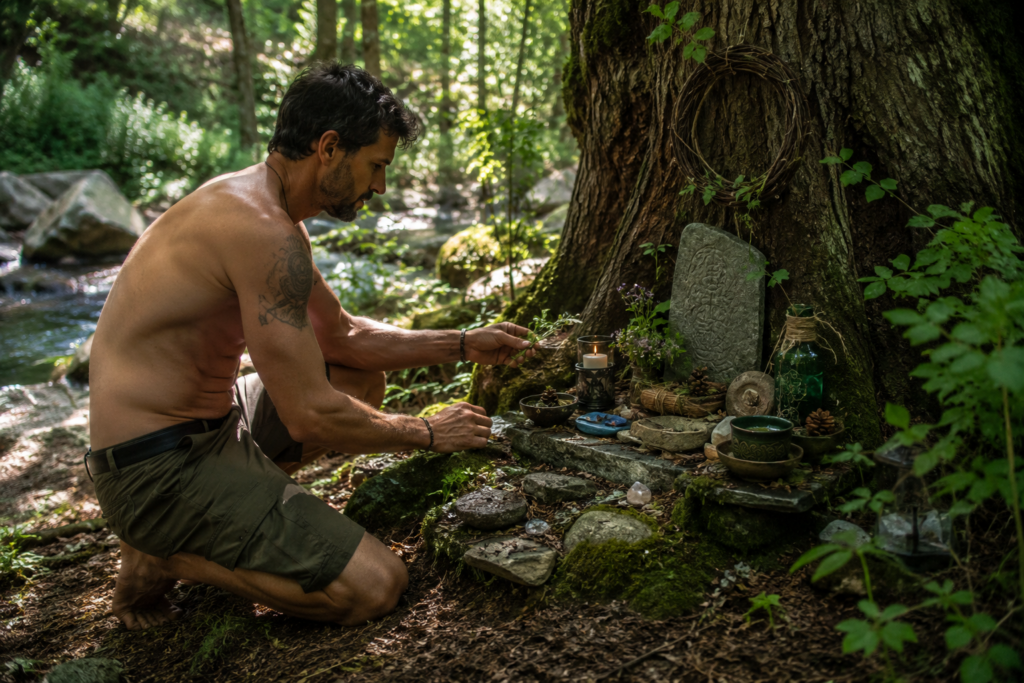
The same principle applies when working with plants, stones, bones, feathers, water, soil, and other materials. Respect does not require pretending we can never use anything. Life uses life: we eat, cut plants, burn wood, build homes, reshape landscapes, and participate in systems of consumption just as other organisms consume and transform one another. An animist ethic does not demand impossible purity. It asks us to participate consciously. Where did this come from? What did its taking cost? What relationship are we creating through its use? Can something be returned, replenished, tended, thanked, or treated with greater care?
Sometimes the answer is an offering. Sometimes it is conservation, growing what we use, refusing a destructively obtained material, or simply expressing gratitude. And sometimes the most respectful choice is not to take at all. That movement from use toward relationship lies close to the heart of animist witchcraft.
We still cast spells. We still choose, shape, protect, petition, and act according to will. Animism does not remove agency from the witch in order to grant it to everything else; it places our agency among many others. Magic becomes less like issuing commands to a collection of cosmic mechanisms and more like participating deliberately in a complicated world of patterns, powers, materials, beings, histories, and relationships.
We affect the web because we are part of it, and because we are part of it, what we do within that web matters.
Relationship Changes Magic
Animism does not ask us to discard technique, correspondence, or magical will. It asks us to notice that the things involved in a working may possess histories, relationships, tendencies, and forms of presence that matter too.
“In a universe of objects, magic can become manipulation. In an animate universe, magic becomes relationship.”
More Than a Meaning in a Book
Rosemary can correspond with protection and still be a particular plant, grown in a particular place, with its own history and relationship to the practitioner. Tradition gives us a language; relationship makes that language particular.
Use Creates History
A ritual tool may begin as an object chosen for a purpose, yet dedication, repetition, memory, and attention can give it an increasingly distinct place within practice. Familiarity itself can become part of the working.
Where We Work Matters
A grove, shoreline, kitchen, threshold, crossroads, or ritual room is not simply interchangeable space. Places gather history, conditions, memory, relationships, and sometimes unmistakable character.
Taking Creates Obligation
Using plants, water, wood, stone, soil, flame, food, or other materials places us inside an exchange. Reciprocity may mean tending, replenishing, offering, conserving, thanking, or sometimes choosing not to take.
Not Everything Is About Us
An animate world can communicate without becoming a universe arranged around the practitioner. A bird may be an omen; it may also simply be a bird pursuing its own life. Relationship requires attention, but discernment keeps attention from becoming projection.
Reciprocity — What Do We Owe a Living World?
If animism changes the way we understand the world, reciprocity changes the way we live within it. Relationship is never entirely one-directional. We receive constantly—from soil, water, plants, animals, other people, places, ancestors, communities, ecosystems, and forces we did nothing to create. Even the most solitary life depends upon exchanges that began long before us and will continue after us. Animism asks us to notice that dependence, and reciprocity begins there.
Reciprocity does not mean that every exchange must be perfectly balanced. Nature rarely works like an account book. A tree does not demand repayment from every creature sheltered beneath its branches, and a river does not issue an invoice for the water taken from it. Relationships are more complicated than accounting. But receiving without ever recognizing, tending, returning, or restraining ourselves eventually turns relationship into extraction.
For us, gratitude is one of the first forms of reciprocity. It is more than saying thank you because etiquette requires it; it is recognizing how much of our existence depends upon what we did not create ourselves. A meal contains sunlight, soil, water, labor, death, growth, transportation, knowledge, and time. A candle contains material, fire, craft, and intention. An herb used in spellwork carries the life of the plant, the conditions in which it grew, the person who tended or gathered it, and often generations of magical or medicinal relationship. Wood was once living tissue, water arrived through a watershed, and stone carries processes unimaginably older than us. Very little reaches our hands without a history.
An animist practice tries not to erase that history simply because something has become useful. This is one reason offerings appear in so many religious and magical traditions: they acknowledge that relationship has occurred. But an offering requires thought. Leaving something behind is not automatically reciprocal merely because we call it sacred. Food that harms wildlife, coins thrown into water, synthetic ribbons tied to trees, wax left on stone, salt poured onto living soil, invasive seeds, plastic trinkets, and other lasting debris may express spiritual intention while doing physical harm.
A sacred offering should not become someone else’s litter or an ecosystem’s burden.
Sometimes the best offering is water, song, prayer, appropriate incense, biodegradable material, tending a neglected place, removing trash, planting something native, supporting restoration work, or simply giving attention without taking anything away. Sometimes the offering is restraint. There is spiritual significance in seeing something beautiful and leaving it where it is: allowing a rare plant to remain unharvested, a feather to stay where it fell, or a stone, shell, bone, or flower to remain part of the place that produced it.
Reciprocity matters when we harvest as well. Taking a small amount from a healthy plant we know, at an appropriate time and in a way that allows it to continue thriving, creates a very different relationship from stripping whatever is available because a spell requires an ingredient. Knowing what is plentiful, threatened, invasive, poisonous, legally protected, or appropriate to gather is not somehow less magical because it involves ecology or practical knowledge. It is exactly the kind of knowledge that becomes necessary once the world stops being treated as a collection of magical supplies.
The same principle extends far beyond wilderness. Reciprocity belongs in gardens, city parks, balconies, kitchens, neighborhoods, homes, and streets. A person living in an apartment is no less capable of animist relationship than someone beside an ancient forest. Pigeons outside the window, a tree growing through pavement, rain collecting on a roof, yeast transforming bread, herbs on a windowsill, an old building settling at night, and the people sharing the block all belong to an inhabited world. Animism does not require us to escape civilization in search of some spiritually pure “Nature.” We are already here.
Our cities are made from stone, metals, timber, water, electricity, animals, fungi, bacteria, human memory, and transformed landscapes. They may be altered environments—sometimes badly damaged ones—but they have not ceased to participate in the world. Reciprocity therefore includes responsibility for the places we have changed. If our rituals teach reverence for rivers while our everyday choices treat waterways as disposable, something has become disconnected. If we honor Earth deities while ignoring where our ritual materials come from, our devotion deserves examination. If we speak reverently about sacred land while leaving rubbish behind after a working, the ritual language has failed to become practice.
Animism is not valuable to us merely because it makes the world feel enchanted. It asks something of us—not perfection, but participation. We consume, alter landscapes, eat living things, use electricity and technology, travel roads, inhabit buildings, and purchase materials through systems we do not fully understand. No one stands outside those exchanges. The goal is therefore not purity. The goal is attention followed by responsibility.
What Does Participation Ask of Us?
This is where animism begins to become sacred ecology. The living world is not sacred because it is always beautiful, peaceful, or kind. It is sacred because we belong to it, depend upon it, and live within relationships that exceed us. Those relationships deserve more than unconscious consumption.
Reciprocity is one way we remember that we are not merely beneficiaries of the world. We are participants with obligations of our own.
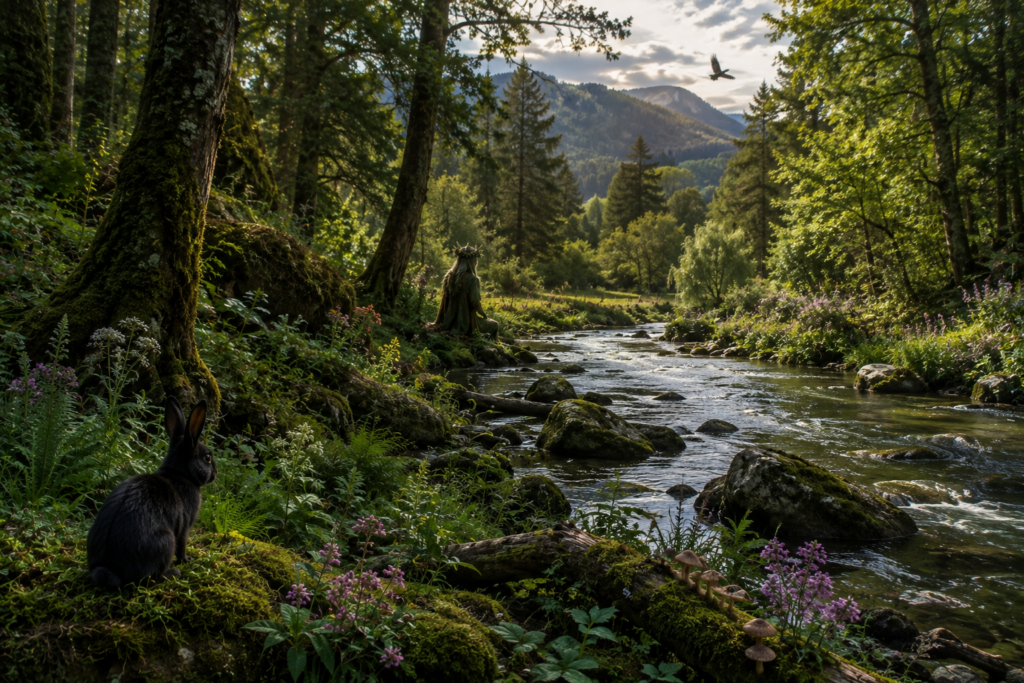
If animism describes the kind of world we believe we inhabit, sacred ecology asks how we should live within it. The two are related but not identical. Animism begins with ontology: reality is understood as animate, relational, responsive, and capable of intelligence and presence. Sacred ecology begins with consequence. If rivers are more than quantities of water, forests more than lumber, animals more than units of biomass, and human beings participants rather than owners standing outside the system, then our relationships with the world carry obligations. This is where reverence becomes practice.
The phrase sacred ecology also has an important history beyond contemporary Pagan spirituality. Ecologist and scholar Fikret Berkes has used it in studying traditional ecological knowledge: ways communities develop knowledge, practice, belief, adaptation, and responsibility through long relationships with particular environments. That understanding is useful because it prevents sacred ecology from becoming merely poetic language for “liking nature.” Ecological knowledge grows through attention, familiarity, and the recognition of patterns that cannot always be learned from abstraction alone.
Attention Reveals Relationship
Animism gives that attention spiritual depth. A place is not valuable only because it provides a measurable ecosystem service, a species does not need to prove its usefulness to human beings in order to deserve existence, and a wetland does not become sacred only when we discover that it filters water for us. The living world possesses relationships and purposes that do not revolve around our needs.
That is an important animist correction because human beings possess an extraordinary capacity to transform environments at enormous scale. Our intelligence allows us to recognize patterns, imagine futures, organize societies, create technologies, and reshape landscapes. Those capacities do not remove us from ecology; they make our participation more consequential. Greater power brings greater responsibility for what our actions change.
Sacred ecology therefore brings together things modern life often separates: spirituality and land use, devotion and consumption, magical materials and their origins, ritual practice and environmental consequence. A witch may speak reverently to a tree while still needing to ask where the wood on the altar came from. A Pagan may honor a river deity while caring what enters the watershed. A practitioner may work with herbs as living allies while still considering whether those plants were harvested sustainably. These are not interruptions of spiritual practice. They are what spiritual practice begins to look like when relationship is taken seriously.
This does not mean every Pagan must become an ecologist, farmer, herbalist, or conservationist. It means learning enough to participate with greater awareness, and that can begin very close to home: knowing some of the plants around us, noticing migrating birds, learning where our drinking water comes from, observing the direction of storms, recognizing what grows in neglected ground, and learning which species are native, introduced, threatened, or invasive. Pay attention to the moon, certainly—but also pay attention to rainfall.
Sacred ecology is built through this kind of intimacy. It brings the sacred down from an abstract idea of “Nature” and returns it to this soil, this watershed, this season, this neighborhood, this body. Generalized reverence can become strangely detached from actual places. It is easy to love an imagined ancient forest; it is harder, and often more important, to care for the damaged creek behind the shopping center. It is easy to speak of the Earth Mother; it is more demanding to ask what our own relationship with the Earth requires.
Within our theology, Gaia offers one way of encountering Earth not merely as a collection of ecosystems but as a living sacred presence: generative, relational, and expressed through the vast interdependence that sustains terrestrial life. Pan speaks differently. Where Gaia can draw our attention toward the living Earth as a whole, Pan evokes the untamed vitality moving within it—animal life, fertility, instinct, wild places, desire, fear, growth, and the refusal of the living world to become entirely domesticated.
Neither deity is required for sacred ecology, nor does nature require gods before it becomes sacred. Rather, an animate worldview leaves room for the powers of land and life to be encountered not only as systems but sometimes as presences. Some practitioners experience deity, some spirits of place, and some profound relationship without personifying the land at all. Sacred ecology has room for each, provided relationship leads toward attention rather than entitlement.
It also makes gratitude more particular. We can thank “the Earth,” but we can also thank the actual apple tree that fed us. We can honor Water while learning the name of our watershed. We can invoke Earth in ritual and then tend the soil beneath our feet. The broad sacred pattern and the particular relationship strengthen one another.
For us, sacred ecology is not an environmental rule imposed upon spirituality from outside. It is what happens when the recognition “I live within a world of relationships” is allowed to mature into a much more demanding question:
“Then what kind of participant will I be?”
“A cumulative body of knowledge, practice, and belief, evolving by adaptive processes and handed down through generations…”
— Fikret Berkes , Sacred EcologyAttention Becomes Responsibility
Reverence matters most when it changes how we participate. Sacred ecology moves from noticing the living world toward learning how to live more carefully within it.
Know the Place
Learn its seasons, water, plants, animals, histories, vulnerabilities, and rhythms before assuming what it needs.
Notice the Cost
Every material has an origin. Ask what was taken, changed, transported, or consumed before it reached your hands.
Return Something
Restore, tend, replenish, protect, give thanks, remove harm, or contribute to the continuation of what supports you.
Leave Room for Others
Not every plant, object, animal, place, or resource exists for human use. Sometimes relationship means choosing not to take.
Animism can become sentimental when the living world is imagined as endlessly welcoming, harmonious, and eager to guide us. That is not the world we recognize. Life nourishes life, but it also consumes life. Forests compete for light, animals defend territory, parasites survive through hosts, fire destroys and renews, rivers flood, storms arrive without regard for whether anyone is prepared, and disease does not become compassionate because the organism causing it is alive. An animate world is not automatically a benevolent one.
Nor is intelligence the same thing as kindness. A being can possess awareness and still be indifferent to us, want something we do not want, defend itself, deceive, compete, withdraw, or refuse relationship altogether. Human beings demonstrate this clearly enough, and animism gives us no reason to assume that other forms of intelligence are morally simpler.
This matters particularly in spirit work. Recognizing spirits as real presences rather than psychological decorations does not mean that every presence deserves invitation, trust, intimacy, or access. Some may be compassionate or curious; others may be hungry, territorial, confused, opportunistic, hostile, or simply uninterested in us. Still others may be so unlike human consciousness that words such as friendly and hostile do not describe them very well at all. Relationship therefore requires boundaries, and a practitioner can acknowledge the reality or intelligence of another being while still refusing entry, agreement, offering, relationship, or further contact.
That refusal is not a failure of animism. It is one of its consequences. If another presence possesses agency, then we must take both its agency and our own seriously. This is why protection, discernment, cleansing, warding, and banishing remain foundational to our practice. We do not protect ourselves because the world is spiritually empty; we protect ourselves because we understand ourselves to live among many forces, beings, intentions, and relationships.
Places deserve the same discernment. A beautiful location is not necessarily safe, and a place that feels powerful is not necessarily inviting us in. Old buildings, waterways, forests, crossroads, caves, cemeteries, ruins, mountains, abandoned places, and thresholds may carry histories and conditions that deserve attention before they inspire romance. Some places feel immediately welcoming, others become familiar only through repeated visits, and sometimes respectful distance is the most appropriate relationship. Animism asks us to listen before assuming access.
It also asks us to accept indifference. One of the most human-centered fantasies about spirituality is the belief that everything unusual must somehow concern us. A storm arriving during ritual may become part of a meaningful experience, or it may simply be a storm. A fox crossing a path may feel extraordinary, or it may be hunting. A spirit may decline to communicate, a god may remain silent, and a place may never reveal whatever character we imagined it ought to possess. An animate world has its own life, and that independence is part of what makes genuine relationship possible.
If everything existed primarily to deliver messages, comfort, signs, and guidance to human beings, animism would simply replace ordinary human domination with a spiritualized version of the same idea. We would still be placing ourselves at the center. Instead, we understand ourselves as one participant among many. Relationship may involve communion, conflict, protection, observation, negotiation, refusal, or simply leaving something alone.
Death belongs to this world as well. Animism does not require us to disguise death as an illusion or insist that every destruction is secretly pleasant. Bodies decay, species disappear, relationships end, landscapes change, and predation and loss exist alongside birth and flourishing. Yet decomposition also reveals how little in the living world is truly isolated: what dies may become food, soil, mineral, habitat, memory, or the beginning of something else. The world continues through transformation, not permanence, and that can be sacred without being comforting.
This is why we resist reducing animism to the soothing phrase that “everything is connected.” Connection by itself tells us very little. Predator and prey are connected. Parasite and host are connected. Wildfire and forest are connected. A person and an adversary are connected. The important questions are what kind of relationship exists, what it asks of us, and what boundaries are necessary within it.
Animism makes those questions unavoidable. It gives us a world that can be beautiful without being tame, sacred without being safe, intelligent without thinking like us, and alive without existing for our benefit. Such a world deserves reverence, but reverence includes respect—and sometimes respect means keeping our distance.
Animism and Its Philosophical Neighbors
Animism overlaps naturally with several religious and philosophical ideas, but they are not synonyms and they do not compete for a single place. A person may hold several of these understandings at once. Within MCC, animism remains the underlying worldview through which many of the others become intelligible.
Animism
Reality is understood as animate, relational, responsive, and capable of many forms of intelligence and presence. Humans belong inside this world rather than standing apart from it. Spirits, sacred places, magical relationships, and divine plurality become possible within a cosmos that was never spiritually empty to begin with.
Polytheism
Polytheism recognizes a plurality of gods. It is not the same thing as animism, but for us the two fit comfortably together. An animate universe capable of many kinds of intelligence and awareness leaves room for genuinely independent divine presences rather than requiring all sacred experience to resolve into a single being.
Pantheism
Pantheism understands the universe itself as divine. An animist may also be pantheistic, but animism does not require it. One can experience rivers, spirits, animals, places, and gods as real presences without concluding that all existence is one single divinity.
Panentheism
Panentheism understands the sacred or divine as present throughout the universe while also exceeding it. This can sit beside animism quite naturally: the world may be alive with particular beings and presences while also participating in a sacred reality larger than any one of them.
Panpsychism
Panpsychism is the philosophical possibility that mind, experience, or proto-mental qualities belong fundamentally to reality rather than appearing from absolutely non-experiential matter. It has interesting points of contact with animism, but it does not necessarily include spirits, personhood, reciprocity, gods, or relationship.
Anima Mundi — The World Soul
The ancient idea of an anima mundi, or World Soul, imagines the cosmos itself as possessing a unifying life or soul. It resonates with animist intuitions about a living universe, but our own view does not require every being or god to be merely a fragment of one universal mind. Unity and plurality can coexist without becoming identical.
They may meet one another without collapsing into the same belief.
Animism, Spirits & Other-than-Human Persons
Animism does not require every presence to fit the same category. A spirit is not necessarily a god. A place-presence may not be the same kind of being as an ancestor, and the beings called Fae do not always fit comfortably into either category. Personhood may have more than one shape. What matters is learning to recognize relationship without assuming that everything we encounter must resemble us.
What Is an Other-than-Human Person?
The phrase other-than-human person is useful because it allows us to speak of personhood without making humanity the measure of everything.
A person, in this sense, need not have a human body, human language, or a mind organized exactly like our own. Personhood may instead involve some combination of agency, individuality, response, relationship, memory, intention, or a distinct center of experience.
This does not mean that every tree or stone contains a tiny human personality. A tree may possess its own manner of being. A river may possess character and continuity without thinking in sentences. A presence may be intelligent in ways for which human consciousness provides a poor comparison.
Animism asks us to become less concerned with whether another being is sufficiently like us and more attentive to what kind of being or relationship may actually be present.
Spirits of Place — When Landscape Becomes Presence
Place-presences are among the most intuitive expressions of animist experience. Anyone who repeatedly visits particular landscapes knows that places develop recognizable character.
Geography, weather, light, ecology, architecture, history, memory, sound, and human activity all contribute to that character. Animism does not deny those explanations. It asks whether they always exhaust the experience.
A grove, riverbank, old building, hill, crossroads, garden, or ritual room can become increasingly coherent through repeated relationship. Sometimes the character appears older than the people encountering it. Sometimes human attention, ritual, memory, and use seem to strengthen what is already present.
Within our practice, we leave room for the possibility that place itself can become presence.
This is one reason our understanding of Sacred Space is relational. A place need not begin spiritually empty and wait for a practitioner to make it sacred.
The Dead, Ancestors & Continuing Relationship
Human death introduces another kind of presence, but animism does not require one universal theory of what happens after death.
The dead may be approached through ancestry, spirit, memory, continuing consciousness, reincarnation, otherworlds, divine realms, or combinations of these understandings. Different traditions answer these questions differently.
Within witchcraft, relationships with the dead may include remembrance, ancestor veneration, mediumship, divination, psychopomp work, or encounters with presences whose identities remain uncertain.
But the dead are not simply another source of magical power. They had lives and relationships of their own. Some may be beloved. Some unknown. Some difficult. Some may not want contact at all.
Animism does not romanticize the dead any more than it romanticizes the living.
Fae & Otherworldly Presences
The beings gathered under the modern word Fae demonstrate why an animist world is difficult to reduce to a tidy catalog.
Folklore does not describe one uniform species called “the Fae.” Traditions speak of beings associated with hills, homes, waters, wild places, boundaries, luck, fertility, craftsmanship, danger, the dead, and otherworldly realms.
Some are described as helpful. Some hazardous. Some deeply ambiguous. Many operate according to customs and relationships that do not map neatly onto human expectations.
For us, Fae traditions make the most sense when approached through an animist lens rather than reduced to fantasy creatures. Landscape, story, spirit, place, and other realms may overlap without becoming identical.
That does not mean every strange woodland experience is Fae. It means that the possibility of other-than-human personhood exists before we begin assigning a name to what we encountered.
When Attention, Pattern & Relationship Become Presence
Not every presence needs to have existed forever in exactly its present form.
A house inhabited for generations develops more than wear. An altar used for decades gathers more than dust. A ritual object repeatedly named, handled, consecrated, carried through important experiences, and entrusted with purpose becomes part of an increasingly dense pattern of relationship.
Shrines receive devotion. Crossroads receive petition. Temples receive generations of prayer. Art receives the concentrated attention of maker and viewer.
Within our animist understanding, attention can become relationship, relationship can establish pattern, and persistent pattern may become increasingly coherent.
We do not insist that every such process produces a conscious, separate spirit. But neither do we assume that presence, intelligence, or personhood can arise only in forms already familiar to human biology.
Some presences may strengthen through relationship. Some fade when neglected. Some places fall quiet. Others appear to persist long after the people who first tended them are gone.
Discernment — Relationship Without Projection
An inhabited world requires more discernment, not less.
Not every sensation is a spirit. Not every coincidence is communication. Not every dream is visitation. Not every old house contains a ghost, and not every unusual feeling in the forest belongs to the Fae.
At the same time, automatically dismissing every encounter because it cannot be easily measured is also an assumption. Our practice tries to remain open without becoming credulous.
Does the experience repeat consistently?
What is happening physically or psychologically?
Is the apparent presence distinct from the place or object itself?
Does divination or independent observation add anything?
What kind of relationship—if any—is appropriate?
Sometimes the most accurate answer is simply: “I do not yet know what that was.”
Animism gives uncertainty room to remain alive. We do not need to force every mystery into a category before we can treat it with attention and appropriate boundaries.
When deliberate spirit contact is involved, our fuller approach is explored in Spirit Relations, Boundaries & Protection .
“Animism does not require everything to be humanlike. It asks whether personhood may have more than one shape.”
Animism tells us something about the world; ecstatic practice asks what may happen when we deliberately change the way we encounter it. Across cultures, people have used rhythm, song, dance, prayer, silence, fasting, dream, repetitive movement, meditation, ordeal, and other altered states of attention to move beyond ordinary waking perception. Such experiences may be understood as spirit journey, soul flight, divine encounter, communication with ancestors, healing, vision, possession, or movement between worlds.
Not all of these practices are shamanism, and that distinction matters. For us, ecstatic spirit practice is often the more useful broader idea. Animism provides a world in which such practice makes sense: if reality contains spirits, ancestors, gods, other-than-human persons, places with presence, and modes of existence not ordinarily available to our senses, then altered consciousness may change the conditions under which relationship becomes possible.
The practitioner does not necessarily create another world by entering trance. They may instead be changing how they perceive and participate in a reality already there. Psychology and neuroscience can investigate many of the mechanisms involved in altered attention, imagery, memory, synchronization, and perception. Animism asks an additional question: what might become perceptible when our ordinary way of organizing experience changes?
We do not assume that every altered state reveals an independent spiritual realm. Human consciousness is extraordinarily capable of symbolism, memory, association, projection, and meaning-making, and trance can magnify those capacities just as readily as it may accompany a spiritual encounter. The fact that an experience occurs internally does not make it meaningless, just as calling an experience spiritual does not exempt it from examination.
Ecstatic practice therefore requires both openness and discernment.
Crossing the Ordinary Threshold
Altered states appear in many religious and magical traditions, but similar techniques do not necessarily belong to the same religion, culture, or cosmology.
Shamanism Is Not a Universal Label
The English word shaman entered European usage from Indigenous cultures of Siberia, particularly Tungusic-speaking peoples such as the Evenki. Scholars later applied shamanism much more broadly to ritual specialists and ecstatic practices across the world.
That comparison can reveal genuine similarities, but it can also blur very different peoples, religions, spirits, ceremonies, histories, and social roles. There is no single universal religion called Shamanism lying unchanged beneath every tradition that uses trance, drumming, healing, spirit communication, or journeying.
For this reason, MCC uses the word carefully. We are often better served by the broader phrase ecstatic spirit practice when discussing techniques that appear in many cultures without claiming that all of those traditions are the same.
Altered States, Perception & Discernment
Rhythm can narrow attention until ordinary distractions recede. Repetition can alter the perception of time. Dream can loosen assumptions carried by waking consciousness. Meditation may make subtle sensations suddenly obvious, while group ritual can create forms of synchronization and shared attention that feel profoundly different from solitary awareness.
None of this proves that every altered state opens an independent spiritual realm. A vivid experience may be psychological, symbolic, remembered, spiritual, or some mixture of these. A powerful experience is not automatically an objective one.
Animist practice therefore allows experience to remain meaningful without rushing to certainty. Calling something internal does not make it worthless, and calling something spiritual does not remove the need for discernment.
Journey, Otherworld & Consistent Relationship
Many ecstatic traditions describe movement: descending or ascending, crossing water, entering forests, following roads, passing through doors, traveling beneath the Earth, rising into the sky, or crossing a threshold between ordinary and otherworldly space.
Consciousness naturally organizes experience through spatial imagery, but within spiritual traditions such journeys may also be understood as genuine encounter. For us, the most useful test is not whether every journey can be forced into one explanation, but whether it develops consistent relationship.
One dramatic vision may be powerful, but relationship takes time. Animist practice is not a competition to travel farther, encounter stranger beings, or collect more spectacular stories. Sometimes the deepest practice is learning one place well.
The Specialist, the Community & Responsibility
Historically, practices labeled shamanic often involve much more than a person having unusual spiritual experiences. Ritual specialists may serve communities through healing, divination, mediation with spirits, guiding the dead, interpreting misfortune, maintaining relationships, or negotiating between human and other-than-human worlds.
That communal dimension matters because spiritual ability is not merely an interesting private experience. Power creates responsibility.
Within modern witchcraft we may work differently, but the same principle remains useful. If someone develops strong abilities in trance, mediumship, divination, spirit work, or otherworldly practice, the important question eventually shifts from “What can I experience?” toward “What am I responsible for because I can?”
Knowledge creates obligation. Relationship creates consequence. Crossing a threshold means eventually returning with some responsibility for how we live on this side of it.
Shamanic Traditions & MCC Practice
We do not describe all MCC practice as shamanic. Animism is much more foundational for us.
Our witchcraft may include trance, invocation, divination, spirit communication, mediumship, journeying, threshold work, and relationships with beings or realms beyond ordinary perception without collapsing those practices into one universal shamanic tradition.
Where we explore shamanism specifically, we do so as a meeting place between animist worldview and ecstatic spirit practice, while recognizing that traditions belonging to particular peoples remain their own.
Our separate Animism & Shamanism page explores that meeting point in greater depth.
Animism becomes most meaningful when it stops being abstract. It is easy to speak about the Earth, Nature, the elements, or the living world as enormous ideas, but none of us actually lives in an abstraction. We live somewhere.
We drink water from a particular watershed and experience particular seasons. Certain birds pass overhead, particular plants push through cracks in the pavement, and our weather arrives from recognizable directions. Roads follow older paths. Buildings stand where something else once stood. Rivers have been redirected, forests cut and regrown, fields cultivated, neighborhoods built, abandoned, remembered, and changed.
Animism asks us to know the world at that scale: this river, this hill, this grove, this street, this garden, this place. The more closely we attend to a place, the less interchangeable it becomes. Two forests may contain the same species and still feel entirely different; two shorelines respond differently to weather and tide; two houses built from similar plans acquire different histories. Even two corners of the same garden can develop distinct communities of plants, insects, shade, moisture, memory, and human attention.
From an animist perspective, those differences are not obstacles to some universal spiritual formula. They are the relationship.
Learning the World Where We Stand
Sacredness becomes particular through attention, history, relationship, memory, and repeated encounter.
The Sacred Grove & the Nemeton
One of the enduring images of European Paganism is the sacred grove. The Celtic-language term nemeton referred to a sacred place or sanctuary and was often associated with groves, although the historical evidence points toward something broader than simply “a grove where Druids worshipped.”
We therefore do not need to imagine that every ancient Celtic community practiced one uniform tree religion or that every sacred place looked the same. What matters for us is the underlying recognition that some places were distinguished through ritual, memory, boundary, relationship, and sacred presence.
Modern Druidry has made the grove a powerful image again—not simply as historical reconstruction, but as a living symbol of relationship with land, season, inspiration, and ecological responsibility.
A grove also teaches through the body. Trees alter light and sound. Roots reshape the ground. Temperature changes beneath the canopy. Wind becomes visible in leaves before it reaches our skin, and animals move differently along the forest edge. The body begins responding before theology does.
Repeated ritual adds another layer. Words have been spoken, offerings made, grief expressed, promises given, celebrations held, and silence shared. The place develops a history of relationship. Within an animist understanding, that matters.
Sacredness Is Not Limited to Wilderness
A sacred place does not require enormous trees, untouched mountains, prehistoric stones, or mist drifting across an ancient hillside. A backyard, balcony garden, city park, cemetery, shoreline beside an industrial district, kitchen, ritual room, roadside tree, neighborhood crossroads, or neglected strip of restored land can all become places of meaningful relationship.
This is why our work with Places and Sacred Space overlaps without becoming identical. Sacred space can be ritually established; place is encountered. Sometimes the two meet immediately, and sometimes relationship transforms one into the other.
Animism also makes us cautious about assuming that humans are always the ones granting sacredness. A place may already possess cultural memory, graves, ecological significance, spiritual associations, or relationships belonging to people who were there before us.
Entering relationship does not make us owners.
Belonging Is Different From Possession
Modern language easily confuses relationship with ownership. We speak of my land, my tree, my altar, my spirits, my sacred place. Sometimes that language is simply practical, but animism reminds us that belonging can move in more than one direction.
A person can belong to a place without possessing it. A practitioner may become part of the history of a grove, and a family may tend land for generations while remaining only one chapter in a much longer story. A tree may outlive the person who planted it; a river certainly does not begin when we first learn its name.
Place-based practice therefore encourages humility. We arrive somewhere already in progress. The land does not begin with our attention, and the relationships we enter may have begun thousands—or millions—of years before us.
Learning a Place Before Working It
When possible, spend time somewhere before deciding what kind of magical work belongs there. Visit in different weather and seasons. Notice what lives there. Learn something of its history and whether the land is public, private, protected, culturally significant, ecologically sensitive, or unsafe.
Listen before offering. Observe before naming. A dramatic first impression may be meaningful, but familiarity teaches things intensity cannot.
This becomes especially important when speaking of spirits of place. We should resist arriving somewhere new, experiencing one powerful sensation, assigning a personality or name to the land, and immediately behaving as though a relationship has already been established.
Relationship takes time. A place may surprise us, contradict our first interpretation, or reveal nothing obviously mystical at all and still become sacred through sustained attention. That is enough.
Animism can speak cosmically. It can ask what intelligence means, how consciousness arises, what gods are, whether spirit inhabits matter, and what kind of universe makes relationship possible. But eventually it returns us here: feet on actual ground, water from an actual river, weather crossing an actual sky, a tree carrying its own scars, a neighborhood holding particular histories, and some small piece of the world we can learn well enough to notice when something changes.
Sacred ecology begins there too. We cannot meaningfully care for “Nature” while remaining indifferent to every actual place, and we cannot build a relationship with the living world only in theory.
Animism becomes practice when the world stops being everywhere and begins being here.
Learning to Think With a Living World
No single writer defines animism, and we do not adopt any thinker wholesale. These voices are useful because they ask different questions about personhood, relationship, perception, ecology, land, and sacred participation. Together they offer several doorways into a conversation much larger than any one tradition.
A. Irving Hallowell
Hallowell’s work with Ojibwe communities helped bring attention to understandings of personhood that were not limited to human beings. His discussion of other-than-human persons became especially influential in later conversations about animism. His work is historically important, while the particular Ojibwe worldview he described should not be treated as a universal template for all animist traditions.
Nurit Bird-David
Bird-David helped reframe modern academic discussion of animism around relationship rather than the old idea that animists merely project human qualities onto lifeless objects. Her work on relational ways of knowing is especially useful for understanding why encounter, participation, and attention matter so much in animist thought.
Graham Harvey
Harvey’s work is one of the clearest contemporary introductions to animism as relationship among human and other-than-human persons. His emphasis on learning how to live respectfully within a larger community of beings strongly complements the relational approach developed throughout this page.
David Abram
Abram approaches the animate Earth through phenomenology, perception, language, and the senses. His idea of the more-than-human world is particularly useful when considering how profoundly human consciousness remains embedded within landscapes, bodies, animals, weather, sound, and place.
Fikret Berkes
Berkes brings the ecological side of this conversation into focus. His work on sacred ecology examines how ecological knowledge, practice, belief, adaptation, and long relationships with place can become intertwined. He reminds us that ecological wisdom is learned through attention as much as abstraction.
Emma Restall Orr
Restall Orr brings the conversation closer to contemporary Pagan and Druid practice. Her writing explores land, relationship, nature, ethics, and the difficult question of what it means to live spiritually within a world that is beautiful, mortal, untamed, and not centered upon human needs.
Starhawk
Starhawk brings earth-centered spirituality directly into modern Pagan practice, combining ritual, ecological attention, permaculture, activism, and questions of power and responsibility. Her work is especially useful where reverence for a living Earth must become something we actually practice rather than simply something we affirm.
“Animism is not diminished by careful thought. Careful thought helps us understand what kind of claim we are making—and what kind of relationship it asks of us.”
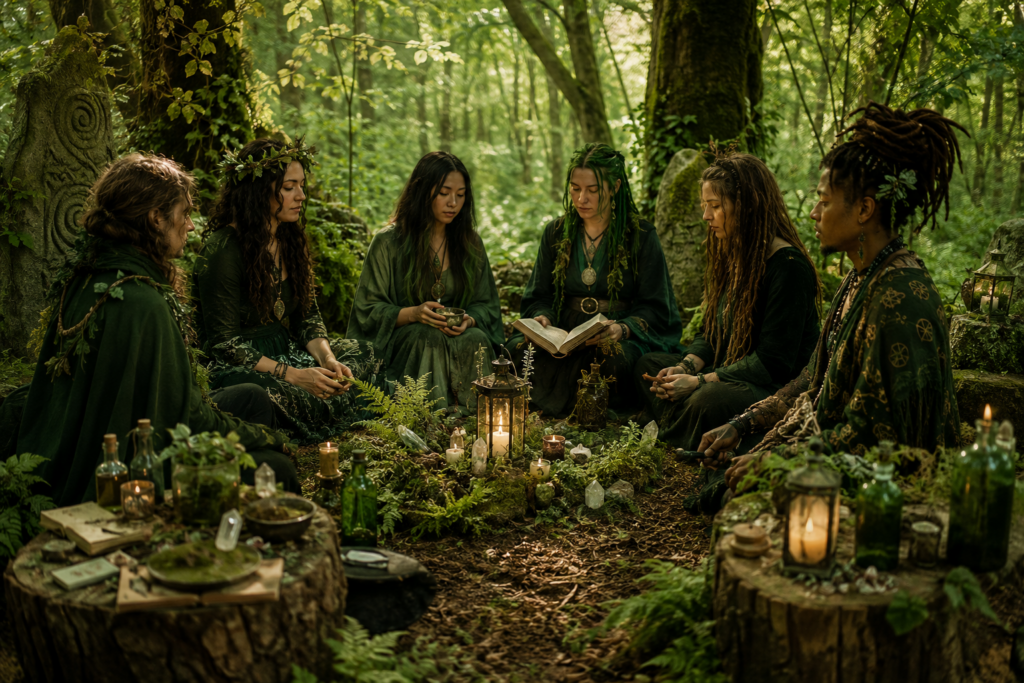
Animism does not give us a simpler universe. It gives us a more inhabited one. A world of relationships is necessarily more complicated than a world of objects because it contains more histories, more possibilities, more forms of agency, and more reasons to question the assumption that human beings are the only participants whose interests matter.
For us, that understanding begins very deeply. Matter forms patterns. Life responds. Organisms sense and adapt. Consciousness encounters, and reflective consciousness remembers, compares, imagines, recognizes patterns, and creates meaning. We do not believe these capacities appeared as something utterly foreign within a universe that had no possibility of them. They belong to what reality is capable of becoming. Science can investigate the mechanisms through which pattern, signaling, organization, response, and cognition emerge; animism makes a further philosophical and spiritual claim: intelligence is not an alien visitor to creation. It belongs here.
Consciousness belongs here too, although we do not assume that every form of awareness resembles our own or that human reflective consciousness is the measure against which everything else should be judged. Animals inhabit sensory worlds we can only partly enter. Plants respond across timescales very different from ours. Places accumulate ecology, history, memory, and relationship. Spirits may remain difficult to categorize, and gods may possess forms and scales of awareness profoundly unlike human consciousness. The universe is capable of looking back at itself. We are one way it does so; the gods may be others.
That does not mean everything is equally conscious, equally powerful, equally sacred in the same manner, or equally interested in us. Animism is not the claim that every pebble is secretly waiting for conversation. It is the refusal to begin with the assumption that silence means emptiness. Sometimes nothing answers. Sometimes we misunderstand. Sometimes our own minds produce the meaning we encounter. Sometimes a place remains indifferent, and sometimes relationship becomes difficult to deny. Animism leaves room for all of those possibilities without demanding certainty before attention can begin.
There is humility in that position. We can learn a river before deciding exactly what sort of spirit or intelligence it may possess. We can tend a tree without solving the nature of plant consciousness. We can respect an animal without pretending its experience mirrors our own, and recognize that a ritual object has accumulated presence without claiming to understand precisely what that presence is. A sacred place may involve ecology, psychology, memory, history, spirit, relationship, or several of these at once. Not knowing does not make an encounter worthless. Attention may become knowledge, relationship, or sometimes the realization that our first interpretation was wrong.
That attention naturally leads toward gratitude—not forced optimism, and not the claim that everything that happens is secretly a gift. The living world contains pain, predation, illness, injustice, accident, death, and destruction alongside beauty and flourishing. Gratitude simply recognizes that none of us is self-created. Air enters our lungs, water moves through our bodies, plants transform sunlight into food, innumerable organisms maintain systems on which we depend, and people we may never meet grow, build, repair, teach, preserve, transport, and create what sustains our lives. The dead leave knowledge behind. Places shelter us. Materials become tools. Relationships become homes. For some of us, gods, ancestors, spirits, and other presences become part of those relationships as well. Gratitude recognizes what we receive; reciprocity asks what we will do in return.
This is why animism sits so deeply beneath our witchcraft. A spell is not performed from outside reality. The witch stands within the working. Body, intention, word, tool, herb, symbol, place, spirit, memory, tradition, and relationship all participate. Will matters. Knowledge and technique matter. Tradition can strengthen practice because repetition establishes patterns that extend beyond a single moment or practitioner. Yet relationship gives those patterns context. Magical power does not have to mean imagining ourselves sovereign over everything involved. We may petition, command when command is appropriate, negotiate, protect, refuse, receive, give, listen, and act decisively while still recognizing that other forms of agency exist beside our own. The witch is neither powerless before the world nor ruler of it. The witch participates.
And participation does not require some distant holy land or a life untouched by modernity. It begins wherever we actually are: knowing what grows near the door, where our water comes from, which birds return with the seasons, what weather usually approaches from which direction, what lies beneath the building, and what our ritual materials are made from. It means caring for objects that have served us well, listening when a place feels different, questioning ourselves when every coincidence begins to look like a message, returning something when we have taken, and sometimes leaving something exactly where we found it. Repeated attention turns abstraction into familiarity, and familiarity can become relationship.
Animism does not make the world alive. The world was alive before we noticed. Our work is to notice more carefully: to recognize intelligence without demanding that it resemble our own, honor gods without reducing every deity to the same explanation, encounter spirits without imagining every shadow is one, and love the living world without pretending it is tame. It asks us to recognize presence without surrendering discernment and to remember that human beings are not standing at the center of creation looking outward.
We are already within it. The soil beneath us, atmosphere around us, organisms within us, people beside us, places that hold our histories, beings we encounter, and vast cosmos overhead belong to one reality in which relationship continually becomes possible.
That is the world animism asks us to meet: not an empty universe waiting to be animated by belief, but a living one waiting to be noticed.
The World Is Not Empty