
Spirit Relations & Boundaries
At the Living Threshold
Spirit contact begins where familiar reality meets something less easily named. That meeting may occur through a doorway, dream, shrine, landscape, divination, ritual, memory, or sudden impression. The task of protection is not to seal every threshold shut, but to decide consciously how contact may begin, what may cross, and what conditions must govern the exchange.
A presence may be acknowledged without being trusted, welcomed without receiving unrestricted access, and respected without being obeyed.
Boundaries do not presume that the unseen is hostile. They recognize that meaningful relationships—visible or invisible—require permission, discernment, responsibility, and a way to close the gate.

A threshold is often imagined as a line: one side here, the other side elsewhere. Yet within magical practice, the threshold is rarely so simple. It is not merely a border between the physical world and a spirit world, nor is it only a doorway through which something may enter. A threshold is the living place where conditions divide, meet, exchange meaning, and re-form. It is where one state of being ends without the next having fully settled into place.
Some thresholds are physical. Doors, gates, bridges, shorelines, roads, crossroads, graves, mirrors, windows, and the boundaries of a home all mark places where movement is regulated. Others are temporal: midnight, dawn, dusk, the change of a season, the beginning of a ritual, the moment immediately before sleep, or the first quiet after a death. Still others are internal. Grief, initiation, illness, trance, devotion, major decisions, and changes of identity can place a person between an old reality and one that has not yet fully arrived.
For this reason, the threshold is not only where things separate. It is also where they merge. Memory may enter the present. Dream may shape waking thought. A ritual symbol may begin as an image and return as a decision, a feeling, or a change in behavior. The dead may be remembered through the living, while the living are changed by what they remember. A message may pass through divination, trance, coincidence, landscape, or story and emerge in a form different from the one in which it began.
MCC generally understands the threshold as a place of translation. What crosses between realms, states, or forms is not always carried over unchanged. An impression may become language. A presence may become sensation. Grief may become ritual. Fear may become caution, or caution may become wisdom. A magical working may begin with intention and return through circumstance, relationship, opportunity, resistance, or insight. The threshold is therefore not an empty passage. It participates in the transformation.
This is part of what makes threshold work powerful, but it is also what makes boundaries necessary. Openness without definition can lead to confusion. A practitioner may sense something without knowing whether it is external, symbolic, emotional, environmental, spiritual, or some combination of these. A message may be received without being correctly interpreted. A presence may be noticed without being understood. The purpose of a boundary is not to deny uncertainty, but to create enough structure that uncertainty can be approached without immediately becoming surrender, fear, or certainty.
Spirit relationship belongs within this larger understanding. Contact with the unseen does not always begin with a dramatic manifestation. It may arise as a recurring dream, an atmosphere in a particular place, a sudden memory, an unexpected shift during divination, a sense of being accompanied, or an impression that does not seem to originate in ordinary thought. These experiences may be meaningful, misinterpreted, psychological, spiritual, environmental, or unresolved. The threshold allows us to remain attentive without deciding too quickly what has crossed it.
A mature practitioner does not need to choose between believing every experience and dismissing every experience. The work is to notice, document, question, test, and decide what degree of engagement is appropriate. Some experiences ask only to be acknowledged. Others may call for ritual, divination, research, cleansing, prayer, or help from another person. Some should be left alone. Some may require the boundary to be strengthened and the contact clearly ended.
The threshold also reminds us that entering and leaving are equally important. Every opening creates a responsibility to understand how it will close. A rite begins, develops, and ends. A guest is welcomed under conditions and later departs. A message is received, considered, and released. Even a valued relationship with a spirit, ancestor, deity, or place should not require the practitioner to remain permanently open. Relationship is not the absence of boundaries; relationship is one of the reasons boundaries matter.
To stand at the threshold is therefore not to remain trapped between worlds. It is to become conscious of passage. It is to recognize that things approach, cross, change, and return—and that the practitioner has a role in determining how that movement occurs. The threshold is not simply where the unknown enters. It is where permission is given, meaning is negotiated, and what has crossed is eventually carried back into life.

Illustrative Sacred Relationships
Keepers and Messengers of the Threshold
Within MCC practice, Hekate and Hermes offer two complementary ways of understanding the threshold. One concerns access, permission, and the authority of the boundary. The other concerns movement, communication, interpretation, and safe passage across it.
Hekate
Hekate represents the threshold as a sacred power in itself. She is associated with keys, crossroads, gates, boundaries, dangerous passages, and the discernment required to decide what may enter. Her presence reminds the practitioner that access is not automatic. A gate may be opened, watched, restricted, or firmly closed.
What approaches must be recognized. What crosses must be translated. What enters must do so under conditions.
Hermes
Hermes represents movement across boundaries: messages carried between realms, negotiation, interpretation, travel, exchange, and psychopompic passage. His presence reminds the practitioner that communication is not only received. It must also be translated, questioned, understood, and carried responsibly back into ordinary life.
Sensitivity does not create obligation. A practitioner may become aware of a presence, atmosphere, message, dream, or unexplained disturbance without owing it attention, conversation, entry, or continued relationship. Perception is not permission. Something may be noticed without being welcomed, and something already present may still be asked to leave.
This principle is especially important for people who experience spirit contact spontaneously. They may have been taught that unusual sensitivity is a gift that must always be used, that every presence deserves assistance, or that refusing contact is spiritually selfish. MCC does not understand discernment that way. A capacity may be meaningful without becoming a permanent duty. The practitioner remains responsible for deciding when, where, how, and whether that capacity is engaged.
The threshold belongs first to the person whose body, home, mind, ritual space, and daily life are being approached. This does not mean that the practitioner controls every being, force, or event beyond the threshold. It means that they retain authority over their own participation. They may decide whether to open a ritual, maintain an altar, answer a message, enter trance, offer hospitality, continue a relationship, or withdraw from one.
Hospitality and boundaries are not opposites. A guest may be welcomed into one room without being given unrestricted access to the entire home. A spirit may be offered water, candlelight, prayer, or conversation without receiving permission to appear in bedrooms, interfere with dreams, touch the body, disturb animals, approach children, or involve other members of the household. Limits do not make hospitality false. They make it intelligible.
Respect also does not require obedience. A presence may be old, powerful, persuasive, distressed, benevolent, frightening, or spiritually significant and still be questioned. Claims of authority should not be accepted merely because they arrive through an unusual experience. A name, title, prediction, demand, or promise may be meaningful, mistaken, symbolic, manipulative, or misunderstood. Reverence should not remove judgment.
This remains true when a presence appears kind or compassionate. Helpful spirits, ancestors, guides, land powers, and other benevolent presences may form lasting relationships with practitioners. Kindness, however, does not make boundaries unnecessary. Healthy relationships generally tolerate clarity. A presence that responds well to limits, patience, questions, and periods of silence gives the practitioner more reason for trust than one that demands immediate intimacy.
Difficult contact should not automatically be interpreted as proof of evil. A presence may be angry, grieving, confused, hungry, territorial, repetitive, or disordered in ways that are difficult for human consciousness to understand. It may also be misidentified, symbolically experienced, psychologically entangled, or connected to the atmosphere of a place. Compassion may be appropriate, but compassion does not require exposure. The practitioner may acknowledge suffering while refusing intrusion.
The need of a spirit does not automatically outrank the well-being of the living. Practitioners are not required to become rescuers, mediators, psychopomps, or permanent points of contact for every troubled presence they encounter. Some situations are beyond an individual’s experience, training, emotional capacity, or responsibility. Seeking help, closing the contact, leaving the location, or declining involvement may be the wisest and most ethical response.
Boundaries should be stated as clearly as possible. Vague discomfort is harder to enforce than a defined condition. Instead of merely hoping that a presence will behave appropriately, the practitioner may name what is and is not permitted: communication may occur through a particular method, at a particular time, for a particular purpose, within a particular space. Contact outside those conditions remains closed.
A boundary also requires consequence. When a limit is ignored, the response should not be endless renegotiation. The practitioner may end communication, remove offerings, close the shrine, cleanse the space, reinforce wards, seek outside help, or discontinue the relationship. A boundary that cannot be acted upon becomes only a request.
This does not mean approaching spirit relations as constant conflict. Most boundaries are quiet. They are established before trouble begins, repeated consistently, and maintained without drama. They allow the practitioner to remain open enough for meaningful contact while preserving sleep, health, relationships, judgment, and ordinary life.
The strongest spirit boundary is therefore not the most aggressive declaration. It is the one the practitioner understands, believes, and is prepared to uphold. It begins with a simple recognition: the unseen may possess its own agency, but so does the person standing at the threshold.

Person · Place · Pattern · Power · Unknown
Who or What Might Be Encountered?
Spirit contact is not one uniform phenomenon. Similar sensations may arise through very different relationships, places, states of consciousness, or causes. These categories are working possibilities rather than final verdicts.
Classification should follow observation, not replace it. A name can help organize an experience, but naming something too quickly may conceal what is actually happening. Document first, compare possibilities, and allow uncertainty to remain where the evidence remains uncertain.
The Human Dead Familiar or unfamiliar people whose lives have ended.
Encounters associated with the human dead may involve people known in life, unfamiliar dead, recent deaths, historical individuals, or presences connected with a particular building, object, road, cemetery, or event. They may seem peaceful, curious, distressed, repetitive, angry, confused, or simply difficult to interpret.
Ancestors and Chosen Dead Relationships formed through lineage, memory, affection, or tradition.
Ancestors may be connected through blood, adoption, family, culture, profession, spiritual lineage, community, or deliberate remembrance. Chosen dead may include teachers, friends, cultural elders, or historical figures toward whom a meaningful relationship has developed.
Residual Echoes and Memories of Place Repeated impressions that may not behave like conscious beings.
Some experiences appear more like patterns than conversations: a sound at the same hour, a recurring image, an atmosphere attached to one room, or a sequence that repeats without reacting to the observer. Practitioners sometimes describe these as residues, echoes, or memories held by a place.
Household and Land Spirits Presences associated with a home, structure, landscape, or local feature.
Some traditions recognize spirits connected with hearth, household, fields, roads, wells, trees, rivers, hills, and other enduring places. These relationships may develop through proximity and repeated care rather than through formal summoning or dramatic contact.
Land Spirits and the Fae Place-based beings whose traditions and temperaments vary widely.
“Fae” should not be used as a convenient label for every unusual nature spirit. Folkloric traditions describe many kinds of beings connected with particular landscapes, households, waterways, roads, boundaries, and ancestral stories. They may be helpful, territorial, generous, indifferent, deceptive, or difficult.
Kind and Compassionate Spirits Helpful, protective, healing, guiding, or peacefully relational presences.
Not every encounter is hostile, hungry, or disturbed. Practitioners may experience presences as reassuring, compassionate, protective, instructive, or quietly helpful. Some form long relationships; others appear briefly during grief, danger, healing, ritual, or transition.
Hungry, Angry, or Disturbed Spirits Presences driven by appetite, grief, rage, fixation, or disordered patterns.
Some presences may appear consumed by suffering, hunger, anger, confusion, repetition, or impulses that seem irrational or profoundly alien to human consciousness. Their behavior may feel coercive, predatory, chaotic, obsessive, or impossible to negotiate with safely.
Religious systems sometimes interpret compassionate and hostile presences through categories such as angels and demons. MCC does not assume that these are universal species. We may use “demon” as historical or cultural shorthand while also considering angry, hungry, distressed, predatory, or deeply unfamiliar spirits.
Psychopompic and Messenger Presences Beings or powers associated with passage, transition, warning, and guidance.
Psychopompic presences are associated with death, transition, escort, passage between states, and the movement of messages across boundaries. They may appear through established deity relationships, ancestral traditions, dreams, rites of death, or moments when a person or spirit is between conditions.
Elemental and Ceremonial Presences Powers encountered through a defined magical language or ritual system.
Some traditions approach the Elements as currents, qualities, or forces; others also understand them as inhabited by relational beings. Ceremonial work may involve presences sometimes given names, offices, seals, elemental attributions, or specific roles within a ritual structure.
These may include elemental beings, guardians, watchtower powers, spirits, or personified principles. Their meaning depends upon the system in which they are encountered and should not be detached casually from that ritual language.
Gods and Divine Presences Sacred relationships involving a different scale of agency and sovereignty.
Gods may be encountered through devotion, ritual, myth, dream, invocation, place, art, crisis, or sustained relationship. They should not be reduced to generic spirits, personal assistants, or ritual mechanisms. Their presence may be intimate while remaining larger than the individual practitioner’s immediate concerns.
Psychological, Environmental, and Uncertain Experiences Experiences whose source remains internal, external, mixed, or unresolved.
Unusual experiences may be influenced by grief, expectation, trauma, suggestion, sleep disruption, memory, symbolism, environmental conditions, medication, illness, stress, pattern recognition, or causes that remain unknown. Considering these possibilities does not automatically strip an experience of meaning.
Some events may contain several layers at once. A dream may arise through the unconscious and still carry spiritual significance. A place may have an environmental explanation and still affect the practitioner symbolically. The aim is not to force every experience into one category, but to respond in a way that remains grounded and proportionate.
Access Is Layered
The Five Gates of Permission
Spirit contact is not a single yes-or-no decision. Each degree of access should be considered separately. A presence may be permitted at one gate while every deeper gate remains closed.
Recognition
Recognition is permission for a presence to become noticeable or to be calmly acknowledged. It may involve atmosphere, sensation, repeated imagery, a dream, an impression, or the sense that something is nearby. Recognition does not authorize conversation, entry, attachment, or continued attention.
This gate is useful when a practitioner is willing to observe but does not yet know what is being encountered. It allows awareness without immediately escalating the relationship.
“You may make your presence known calmly and without frightening, touching, following, or disturbing anyone in this household.”
Communication
Communication grants permission to convey information through a defined method. That method might be divination, ritual speech, writing, mediumship, dream, image, sound, or another channel the practitioner has deliberately chosen.
Permission to communicate through one method does not extend automatically to every other method. A presence invited through cards has not thereby been invited into sleep, the body, the home, or the thoughts of other people.
“Communication is permitted through this method, within this working, until I formally close it.”
Proximity
Proximity concerns how near a presence may come and which spaces it may approach. A practitioner may permit contact at an outdoor shrine, divination table, ritual circle, doorway, grave, altar, or other defined place without opening the entire home.
Recognition from a distance is not the same as permission to cross a threshold. Proximity should be limited by place, duration, and purpose.
“You may approach this altar during this rite. You may not move beyond this space, follow me, or remain after the rite has ended.”
Participation
Participation permits a presence to take part in a defined ritual, offering, divination, healing, protection, remembrance, or other magical act. The role should be named clearly: witness, assist, advise, carry, protect, receive, or another limited function.
Participation does not grant command over the practitioner, ownership of the working, continuing authority, or permission to alter the purpose of the rite.
“You may participate only in the purpose named here. You may not redirect this work, bind anyone present, or claim authority beyond this rite.”
Embodiment
Embodiment includes trance, invocation, channeling, bodily sensation, voluntary overshadowing, dream entry, touch, voice, movement, or other forms of contact involving the practitioner’s body or intimate consciousness. This is a fundamentally different degree of access from being noticed or heard.
Consent should be explicit, informed, limited, and capable of being withdrawn immediately. No earlier gate implies permission to enter this one.
“No bodily, dream, trance, voice, touch, or intimate access is permitted unless I explicitly open that gate for a defined purpose and duration.”
What Remains Off Limits
These boundaries should not be treated as casually implied permissions. They remain closed unless the person directly affected has knowingly and explicitly chosen otherwise.

Spirit contact does not always involve the same degree of openness. Noticing an atmosphere, praying to a deity, reading cards, receiving a mediumistic impression, inviting a presence into a ritual space, and allowing a presence to move through the body are not interchangeable acts. Each opens a different part of the practitioner’s attention, environment, relationship, or embodied awareness.
These degrees should not be mistaken for a ladder of spiritual achievement. Deeper access is not necessarily better access. A person who receives useful guidance through quiet prayer or divination is not less developed than someone who practices trance or invocation. Greater intensity does not prove greater truth, and dramatic contact does not automatically produce wisdom.
The appropriate degree of openness depends upon purpose. A practitioner seeking information may need only divination. Someone honoring an ancestor may need only a candle, an offering, and spoken remembrance. A carefully bounded mediumistic session may allow impressions to be received without inviting a presence into the home indefinitely. The method should answer the need rather than turning every encounter into the most intimate form of contact available.
Each degree of openness also changes what must be protected. Simple awareness may require only grounding and documentation. Direct communication requires clearer limits around method and duration. Invitation requires a defined place and a formal closing. Mediumship requires attention to interpretation, emotional influence, and the practitioner’s ability to distinguish reception from certainty. Evocation requires a prepared external boundary. Invocation and other embodied forms require explicit consent concerning the body, voice, movement, consciousness, and method of release.
Openness can occur gradually, but it may also happen unexpectedly. A dream may become unusually vivid. A divination session may seem to shift into direct communication. A devotional rite may develop into a powerful sense of presence. When contact moves beyond the degree originally intended, the practitioner does not need to continue simply because it has begun. The working may be paused, narrowed, or closed.
The practitioner should know what has been opened. Is attention being directed toward a possibility, or is a particular presence being addressed? Is communication symbolic, intuitive, verbal, mediumistic, evocational, or embodied? Is the presence being acknowledged at a distance, invited into a specific space, or permitted to influence the practitioner’s consciousness? Clear language makes it easier to recognize when the encounter has crossed into a degree of openness that was never granted.
The practitioner should also know how each degree ends. Looking away may be enough to end casual observation, but it is not necessarily enough to close a formal invitation. A divination tool may need to be cleared and put away. An offering rite may need a spoken conclusion. An invited presence may need to be released. Trance or embodiment requires a deliberate return to ordinary awareness, followed by grounding, rest, and observation.
Some practitioners find that their safest and most meaningful relationships remain near the outer degrees of openness. Others may undertake mediumship, evocation, or invocation through training, tradition, necessity, or sustained relationship. The purpose of this scale is not to direct everyone inward. It is to help the practitioner recognize what each movement inward asks of them.
A sound practice opens no farther than the work requires and closes every gate that no longer needs to remain open.
From Observation to Intimacy
A Scale of Contact and Openness
Moving inward changes what is being opened, what preparation is required, and what kind of closing must follow. No stage is automatically better, truer, or more spiritually advanced than another.
Open only as far as the purpose requires, and never mistake intensity for accuracy, authority, or spiritual maturity.
Notice
The practitioner notices an atmosphere, impression, dream, repetition, sensation, or possible presence without deliberately initiating communication.
What opens: Attention and observation.
Primary boundary: Recognition does not grant approach or continued contact.
Closing: Withdraw attention, ground, and record the experience without escalating it.
Address
The practitioner speaks, prays, names, greets, or otherwise acknowledges a presence without necessarily inviting a reply or deeper approach.
What opens: Deliberate attention and one-directional address.
Primary boundary: Being spoken to does not grant permission to enter, remain, or answer through every available channel.
Closing: End the address clearly and return attention to ordinary activity.
Exchange
A structured exchange occurs through divination, prayer and response, signs, offerings, ritual questions, or another agreed symbolic method.
What opens: A defined channel of communication or reciprocity.
Primary boundary: One method does not authorize unrelated dreams, bodily sensations, household activity, or continuing messages.
Closing: State that the exchange is complete, clear the method, and put the tools away.
Invite
A presence is welcomed to approach a shrine, altar, circle, offering place, ritual room, or other defined location for a named purpose and duration.
What opens: A particular place and period of contact.
Primary boundary: Invitation into one ritual space does not open the whole home or establish permanent residence.
Closing: Thank where appropriate, withdraw the invitation, remove or settle offerings, and restore the space.
Mediate
Through mediumship or related practice, the practitioner receives, interprets, and communicates impressions associated with a spirit or unseen presence.
What opens: Intuitive, symbolic, emotional, sensory, or mediumistic reception.
Primary boundary: Receiving an impression does not make every interpretation correct or every claimed identity reliable.
Closing: End reception deliberately, release the contact, ground, and document before interpretation hardens into certainty.
Evoke
A presence is deliberately called into a prepared external boundary, vessel, altar, circle, or ritual field so that it may be encountered across a maintained distinction.
What opens: A defined external place of encounter.
Primary boundary: The presence remains across the established boundary rather than being invited into the practitioner’s body or identity.
Closing: Give a formal release or dismissal, close the vessel or boundary, and dismantle the ritual structure in order.
Embody
Through invocation, channeling, trance, voluntary overshadowing, voice, movement, or another embodied method, the practitioner permits a power or presence to affect intimate consciousness or bodily expression.
What opens: The body, voice, attention, identity, movement, trance state, or intimate consciousness.
Primary boundary: Consent must be explicit, informed, limited, observable, and capable of being withdrawn immediately.
Closing: Release the presence, reclaim name and bodily awareness, ground physically, rest, and observe aftereffects before attempting further contact.
Define Before Opening
Set the Terms Before Contact
A boundary is most useful when it is established before emotion, surprise, urgency, or unusual experience begins to shape the encounter. Define the relationship while judgment is clear.
No permission carries sideways. Access granted through one method, place, or purpose does not extend automatically into another.
01 Who Is Being Invited? Define the intended relationship as specifically as circumstances allow.
A broad invitation such as “any spirit who wishes to speak” creates unnecessary uncertainty. Name the individual, relationship, category, deity, ancestor, land presence, or ritual role being approached. When a specific identity is not known, define the qualities and conditions required.
Identity should remain open to verification. Naming the intended presence establishes the invitation; it does not prove that every response comes from that source.
- The specific person, being, relationship, or category intended.
- Whether substitutes, messengers, companions, or unnamed presences are excluded.
- What evidence would cause the claimed identity to be questioned.
“This invitation is extended only to the presence named and intended here. No other being, messenger, companion, or substitute is included.”
02 Why Is Contact Being Sought? Give the encounter a purpose narrow enough to recognize when it is complete.
Contact may be sought for remembrance, devotion, information, reconciliation, divination, protection, healing, ritual participation, assistance with passage, or another defined need. Curiosity is not inherently wrong, but undefined curiosity can encourage a working to expand without a natural stopping point.
A purpose also allows the practitioner to refuse unrelated demands. A presence invited to receive an offering has not thereby been invited to advise every decision or establish an ongoing relationship.
- The question, offering, task, remembrance, or ritual purpose.
- What subjects remain outside the encounter.
- What will show that the purpose has been fulfilled or cannot be fulfilled.
“This contact is opened for the purpose named here and for no unrelated request, demand, promise, or obligation.”
03 Where May Contact Occur? Open a defined place rather than the whole home or landscape.
Contact may be limited to an altar, ritual room, circle, outdoor shrine, grave, table, doorway, divination space, or another clearly identified location. The physical boundary should match the purpose of the work.
A spirit invited to an altar is not necessarily invited into every room. A presence approached at a cemetery or woodland boundary should not be assumed to have permission to follow the practitioner home.
- The exact room, altar, circle, shrine, or outdoor location.
- Whether the presence may cross doors, windows, property lines, or ritual boundaries.
- Whether the invitation ends when the practitioner leaves the location.
“Contact is permitted only within this prepared place. No invitation extends beyond its boundary, and nothing encountered here may follow me when I leave.”
04 How May Communication Occur? Choose the channel rather than leaving every form of access available.
Communication may occur through cards, pendulum, ritual speech, impressions, automatic writing, dreams, mediumship, symbols, offerings, or another method. Each channel carries different interpretive risks and degrees of intimacy.
Permission through one channel does not grant access through all channels. A presence invited to communicate through divination is not automatically permitted to enter dreams, create bodily sensations, move objects, speak through another person, or continue after the tools have been closed.
- The permitted tool, sense, symbolic system, or ritual method.
- Which experiences will not be accepted as communication.
- How the chosen channel will be formally opened and closed.
“Communication is permitted only through this chosen method, during this working, and ends when the method is closed.”
05 What Remains Off Limits? State prohibitions plainly rather than assuming they will be understood.
Some boundaries should remain closed by default: children, animals, unwilling household members, bedrooms, bodily access, unrequested dreams, private thoughts, sexual contact, frightening manifestations, threats, and communication outside agreed times.
Each person governs their own participation. One practitioner cannot grant spiritual access to another person’s body, room, dreams, possessions, or attention simply because they share a home or ritual.
- Who may not be approached or involved.
- Which rooms, bodies, dreams, thoughts, and possessions remain closed.
- Which behaviors immediately end the contact.
“You may not approach children, animals, unwilling persons, bedrooms, bodies, private thoughts, or dreams. You may not threaten, frighten, touch, follow, bind, or remain outside the permission stated here.”
06 How Long May Contact Continue? Set a duration so the relationship does not remain indefinitely open.
Contact may be limited to a single question, one ritual, the burning of a candle, a stated period, or a particular stage of work. Duration should be understandable to the practitioner and connected to a visible or spoken ending.
A valued relationship may continue across years while individual sessions still open and close. Ongoing relationship does not require ongoing exposure.
- The starting point and intended ending.
- Whether the invitation applies once or may be renewed.
- What happens when the allotted time ends before the purpose is fulfilled.
“This permission continues only for the duration of this working and ends when I state that the contact is complete.”
07 How Will the Contact Be Closed? Prepare the ending before opening the encounter.
Every opening should have a corresponding closure. Depending on the practice, closing may involve thanking, dismissing, withdrawing permission, extinguishing a candle, covering a mirror, putting away cards, closing a circle, removing an offering, sealing a vessel, ringing a bell, cleansing, grounding, or leaving a location.
The practitioner should possess a way to stop the encounter even when it does not proceed as expected. Closing should not depend entirely upon the presence’s agreement.
- The statement that ends communication and withdraws access.
- The physical act that closes the method or ritual space.
- The grounding, documentation, and aftercare that follow.
“This contact is now complete. Permission to approach, communicate, influence, enter, follow, or remain is withdrawn. This method and this threshold are closed.”
Name who may approach, why they are invited, where they may stand, how they may speak, what remains forbidden, when the contact ends, and how the threshold will close.
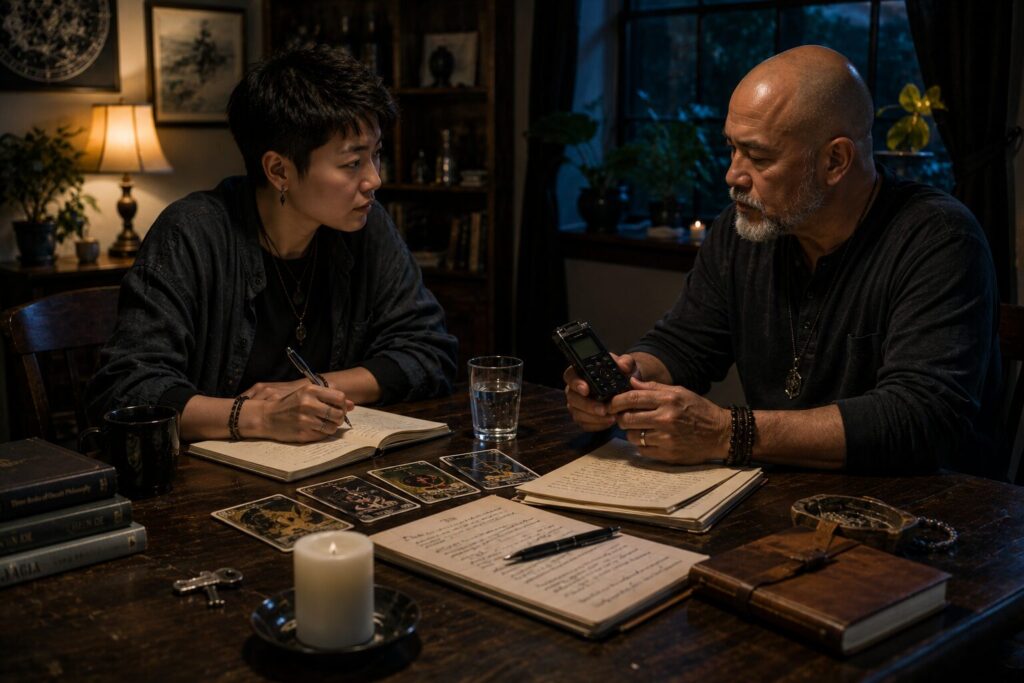
An unusual experience may deserve attention without immediately deserving belief. A name heard in meditation, a message received through divination, a vivid dream, a sudden impression, or a presence that appears to identify itself may be meaningful. None of these experiences, however, proves its own interpretation.
Spirit discernment begins by separating what was experienced from what has been concluded about it. “I heard a name” is an observation. “A particular deity spoke to me” is an interpretation. “The room became cold” is an observation. “An angry spirit entered the house” is an interpretation. Keeping those levels distinct allows meaning to develop without forcing certainty too soon.
Identity should be tested over time. A presence may give a familiar name, religious title, ancestral relationship, or impressive history. That claim should not be accepted merely because it feels powerful or arrives through an altered state. A name may be symbolic, mistaken, misunderstood, deliberately borrowed, or supplied through expectation and memory. Trust grows through consistency rather than introduction.
The character of the communication matters as much as the claimed identity. Consider whether the presence respects questions, boundaries, delays, and refusal. Does it allow the practitioner to consult other people or methods? Does it tolerate periods of silence? Does it encourage judgment and responsibility, or does it demand immediate obedience?
Coercive communication often narrows the practitioner’s world. It may insist that no one else can understand, that ordinary relationships are spiritually inferior, that secrecy is proof of loyalty, or that catastrophe will follow if instructions are not obeyed. Urgency, flattery, fear, threats, exclusivity, and claims of unquestionable authority are reasons to slow down rather than signs that a message is important.
A compassionate or helpful presence may still be misunderstood, and a difficult message is not automatically malicious. Useful discernment looks beyond whether the practitioner likes what is being said. Some accurate guidance may be uncomfortable. Some flattering guidance may be harmful. The question is not simply whether the message feels pleasant, but whether the relationship supports clarity, agency, proportion, and responsible action.
Claims that can be checked should be checked. Dates, names, locations, family histories, predictions, descriptions of objects, and factual statements should not be protected from examination merely because they were received spiritually. Divination may offer a second symbolic perspective, but it should not be treated as automatic proof. Research, observation, records, environmental checks, and consultation with another grounded person may reveal details that personal interpretation missed.
Patterns matter more than isolated moments. A single dream, coincidence, successful prediction, or intense sensation may be striking without establishing a dependable relationship. Record what happened before revising it into a story. Note the time, location, physical condition, emotional state, method used, exact message, and what occurred afterward. Return to the record later and look for consistency, contradiction, selection, and forgotten failures as well as apparent successes.
The effect of contact on ordinary life also matters. A relationship that repeatedly destroys sleep, encourages obsession, creates fear, isolates the practitioner, demands escalating offerings, or makes independent judgment feel forbidden should not be excused because it appears spiritually important. Contact does not need to be proven fraudulent or evil before it may be limited or ended.
Psychological and environmental possibilities should remain available throughout the process. Grief, expectation, trauma, stress, sleep disturbance, memory, suggestion, medication, illness, architecture, sound, animals, electrical problems, and ordinary human conflict may shape unusual experiences. Considering these possibilities is not a betrayal of magical practice. It is part of refusing to make the unseen responsible for everything that is not immediately understood.
Uncertainty is sometimes the most accurate conclusion. A practitioner may decide that an experience was meaningful without claiming to know exactly what caused it. They may preserve several possible interpretations, remain watchful, or decline further contact until more information appears.
Trust should be earned through pattern, consistency, respect, corroboration, and time. A presence that cannot tolerate careful discernment has already provided useful information about the relationship it is offering.
Discernment Before Certainty
Eight Tests Before Trust
No single sign proves a spirit’s identity, honesty, wisdom, or intention. Trust should form through repeated patterns that remain coherent when questioned, checked, delayed, and bounded.
Record what happened first. Decide what it might mean second. Trust the interpretation only as evidence accumulates.
The Boundary Test
Does the presence accept a clear “no,” a delay, a narrower method, or the end of contact?
Respect for limits does not prove benevolence, but repeated refusal to honor limits is meaningful information.
The Consistency Test
Does the identity, manner, purpose, and message remain reasonably coherent over time?
Allow for symbolism and imperfect interpretation, but note identities and stories that change whenever they are questioned.
The Corroboration Test
Can any factual claim be checked through records, observation, research, or another independent method?
Record the claim before researching it. This reduces the temptation to reshape a vague message around information found later.
The Independence Test
Does the relationship preserve the practitioner’s judgment, ordinary relationships, and ability to seek outside perspectives?
A presence that requires secrecy, isolation, or exclusive spiritual authority should be approached with particular caution.
The Proportion Test
Does the scale of the response match the experience, or is every event becoming a crisis, prophecy, attack, or cosmic command?
Meaningful spiritual practice still allows ordinary events to remain ordinary and uncertainty to remain unresolved.
The Ordinary-Cause Test
Have physical, environmental, relational, psychological, and technological possibilities also been considered?
Exploring ordinary causes does not invalidate spiritual meaning. It prevents a premature explanation from replacing investigation.
The Effect Test
What does continued contact produce in the practitioner’s sleep, judgment, health, relationships, attention, and daily functioning?
A spiritually impressive relationship may still be unhealthy when its repeated effects are fear, depletion, obsession, or dependency.
The Time Test
Does the interpretation remain persuasive after rest, distance, documentation, and the emotional intensity of the moment has passed?
Urgent decisions should rarely be based on a single unverified encounter. Time often reveals patterns that intensity conceals.
Patterns That May Support Trust
- Boundaries and refusal are respected.
- Identity and purpose remain reasonably consistent.
- Questions and independent checks are permitted.
- The practitioner retains agency and ordinary relationships.
- Contact may be paused and closed without retaliation.
- The relationship develops gradually rather than demanding instant devotion.
Patterns That Call for Distance
- Threats, punishment, urgency, or escalating demands.
- Flattery used to establish exceptional status or obedience.
- Claims that no one else can understand or be trusted.
- Repeated intrusion outside agreed times or methods.
- Pressure toward secrecy, isolation, vows, or permanent access.
- Increasing fear, exhaustion, fixation, or inability to close contact.
“By their language, as you distinguish a trifler from a man of sense.”— Allan Kardec , The Mediums’ Book, Chapter XXIV
Kardec’s classifications belong to his particular Spiritist theology. The enduring practical point is that an impressive name should not outweigh the character and quality of the communication.

Offerings are among the oldest ways human beings have expressed relationship with gods, spirits, ancestors, the dead, and the powers of place. Food, water, flame, incense, flowers, song, labor, prayer, art, remembrance, and acts of care may all become offerings when they are given deliberately. Their meaning does not arise from the object alone, but from the relationship, tradition, intention, and manner in which the gift is made.
An offering is not automatically a payment. It does not purchase obedience, guarantee a result, or create unrestricted access to the giver. Nor does accepting an offering necessarily prove that a presence has entered into a permanent agreement. The language of exchange can be useful, but spirit relationship should not be reduced to a commercial transaction in which every gift creates a debt and every outcome has a fixed price.
Reciprocity is broader than repayment. It may involve gratitude, attention, remembrance, stewardship, hospitality, fulfilled obligations, or the continued care of a relationship. A household spirit might be acknowledged through the tending of a home. A land presence may be honored through respectful behavior toward the place. An ancestor may be remembered through food, story, or family care. A deity may receive devotion, ritual, charity, creative work, or offerings shaped by an established tradition.
The appropriate offering depends upon whom or what is being approached. A practice meaningful in one religion, culture, family, or region may be unsuitable in another. Before adopting a traditional offering, learn its context. Understand whether it is devotional, funerary, seasonal, initiatory, contractual, or reserved for a specific kind of relationship. A gift should not be separated casually from the religious or cultural structure that gives it meaning.
Simple offerings are often sufficient. Water, candlelight, incense, flowers, bread, fruit, prayer, music, or the careful cleaning of a shrine can carry more integrity than an elaborate gift made for display. Cost does not determine spiritual value. A practitioner should not endanger their health, finances, home, animals, environment, or legal safety in order to prove sincerity.
Offerings also require practical responsibility. Food may spoil. Alcohol, smoke, fire, plants, oils, salt, and outdoor materials can affect children, animals, wildlife, waterways, soil, and household members. An offering should be placed, maintained, and removed in a way that respects both the relationship and the physical world through which it is expressed.
The manner of removal should be considered before the offering is placed. Some items may be composted, buried where lawful and environmentally appropriate, returned to flowing water only when harmless, burned safely, consumed where the tradition permits, or disposed of respectfully. Not everything placed upon an altar must remain there indefinitely. Decay is not always sacred, and neglect should not be mistaken for devotion.
Repeated offerings can establish a pattern of relationship. This may be intentional, but patterns should not be created carelessly. A gift made once during grief, emergency, gratitude, or curiosity should not automatically become a lifelong obligation. The practitioner may state clearly whether an offering is singular, seasonal, temporary, or part of an ongoing devotional practice.
Promises require greater caution than offerings. A promise carries expectation into the future and may shape the practitioner’s choices long after the intensity of the original encounter has passed. Vows involving lifelong service, permanent devotion, secrecy, blood, sexual access, bodily access, exclusive loyalty, repeated offerings, or major changes of life should never be made impulsively.
A promise should be understood before it is spoken. What exactly is being offered? For how long? Under what conditions? What would fulfill the promise? What happens if illness, poverty, relocation, family responsibility, change of tradition, or altered circumstances make fulfillment impossible? A commitment that contains no means of completion, revision, or ethical release can become a burden rather than a relationship.
Promises made during trance, grief, fear, intoxication, exhaustion, crisis, or overwhelming spiritual emotion deserve particular scrutiny. Powerful experience may create a sincere feeling of certainty without creating reliable long-term judgment. The practitioner may acknowledge the moment without binding their future self to it immediately. A period of waiting, documentation, divination, counsel, and ordinary reflection can protect both parties from a vow that should never have been made.
No presence should require a promise before allowing time for consideration. Urgency is not proof of sacred necessity. Threats, punishment, escalating demands, or claims that hesitation demonstrates disloyalty are reasons to stop and reassess the contact. A healthy relationship can usually tolerate questions, limits, negotiation, and a refusal to promise more than the practitioner can honestly give.
Even an established relationship does not erase consent. A practitioner may change the frequency of offerings, close a shrine, pause devotional work, renegotiate a commitment, or end contact when circumstances require it. This should be done honestly and respectfully, but respect does not mean permanent captivity to every past decision.
Promises made on behalf of other people are especially problematic. A practitioner cannot pledge another person’s devotion, dreams, labor, body, possessions, home, children, animals, or spiritual participation. Shared households require shared consent. An offering placed in a common space does not grant permission to involve everyone who lives there.
Offerings should express relationship rather than anxiety. When a practitioner begins giving repeatedly because they fear punishment, cannot determine whether enough has been given, or believe every misfortune signals spiritual displeasure, the practice may have moved away from reciprocity and toward compulsion. At that point, the offering cycle should be paused and examined.
The strongest offerings are not those that create the greatest debt. They are those given clearly, responsibly, and in proportion to the relationship. The strongest promises are not the most dramatic. They are the ones that can be understood, fulfilled, and ethically upheld.
A gift may honor the threshold. It should not quietly surrender it.
Divine Relationship and Sovereignty
Gods Do Not Stand at the Threshold Like Other Spirits
Divine contact belongs within the wider field of spirit relationship, but gods should not be reduced to household presences, ritual mechanisms, personal guides, or servants waiting to receive instructions.
A practitioner may determine whether they pray, maintain an altar, enter devotion, accept an invitation, invoke a divine presence, or continue a relationship. They may close a ritual, leave a tradition, remove an altar, decline a request, or refuse bodily and intimate access. These decisions belong to the practitioner because they concern their participation, their home, their body, and their life.
This authority should not be confused with control over the god. Divine beings possess their own agency, scale, concerns, and sovereignty. A prayer may go unanswered. An invitation may not produce an encounter. A request may be refused, redirected, or answered in a form the practitioner did not expect. Relationship does not turn divine presence into a programmable force.
Boundaries still matter. A practitioner may limit when devotional work occurs, what forms of contact they accept, which rooms contain an altar, whether invocation is permitted, and what commitments they are prepared to make. Yet these boundaries govern the relationship from the human side; they do not define the whole existence or power of the deity.
Nor does reverence require unquestioning obedience. Myth, tradition, personal experience, divination, ethics, community, and ordinary judgment all contribute to discernment. A claimed divine instruction should not be exempt from examination simply because it arrives under a sacred name.
The Practitioner May Govern
- Their participation and devotional commitments
- The use of their body, voice, dreams, and attention
- The placement and maintenance of an altar
- When ritual contact begins and ends
- Which promises they will or will not make
- Whether a relationship continues
The Practitioner Does Not Govern
- The full nature or sovereignty of the god
- Whether every prayer receives an answer
- How a deity must appear or communicate
- The god’s relationships with other people
- The meaning of an entire tradition through one private experience
- Divine attention as though it were a personal possession
The practitioner governs the gate through which they participate. They do not thereby place the whole of the divine on the other side of a household command.

Permission May Be Withdrawn
When Contact Should End
Spirit contact does not need to become catastrophic before it may be closed. Repeated intrusion, instability, coercion, or harm is enough. The practitioner does not owe an unwanted relationship endless opportunities to improve.
A presence does not need to be declared evil before contact may be ended. Disruption, coercion, or repeated refusal to respect boundaries is sufficient.
Boundaries Are Repeatedly Ignored
Contact continues outside the agreed place, time, method, or purpose despite clear correction. A limit that is repeatedly tested is not being respected.
Threats or Punishment Appear
The presence introduces fear, catastrophe, retaliation, spiritual punishment, or harm as consequences for refusal, delay, doubt, or independence.
Identity Changes Under Questioning
Names, histories, purposes, and claims shift whenever inconsistencies are noticed, while the practitioner is discouraged from checking further.
Exclusive Authority Is Claimed
The contact insists that no teacher, friend, tradition, record, divination method, or outside perspective may be trusted.
Demands Continue to Escalate
Offerings, vows, secrecy, devotional labor, bodily access, financial expense, or ritual intensity continually increase without a stable or ethical limit.
Ordinary Life Is Deteriorating
Sleep, health, judgment, relationships, work, personal care, or the ability to attend to ordinary responsibilities is being persistently damaged.
Others Are Drawn In Without Consent
Children, animals, partners, roommates, visitors, or unwilling ritual participants are approached, frightened, disturbed, or treated as part of the relationship.
The Contact Cannot Be Reliably Closed
The practitioner repeatedly ends the session, but communication, trance, dreams, manifestations, or intrusive attention continue without permission.
Close First. Interpret Later.
Say plainly that communication and permission are withdrawn.
Put away cards, close the circle, extinguish candles, or seal the vessel.
Take down temporary invitations, offerings, open mirrors, or active ritual links.
Reinforce doors, rooms, wards, body, sleep, and household limits.
Eat, drink water, wash, rest, open a window, and attend to ordinary surroundings.
Record what occurred and consult someone grounded when the situation remains unclear.
“This contact is ended. Every permission to approach, speak, influence, enter, follow, touch, dream, remain, or return through this opening is withdrawn. Leave this person, this household, and this boundary now.”
Deliberate Opening Beyond Ordinary Contact
Restricted & Advanced Contact
Deliberate summoning and coercive conjuration create a different level of exposure than sensing, prayer, offerings, divination, mediumship, or carefully bounded devotional contact.
Detailed restricted material is placed beyond MCC’s established age-confirmation gateway.
Summoning is not included on this page as a final achievement or an inevitable next step. It is a deliberate operation in which contact is actively sought through a defined ritual method, sometimes using names, seals, constraints, offerings, authority formulas, vessels, or systems of command.
Such work requires more than confidence or curiosity. Before any opening occurs, the practitioner should understand what is being approached, why the contact is necessary, how identity will be evaluated, what boundary will contain the encounter, what authority the ritual claims, and how the presence will be released if cooperation fails.
What Changes in Summoning Work
Ordinary spirit awareness may occur without deliberately creating an opening. Summoning intentionally establishes one and may ask a presence to appear, respond, enter a defined field, or perform a particular function.
- Contact is deliberately initiated rather than merely noticed.
- The identity and purpose of the being become central concerns.
- The ritual may use inherited names, seals, hierarchies, or authority structures.
- Containment and release must be prepared before contact begins.
- Mistakes may affect the practitioner, household, ritual space, and others nearby.
- Ethical questions increase when coercion, constraint, or compelled service is involved.
What Should Already Be Established
A practitioner should not use summoning as their first experience of ritual structure, spirit discernment, protection, or closure.
- Dependable grounding and spiritual-hygiene practices
- Experience creating, holding, and closing ritual space
- Clear distinction between invocation, evocation, and summoning
- A tested means of banishing, dismissal, and physical recovery
- Understanding of the source tradition and its assumptions
- A reason proportionate to the risk and intensity of the operation
A practitioner who never summons is not incomplete. Prayer, offerings, divination, devotional relationship, mediumship, evocation, and simple awareness may provide every form of contact a person meaningfully needs.
The Otherworld Threshold provides the established adult gateway to MCC’s restricted material, including deeper discussion of summoning and conjuration.
Enter the Otherworld Threshold 18+
Relationship Changes the Boundary
Different Relationships Require Different Boundaries
A single rule cannot govern every encounter. The dead, land spirits, deities, elemental presences, mediumistic contact, and uncertain phenomena involve different forms of agency, intimacy, tradition, responsibility, and risk.
Do not use devotional language for every ghost, ceremonial commands for every land spirit, household rules for a god, or mediumistic openness for a phenomenon that has not yet shown itself to be conscious.
01 Ancestors and the Familiar Dead Relationship may be intimate without granting permanent or unrestricted access.
Ancestors, relatives, friends, teachers, and chosen dead may be approached through memory, offerings, family customs, prayer, dreams, divination, or mediumship. Familiarity can make communication feel safer, but death does not erase difficult personalities, family conflict, harmful beliefs, or the need for consent.
Define who may approach, which ancestors remain excluded, where remembrance occurs, and whether dreams or spontaneous contact are permitted.
Honor may include affection, grief, selective remembrance, correction, distance, forgiveness, or refusal. An ancestor need not be idealized to be acknowledged.
“Those remembered here may approach in peace and within the boundaries of this shrine. No family claim grants access beyond the permission I knowingly give.”
02 Ghosts, Distress, and Spiritual Unrest Compassion may guide the response, but it does not require continued exposure.
Unfamiliar dead and distressed presences may appear confused, repetitive, frightened, angry, territorial, or unable to disengage from a person or place. Some situations may call for acknowledgment, cleansing, redirection, psychopompic assistance, or a firm end to contact.
Do not promise rescue before understanding the situation. Limit where contact occurs and prevent the presence from following, attaching, or involving the household.
Distress does not always mean hostility, but neither grief nor confusion creates an automatic right to the practitioner’s attention, body, home, or sleep.
“You may be acknowledged without entering this home or attaching yourself to anyone here. Help may be sought, but access remains closed.”
03 Land Spirits and the Fae Relationship begins with observation of place rather than an assumption of ownership.
Land spirits and beings described through Fae traditions may be connected with a specific tree, stream, hill, boundary, household, road, or region. Their customs and temperaments vary, and not every place-based presence seeks human companionship.
Avoid casual promises, challenges, invitations to follow, and gifts whose meaning is not understood. Keep the relationship connected to the place where it began.
Stewardship, restraint, consistency, and respect for local conditions may matter more than elaborate offerings or attempts to force visible contact.
“I acknowledge the powers and presences of this place. I take nothing, promise nothing, and invite nothing to follow me beyond this boundary.”
04 Elemental and Ceremonial Presences The ritual system defines the language, role, access, and method of release.
Elemental and ceremonial presences may be encountered as forces, relational beings, guardians, watchtower powers, named spirits, or personified principles. Their roles depend upon the system through which they are approached and should not be removed casually from that structure.
Understand the rite’s names, symbols, directional structure, claimed authority, containment, and dismissal before opening contact.
Do not assume every elemental force is a person or that every named ceremonial presence is interchangeable with a general nature spirit.
“Only the role and presence named within this rite are invited. The structure, limits, and formal dismissal of this working remain in force.”
05 Mediumistic Contact Receiving an impression is not the same as surrendering interpretation or control.
Mediumship may involve images, sensations, emotions, words, dreams, bodily impressions, or a sense of presence. The practitioner receives and interprets; neither reception nor intensity proves identity, accuracy, or authority.
Define the duration, method, bodily limits, intended sitter or recipient, and whether contact outside formal sessions is permitted.
Preserve uncertainty between the impression received and the interpretation eventually offered to another person.
“I receive only through the method and duration established here. I retain judgment over every impression and close reception when this session ends.”
06 Deities and Sacred Presences The practitioner governs participation without reducing divine sovereignty.
Gods may be approached through devotion, prayer, offerings, ritual, myth, art, dream, invocation, or mystical experience. They should not be treated as minor spirits waiting to obey household commands or perform personal errands.
The practitioner decides what they permit in their body, home, altar, commitments, and devotional life.
Divine relationship may involve petition, reverence, negotiation, refusal, silence, mystery, and responses that do not conform to personal expectation.
“I open this act of devotion freely and within the commitments I knowingly choose. Reverence does not remove discernment or consent.”
07 Difficult or Predatory Contact A practitioner does not need a complete classification before refusing intrusion.
Some presences or experiences may appear coercive, hungry, angry, obsessive, deceptive, threatening, or profoundly disordered to human consciousness. Religious traditions may interpret such contact through categories such as demons, hostile spirits, attachments, or spiritual affliction.
End contact, withdraw permission, reinforce protection, address physical safety, and seek help without waiting for the presence to agree.
Compassion, curiosity, and classification come after safety. The practitioner is not required to negotiate with something that repeatedly causes harm.
“No relationship is offered here. Every permission is withdrawn. You may not approach, communicate, influence, attach, follow, enter, or remain.”
08 Uncertain Phenomena Respond usefully without forcing the experience into a final category.
An experience may remain psychological, environmental, spiritual, symbolic, mixed, or unresolved. Uncertainty does not make the event meaningless, but it should affect how confidently the practitioner interprets and responds to it.
Use methods that remain safe under several possible explanations: document, ground, investigate, reduce stimulation, and avoid escalating contact.
Do not build promises, identities, rituals, or major decisions upon an experience whose source has not become reasonably clear.
“I acknowledge that something was experienced without claiming certainty about its cause. No invitation or continuing relationship is created.”
The boundary should fit the being, place, practice, degree of openness, and actual relationship—not merely the practitioner’s preferred explanation of what has occurred.
Opening contact receives much of the attention in spirit work, but the ending reveals whether the structure was complete. Closing is not an apology for having opened, nor is it merely a protective action taken when something has gone wrong. It is the final movement of the relationship: the moment when permission is withdrawn, purpose is declared complete, and both the ritual space and the practitioner are returned to ordinary conditions.
A clear closing does not deny that a meaningful relationship may continue. Ancestors may remain honored, gods may remain present within devotional life, and familiar spirits may be approached again. What ends is the particular period of access established for the working. An ongoing relationship does not require a permanently open channel.
The practitioner should state plainly that the encounter is complete. Ambiguous language can leave the ending dependent upon mood or interpretation. A closing should name what is ending: communication, approach, participation, influence, bodily access, dream contact, or permission to remain. What was opened deliberately should be closed deliberately.
Gratitude may be appropriate, but it should not become automatic submission. A compassionate presence, ancestor, deity, guardian, or invited ally may be thanked sincerely. A disruptive or coercive presence need not receive ceremonial warmth before being dismissed. Courtesy belongs where courtesy is warranted; withdrawal of permission does not require emotional agreement.
Release and dismissal are related but not identical. To release is to acknowledge that a welcomed presence may depart freely. To dismiss is to state that the encounter has ended and continued presence is not permitted. Some workings require one, some the other, and some both: gratitude for what was offered, followed by a firm ending of access.
The method of communication should also be closed. Cards are gathered and covered. A pendulum is put away. A mirror is veiled. A vessel is sealed. A candle is extinguished safely. A circle is opened. A doorway is marked closed. A shrine used for a temporary rite is returned to its ordinary condition. These physical actions help the body and mind recognize that the ritual state has ended.
The space should then be restored. This does not always require aggressive cleansing. A peaceful offering rite may need only the removal of materials and a spoken conclusion. A difficult encounter may call for smoke, sound, water, prayer, sweeping, ward renewal, or another established protective method. Cleansing should answer the condition actually present rather than becoming an automatic expression of fear.
The practitioner must also return fully to the body. Spirit work can leave attention expanded, inwardly focused, emotionally stirred, or unusually sensitive. Eating, drinking water, washing the hands, touching the floor, stepping outside, changing clothing, speaking with another person, or doing an ordinary household task can help re-establish physical orientation.
Recording should come before certainty. Write what occurred while the details remain fresh, but distinguish observation from interpretation. Record the exact words, impressions, physical conditions, emotional state, methods used, and how the closing felt. Later reflection may reveal patterns that were hidden by the intensity of the moment.
Aftercare matters. Some experiences require sleep, quiet, food, company, a walk, or time away from further practice. A powerful encounter does not always need to be interpreted immediately. Allowing the nervous system to settle may be more useful than pulling additional cards, reopening communication, or seeking repeated confirmation.
The practitioner should finally verify that the threshold feels closed. The room should feel ordinary again. The body should feel present. Attention should be capable of moving elsewhere. If contact continues, repeat the closing more firmly, remove remaining invitations, reinforce household boundaries, and seek another grounded perspective when needed.
A complete closing does not erase what happened. It places the experience within a beginning, middle, and end. It returns the unknown to its proper distance and the practitioner to the life in which meaning must eventually be carried.
Return the World to Ordinary Form
Closing the Threshold
A complete closing ends permission, settles the relationship, restores the space, returns attention to the body, and preserves a record without requiring immediate certainty.
A simple offering may need a simple conclusion. Mediumship, evocation, invocation, trance, difficult contact, or prolonged disturbance requires a more deliberate return.
State That Communication Is Complete
Name the ending aloud. Do not depend upon silence, distraction, or walking away to communicate that permission has changed.
Thank Where Thanks Are Appropriate
Acknowledge welcomed assistance, witness, teaching, protection, or relationship. Gratitude may be sincere without becoming a promise of future access.
Withdraw Permission to Approach or Remain
State clearly that the invitation, access, proximity, participation, influence, and duration established for this working have ended.
Release or Dismiss the Presence
Release cooperative guests respectfully. Dismiss intrusive contact firmly. The presence’s agreement is not required for the practitioner to withdraw consent.
Close the Method of Communication
Gather cards, still the pendulum, close the mirror, end trance, seal the vessel, extinguish the candle, or otherwise return the chosen channel to inactivity.
Close the Circle, Gate, Shrine, or Ritual Space
Release quarters and guardians where used, open or dissolve the circle, mark doors and thresholds closed, and remove temporary invitations.
Cleanse Only as Needed
Use smoke, sound, water, prayer, sweeping, ventilation, or ward renewal when the condition calls for it. Peaceful contact does not need to be treated as contamination.
Ground and Return to the Body
Drink water, eat, wash, touch the ground, change clothing, stretch, speak, or perform an ordinary task until attention is fully present again.
Record Before Interpreting
Write the exact observations, conditions, words, emotions, methods, and aftereffects. Preserve uncertainty before memory reshapes the encounter into a settled story.
“This communication is complete. Permission to approach, speak, influence, enter, follow, touch, dream, remain, or return through this opening is withdrawn. Go in peace where peace is possible, and go beyond this boundary in every case.”
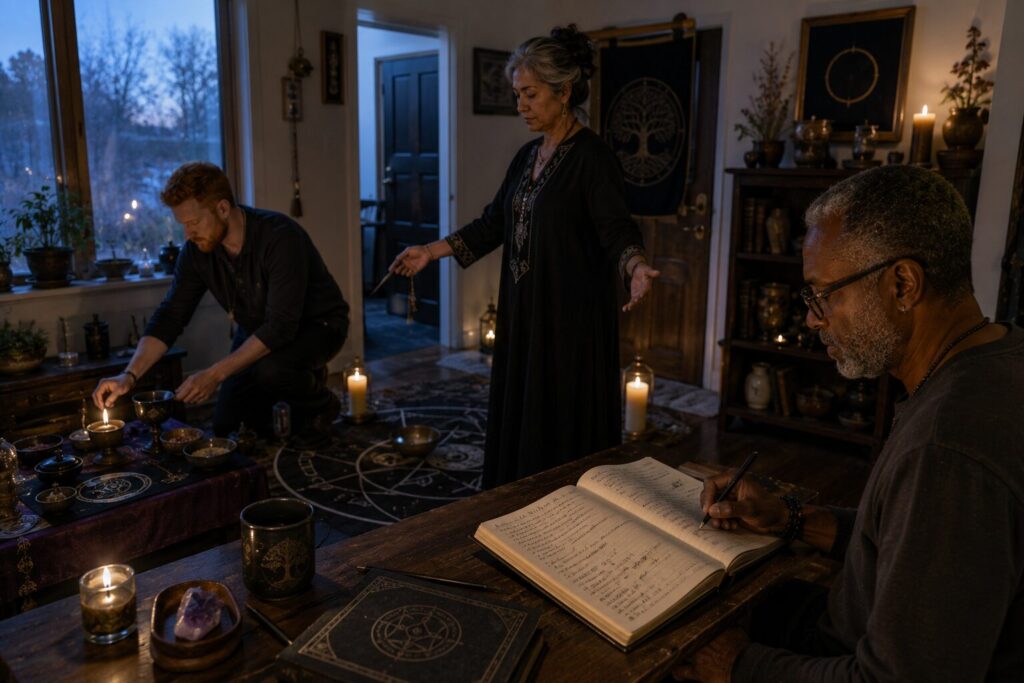
Before · During · After
A Sound Pattern for Spirit Work
A dependable practice does not rely upon intensity or improvisation alone. It gives every encounter a clear preparation, a governed period of contact, and a complete return to ordinary life.
Prepare before opening, remain discerning while contact is active, and close before interpretation becomes the only thing holding the experience together.
Establish the Conditions
Decide what the work is, protect the people and place, and define the permitted relationship.
Prepare
Clarify the purpose, physical condition, emotional readiness, tools, location, and expected duration. Do not begin merely because an experience feels urgent.
Protect
Establish grounding, household limits, ritual boundaries, physical safety, and a dependable method of stopping the work.
Define
Name who may approach, why contact is sought, where it may occur, how communication may happen, and what remains closed.
When the purpose, boundary, or method of closure cannot be stated clearly, the threshold is not yet ready to open.
Govern the Encounter
Open no farther than necessary, observe what actually occurs, and retain authority over every response.
Invite
Open only the agreed degree of recognition, communication, proximity, participation, or intimate access.
Discern
Separate observation from interpretation. Question identity, consistency, effect, ordinary causes, and respect for boundaries.
Respond
Listen, question, accept, refuse, narrow, redirect, or end the contact according to what is actually occurring.
When contact moves beyond the agreed terms, becomes coercive, or cannot be interpreted safely, close first and investigate later.
Complete the Return
End the relationship for this working, restore ordinary conditions, and preserve an accurate record.
Release
Thank where appropriate, dismiss where necessary, and withdraw permission to approach, influence, follow, enter, or remain.
Close
Close the method, boundary, shrine, circle, gate, or ritual space. Ground physically and return attention to ordinary life.
Record
Write the observations, conditions, words, emotions, uncertainties, closure, and aftereffects before memory reshapes them.
When the room, body, or channel does not feel closed, repeat the ending, remove remaining invitations, and seek grounded assistance.
The purpose of structure is not to make spirit contact rigid. It is to ensure that openness remains chosen, relationship remains accountable, and the practitioner can always return fully to themselves.
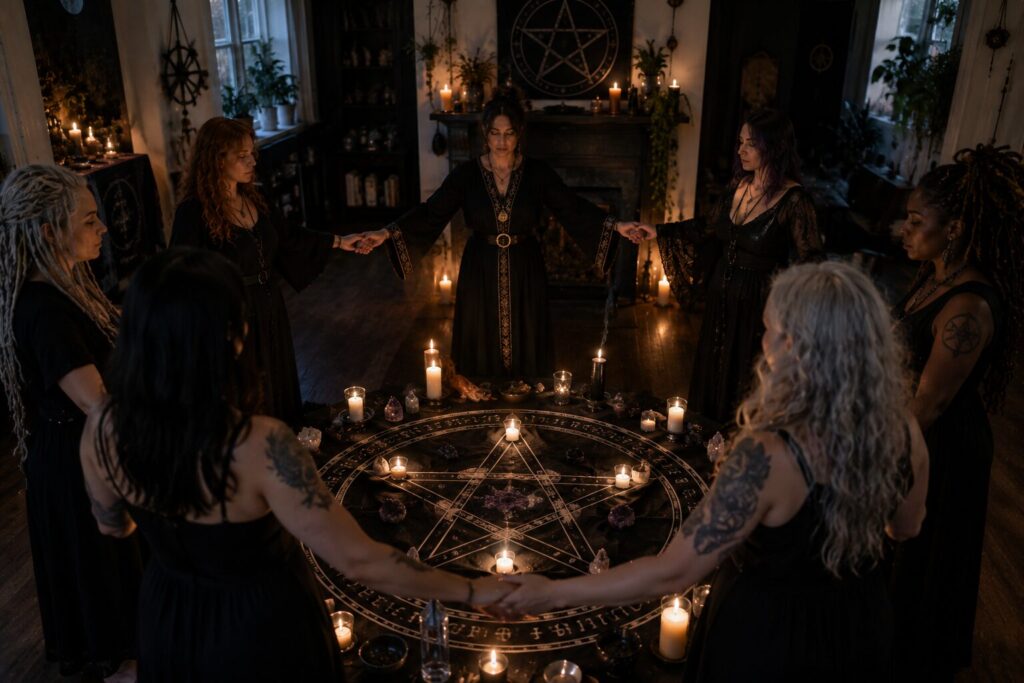
Relationship Held Within Boundaries
At the Threshold, We Remain Ourselves
Spirit relationship may deepen wonder, devotion, remembrance, healing, and magical practice. Its value does not depend upon surrendering judgment, consent, ordinary life, or the ability to close the gate.
“A sound spirit boundary does not prove that the unseen is hostile. It shows that relationship matters enough to be entered consciously, governed responsibly, and ended with clarity.”— Kael, MCC
Sensitivity, perception, and spiritual experience do not remove the practitioner’s right to decide when and how contact occurs.
Respect, reciprocity, devotion, and compassion remain compatible with questions, limits, refusal, and independent judgment.
A practice that can open but cannot end is not complete. Closure protects meaning as much as it protects the practitioner.
MCC offers spiritual education and perspective rather than emergency, medical, mental-health, legal, or law-enforcement services. Immediate physical safety and appropriate professional care should always come first.