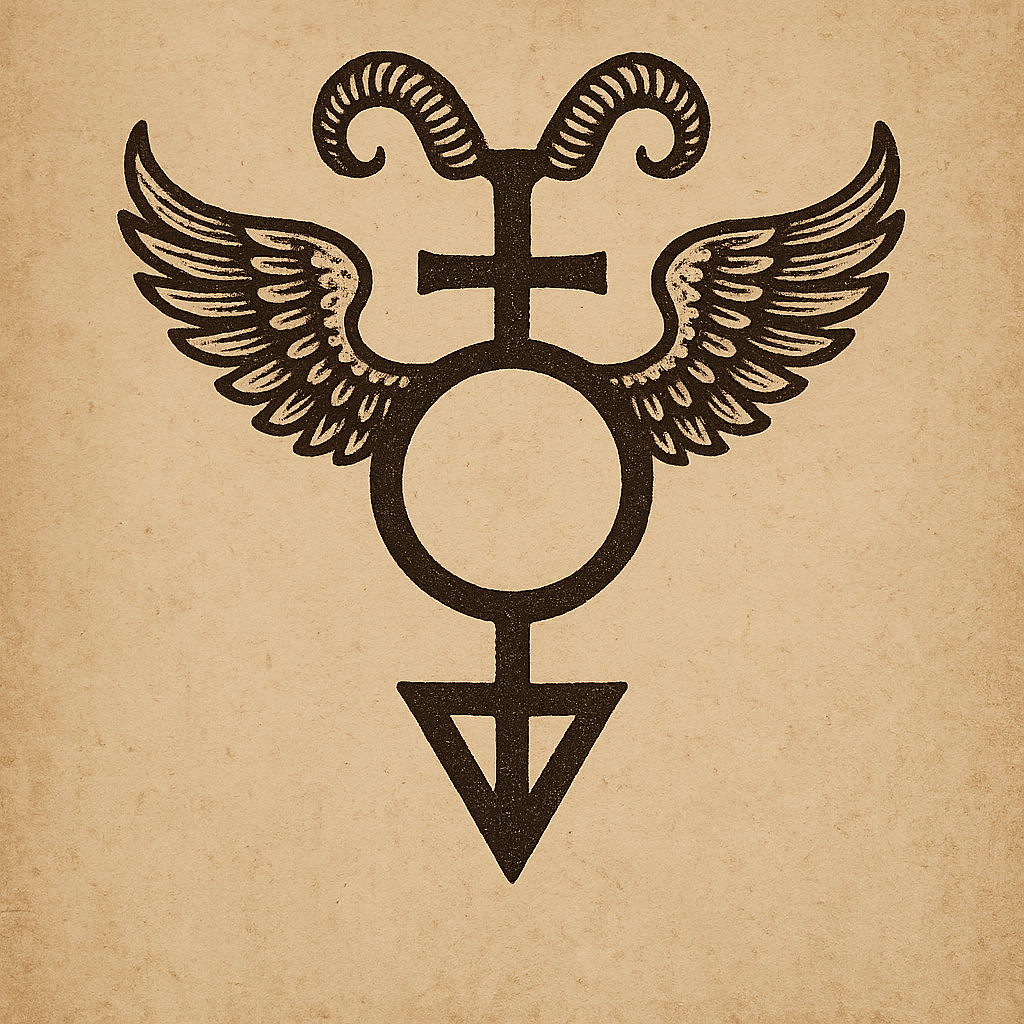
Hekate
Witch Queen of the Crossroads
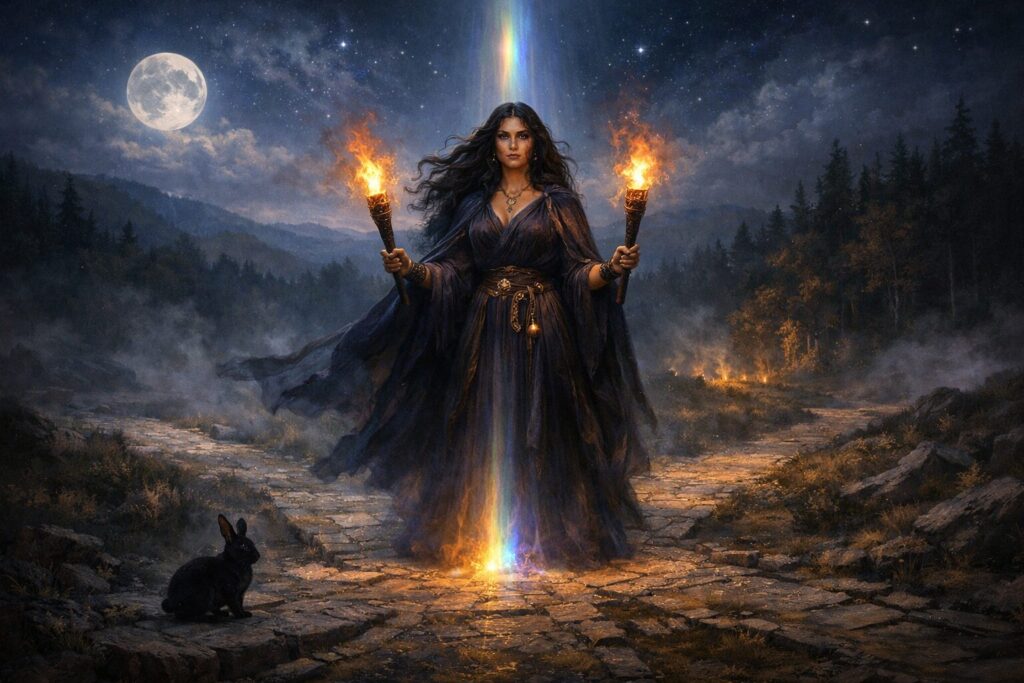
At every crossroads where the known meets the unknown, Hekate stands.
She is not merely a goddess of roads, nor only a figure of torchlight, ghosts, or old shrines half-buried in the memory of Greece. Hekate is the keeper of thresholds in the deepest sense: the guardian of those charged and perilous places where one state becomes another, where light meets shadow, where the visible world opens into the unseen, and where power moves from mystery into form. To encounter her is to encounter the living boundary itself—not as emptiness, but as presence; not as absence, but as a current alive with intelligence, secrecy, and possibility.
Among the old gods, Hekate has always carried an unusual gravity. She stands close to the oldest layers of divine memory, nearer in age and atmosphere to primordial powers than to the polished order of later Olympian religion. Though her forms and titles changed across time, her current did not. As cultures shifted, as theology evolved, and as witches, mystics, and spirit-workers came to know her under new names and moods, something essential remained the same: Hekate is the one who moves at the edges of worlds and keeps watch where passage becomes transformation.
For this reason, she is called the patron goddess of witches with good reason. Witches are threshold-walkers by nature. They work between seen and unseen, symbol and force, self and shadow, spirit and matter, old life and new becoming. Hekate belongs naturally to that work because she governs not fantasy, but access. She does not invent the hidden powers of creation, nor does she manufacture magic as though it were separate from the cosmos. Rather, magic is woven into existence itself: a natural current, subtle and real, moving through the layers of being. Hekate governs this current because she knows its concealed passages, holds its keys, and reveals its pathways to those prepared to walk them.
If Gaia is the living body of the world, Hekate is the hidden ways that move through it—and beyond it. She is not confined to this world alone. Her thresholds are not merely physical places, though they may appear as doorways, shorelines, dusk, grave-paths, crossroads, or the boundaries between the seasons. They are also spiritual, psychological, and cosmic. She stands where life passes into death, where ignorance passes into knowledge, where fear passes into initiation, where one self is shed and another begins to emerge. She is therefore a goddess not only of passage, but of revelation: teacher of hidden knowledge, torchbearer in darkness, and queen of those mysteries that cannot be understood from a distance but only by crossing into them.
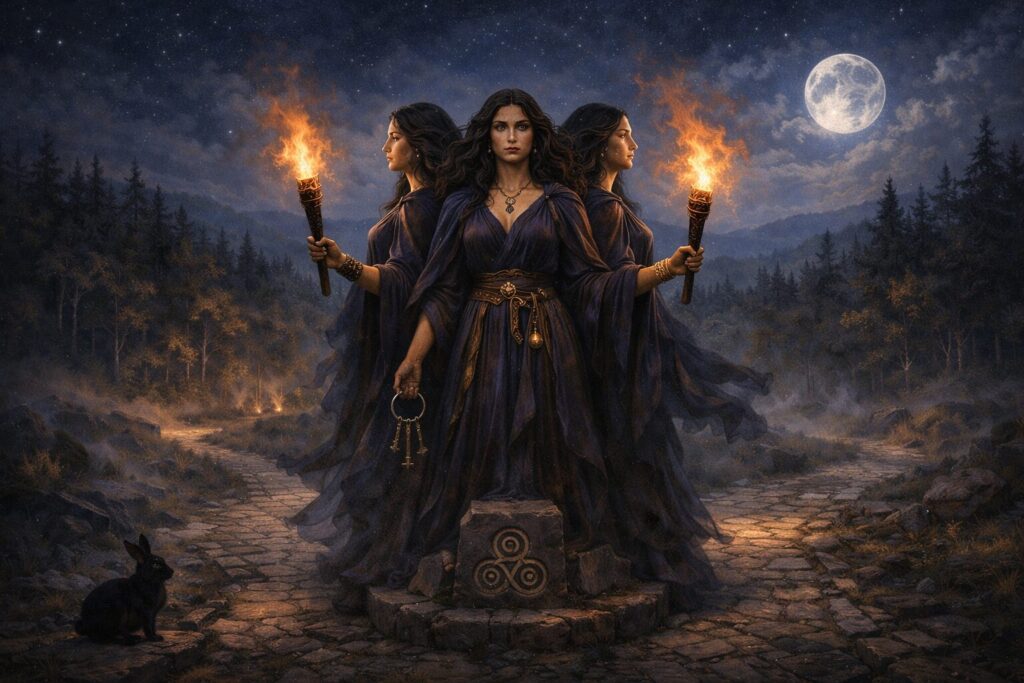
In later ages, Hekate came to be represented in triple form, and that symbolism has endured for good reason. Yet for us, this does not mean she is simply another version of the maiden-mother-crone formula so often repeated in modern paganism. That is a different theological pattern and belongs elsewhere. Hekate’s triform nature is better understood as an expression of her threshold sovereignty: her power to move through realms, to stand at the meeting of directions, to behold more than one path at once, and to illumine the points where realities touch. Her threefoldness belongs to crossroads, to passage, to multiplicity of vision, and to the hidden architecture of becoming.
This also explains why her personality appears to shift across history. The Hekate of early devotion, the Hekate of magical texts, the Hekate feared by some, revered by others, and embraced by modern witches are not false masks over an empty center. They are historical translations of a real divine being whose presence was encountered through different cultural imaginations. Her current remains consistent even when her expression changes. She is ancient, but not frozen. She is stable in essence while alive in revelation. To know Hekate is therefore not only to study a goddess of the past, but to meet a power that still moves through the present with unsettling relevance.
That relevance is one reason so many witches turn to her today. We live in an age of thresholds: collapsing certainties, spiritual hunger, fractured identities, reawakened ritual, and a widespread desire to recover forms of knowing deeper than surface belief. In such a world, Hekate does not appear as a decorative dark goddess or an aesthetic emblem of occult mood. She appears as guide, initiator, protector, and revealer. She teaches that tension is not merely conflict, but the very pressure through which change enters the world. At the crossroads, opposites meet. In that meeting there is danger, but also creation. Manifestation itself is born in such moments.
To walk with Hekate, then, is not simply to admire mystery. It is to accept that the hidden is real, that the shadow contains knowledge, that thresholds demand reverence, and that magic belongs to the structure of existence itself. She stands with keys in hand and torches raised, not to remove darkness, but to teach us how to see within it. She is the witch queen of the crossroads, the guardian of passage, the keeper of secret ways, and one of the great gods through whom the deeper pattern of creation may be approached.
If this page follows her truly, it must do what all thresholds do: open.
A Note on the Name: The goddess’s name is commonly written in English as Hekate, Hecate, or sometimes in more scholarly transliterations connected to Greek usage. On this page, we prefer Hekate with a k because it feels closer to the form most familiar in modern pagan and witchcraft practice, and because it helps distinguish her more clearly from later Latinized spellings. None of these forms are “wrong” in a simple sense. They reflect different periods, languages, and traditions of transmission. What matters most is the goddess herself rather than anxiety over orthography, though for clarity and consistency, Hekate is the form we use throughout this page.
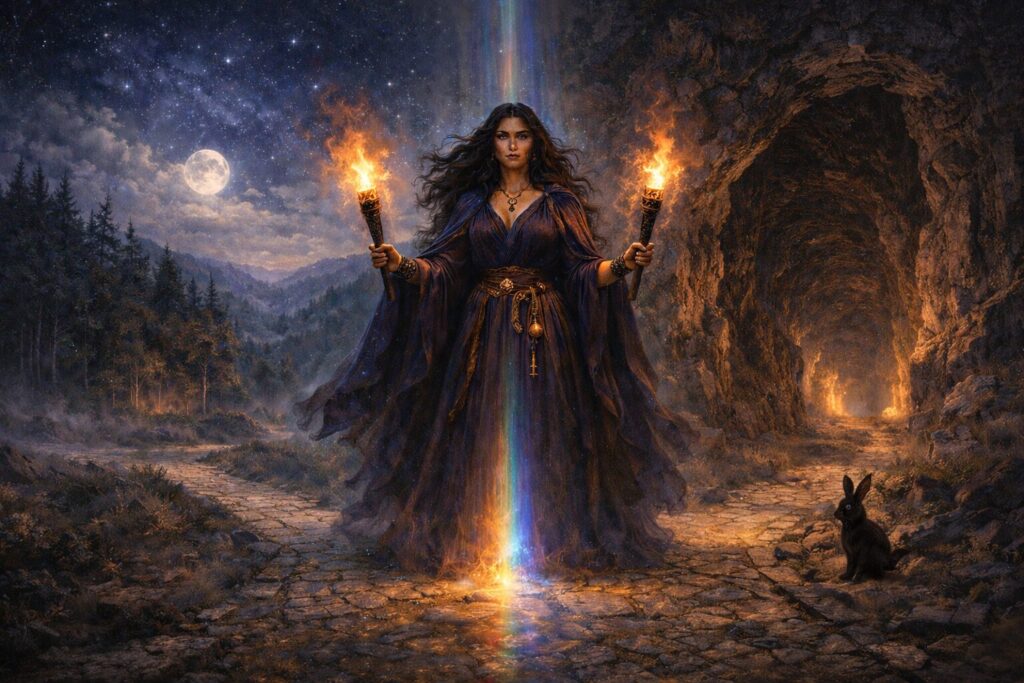
The Goddess of the Threshold
Hekate is not merely associated with thresholds as poetic decoration. She belongs to them in essence. To understand her, one must understand why thresholds matter—why crossings, boundaries, tensions, and hidden passages have always been places of power.
Hekate’s presence at the crossroads is not only symbolic. It is historical. Across centuries and cultures, people encountered her in different ways and gave those encounters language through myth, ritual, and devotion. The Hekate who appears in early Greek religion is not identical in personality to the Hekate of later magical texts, medieval superstition, or modern witchcraft practice. Yet these changes do not mean the goddess herself is inconsistent. Rather, they reveal how a living divine presence is interpreted differently as human cultures evolve.
Like many ancient gods, Hekate’s personality shifted as she moved through history, while the current she represents remained recognizable. Early worshipers honored her as a powerful and mysterious goddess whose authority extended across realms. Later traditions emphasized her association with spirits, magic, and hidden knowledge. In modern witchcraft she has become widely recognized as the patron goddess of witches, a guide through shadow and transformation. Each of these expressions reflects a different way of understanding the same threshold power.
To understand Hekate fully, then, we must follow her procession through time and observe how her image developed. What emerges is not a contradiction but a continuity: an ancient goddess whose nature has always been connected to the unseen paths of power, even as the cultures describing her changed around her.
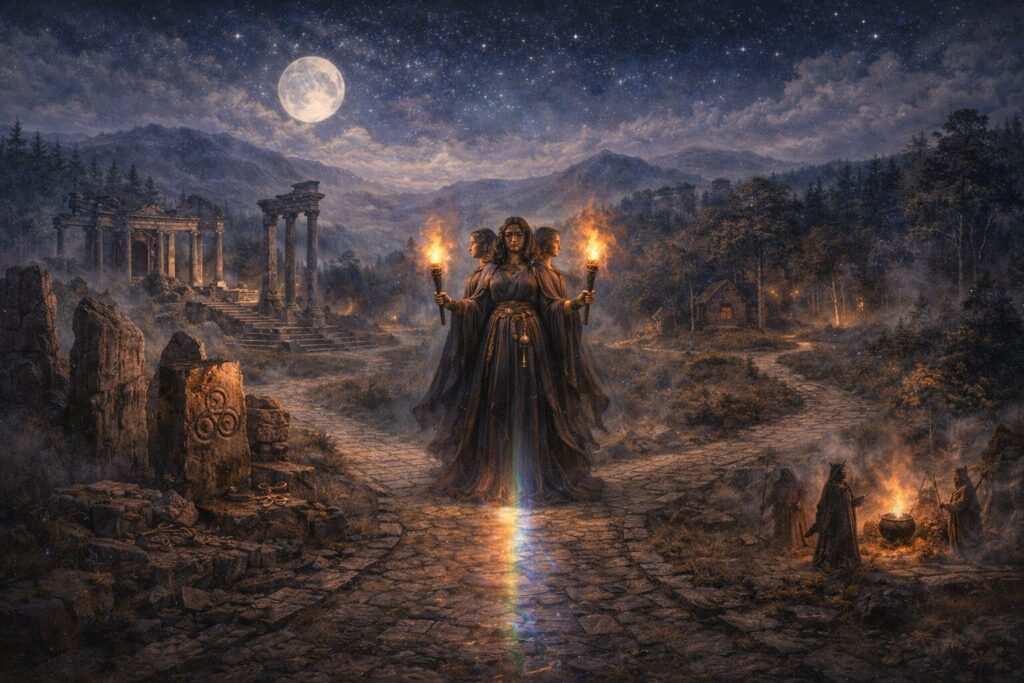
Hekate Through Time
Hekate’s image has never remained still. As she moved through ancient religion, magical practice, medieval imagination, and modern witchcraft, her expression changed—but the current beneath those changes remained recognizable. To follow Hekate through time is to watch an ancient goddess translated through different ages without losing the threshold power at her core.
Magic, in the understanding of this coven, is not a supernatural trick imposed upon reality from the outside. It is part of reality itself. Just as gravity, light, and life arise from the deeper structure of creation, so too does magic emerge as one of the subtle currents through which the world moves, transforms, and becomes. It operates through hidden relationships: symbol and meaning, intention and manifestation, matter and spirit, visible form and invisible influence. To work magic is therefore not to break the natural order but to participate consciously in forces already woven into existence.
Hekate’s place within this mystery is often misunderstood. She does not “own” magic in the way later fantasy stories imagine a goddess dispensing spells to favored followers. Magic does not belong to Hekate. Hekate belongs to the places where magic enters the world. She stands where unseen currents cross into form, where intention begins to move through symbol, and where the invisible architecture of reality briefly becomes accessible to human awareness.
This is why she is so closely associated with thresholds. The moment when a spell begins to manifest, the instant when knowledge breaks through ignorance, the crossing between the living and the dead, the psychological passage through shadow toward integration—all of these are threshold events. Something unseen presses into the visible. Something hidden becomes active. In these charged moments Hekate’s presence is often felt most strongly, because she governs the passages through which such transformation occurs.
One way to imagine this is through the ancient image of a ray or current entering the world. Creation itself seems to move through such moments: a spark of possibility becoming form, a hidden pattern becoming event. In the symbolic language of this tradition, that current is sometimes imagined as a finger of light descending through the structure of reality. Hekate does not create that current. Instead, she stands at the threshold through which it passes. She guards the crossing, illumines the passage with her torches, and reveals the conditions under which that power may be approached responsibly.
For this reason she is often experienced not simply as a goddess of magic, but as its teacher and revealer. Witches who work with Hekate frequently describe her influence not as immediate power granted from above, but as guidance toward deeper perception. She encourages discipline, awareness, and courage in the face of hidden knowledge. Her torches do not eliminate mystery. They illuminate the path just enough for the practitioner to continue deeper into it.
In this sense Hekate’s role in witchcraft is profoundly initiatory. She does not simply help someone perform magic; she transforms how that person understands the world in which magic operates. Through her influence the practitioner learns to recognize thresholds everywhere—in the psyche, in ritual space, in moments of decision, and in the unseen layers of reality itself. The witch becomes not merely a user of techniques but a walker of hidden roads.
It is therefore no accident that Hekate is widely called the patron goddess of witches. Witchcraft, at its heart, is threshold work. It asks practitioners to move between knowledge and mystery, intention and manifestation, spirit and matter. Hekate stands at each of those crossings, holding keys in one hand and torchlight in the other, guiding those who are willing to step beyond certainty and into the living currents of creation.
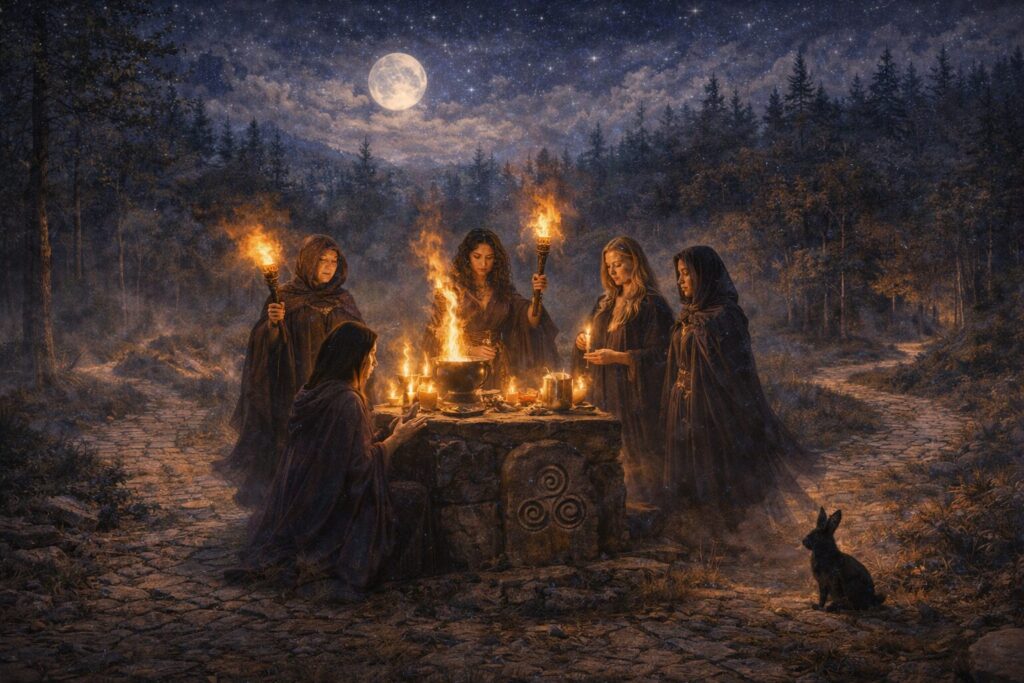
Symbols of Hekate
Hekate’s symbols are not decorative additions to an already finished goddess. They are part of the language through which her power has been recognized, approached, and understood. Each one reveals something essential about her nature as threshold guardian, witch queen, and revealer of hidden ways.
Torches
The torch is one of Hekate’s most enduring signs. It represents illumination within darkness, not the destruction of mystery. Her light does not flatten the unknown into easy certainty; it reveals enough of the path for one to continue.
In this sense the torch symbolizes initiation, guidance, and the finger of light entering hidden places. Hekate’s flame is not mere comfort. It is the sacred light carried into the threshold so that transformation can occur without blindness.
Keys
Keys symbolize access. They imply that something is closed, hidden, protected, or sacred—and that entry requires right relation, not mere curiosity. Hekate as keeper of keys is therefore not simply a goddess who opens doors, but one who governs whether, when, and how passage is granted.
Her keys belong to thresholds of many kinds: spiritual gates, inner states, magical knowledge, hidden roads between worlds, and the sealed chambers of the self. To receive a key from Hekate symbolically is to be entrusted with responsibility as much as access.
Crossroads
The crossroads is perhaps Hekate’s greatest symbol because it gathers choice, tension, uncertainty, and creation into one image. At the crossroads, more than one future is possible. The road opens, divides, and asks for discernment.
This is why crossroads are sacred to witches, spirit-workers, and all who undergo transformation. They signify the meeting point between paths, but also between identities, worlds, and states of being. Hekate reigns there because she is the keeper of what happens when possibility becomes passage.
The Strophalos
Often called the Hekate Wheel, the strophalos has become one of the most recognizable symbols associated with her in modern practice. Its turning geometry suggests motion, magical circulation, and the patterned flow of hidden power through the cosmos.
Whether approached historically, ritually, or symbolically, the wheel speaks to Hekate’s governance of movement through unseen channels. It represents the turning of magical force, the ordered dynamism beneath apparent stillness, and the way hidden knowledge unfolds in cycles rather than straight lines.
Dogs
Dogs have long been associated with Hekate as guardians, companions, and creatures sensitive to what humans often miss. They stand close to thresholds themselves—watchful at the edge of home, alert to movement in darkness, responsive to presences that remain hidden to ordinary sight.
In Hekate’s symbolism, dogs represent vigilance, protection, and the instinctive awareness needed to navigate unseen realities. They are not merely animals at her side. They express her role as one who senses what approaches before it fully arrives.
Night and the Dark Moon
Though Hekate is not reducible to a moon goddess alone, night and the dark moon have become deeply important to her symbolism. These are times when the visible world softens, certainty thins, and hidden layers of reality become easier to sense.
The dark moon especially suits Hekate because it is a threshold of endings, preparation, and unseen gestation. What has not yet emerged gathers there. In that silence and tension, Hekate is often felt most strongly as torchbearer, guide, and keeper of the hidden way.
Symbols matter because they show how a goddess is recognized, but devotion matters because it is how a relationship is lived. Hekate is not honored only through study, titles, or old associations preserved in books. She is approached through practice: through the lighting of torches and candles, through prayer at thresholds, through offerings poured at the crossroads, through the quiet disciplines of shadow work, spirit attention, divination, and magical transformation. What her symbols express in image, devotion expresses in action.
To honor Hekate well is not merely to surround oneself with her aesthetic. It is to cultivate reverence for the places where change occurs. It is to notice the charged edges of life rather than fleeing from them, to approach mystery with discipline rather than performance, and to recognize that thresholds require both courage and respect. For many witches, this is why devotion to Hekate becomes so powerful: she is not only a goddess to admire, but a presence who teaches how to walk the hidden roads with seriousness, clarity, and purpose.
In modern pagan practice, her rites often become woven into a larger spiritual life. Dark moon observances, threshold blessings, candles lit for guidance, protective workings, crossroads offerings, spirit practice, and the deeper labor of facing the shadow all become ways of entering into relationship with her. These acts are not identical, nor are they required in one fixed form. But together they show why Hekate remains so compelling to witches today: she meets practitioners where transformation is already underway and teaches them how to cross more consciously.
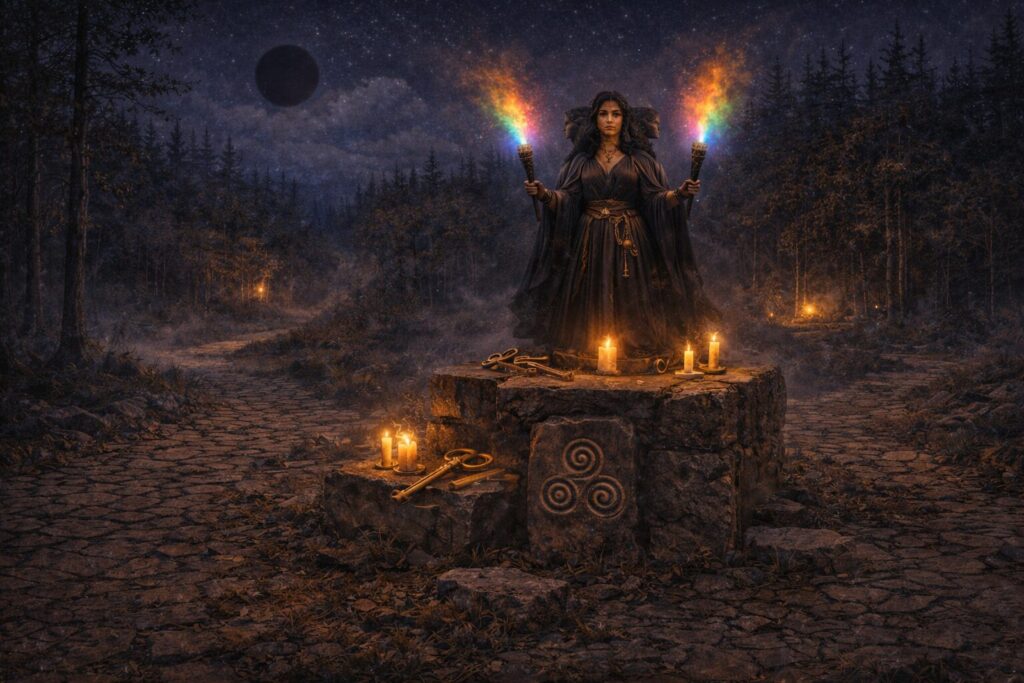
Honoring Hekate
Hekate is honored not only through symbolism or ancient memory, but through living practice. For witches and pagans today, devotion to her often takes shape in acts of reverence performed at thresholds—in prayer, in offerings, in ritual observance, and in the disciplines through which hidden knowledge becomes lived transformation.
Devotion at the Threshold
To honor Hekate is often to honor her where boundaries are felt most strongly. Candles or torches may be lit in prayer. A blessing may be spoken at a doorway, gate, or path before beginning difficult work. Offerings may be quietly poured at the crossroads not as superstition, but as reverence for the powers that govern passage, change, and unseen movement. Devotion to Hekate tends to be most meaningful when it is performed with seriousness, attention, and humility rather than display.
For many practitioners, her rites align naturally with the dark moon and the contemplative rhythms explored in lunar practice. She may also be honored at the boundaries of the year, where one season gives way to another and the old world loosens its hold before the new one fully arrives, making her presence especially resonant alongside seasonal celebrations. Even simple rites—lighting a candle for guidance, laying down an offering, or pausing at a liminal place in honest prayer—can become profound when approached with depth.
In this way Hekate devotion is less about rigid formalism than about learning how to recognize sacred crossings. A threshold blessed with intention, a crossroads acknowledged with respect, or a quiet rite performed under the dark moon may all become ways of standing in her presence.
Hekate in Modern Witchcraft Practice
Hekate is called the patron goddess of witches with good reason because so much of witchcraft unfolds in the spaces she governs. She is present in the inward labor of shadow work, where one must confront the hidden self and cross from denial into truth. She stands near divination, where symbols and intuition become a threshold through which knowledge appears. She is also deeply relevant to threshold magic, where crossings themselves become sites of ritual force.
Her presence is equally strong in spirit-facing work. Those exploring psychopomp work, spiritualism, or necromancy often find her standing near the difficult boundary between the living and the dead. Practitioners working with prayer, calling, or ritual presence may also meet her through invocation and even, in more carefully bounded contexts, evocation. She is not reducible to any one of these paths, but she moves naturally among them because they all involve hidden passage.
Even the practical foundations of the craft may be drawn into her orbit. Work with herbs, the disciplined use of ritual implements through tool basics, and the larger study of magical structure through magic types all become more intelligible when seen through Hekate’s lens. She teaches that magic is not random technique, but relationship to the hidden roads by which power enters the world.
Just as certain places carry the power of thresholds, certain moments in time do as well. Time itself moves through crossings: night into day, season into season, ending into beginning. These transitions are rarely loud, yet they hold a particular spiritual tension. Something is closing, something else is preparing to emerge, and the world briefly pauses in the interval between them. For those attentive to sacred rhythms, these moments are not empty space but charged thresholds in the movement of life.
Hekate is naturally honored at such crossings of time. Her presence is especially felt when the visible world grows quiet enough for hidden patterns to become perceptible. Just as she stands at crossroads in the landscape, she also stands at crossroads in the calendar, guiding practitioners through moments when the old cycle loosens and the new one begins to gather strength.
Among these times, the dark moon has long held special significance. It is a period when the lunar light disappears and the sky grows momentarily still before the next cycle begins. In many traditions this moment is associated with Hekate’s Deipnon, a rite historically connected with offerings, purification, and preparation for the coming lunar month. The dark moon does not represent absence or emptiness. Rather, it marks the hidden interval where renewal gathers out of sight.
Seasonal boundaries carry a similar power. When summer turns toward autumn, when winter begins to break, when harvest gives way to dormancy, the earth itself passes through thresholds of transformation. For practitioners who work closely with the rhythms of nature, these times provide powerful opportunities to honor Hekate as guardian of passage and guide through change. Observances connected to lunar cycles and seasonal turning points often deepen this relationship, weaving devotion to Hekate naturally into broader practices such as lunar work and seasonal celebration.
In this way, honoring Hekate becomes not only a matter of where one stands, but also when. Certain nights invite reflection. Certain thresholds in the year invite offering. At these moments, time itself becomes a crossroads, and Hekate stands watch there as surely as she does at any road that divides beneath the moon.
Sacred Times of Hekate
Hekate is not honored only in places of crossing, but in moments of crossing. Certain nights and turning points in the year carry her presence with particular force because they reveal time itself as a threshold through which change, release, and renewal move.
The Dark Moon and Hekate’s Deipnon
The dark moon has long been one of the times most closely associated with Hekate because it is a threshold of concealment, release, and preparation. Lunar light falls away, the visible cycle goes still, and for a brief interval the world seems to draw inward. This does not signify emptiness. It signifies gestation. The next becoming is gathering, but it has not yet emerged into form.
Historically, this period became linked with Hekate’s Deipnon, a rite of offering, purification, and spiritual clearing observed before the new lunar month began. The Deipnon mattered not merely because offerings were left, but because it recognized a profound truth: thresholds in time require attention. Before a new cycle opens, something of the old must be acknowledged, released, or set in order. In this sense, the rite honors Hekate as keeper of the boundary between what is ending and what is about to begin.
For modern practitioners, this may take many forms. Some leave offerings or prayers in quiet reverence. Some use the dark moon for cleansing, reflection, spirit work, or rites of release. Others approach it through contemplative observance, recognizing that not every sacred act must be dramatic to be real. Those who work closely with lunar cycles may find this especially resonant alongside lunar practice, where the dark moon becomes a time of pause, hidden movement, and subtle realignment.
Spiritually, the Deipnon matters because it teaches that sacred transition is not accidental. One prepares for crossing. One clears what clings. One honors the unseen forces present in endings. Under Hekate’s watch, the dark moon becomes not a blank space, but a chamber of threshold power.
Seasonal Boundaries and Threshold Times
Hekate also belongs to the turning places of the year. Seasonal boundaries are among the oldest thresholds known to human life. They shape planting and harvest, abundance and austerity, descent and return, awakening and decline. At these moments the earth itself passes through visible transformation, and so the spiritual atmosphere often changes with it.
Hekate is not the goddess of the seasons in the same way that some deities are, yet she walks their edges. She is present where one season yields to another, where the world loosens its old form before assuming the next. These intervals can be especially potent for rites of blessing, protection, release, divination, and inner redirection, because they carry the same logic as the crossroads: something is ending, something is opening, and the threshold between them is spiritually alive.
Within the Wheel of the Year, Hekate is often felt most strongly at the boundaries between seasonal powers rather than as the central deity of any single festival. Moments such as the descent toward Samhain, the quiet turning toward Imbolc, or the deep inward pause of winter carry a particular resonance with her presence because they mark transitions in the life of the earth itself. At these hinge-points the old cycle loosens and the next begins to stir beneath the surface.
In this way Hekate walks the edges of the seasonal wheel, guarding the passage from one sacred season into another rather than ruling the cycle alone. Just as she stands at the crossroads between paths, she stands at the turning of the year where one sacred rhythm yields to the next.
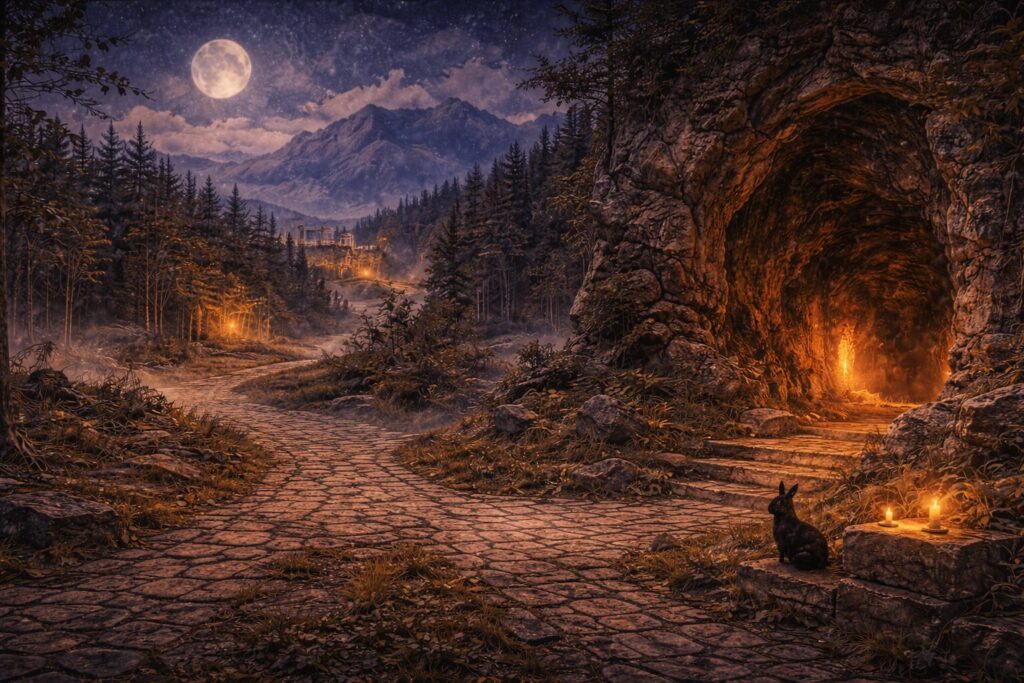
Just as Hekate is honored at sacred moments in time, she is also encountered in places where the world itself becomes liminal. These are locations where boundaries thin, where movement between states becomes perceptible, and where the unseen presses close enough to be felt. In ancient devotion such places were often marked deliberately: shrines set at crossroads, small altars at city gates, torches lit at cave entrances, offerings placed where roads divided beneath the night sky. Yet these sacred places were rarely confined to formal temples alone. Hekate’s geography has always been broader than any single sanctuary.
The most characteristic places of Hekate share a common quality: they exist between conditions. A crossroads lies between journeys. A cave mouth stands between light and darkness. A graveyard rests between memory and presence, where the living remember and the dead remain spiritually near. Forest paths, shoreline boundaries, mountain passes, and old gates carry similar atmospheres. Each of these locations marks a point where one world brushes another.
For witches and seekers today, these places remain meaningful not because they are relics of the past but because the conditions they represent still exist. A quiet crossroads beneath the moon can still feel charged with possibility. A cave opening can still suggest the entrance to deeper layers of reality. A cemetery path walked with reverence can become a place of remembrance and spiritual encounter. These are not locations where Hekate is imprisoned, but places where her presence becomes easier to recognize.
At the same time, history preserves a few sites where devotion to Hekate once took especially visible form. These ancient sanctuaries remind us that the threshold goddess was not only a figure of folklore or magic, but a deity honored in organized cult and pilgrimage. To visit such places today is not simply to see ruins, but to stand where generations once acknowledged the mysterious power of crossing between worlds.
Crossroads
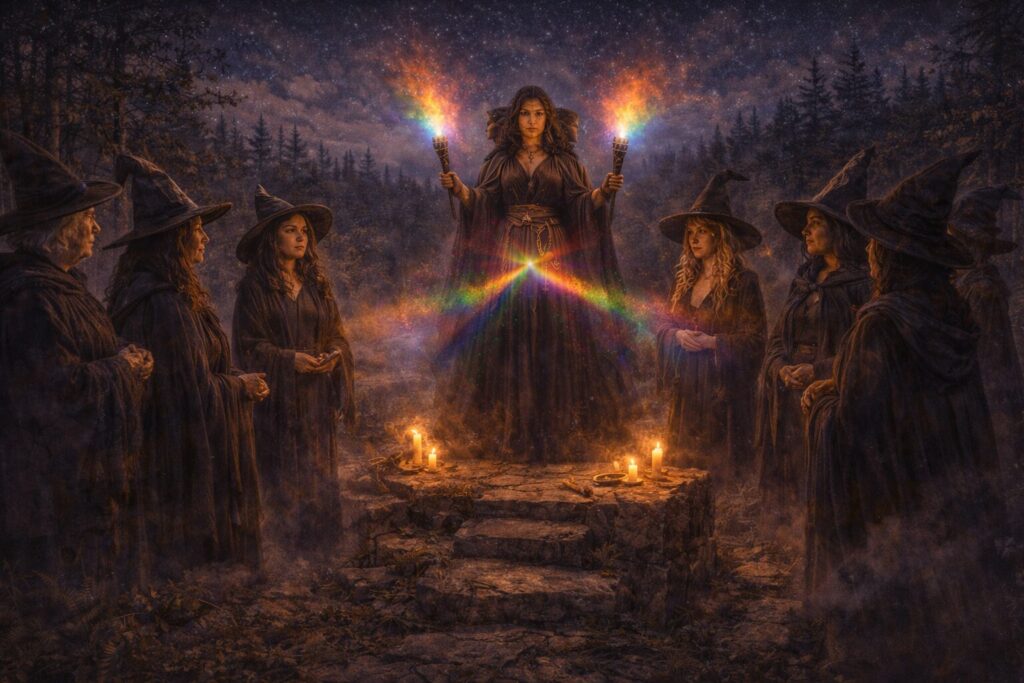
The crossroads is Hekate’s most iconic sacred place because it embodies the threshold itself. Where roads divide and converge, travelers must pause, choose direction, and accept the uncertainty of what lies ahead. For this reason crossroads have long been treated as spiritually potent sites where offerings were made and prayers spoken to the goddess who guards the meeting of paths.
Caves and Hidden Openings
Cave entrances have often been associated with Hekate because they symbolize passage between worlds. Standing between daylight and the unseen depths of the earth, caves evoke the mystery of descent into hidden knowledge. Such places naturally invite reverence for a goddess who moves freely between realms and guides those who enter the unknown.
Grave Paths and Places of Remembrance
Cemeteries and grave edges have also been linked with Hekate, not as places of fear but as landscapes of remembrance and spiritual encounter. Here the living stand near the memory of those who came before, and the boundary between worlds feels thinner. Approached with respect, such places remind practitioners that life itself moves through thresholds, and that the goddess of crossroads is present wherever passage between states of being occurs.
Ancient Sanctuaries
Although Hekate’s sacred geography was often decentralized, a few major sanctuaries existed in the ancient world. One of the most important was her temple at Lagina in modern Turkey, where ritual processions honoring the goddess were once held.
Hekate also appears within the sacred landscape of the Eleusinian Mysteries, where she assisted Demeter in the search for Persephone and later stood near the threshold between the living world and the underworld. These places remind us that the goddess of hidden ways was once honored openly in temples as well as at crossroads.
Why Witches Turn to Hekate
Across the modern world, witches and practitioners of earth-centered spirituality frequently find themselves drawn toward Hekate. This attraction is not accidental, nor is it merely the result of fashion or aesthetic association. It arises from something deeper in the nature of the goddess herself. Hekate governs the places where transformation becomes possible, and witchcraft, at its heart, is the practice of transformation.
To practice magic is to step into the tension between what exists and what might emerge. It is to stand between certainty and possibility, between the visible world and the hidden currents that move beneath it. These are precisely the spaces Hekate inhabits. She is the keeper of thresholds, the one who stands where roads divide and where unseen doors open into new conditions of being. For those who work magic seriously, such places are not abstractions but lived realities. Every act of spellcraft, divination, spirit work, or inner transformation involves crossing from one state into another.
Because of this, Hekate is often called the patron goddess of witches with good reason. She does not merely observe magical practice; she governs the conditions under which magic becomes possible. The witch approaches the crossroads, the hidden path, the threshold of change, and there Hekate is already present. Her torches illuminate the uncertain road ahead, not by removing mystery but by revealing enough of the path to move forward with intention.
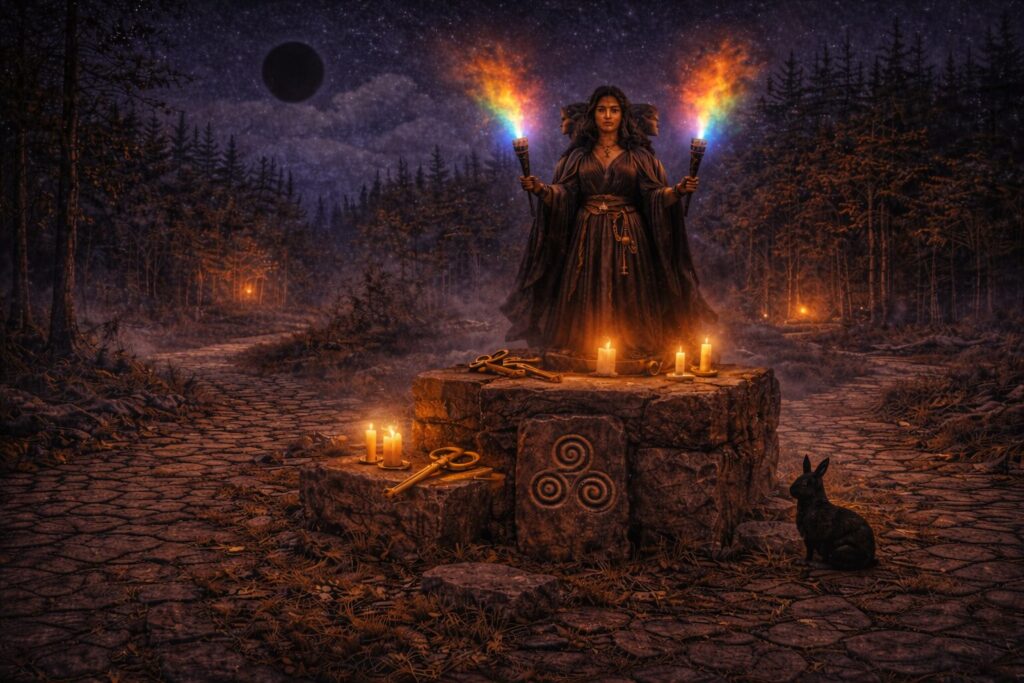
Modern practitioners also recognize that Hekate speaks powerfully to the inner dimensions of magic. Much of the witch’s work is not outward spectacle but inward encounter: confronting the shadow, examining hidden motives, facing fears, and learning to navigate the deep psychological and spiritual landscapes that shape one’s life. In these journeys Hekate appears not only as guardian but as teacher and revealer. She is associated with hidden knowledge precisely because transformation requires the courage to see what lies beneath the surface.
For many witches, devotion to Hekate also reflects a commitment to autonomy and responsibility. She is not a goddess who promises comfort without effort. The crossroads demands choice. The torch illuminates, but it does not force the traveler to walk. To follow Hekate is therefore to accept the discipline of awareness: to recognize that every path carries consequences and that true magical practice requires maturity as well as curiosity.
This is one reason Hekate has become such a powerful presence in modern witchcraft communities. Her mythology and symbolism resonate with practitioners who understand that magic is not simply a set of techniques but a relationship with the deeper structure of reality. In her we see a goddess who moves freely between realms, who guards the meeting of light and darkness, and who stands where transformation begins. She embodies the moment when tension gives rise to change and when possibility gathers enough force to become manifestation.
In this sense Hekate is not merely a figure inherited from the ancient world. She is a living archetype of the magical threshold itself. Wherever a practitioner stands between what has been and what may yet come, wherever courage is required to step into the unknown, wherever the hidden currents of creation begin to move toward form, the torch of Hekate burns nearby.
Hekate and the Crossroads of Creation
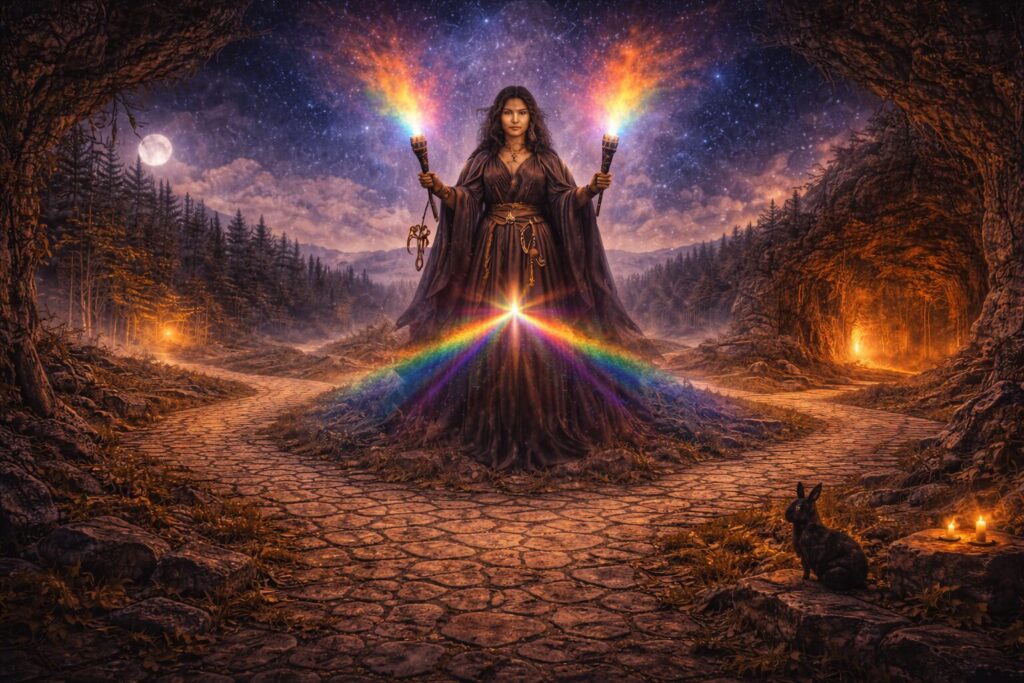
At every crossroads where the known meets the unknown, Hekate stands. This image has endured for centuries because it expresses something fundamental about the nature of change itself. Creation does not occur in stillness alone. It emerges where tension gathers between possibilities, where the path forward has not yet been chosen, and where the future remains open enough for transformation to occur.
A crossroads is therefore more than a place where roads intersect. It is a symbol of the moment when reality pauses before movement, when several futures exist at once and the act of choosing becomes the force that shapes what comes next. In this charged interval, Hekate appears as torchbearer and guardian. She does not create the tension that brings new worlds into being, but she stands watch where it gathers, illuminating the threshold where possibility becomes manifestation.
In the language of myth and symbol, this moment can be imagined as a beam of creative force entering the world. A finger of light touches the threshold of reality, and where that light meets the receptive ground of existence, something new begins to form. Hekate does not command this creative current as a ruler commands a domain. Instead, she governs the gateway through which it enters. She is the keeper of the threshold where unseen power crosses into visible life.
This is why the imagery of torches and keys belongs so naturally to her. The torch reveals the crossing. The key opens the passage. Together they symbolize the moment when hidden knowledge becomes accessible and when transformation becomes possible. Standing at the crossroads between realms—earth, spirit, and the unseen depths—Hekate holds the conditions through which movement between worlds can occur.
For the practitioner, this symbolism carries a profound lesson. Magic itself is a threshold art. It works within the tension between what exists and what could exist. To practice magic is therefore to stand where Hekate stands: at the edge of becoming, where intention meets the hidden currents of creation and where the future begins to take shape.
In this way Hekate is not simply a goddess of crossroads in the physical world. She is the guardian of every threshold where change enters reality. She walks beside those who approach the unknown with courage, who seek knowledge beneath appearances, and who understand that transformation is born not from certainty but from the willingness to stand within the living crossroads of creation.
“Hekate whom Zeus honored above all.” — Hesiod, Theogony
A Blessing of the Crossroads
When you stand at a place where the road divides and the way forward is uncertain, may the torches of Hekate burn nearby. May their light reveal enough of the path for you to walk with courage, even when the full journey cannot yet be seen.
May the keeper of keys open the gates of understanding when you are ready to pass, and may she guard the thresholds that must remain closed until their proper time.
When the world grows quiet and the hidden currents of life begin to move beneath the surface, may you feel the presence of the goddess who walks between realms. May her guidance lead you through shadow without fear, through mystery without confusion, and through transformation with wisdom.
May the torches of Hekate light your way.