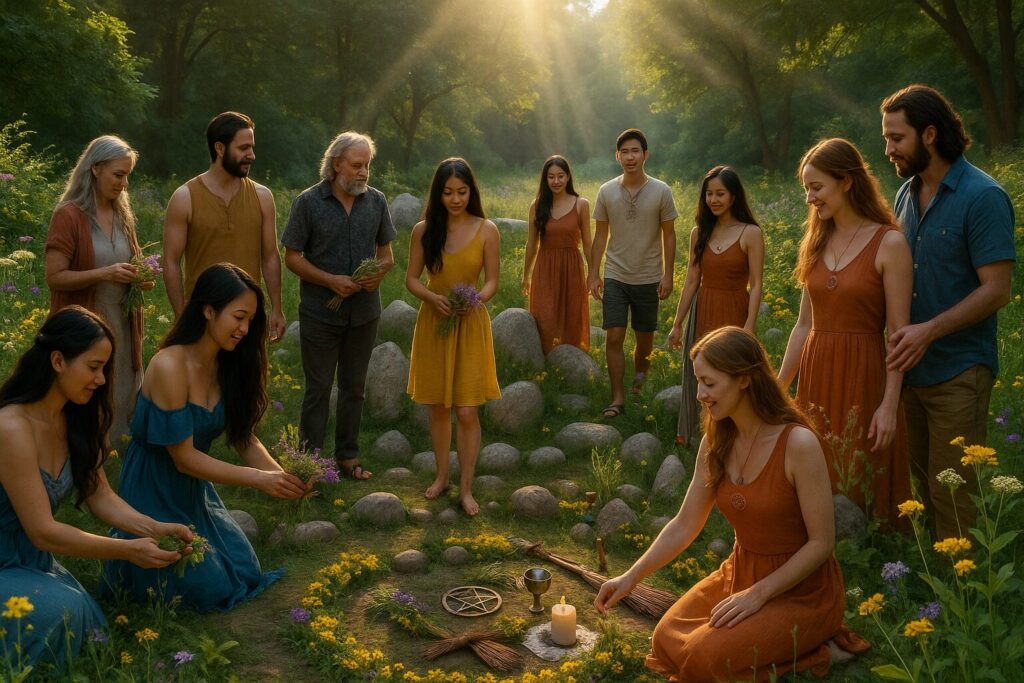
Wiccan ethics, as described by the Coven of the Veiled Moon, are not a list of fixed commandments but a living practice — a way of moving through the world with intention, responsibility, and reverence. Our tradition understands ethics as the quiet architecture beneath all magic: the questions we ask before we act, the awareness we bring to power, and the care we owe to ourselves, our communities, and the unseen. This page offers a gentle framework for understanding how we approach choice, consequence, consent, and the deep moral imagination at the heart of the Craft.
Wicca & Ethics
In our coven, ethics are less about fear of punishment and more about responsibility, consent, and care. Click each heading below to expand.
What We Mean by Wicca & Ethics
When we speak about “Wicca” here, we are talking about a family of modern witchcraft traditions that place responsibility, reciprocity, and consent at the center of magical work. Not every witch is Wiccan, and not every Wiccan coven shares the same theology, but most agree that power should be handled with care.
Ethics in Wicca are not meant to be a rigid rulebook. They are more like a compass: principles that help us navigate choices about spells, relationships, and the spirits and powers we call into our lives. Different traditions will phrase these principles differently, but they broadly ask: What might this do? Who might this touch? Am I willing to live with the consequences?
In our practice, ethics are not an afterthought tacked onto spellcraft. They are the frame in which magic makes sense: honoring consent, tending to harm, and remembering that every working echoes outward into a living world.
The Wiccan Rede “An It Harm None”

The best-known ethical phrase in Wicca is the Rede: “An it harm none, do what ye will.” One common misunderstanding is to treat this as a demand for moral perfection or a promise that magic can ever be entirely risk-free. In practice, the Rede is a call to mindfulness, not a guarantee.
Different Wiccan traditions interpret the Rede in different ways. Some see it as a poetic reminder to weigh potential harm before acting. Others treat it as an invitation to cultivate a will that is aligned with compassion rather than selfishness. Very few serious practitioners believe it is possible to move through life without any harm at all.
The Threefold Law & Consequences
The “Threefold Law” is sometimes described as a cosmic accounting system: whatever you send out comes back to you three times over. Taken literally, it can sound like a threat or like magical physics. Many experienced Wiccans, however, understand it in a more symbolic way.
Actions echo. A working that is careless with consent, honesty, or well-being does not simply vanish when the candles go out. It shapes your relationships, your own habits, and the kind of person you are becoming. In that sense, the “threefold” return can be read as a reminder that consequences are often larger, messier, and more tangled than we first imagine.
Consent, Boundaries & Magical Responsibility
Modern Wiccan and neopagan communities increasingly emphasize consent as a core ethical principle. This includes consent in ritual (touch, trance, sharing personal experiences), consent around energy work and spellcraft, and consent in how we speak about others in magical contexts.
Many witches choose not to cast spells that directly manipulate another person’s will, especially in matters of love, sex, or major life decisions. Others may work blessings or protection without naming a specific outcome. Either way, responsible magic asks: Have I respected this person’s autonomy? Am I using this working to avoid an honest conversation?
Deities, Oaths & Personal Sovereignty

In many Wiccan traditions, relationships with deities, spirits, and ancestors are grounded in reciprocity rather than blind obedience. Oaths, dedications, and promises are taken seriously precisely because the witch is understood to be a sovereign being entering into a voluntary relationship.
Different covens will have different expectations around secrecy, initiation, and sharing of ritual material. What matters ethically is that these expectations are explained clearly, agreed to freely, and never used to conceal abuse or to strip someone of their basic autonomy.
Community, Covens & Power Dynamics

Wicca is often practiced in small circles or covens where trust is essential and power dynamics are real. High Priestesses, High Priests, and teachers hold influence. Healthy groups recognize this and put boundaries and accountability in place.
It is reasonable for a coven to keep its location and member identities private. It is not reasonable for leaders to demand absolute obedience, to isolate seekers from friends and family, or to discourage questions. A functional coven nurtures its people; it does not consume them.
Traditional Wicca & Eclectic Paths

Traditional Wicca (such as Gardnerian and Alexandrian) is lineage-based, initiatory, and usually oathbound. Training happens in person, within a coven, and much of the liturgy is not published. Eclectic Wicca and neopagan witchcraft draw from many sources and may be more flexible, experimental, and public.
Both approaches can be ethical and meaningful. The crucial questions are: Is this path honest about what it is? Does it respect consent and boundaries? Does it take seriously the impact of magic on real lives? In Coven of the Veiled Moon, our practice is eclectic neopagan, in conversation with Traditional Wicca but not claiming its lineages.
Finding a Coven & Reputable Organisations
Established Wiccan Organisations & How to Find a Coven
Wiccan traditions vary widely in structure and accessibility. Some, such as Gardnerian and Alexandrian Wicca, are initiatory mystery traditions: small, private covens that maintain lineage, training, and oathbound material passed from teacher to student. These covens rarely advertise publicly. Instead, seekers are usually introduced through community events, metaphysical bookstores, occult meet-ups, reputable festivals, or word-of-mouth within local circles. Most initiatory groups will never post their coven names online, and this is normal and healthy for the tradition.
Other organisations are more public-facing, offering education, clergy, training paths, ritual gatherings, or online resources for seekers. The list below represents a small sample of well-established Wiccan and Witchcraft organisations, each with a clear lineage or long-standing presence. No list can ever be exhaustive, and inclusion here does not imply endorsement of every teaching or practice.
My Cousin’s Coven and the Coven of the Veiled Moon are not formally affiliated with these groups and know most of them only by reputation. As with any spiritual path, seekers should take time to find communities and teachers whose ethics, boundaries, and values genuinely align with their own.
Traditional Wicca (Gardnerian & Alexandrian)
Initiatory, lineage-based traditions
-
Gardnerian Wicca – Official Site
Verified initiates providing seeker guidance and accurate historical information.
Visit Site -
Gardnerian Seekers’ Network
Outer-court education and pathways for seekers, run by legitimate initiates.
Visit Site -
Alexandrian Wicca – Official (USA)
Reliable resource for training expectations, history, and validated lineages.
Visit Site -
Alexandrian Witchcraft – UK / EU
Represents European initiatory networks; includes historical materials and seeker guidelines.
Visit Site -
Alexandrian Wicca (Archive-backed Site)
Older but historically significant site maintained by initiates.
Visit Site
Public Wiccan Churches & Pagan Organisations
Not lineage-based; more accessible to newcomers
-
Covenant of the Goddess (CoG)
One of the oldest Wiccan organisations (founded 1975). Cross-tradition, clergy, and advocacy.
Visit Site -
Aquarian Tabernacle Church (ATC)
Large international Wiccan church offering open rituals, training, and community.
Visit Site -
Children of Artemis (CoA)
UK-based organisation known for Witchfest and major Pagan gatherings.
Visit Site -
Pagan Federation (UK)
Umbrella Pagan organisation with strong resources on Wicca, ethics, and public education.
Visit Site
Coven of the Veiled Moon & Eclectic Neopagan Witchcraft
Safety Tips for Seekers
Because covens and organisations vary, it is important to use discernment. A few common guidelines:
- Legitimate initiatory covens do not charge money for initiation itself (though they may share costs for supplies or space).
- No group should demand sexual activity, romantic involvement, or secrecy about abuse as a requirement for training or belonging.
- Healthy teachers encourage questions, informed consent, and personal boundaries. You should feel safe and respected at every stage.
- It is always acceptable to step back, say “no,” or look elsewhere if something feels off.
- Privacy is normal in initiatory traditions — coven names, legal names, and locations are often kept discreet. Privacy, however, should never be used to hide harmful behavior.
In all cases, let your ethics, intuition, and well-being lead. Wicca and modern witchcraft are at their best when they foster autonomy, consent, and genuine care for one another and the wider world.