Western Esoteric Traditions
Currents, systems, and methods in the wider landscape of magic
Western esoteric traditions form one of the major intellectual, ritual, and philosophical lineages within the history of magic in the West. Broadly speaking, Western esotericism refers to a family of mystical, magical, initiatory, and symbolic traditions concerned with hidden knowledge, spiritual transformation, correspondences between seen and unseen realities, and disciplined methods of engaging powers beyond the ordinary material world. Within this wider field belong traditions such as Hermeticism, Kabbalah, alchemy, Rosicrucianism, ceremonial magic, and later currents that reworked older systems into modern forms.
This page does not treat those traditions as identical to witchcraft, nor as bodies of belief that must be adopted wholesale. Witchcraft is its own living field of practice: experiential, embodied, relational, and often rooted in season, spirit, place, intuition, and direct magical work. Yet witchcraft has not developed in isolation. Modern forms of the Craft have borrowed from, reacted to, and at times overlapped with broader esoteric traditions, especially in the use of correspondences, ritual structure, subtle-energy models, protective forms, spirit work, and symbolic systems for understanding how magic moves.
To study these traditions, then, is not to step away from witchcraft, but to better understand one of the larger conversations in which witchcraft has participated. Some of the sections below describe full traditions. Others explore broader frameworks or methods that move across multiple systems. Together, they form a wider map of Western esoteric knowledge and its many points of contact with magical practice.
How to Approach This Page
This page is best approached as a map rather than a sequence, and as an invitation rather than a curriculum. You do not need to study every current in order to be a witch, nor do you need to adopt the worldview of every tradition in order to learn from its methods, symbols, or ways of thinking. These traditions are presented here as sources of context, structure, and expanded understanding—not as requirements.
If you are new to practice, it is often wiser to begin with your primary path, whether that is witchcraft or another spiritual tradition, and return to these materials later as a way of deepening your understanding. In that sense, these systems are often more useful as added layers of interpretation than as starting points. For more experienced practitioners, they can provide language for pattern, transformation, ritual structure, and the disciplined use of symbol.
The goal is not accumulation for its own sake. It is discernment: understanding what a tradition is, what it assumes, what it offers, where it differs from the Craft, and what may be taken from it thoughtfully and responsibly.
Western Esotericism and Witchcraft
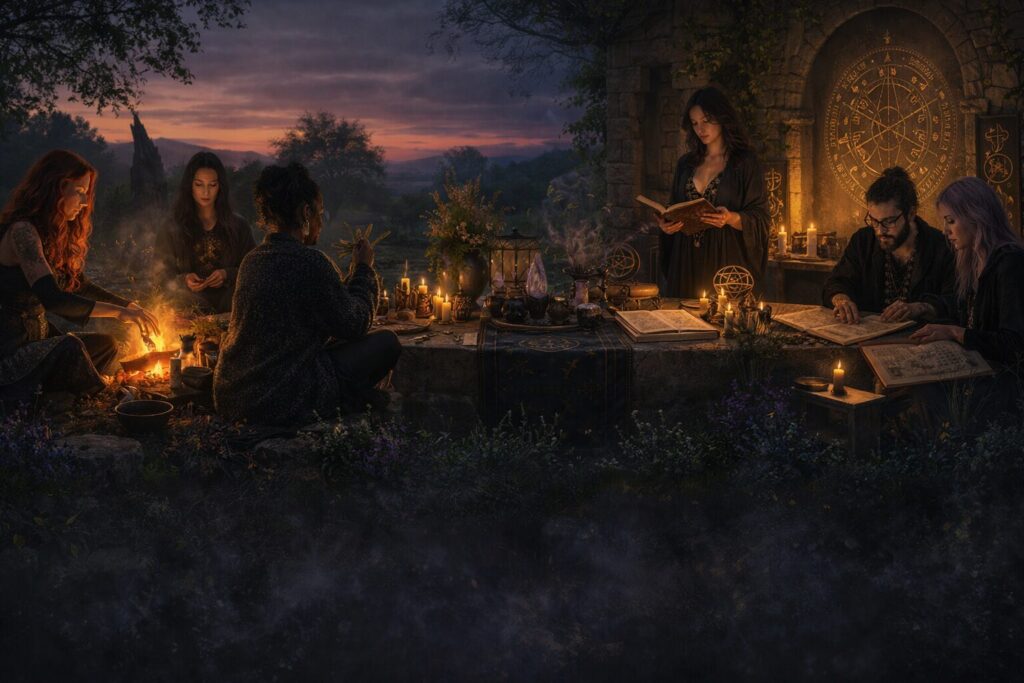
Witchcraft and Western esotericism are related, but they are not the same field.
Western esoteric traditions tend to emphasize structured cosmologies, symbolic systems, metaphysical frameworks, and formalized methods of ritual and initiation. Many are concerned with mapping the structure of reality, understanding the relationship between spirit and matter, and working within established systems of correspondence, hierarchy, and transformation. They often prioritize discipline, structure, and the refinement of knowledge through study and practice.
Witchcraft, by contrast, is more immediately practice-centered. It is often rooted in direct experience, relationship with land and spirit, seasonal awareness, intuitive engagement, and the embodied shaping of energy. While it may incorporate structure and symbolism, it is not dependent on any single formal system, and it frequently adapts its methods to the needs of the practitioner and the context of the work.
Despite these differences, the overlap between the two is significant. Modern witchcraft has drawn from Western esoteric traditions in its use of correspondences, ritual forms, protective structures, planetary associations, subtle-energy concepts, and symbolic frameworks for understanding how magic operates. At the same time, it has reinterpreted these elements—often simplifying, adapting, or grounding them into more accessible and experiential forms.
This also means that not every assumption within these traditions needs to be accepted in order for their methods to be useful. Some systems are built around specific theological or cosmological models—such as detailed hierarchies of angels, rigid metaphysical structures, or defined spiritual authorities—that may not align with every practitioner’s worldview. A witch may not adopt these frameworks as literal truth, yet still find value in the techniques, symbolic languages, and disciplined approaches those systems preserve.
In practice, this becomes a matter of discernment. Techniques can be studied without adopting the full belief structure in which they originated. Systems can be understood without being followed completely. What is taken from a tradition should be engaged with thoughtfully, with awareness of both its strengths and its limitations.
No single system holds a complete account of reality. Each tradition reveals certain patterns clearly while obscuring others. Understanding where they differ—and why—can be as valuable as understanding where they align. For the practitioner, this creates space not for confusion, but for a more informed and intentional relationship with the wider landscape of magic.
Taken together, these traditions offer a range of conceptual tools, symbolic systems, and practical methods that can deepen how magic is understood and worked.
They provide structured ways of thinking about reality, including systems of correspondence that relate inner and outer experience, spirit and matter, intention and manifestation. They offer symbolic languages that help organize perception and give form to otherwise abstract or intuitive processes. Many also present models of transformation—whether spiritual, psychological, energetic, or ritual—that describe how change occurs over time and through practice.
In addition to theory, these traditions preserve methods. These include approaches to ritual construction, invocation and evocation, altered states, sacred speech, purification, protection, and disciplined interaction with non-physical intelligences. While not all of these methods will align with every practitioner, they represent developed techniques that have been refined within specific systems.
Not every framework presented here will resonate, and not every method will be useful in every context. However, even where a system does not fully align, it can still offer insight. Disagreement, limitation, and difference are part of the learning process. Each tradition clarifies certain aspects of magic while leaving others less defined.
Approached thoughtfully, these traditions do not replace practice—they expand how it is understood.
The sections below represent different kinds of knowledge within the wider field of Western esotericism. Some are complete traditions with their own histories and internal systems. Others are broader frameworks that help define how this body of knowledge is understood. Still others describe methods and approaches that move across multiple traditions and are applied in different ways.
They are presented together not because they are identical, but because they are interconnected. Many traditions share underlying assumptions while differing in structure and interpretation. Many methods appear across systems, even where the surrounding beliefs are not the same. Understanding how these pieces relate to one another offers a clearer view of the broader landscape.
What follows is not a hierarchy, but a map.
The Card Sequence
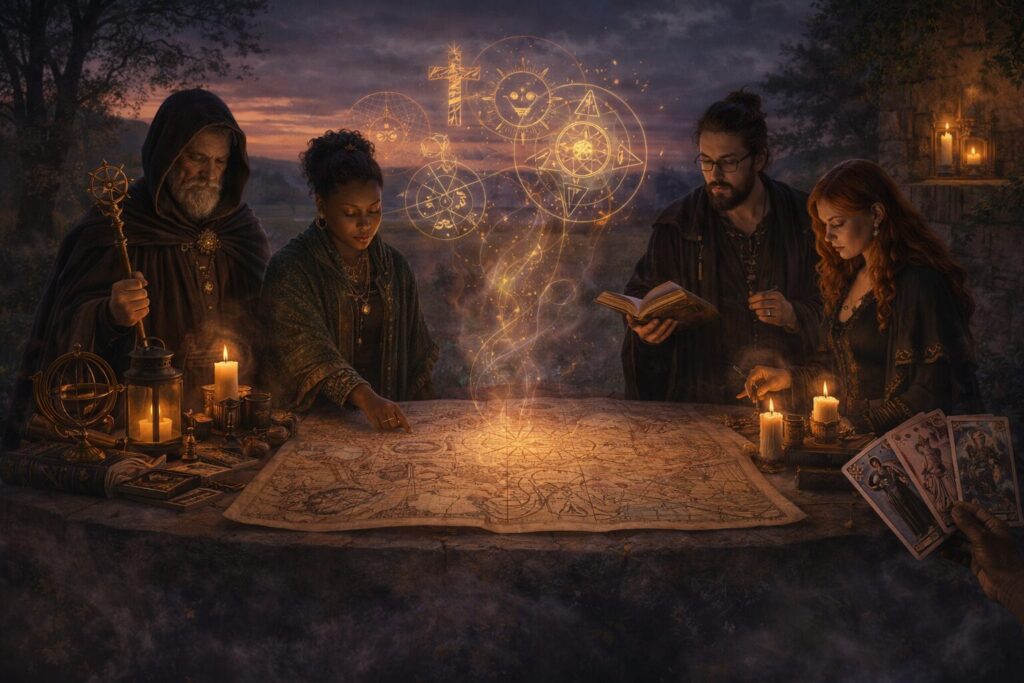
The traditions, frameworks, and methods below are arranged as individual entries so that each can be approached on its own terms. Some represent historical traditions, some describe broader interpretive frameworks, and some trace methods that travel across systems. Read straight through or move by interest; each card is meant to stand alone while still contributing to the larger map.
Hermeticism
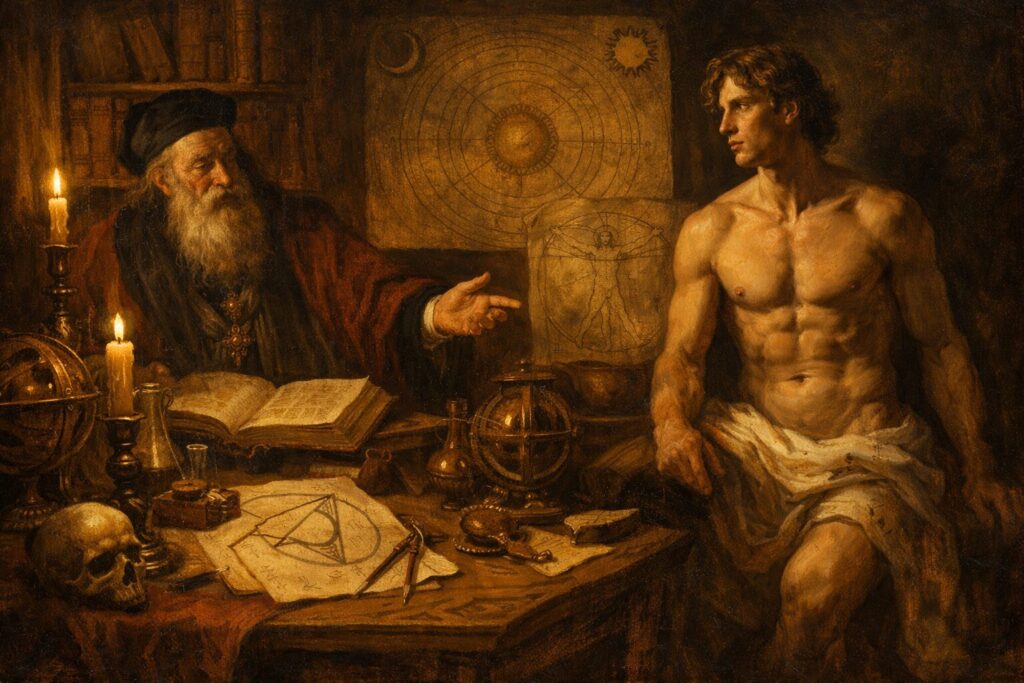
Hermeticism is one of the foundational traditions of Western esotericism, drawing on late antique texts attributed to Hermes Trismegistus and on a vision of the cosmos as ordered, meaningful, and alive with correspondence. At its heart is the idea that reality is not random or inert, but structured through relationships between levels of being: spirit and matter, above and below, the greater world and the human soul. In this view, to know the universe is not merely to observe it from a distance, but to participate in it more consciously.
Hermetic thought became deeply influential in the history of magic because it offered a language for understanding how symbols, forces, and patterns interact. Its central principle of correspondence—often summarized through the phrase “as above, so below”—helped shape later developments in alchemy, astrology, ceremonial practice, and occult philosophy. Rather than treating the visible and invisible as separate worlds, Hermeticism understands them as reflections of one another. The human being is therefore not outside the cosmos, but a smaller image of it, capable of study, alignment, and transformation.
This makes Hermeticism especially important within the wider landscape of magic. It is not simply a historical curiosity or an abstract philosophy; it is one of the major sources of the symbolic logic that continues to shape modern esoteric practice. Ideas about planetary influence, elemental balance, spiritual ascent, sacred language, and the transformative power of knowledge all bear the imprint of Hermetic thinking. Even when later systems move in very different directions, many still retain its basic assumption that the universe can be read, interpreted, and worked with through meaningful patterns.
For a witch, Hermeticism does not need to be adopted as a complete worldview in order to be useful. Its greatest gift may be the way it sharpens perception. It provides a disciplined framework for understanding why correspondences matter, how symbolic relationships function, and why magical work is often strengthened through coherence between intention, image, timing, material, and force. Where witchcraft often knows these truths through practice and experience, Hermeticism offers a more formal language for articulating them. It can therefore deepen understanding without replacing the immediacy or embodied nature of the Craft.
Studied in this way, Hermeticism becomes less a doctrine to adopt than a way of seeing. It teaches that reality is layered, relational, and intelligible; that transformation begins in perception as much as in action; and that magic is not imposed upon the world from outside, but arises through conscious engagement with the patterns already woven through it.
Kabbalah
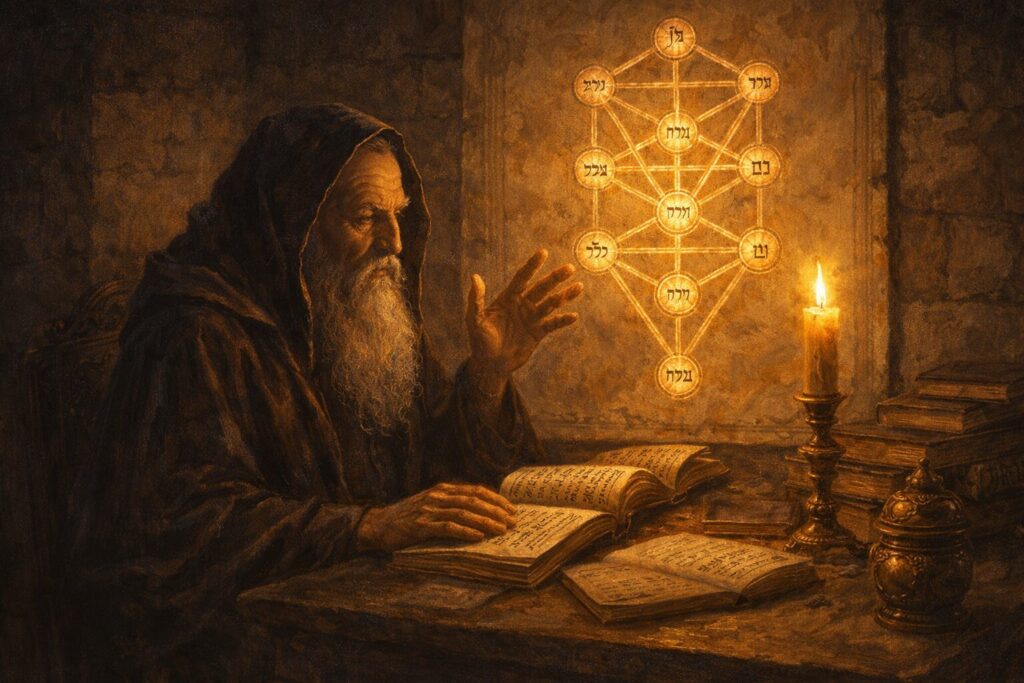
Kabbalah is a mystical tradition rooted in Jewish thought that seeks to understand how the infinite becomes manifest within creation. Rather than treating the world as separate from the sacred, it presents existence as a living unfolding of divine reality, structured through emanation, relationship, and return. Its most widely recognized symbol, the Tree of Life, offers a map of that unfolding: a pattern through which divine force descends into form and through which consciousness may ascend again toward source.
In this vision, reality is neither flat nor accidental. It is layered, dynamic, and internally ordered. The Sephirot are not merely abstract concepts but living principles—modes through which power, wisdom, beauty, strength, and manifestation are expressed. Kabbalah therefore became not only a theology of divine presence, but a profound symbolic system for understanding how the visible and invisible worlds interpenetrate. It asks how spirit enters matter, how consciousness is refined, and how the soul might move with greater awareness through a world already filled with sacred pattern.
As Kabbalah moved outward through the history of Western esotericism, its symbols were adapted into broader magical and philosophical systems. The Tree of Life became a framework for correspondences, initiation, ritual order, and contemplative ascent, especially in later ceremonial magic. In that adapted form, Kabbalah came to function as one of the great organizing grammars of modern esoteric thought, shaping how practitioners linked planets, numbers, colors, letters, paths, and states of being. Even where its original theology was transformed or reinterpreted, its architecture endured because it offered an unusually elegant way of mapping relationship within complexity.
For a witch, Kabbalah can be approached with both respect and discernment. It is not necessary to adopt every theological assumption within it in order to appreciate what it reveals. Its value often lies in the clarity of its structure: it provides a way to think about balance and imbalance, descent and ascent, manifestation and return. Where witchcraft may know these processes through cycle, intuition, spirit contact, and direct practice, Kabbalah offers a more formal symbolic framework through which those experiences can be organized and interpreted. It can deepen one’s understanding of magical movement without demanding that the Craft be collapsed into a system that emerged from a different lineage.
Studied in this spirit, Kabbalah becomes less a rigid diagram than a living pattern of relationship. It reminds us that manifestation is not random, that power moves through structure, and that knowledge can serve as a form of alignment rather than mere accumulation. Its enduring gift is a vision of the cosmos as ordered yet mysterious, structured yet alive—a universe in which every level of reality participates in a larger and more meaningful whole.
Thelema
Thelema is a modern esoteric and magical tradition most closely associated with Aleister Crowley, though it draws from older streams of Hermeticism, ceremonial magic, mysticism, and ritual symbolism. Its central idea is that each person has a True Will—not simply desire in the ordinary sense, but a deeper and more essential path of being that reflects one’s proper alignment within reality. In Thelemic thought, the spiritual task is not passive obedience or moral conformity, but the difficult work of discovering and enacting that deeper will with clarity, discipline, and force.
This makes Thelema distinct within the wider field of Western esotericism. Where some traditions focus primarily on cosmological order or symbolic architecture, Thelema places unusual emphasis on the practitioner as an agent of becoming. It is concerned with the development of consciousness, the refinement of intention, and the transformation of the self through ritual, testing, and self-knowledge. Its language is often provocative, but beneath that style lies a serious spiritual framework: one that asks what it means to live deliberately, to distinguish passing impulse from deeper calling, and to align magical practice with a more integrated understanding of purpose.
Thelema is also important because it helped shape much of modern occult culture. It contributed to how later practitioners thought about ritual authority, personal sovereignty, magical identity, and the relationship between will and manifestation. It stands at a crossroads between older ceremonial systems and more modern currents of psychological, initiatory, and experimental magic. Even where readers do not resonate with its tone or every element of its worldview, it remains one of the major traditions through which twentieth-century magic redefined itself.
For a witch, Thelema can be useful not as a system to absorb wholesale, but as a lens that sharpens certain questions. What is the difference between wish and will? What does it mean to practice in alignment rather than in reaction? How might magical work become more focused, more deliberate, and more truthful? Witchcraft often approaches these questions through lived relationship, cycle, intuition, and embodied practice; Thelema approaches them through a more explicit language of purpose, discipline, and conscious self-direction. That difference can be productive. It offers a way to think more rigorously about agency without requiring every practitioner to share the same metaphysical assumptions.
Studied with discernment, Thelema offers a demanding but valuable gift: it insists that magic is not only about influence or result, but about the shaping of the practitioner. Its deeper lesson is that power without alignment becomes distortion, while intention rooted in a truer center can become a genuine force of transformation.
Enochian
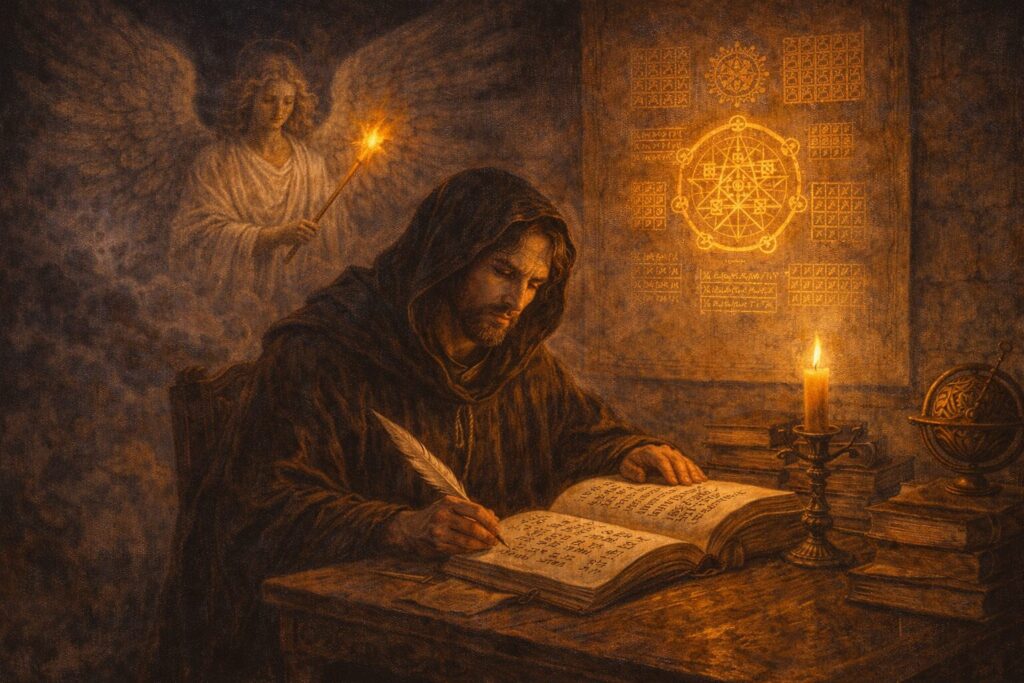
Enochian magic is a highly structured system of ceremonial practice developed in the late sixteenth century through the work of John Dee and Edward Kelley. It is based on a series of visionary communications said to originate from angelic intelligences, which produced a distinct language, symbolic tables, ritual structures, and a cosmology organized through layered spiritual realms. Unlike many broader philosophical traditions, Enochian is technical in nature: it is concerned not only with what reality is, but with precise methods for engaging it.
Central to the system are the Enochian language, the Watchtowers, and a set of ritual calls or keys used to access different levels of the spiritual structure. These elements form a system that is both symbolic and operational, combining geometry, sound, intention, and carefully ordered procedure. In later centuries, Enochian was incorporated into broader ceremonial magic traditions, where it became one of the most complex and demanding frameworks for spirit work and visionary practice.
What distinguishes Enochian from many other traditions is its specificity. It does not offer a general philosophy of correspondence or transformation in the same way as Hermeticism or alchemy; instead, it presents a detailed system with its own internal logic, language, and protocol. This precision is both its strength and its challenge. When approached carefully, it demonstrates how disciplined structure, clear symbolic systems, and exact method can produce powerful results. It also shows how magic can be organized into repeatable forms without losing its connection to vision and experience.
For a witch, Enochian magic is not necessarily a system to adopt in full, particularly where its cosmology or angelic framework does not align with one’s own understanding of spirit. However, its techniques offer important lessons. It illustrates the value of clarity in ritual design, the role of language and vibration in magical work, and the importance of preparation, protection, and intentional structure when engaging with non-human intelligences. Even when adapted or simplified, these principles can strengthen practice.
Studied in this way, Enochian becomes less about accepting a specific worldview and more about learning from a system that has refined its methods to a high degree. Its enduring contribution lies in showing that magic can be both visionary and exacting, both experiential and structured—an intersection that continues to influence how practitioners approach complex forms of ritual work.
Alchemy
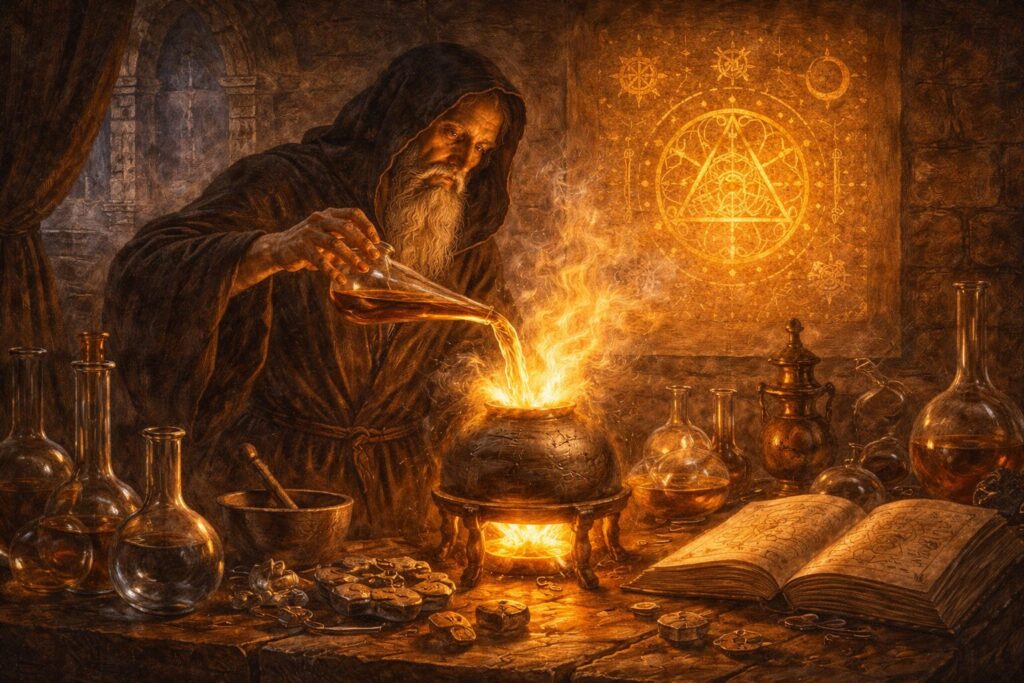
Alchemy is one of the most enduring and symbolically rich traditions within Western esotericism, often described as both a proto-science and a spiritual discipline. While historically associated with the transformation of materials—most famously the attempt to turn base metals into gold—alchemy has long been understood on multiple levels at once. Beneath its laboratory imagery lies a deeper concern with transformation itself: the refinement of substance, the purification of essence, and the gradual movement from fragmentation toward wholeness.
Alchemical texts are written in a language of symbol and process, using images such as the Philosopher’s Stone, the Great Work, and stages of dissolution, separation, recombination, and refinement. These processes describe not only changes in matter but changes in perception, consciousness, and being. In this sense, alchemy bridges the material and the spiritual without fully separating them: transformation in one realm reflects transformation in the other.
As the tradition developed, alchemy became central to how Western esoteric systems understood change. It influenced later magical, mystical, and even psychological frameworks, including interpretations of transformation found in Hermetic philosophy and, much later, in the symbolic work of Carl Jung. Through these adaptations, alchemy came to represent not only a historical practice but a general model of how transformation unfolds—through stages, through tension, and through sustained engagement rather than sudden change.
For a witch, alchemy can be especially resonant because it does not require strict adherence to a single cosmology in order to be meaningful. Its language is flexible, its symbols adaptable, and its processes recognizable across many forms of magical work. It offers a way of understanding spellcraft, ritual, and personal practice as part of a larger arc of transformation: not simply the achievement of a result, but the gradual reshaping of conditions, relationships, and the self.
Studied in this way, alchemy becomes less about literal transmutation and more about the disciplined art of change. Its enduring lesson is that transformation is rarely instantaneous or simple. It unfolds through stages, requires attention and patience, and often reveals its meaning only in retrospect. In a magical context, this perspective deepens practice by situating each working within a longer process of becoming—one that is both material and deeply symbolic at the same time.
Gnosticism
Gnosticism refers to a diverse group of early mystical movements that emerged in the first centuries of the Common Era, unified not by a single doctrine but by a shared emphasis on gnosis—direct, experiential knowledge of the divine. Rather than prioritizing belief or external authority, Gnostic traditions teach that true understanding comes through inner awakening, insight, and recognition of one’s deeper spiritual nature. In many Gnostic systems, the material world is seen as incomplete or obscured, and the task of the practitioner is to perceive beyond appearances toward a more fundamental truth.
Gnostic cosmologies often describe a layered universe in which divine reality becomes fragmented or concealed, sometimes expressed through figures such as the Demiurge and emanations of divine presence. While these structures vary widely across texts and traditions, their symbolic function is consistent: they provide a language for understanding disconnection, illusion, and the possibility of return. The emphasis is not on literal belief in every figure or narrative, but on the underlying experience they attempt to describe—the sense that reality contains hidden layers that must be perceived rather than simply accepted.
As part of the broader development of Western esotericism, Gnostic ideas influenced later mystical, philosophical, and magical systems, particularly those concerned with inner knowledge, liberation, and the distinction between surface appearance and deeper truth. It contributes to a long-standing current within esoteric thought that values insight over authority, experience over doctrine, and awakening over conformity.
For a witch, Gnosticism can be approached less as a fixed theology and more as a perspective on knowledge and perception. It invites questions about what is taken for granted, what is hidden, and how understanding arises through experience rather than instruction. Witchcraft often engages with similar dynamics through intuition, spirit contact, and direct practice; Gnosticism frames these processes in terms of revelation and recognition. The two are not identical, but they intersect in their shared emphasis on knowing through encounter rather than abstraction.
Studied in this way, Gnosticism offers a critical and introspective dimension to magical work. It suggests that transformation is not only a matter of changing external conditions, but of seeing more clearly—of recognizing the patterns that shape perception and the possibilities that emerge when those patterns are understood. Its enduring contribution is a reminder that knowledge, when it is lived rather than merely learned, can itself be a form of liberation.
Neoplatonism
Neoplatonism is a philosophical and mystical tradition that emerged in the later Roman world, most notably through the work of Plotinus. It builds on the earlier thought of Plato, but extends it into a more explicitly spiritual and cosmological system. At its center is the idea of the One, an ultimate source of all existence that is beyond form, beyond division, and beyond direct description. From this source, reality unfolds in a process of emanation, moving from unity into multiplicity while still remaining connected to its origin.
In Neoplatonic thought, the structure of the universe is hierarchical but continuous. Levels of reality—often described in terms of intellect, soul, and material form—are not separate worlds, but expressions of the same underlying source at different degrees of manifestation. This creates a model in which ascent is possible: the human soul, through contemplation, discipline, and refinement of perception, can move toward greater unity and clarity. Knowledge, in this sense, is not simply intellectual but transformative. To understand reality more deeply is to become more aligned with it.
Neoplatonism has had a profound influence on the development of Western esotericism, shaping the metaphysical foundations of traditions such as Hermeticism, Kabbalah, and later ceremonial systems. Its ideas about emanation, unity, and return underpin many symbolic and magical frameworks, even where they are not explicitly named. It provides a philosophical structure that helps explain why correspondences exist, how levels of reality relate to one another, and why transformation is understood as a movement toward coherence rather than mere change.
For a witch, Neoplatonism can serve as a way of thinking more clearly about relationship and structure without requiring adherence to a rigid hierarchy or abstract system. It offers a lens through which the interconnectedness of all things can be understood more formally, complementing the experiential knowledge that often arises through practice. Where witchcraft engages with cycles, land, and spirit through direct interaction, Neoplatonism provides a conceptual framework for understanding how those relationships might be situated within a larger pattern of being.
Studied with discernment, Neoplatonism becomes less a distant philosophy and more a clarifying influence. Its enduring contribution is the idea that reality is fundamentally unified, that diversity arises from that unity without breaking it, and that understanding is itself a path of return. In a magical context, this perspective deepens practice by situating individual acts within a broader movement toward coherence, alignment, and integration.
Rosicrucianism
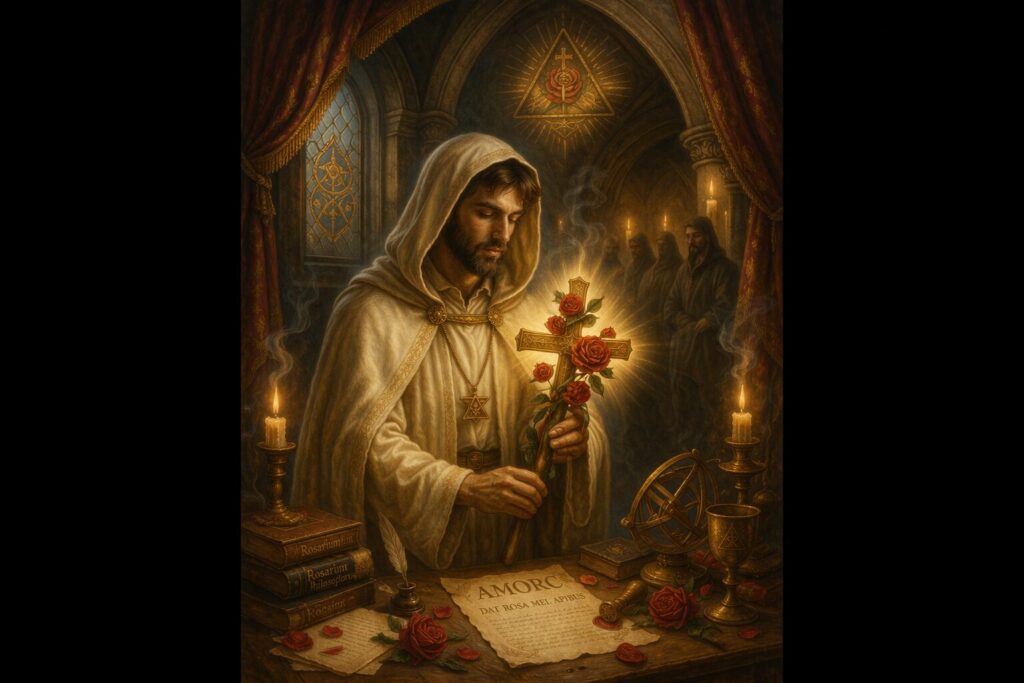
Rosicrucianism emerged in early modern Europe through a series of mysterious manifestos that described a hidden brotherhood devoted to spiritual knowledge, transformation, and the reform of both the individual and society. Whether or not such a brotherhood existed in the form described, the ideas contained within these texts had a profound influence on the development of Western esoteric thought. Rosicrucianism draws together elements of Hermetic philosophy, alchemy, Christian mysticism, and early scientific inquiry into a vision of knowledge that is both spiritual and transformative.
At its core, Rosicrucianism presents the idea that true knowledge is not merely intellectual, but initiatory. It must be discovered, lived, and embodied. The figure of Christian Rosenkreuz, whether historical or symbolic, represents this journey: a path of study, refinement, and inner transformation that leads toward greater clarity and alignment. The tradition emphasizes that knowledge, ethics, and spiritual development are intertwined, and that the transformation of the individual is inseparable from the transformation of the world they inhabit.
As Rosicrucian ideas spread, they influenced a wide range of later movements, including early modern science, mystical philosophy, and the development of ceremonial magic traditions. It helped shape the idea that knowledge could be both hidden and shared, that symbolic systems could encode deeper truths, and that spiritual insight could coexist with disciplined study. In this sense, Rosicrucianism acts as a bridge between older esoteric traditions and more modern approaches to knowledge and practice.
For a witch, Rosicrucianism offers a perspective on practice that emphasizes intentional development rather than isolated workings. It suggests that magical work can be part of a broader process of refinement—one that involves study, ethical consideration, and the gradual alignment of intention, understanding, and action. While its specific symbols and frameworks may not be adopted directly, its underlying approach to knowledge as something lived and integrated can deepen how practice is understood.
Studied with care, Rosicrucianism reveals a vision of magic that is both inward and outward, both personal and collective. Its enduring contribution is the idea that transformation is not accidental, but cultivated—that insight, discipline, and intention together can reshape not only the practitioner, but their relationship to the wider world.
Ceremonial Magic
Ceremonial magic refers to a family of structured magical practices that emphasize formal ritual, symbolic precision, and disciplined method. Drawing from traditions such as Hermeticism, Kabbalah, Neoplatonism, and Renaissance occult philosophy, it developed as a way of engaging with spiritual forces through carefully designed operations. These practices often involve defined spaces, consecrated tools, invocations, and layered symbolic correspondences, all working together to create a coherent and intentional magical environment.
Unlike more intuitive or adaptive forms of magic, ceremonial systems place strong emphasis on structure. Timing, language, geometry, direction, and sequence are all considered significant. Rituals are often repeatable and codified, not because they are rigid for their own sake, but because precision is understood to strengthen clarity and effectiveness. Through this approach, ceremonial magic seeks to align the practitioner, the ritual space, and the intended force or intelligence into a unified working pattern.
Central to many ceremonial traditions is the concept of theurgy—the practice of invoking or cooperating with higher spiritual intelligences for the purpose of transformation, knowledge, or alignment. This can include angelic, planetary, or symbolic forces, depending on the system. While these frameworks are often embedded in specific cosmologies, the underlying methods—ritual preparation, focused intention, symbolic coherence, and disciplined engagement—have influenced a wide range of magical practices beyond their original contexts.
For a witch, ceremonial magic can be both familiar and distinct. Many elements—casting space, working with directions, calling forces, using tools—have parallels in the Craft. The difference often lies in degree of structure and the level of formalization. Where witchcraft may adapt fluidly to situation and intuition, ceremonial magic tends to rely on established forms and precise correspondences. Studying it can therefore sharpen awareness of how ritual is constructed, how symbolism operates, and how intention can be reinforced through consistency and design.
Approached with discernment, ceremonial magic offers not a replacement for the Craft, but a refinement of certain aspects of practice. Its enduring contribution is the demonstration that structure can enhance power when used intentionally, and that disciplined form does not diminish magic, but can focus and amplify it. It provides a clear example of how method, symbolism, and intention can be brought into alignment to create a coherent and effective magical act.
Other Currents & Crossroads
Not all forms of magic or esoteric practice belong cleanly to a single tradition. Many emerge at the intersections—where systems overlap, where ideas are adapted, or where practitioners intentionally move between structures rather than remaining within one. These are often referred to as crossroads or composite currents: approaches that draw from multiple sources, combine techniques, or reinterpret older frameworks in new ways. Within this space, the boundaries between traditions become more fluid, and the emphasis shifts from lineage to application.
One of the most well-known examples is Chaos Magic, a modern approach that deliberately rejects fixed systems in favor of adaptability, experimentation, and results-based practice. Other forms include eclectic occultism, syncretic traditions, and hybrid systems that combine elements of Hermeticism, Kabbalah, ceremonial magic, folk practices, and modern psychological frameworks. These currents often prioritize flexibility, personal experience, and the practical effectiveness of methods over adherence to any single inherited structure.
This space is also where many contemporary practitioners operate, whether consciously or not. Modern magical practice frequently involves combining techniques, adapting symbols, and working across systems in ways that would not have been recognized as coherent within older traditions. While this flexibility can be creative and powerful, it also introduces complexity. Without clear understanding, it can lead to fragmentation or superficial use of systems that were originally designed with deeper internal logic.
For a witch, the crossroads are both familiar and instructive. Witchcraft has long existed in a space of adaptation, drawing from local practice, inherited knowledge, and evolving forms of magic. The difference lies in how consciously that blending is approached. Studying these composite currents can sharpen awareness of how systems interact, where they align, and where they conflict. It encourages a more intentional approach to combining methods, rather than an unexamined one.
Understood in this way, the crossroads are not a lesser or secondary space, but a dynamic one. They reveal how magical knowledge continues to evolve, how traditions are reinterpreted over time, and how new forms of practice emerge from the meeting of older ones. Their enduring lesson is that flexibility and structure are not opposites, but forces that must be balanced carefully if practice is to remain both coherent and alive.
Currents of Magic
The underlying methods that move across traditions—how magic actually works beneath different systems.
ExploreOccult
The study of hidden forces, symbolic patterns, and the unseen structures beneath reality.
ExploreCeremonial & High Magic
Structured ritual systems focused on precision, alignment, and transformation through disciplined practice.
ExploreNew Age
A modern spiritual current translating older esoteric ideas into accessible contemporary language.
ExploreThe traditions and frameworks presented here do not form a single system, nor are they meant to be reconciled into one. They differ in structure, worldview, method, and intention. Some emphasize ascent, others embodiment; some rely on hierarchy and order, others on fluidity and adaptation. Each reveals certain aspects of magic with clarity while leaving others less defined.
For the practitioner, this diversity is not a problem to be solved, but a landscape to be understood. No single tradition contains the whole of magical knowledge, and no single method is universally applicable. What matters is not the adoption of a system in its entirety, but the ability to engage with it thoughtfully—recognizing what it offers, where it aligns, and where it does not.
Within a witchcraft-centered practice, this becomes a matter of relationship rather than replacement. These traditions can inform, sharpen, and deepen understanding, but they do not displace the Craft itself. Witchcraft remains grounded in practice, in experience, in the lived interaction between practitioner, world, and unseen forces. The systems explored here can provide language, structure, and perspective, but they do not substitute for direct work.
Over time, each practitioner develops their own way of navigating this landscape. Some will move deeply into one tradition, others will draw selectively from many, and others will remain primarily within the Craft while using these systems as reference and context. There is no single correct approach.
What remains consistent is the need for discernment. To study carefully, to practice intentionally, and to understand that knowledge is not only something to be gathered, but something to be integrated. In this way, these traditions become not endpoints, but tools—ways of seeing, thinking, and working that expand what is possible without defining it completely.
Continue Your Path
Return to the Craft, explore traditions, or step into practice.