Lore of the Witch
Feared and sought. Condemned and consulted. Monster, healer, outsider, neighbor, magician, warning, possibility.
The witch has never carried only one meaning.
Across centuries of story, accusation, folklore, art, religion, gossip, fear, and imagination, the witch has appeared again and again as someone standing just beyond what a culture considers ordinary. Sometimes she is blamed for what cannot be explained. Sometimes he is sought because ordinary answers have failed. Sometimes the witch is a monster, sometimes a helper, sometimes a temptation, sometimes a warning—and sometimes the figure holds traces of people who really did practice magic.
That contradiction matters.
Stories about witches do not simply tell us what people believed witches were. They also tell us what a culture feared, desired, prohibited, envied, needed, and secretly hoped might be possible.
At Coven of the Veiled Moon, we do not treat every witch of folklore as hidden history, nor every accusation as evidence of an actual magical practitioner. But neither do we think the figure appeared from nowhere. Beneath exaggeration, persecution, fantasy, and reinvention, something recognizable keeps returning: the person who works at the edges of ordinary knowledge, engages with magic and the unseen, and does what others may fear while still seeking their help.
This page is about that witch—the one imagined by others, remembered in stories, distorted by enemies, reclaimed by practitioners, and still being rewritten today.
For the broader practice, history, and meaning of witchcraft, explore Witchcraft.
The Witch in the Story
The witch is not one historical person carried unchanged through time. She is a figure assembled from many things: real magical practice, accusation, religious anxiety, village gossip, folk belief, fairy tale, literature, art, persecution, memory, and eventually the voices of people who deliberately chose the name for themselves.
That makes witch lore unusually complicated. The historical practitioner, the person accused of witchcraft, the witch of folklore, and the modern self-identified witch can overlap, but they are not the same person.
Many people accused as witches probably practiced no magic at all. Others may have used household charms, divination, healing, counter-magic, spirit work, or other practices that their communities understood in very different ways. Still others practiced forms of learned or ceremonial magic without being socially categorized as witches. The word itself has never neatly contained everyone who worked magically.
Nor should every older magical specialist be retroactively turned into a modern witch. Seers, cunning folk, healers, ritual specialists, astrologers, diviners, spirit workers, and household practitioners belonged to their own cultures and understood themselves through their own language.
And yet witchcraft did not emerge from nowhere.
Long before modern people consciously reclaimed the identity, magic already lived in homes, villages, temples, courts, workshops, fields, crossroads, and private devotional practice. People protected houses, sought omens, made charms, addressed spirits, worked healing rites, cursed enemies, blessed crops, read the heavens, and attempted to influence uncertain circumstances. Some practices were learned and elaborate. Others were simply part of ordinary life.
Modern witchcraft inherited from that much older magical landscape, even when the people within it would never have called themselves witches.
Lore adds another layer.
The witch of story is often less a portrait of a particular practitioner than a cultural idea. She becomes the person who knows what respectable society says should remain unknown. He crosses boundaries other people are told to respect. The witch may heal or harm, reveal secrets, speak with spirits, leave the ordinary world, change shape, command weather, live beyond the village, or possess knowledge that cannot be easily controlled.
Some of that is fantasy. Some is accusation. Some preserves distorted memories of genuine magical practice. And some tells us more about the people telling the story than about witches at all.
That is why this page begins with lore rather than trying to make folklore serve as history.
The question is not simply “Were witches really like this?”
It is also:
Why did people imagine witches this way?
What frightened them? What fascinated them? What kinds of power did they distrust? What kinds of people were permitted knowledge—and who became suspicious for having it? Why was the witch condemned in one story, sought out in another, and sometimes both at once?
Those contradictions are where witch lore becomes most interesting.
For the wider history and practice, explore Witchcraft and Witchcraft Traditions.
They told stories about what happened beyond her door.
They rarely wrote down why they kept knocking on it.
The Witch They Feared
The feared witch is one of the loudest figures we inherited. She spoils the harvest, raises storms, sickens livestock, steals fertility, poisons wells, curses children, changes shape, flies by night, consorts with forbidden powers, and gathers with others beyond the boundaries of respectable society.
That figure was never simply a description of magical practice. It was also a vessel into which people poured fear.
When illness arrived without explanation, when crops failed, when an animal suddenly died, when weather destroyed a season’s work, or when one household prospered while another did not, witchcraft could offer an explanation. Suspicion also grew from ordinary human conflict: an argument between neighbors, refused charity, resentment, a threatening word remembered after something went wrong. In parts of early modern Europe, local accusations like these could intersect with increasingly elaborate religious and legal ideas about what witches supposedly were and whom they served. Historians therefore treat witch persecution as something more complicated than authorities simply inventing a belief and imposing it from above. Popular fear, community conflict, religious doctrine, courts, and learned demonology could feed one another.
Over time, learned writers helped gather many different fears into a more terrifying composite witch. Harmful magic was joined to ideas of demonic allegiance, secret assemblies, night flight, shape-changing, sexual transgression, and deliberate rejection of the accepted religious order. Images that had existed separately could be made into parts of a single imagined conspiracy. Cornell’s historical witchcraft collection, for example, traces precisely these developing themes through early printed works: night flying, shapeshifting, demonic pacts, gendered stereotypes, and witch persecutions.
But the feared witch also reveals something about power.
Again and again, the witch is imagined as someone possessing power that has not been granted by an approved institution. She may know without having been taught by an authorized teacher. She may heal without the sanctioned healer, speak with spirits without clergy, influence love or fertility without permission, know what happens in private, or act upon an enemy who appears otherwise beyond her reach.
That does not mean every witch accusation was secretly a campaign against an empowered magical practitioner. Often the accused person may have possessed no such power at all. But the idea of the witch tells us what kinds of unauthorized power could become frightening.
And gender became deeply entangled with that fear. Women were disproportionately represented among those prosecuted for witchcraft in much of early modern Europe, although men were also accused and in some regions formed a much larger share than the stereotype suggests. We will return to that complexity later, because the familiar assumption that witch means woman and wizard means man hides a much stranger history.
The witch could also embody anxiety about age, poverty, sexuality, anger, independence, bodily difference, religious nonconformity, outsiders, and people whose place within the social order was uncertain. Not every accusation fits one explanation. Witch hunts differed enormously by place and period. What recurs is the usefulness of the witch as an answer to a disturbing question:
Who caused this?
Once a culture accepts that hidden human agency may lie behind inexplicable harm, the person at the edge of trust can become extraordinarily dangerous in the imagination.
And imagination does not remain neatly separated from reality.
Stories influence accusations. Accusations create new stories. Trials preserve those stories in writing. Artists give them bodies. Folklore carries them forward. Eventually the hat, broom, cauldron, familiar, storm, secret gathering, night flight, and monstrous old woman become so familiar that they can appear to have always belonged together.
They did not.
The feared witch was assembled.
That does not make her unimportant. Quite the opposite. She became one of Western culture’s most durable figures precisely because she could carry so many fears at once.
And yet fear is only half of the contradiction.
The people who told one another to beware of magic also lived in societies where magical assistance could be useful, familiar, and actively sought. Before we get there, however, we need to ask a harder question:
Whose version of the witch survived for us to read?
What the Records Cannot Tell Us
Much of what survives about witches was not written by people calling themselves witches.
It was written by courts, clergy, magistrates, demonologists, physicians, theologians, pamphleteers, neighbors giving testimony, later folklorists, and eventually historians trying to reconstruct what happened from records created for very different purposes.
That matters.
A trial record can tell us that someone was accused of flying at night, harming livestock, meeting spirits, attending a sabbat, or causing illness. It does not automatically tell us that the accused person believed they had done those things—or that the event happened as the record describes it.
Likewise, a demonologist describing what witches supposedly did may give us invaluable evidence about the beliefs of his own time while telling us very little about the private practices of the people he claimed to describe.
This becomes particularly important with one of the most enduring images in witch lore: the secret gathering.
Stories of witches meeting at night, dancing, feasting, flying, worshipping forbidden powers, exchanging magical knowledge, or engaging in acts that inverted accepted religious and social order became increasingly elaborate in European witch literature. Some accused people eventually repeated versions of these stories themselves.
But testimony exists inside circumstances.
Questions could be leading. Interrogation could be coercive. Torture was used in some jurisdictions. Accused people sometimes learned what authorities expected to hear. Stories also traveled between communities and through printed material, so one region’s witch lore could influence another’s.
None of this means the records are worthless.
It means we have to ask what kind of truth a particular record can actually support.
A confession may tell us something about interrogation. A neighbor’s testimony may preserve local magical beliefs. A charm found in a household may give us evidence of practice. A demonological book may reveal elite religious anxieties. A folk tale collected centuries later may preserve an old motif while also carrying the assumptions of the person who recorded it.
The sources speak—but they do not all speak about the same thing.
A record that says someone was accused of witchcraft is strong evidence that the accusation occurred. It is not, by itself, proof that everything alleged in the accusation occurred.
There is another silence in the archive.
Ordinary magical practice often leaves much less dramatic evidence.
A protective charm tucked into a house does not generate a sensational pamphlet. A spoken blessing may disappear with the person who knew it. A family practice can continue for generations without anyone writing a treatise about it. Knowledge transmitted at a kitchen table, bedside, field edge, or hearth may leave only fragments behind.
This is one reason we should be cautious about allowing persecution records to define the whole magical landscape.
People practiced charms, divination, healing, counter-magic, astrology, protective rites, household magic, spirit work, and forms of learned ritual magic outside the stereotypical image of the persecuted witch. Some practitioners were respected. Some were tolerated. Some were feared. Some moved between those categories depending on who needed them and what had gone wrong.
And many people accused of witchcraft were probably not practitioners at all.
That matters just as much.
The romantic modern story that the witch trials were simply the persecution of a hidden population of Pagan healers or midwives gives the accused a tidy identity they often did not claim for themselves. It can replace one imposed story with another.
We do not need to turn every victim of witch persecution into a modern witch in order to remember them.
At the same time, rejecting that myth does not require pretending that magical practice disappeared from ordinary life. Household magic, folk magic, learned magic, divination, charms, spirit beliefs, healing rites, protective customs, and harmful magic all existed in various forms.
The historical world was simply messier than either caricature allows.
That messiness is important to witch lore because the witch we inherited was created partly from real practices, partly from fear of practices, partly from accusations against people who practiced nothing at all, and partly from stories that grew larger with every retelling.
The archive therefore gives us neither a clear photograph nor an empty page.
It gives us fragments.
And fragments have to be read with care.
For deeper historical and research material, visit Study, Practice & Resources. We will also include a fuller Sources & Further Reading section near the end of this page.
The Witch They Went To
Fear did not always keep people away from magic.
The same communities that warned against witches could also contain people known for charms, divination, healing, counter-magic, protective work, spirit knowledge, or the ability to solve problems that ordinary means had not solved. Sometimes such practitioners were respected. Sometimes they were tolerated. Sometimes they were regarded with suspicion. And sometimes those attitudes existed at the same time.
Public disapproval and private need have never been mutually exclusive.
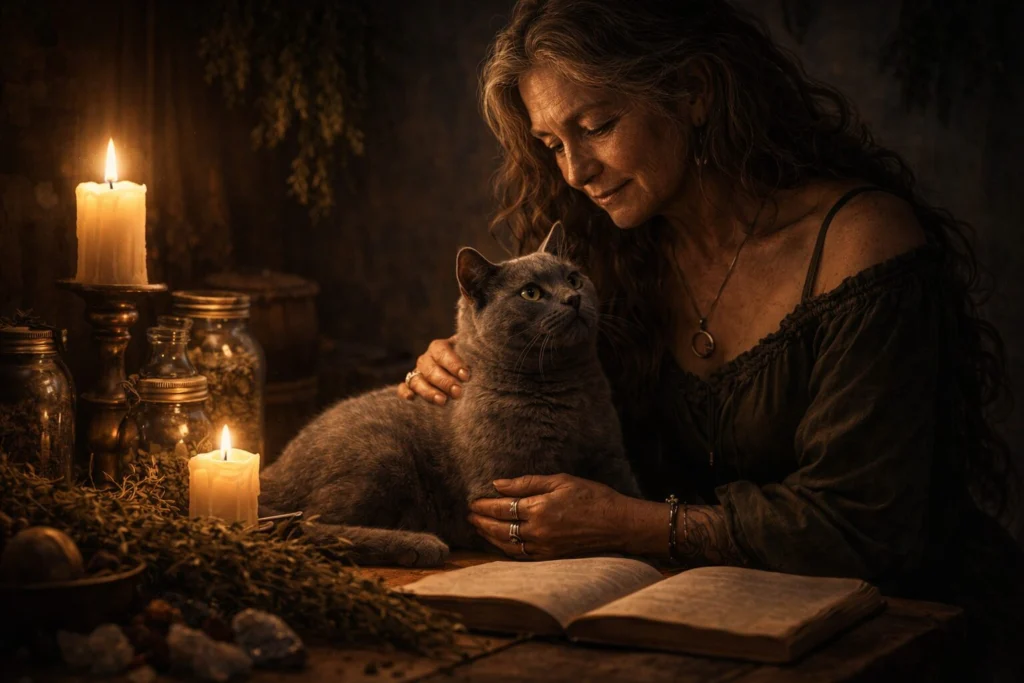
When something was lost, someone might seek the person reputed to know how to find it.
When a household feared harmful magic, someone might know how to break it.
When illness lingered, a charm or blessing might be tried alongside whatever other remedies were available. Questions of love, fertility, luck, weather, livestock, protection, spirits, theft, dreams, and uncertain futures could all become reasons to seek magical help.
The person providing that help did not always resemble the harmless healer of modern romantic imagination.
Someone capable of blessing was understood to be capable of withholding a blessing. A practitioner who knew how to counter a curse might also know how one was made. Knowledge of healing plants could exist beside knowledge of dangerous ones. Protection sometimes included retaliation. Justice and vengeance can look very different depending on which side of the working one occupies.
That ambiguity is part of the witch.
The magical specialist could be useful precisely because they were believed to possess knowledge that ordinary people did not. And unusual knowledge creates a peculiar social position: the person you seek when you need them can also become the person you fear when things go wrong.
A neighbor who successfully finds a missing object may seem gifted when the result is welcome. The same reputation can become unsettling when privacy matters.
Someone reputed to influence weather is valuable when rain is needed and suspicious when a storm destroys a field.
A person thought capable of communicating with spirits may be sought when the dead are missed and avoided when the unseen feels too close.
The gift and the danger can be imagined as two sides of the same power.
This is one reason the witch so often occupies an unstable place in folklore. She is neither fully outside the community nor safely inside it. People may gossip about her, fear her temper, question her methods—and still know exactly where her door is.
The witch was not only the person people feared. The witch was also the person ordinary explanations sometimes sent people toward.
That does not mean every village secretly housed someone who would have called themselves a witch. Many helpful magical practitioners used other names, or no special name at all. Household magic could be practiced without creating a separate magical profession. Folk specialists belonged to particular local cultures and traditions, and later applying the modern word witch to all of them can erase important differences.
But they matter to witch lore because they complicate the picture.
The hostile witch of accusation is supposedly useful to no one except herself or whatever sinister power she serves.
The lived magical landscape was far less tidy.
People have long wanted ways to protect themselves, know the unknown, recover what was lost, influence uncertain circumstances, heal what hurts, communicate with what cannot be seen, and act when ordinary authority offers no satisfying answer.
Where those needs exist, some form of magical specialist tends to appear.
And those specialists are part of the older current from which modern witchcraft eventually draws—even when their names, cosmologies, methods, and identities were different from ours.
MCC explores some of those surviving and reconstructed pathways more fully in Witchcraft Traditions.
They crossed themselves when she passed.
When the child would not recover, they sent for her.
Neither Saint nor Monster
Modern discussions of witchcraft sometimes correct an old distortion by creating a new one.
The hostile caricature tells us that the witch is fundamentally corrupt: malicious, dangerous, selfish, aligned with evil, and interested only in harm.
The romantic caricature responds by insisting that the real witch was always something gentler—a healer, herbalist, midwife, wise woman, nature-lover, or misunderstood spiritual helper who would never deliberately cause harm.
Neither picture is large enough.
The witch was not always the monster her enemies described.
Neither was every magical practitioner a harmless village healer.
Magic has been used for protection and healing, but also for coercion and revenge. Practitioners have blessed homes, sought visions, eased suffering, protected children, strengthened crops, attracted love, and helped people navigate uncertainty.
They have also cursed enemies, bound rivals, attempted to control affection, retaliated against perceived injustice, sought advantage over others, and performed workings intended to frighten or harm.
Sometimes the same practitioner might do both.
That does not make witchcraft uniquely sinister. It makes it a human practice.
A knife can prepare food or wound. Knowledge can heal or exploit. Authority can protect or oppress. Magical practice carries the same uncomfortable reality: power gains its moral character through how it is understood, directed, and used.
Even the categories themselves are complicated. Protection may include sending harm back to its source. Justice may look like vengeance to the person receiving it. A love working may feel harmless to one practitioner and coercive to another. A curse may be condemned in principle until the person condemning it feels powerless against someone who has caused real harm.
Witch lore preserves this ambiguity remarkably well.
The witch may save the child in one story and threaten one in another. She may break the enchantment or cast it. He may reveal the danger or become the danger. The same knowledge that makes the witch valuable also makes the witch difficult to categorize.
Modern witches do not have to accept the moral judgments embedded in old stories. But neither do we need to pretend that witchcraft becomes legitimate only when it is made completely harmless.
We are responsible for what we do with what we know.
That is a much more useful ethical position than declaring witchcraft inherently good or inherently evil.
The Witch at the Threshold
The witch is rarely imagined at the comfortable center of things.
Again and again, lore places the witch at an edge: the last house before the forest, the hedge surrounding cultivated land, the crossroads, the graveyard gate, the mountain, the cave, the ruined place, the well, the shoreline, or the path that disappears beyond the village.
These are not merely atmospheric settings.
They are thresholds—places where one condition becomes another.
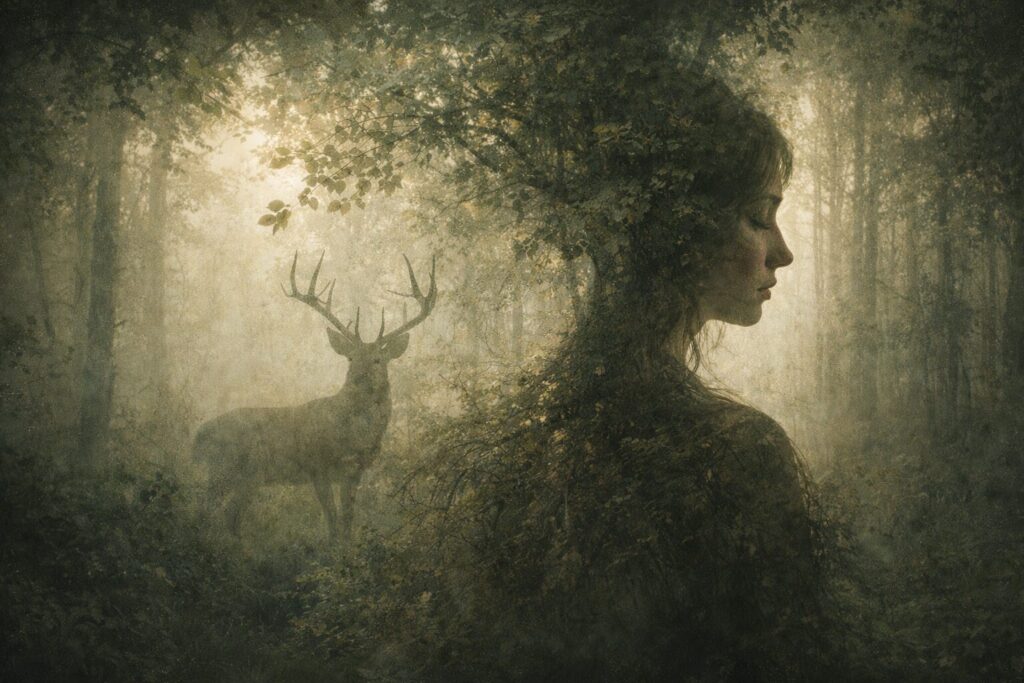
The same pattern appears in what witches are imagined to do.
The witch moves between the ordinary and the magical, the visible and unseen, healing and harm, life and death, wilderness and settlement, accepted knowledge and forbidden knowledge.
She knows the path others are warned not to follow.
He speaks with what other people cannot see.
The witch enters states of consciousness that blur the boundary between dream, vision, ritual, imagination, spirit, and ordinary awareness. In lore, the witch may travel without the body, cross into another world, speak with the dead, encounter strange beings, foresee events, transform shape, or return with knowledge gained somewhere beyond normal perception.
Whether we read these stories literally, spiritually, psychologically, symbolically, or as combinations of all four, the recurring structure remains striking.
The witch goes somewhere others do not—and returns knowing something.
That makes the witch useful in stories because thresholds are inherently uncertain.
Birth is a threshold. Death is a threshold. Illness is a threshold. Adolescence, marriage, grief, initiation, exile, migration, the beginning of winter, the end of a harvest, midnight, dawn, and the turning of a year all occupy spaces where one state has ended and another has not fully settled.
Cultures create rituals around such moments because uncertainty invites both possibility and danger.
And the witch repeatedly appears there.
The witch of the threshold is therefore not simply an outsider.
An outsider can merely be excluded.
The witch is more unsettling because she may be able to move between worlds that others experience as separate.
That movement gives her an unusual relationship to boundaries. She may guard them, cross them, ignore them, strengthen them, or deliberately open them.
Sometimes this is presented as wisdom. Sometimes as transgression. Often it is both.
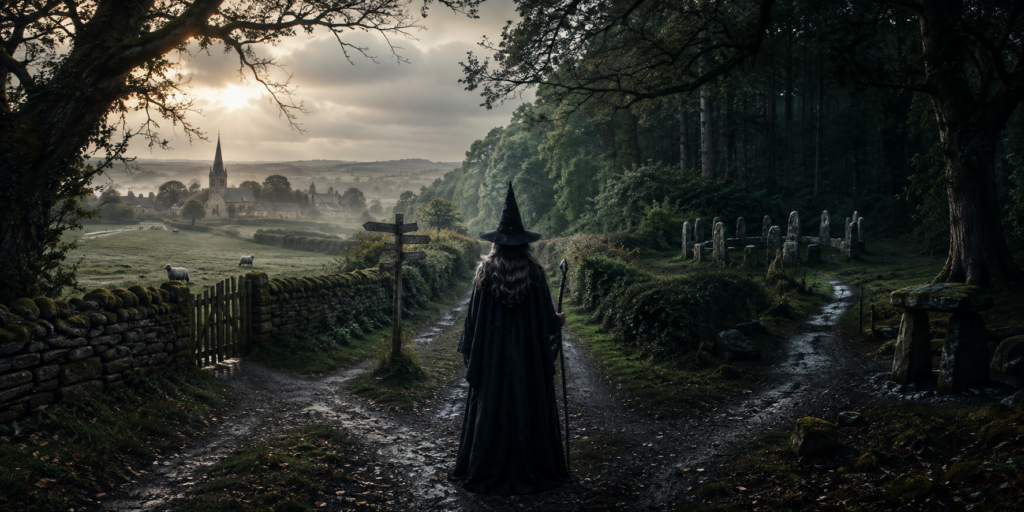
The landscape surrounding the witch carries the same symbolism.
The hedge separates cultivated ground from what grows beyond human ordering. The crossroads offers several possible directions without telling the traveler which one is correct. The forest obscures sightlines and social rules. The graveyard brings the living beside the dead. The well leads downward into darkness while bringing life-giving water upward.
Witch lore repeatedly puts magical figures in such places because the landscape itself is already telling a threshold story.
For many modern practitioners, these locations can also be more than symbols. Place can have presence. Land can hold memory, relationship, spirit, history, and power of its own.
For a deeper exploration of living land, place, and relationship, see Animism & Sacred Ecology.
The Current Beneath the Story
At My Cousin’s Coven, we do not believe the recurrence of the witch proves that one secret, uninterrupted witch religion survived unchanged from antiquity into the present.
We do think something more interesting persists beneath the stories.
Across changing periods and traditions, people continue to practice forms of magic concerned with divination, altered states, protection, healing, harmful magic, spirit relations, death, land, ritual, hidden knowledge, and the attempt to act upon circumstances that are not entirely under ordinary human control.
The names change. The cosmologies change. The methods change. What a culture permits, fears, or recognizes as magic changes too. Yet the current itself keeps appearing.
Folklore can exaggerate that current, condemn it, romanticize it, turn it into fantasy, or misunderstand it completely. But distortion does not always erase what lies underneath.
Sometimes a distorted image still preserves a silhouette.
This is one reason the witch remains recognizable even when the details change.
We do not need every tale of night flight to be a literal travel report, every spirit encounter to be accepted without question, or every folkloric witch to conceal a historical practitioner. The recurring figure matters because human beings have repeatedly recognized a person who approaches the uncertain boundary between the known and unknown and says:
There may be something on the other side worth learning.
That possibility is part of the witch’s mystery—and part of the witch’s danger.
Explore the relationship between story and spiritual meaning in Encountering Myth, or return to the broader practice through Witchcraft.
Witches, Wizards, Warlocks & Men Who Practiced Magic
The familiar Western witch is overwhelmingly female in popular imagination: the old woman at the edge of the village, the young enchantress, the hag, the wise woman, the woman accused of possessing dangerous knowledge.
There are historical reasons for that association. Women made up roughly four-fifths of those accused in the early modern European witch persecutions overall, although the balance varied enormously between regions and significant numbers of men were prosecuted as witches as well.
But there is another complication.
Men practiced magic too. They were simply not always described with the same words.
Depending upon period, place, social position, education, and the kind of magic involved, a magical man might appear in the record as a cunning man, astrologer, alchemist, conjurer, sorcerer, learned magician, ceremonial magician, wizard—or witch.
The vocabulary can make the history appear more divided by gender than magical practice itself actually was.
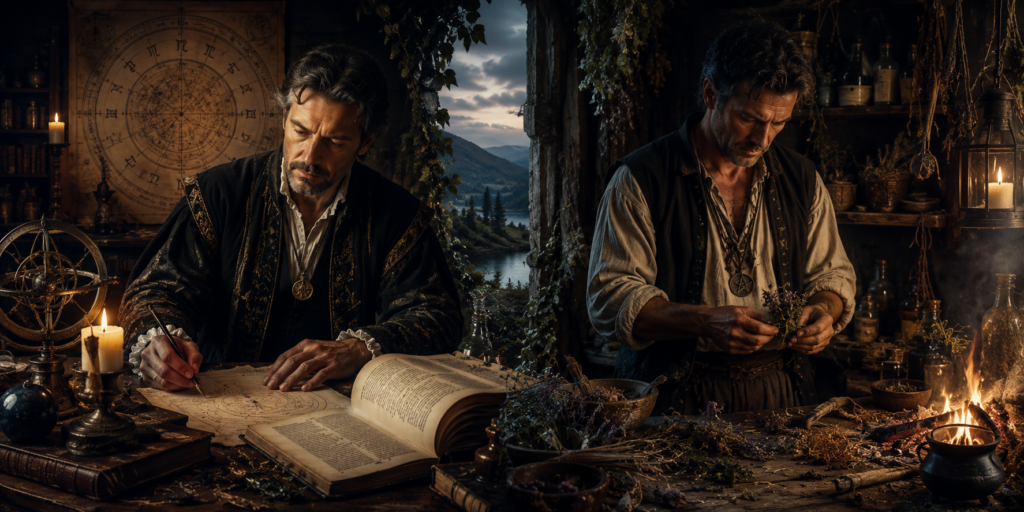
One man could be imagined as learned while another was considered suspicious, even when both claimed knowledge that reached beyond ordinary experience.
Class, literacy, religious approval, patronage, location, and reputation could change how magic was interpreted. So could gender.
Open the sections below for some of the distinctions hidden behind our modern vocabulary.
Men Accused as Witches
Witch persecution was strongly gendered, but it was never exclusively directed at women.
Across early modern Europe, women constituted the majority of those accused of witchcraft, while men made up a substantial minority. The proportions varied dramatically from one region to another, and particular outbreaks could involve large numbers of men.
That matters because the later cultural shorthand woman = witch can make historical male witches almost disappear from view.
Men could be accused of harmful magic, supernatural knowledge, spirit dealings, participation in imagined witch gatherings, or association with other accused witches just as women could. There was never a historical rule that only women could be witches.
When Magic Received Another Name
Gender was only one of the things that affected the language surrounding magic.
A literate man studying astrology, alchemy, ritual texts, or learned forms of magic could occupy a very different social category from a village practitioner known for charms, divination, healing, or counter-magic.
Depending on time and place, magical men might be described as astrologers, alchemists, conjurers, cunning men, sorcerers, ceremonial magicians, learned magicians, or wizards.
These categories were not interchangeable, and we should not flatten them into one historical profession. But their existence reminds us that magic did not become female simply because the cultural image of the witch did.
Why Did the Witch Become So Female?
European witch persecution developed within societies whose assumptions about gender shaped ideas of authority, sexuality, household roles, religious obedience, vulnerability, anger, knowledge, and proper behavior.
Learned demonological writing also increasingly portrayed witchcraft through explicitly gendered ideas about women, temptation, spiritual weakness, sexuality, and disorder. Those ideas interacted with local conflicts and accusations rather than providing one simple explanation for every trial.
The result was a powerful cultural association between woman and witch that eventually became larger than the historical record itself.
Yet the proportions differed considerably by region. The fact that men could form a substantial part of particular witch persecutions warns us against treating gender as a universal rule rather than an important historical pattern.
What About the Word “Warlock”?
Few witchcraft words produce arguments quite as reliably as warlock.
The word descends from Old English wærloga, associated with a traitor, deceiver, or oath-breaker. That history is real. But the modern argument sometimes stops there.
The word did not remain frozen in its Old English meaning. By the sixteenth century, Scottish usage had developed the specific sense of a male witch or male practitioner of sorcery.
So saying “warlock originally meant oath-breaker” is etymologically defensible. Saying “therefore warlock has never meant male witch” is not.
Later literature, folklore, fantasy, and popular culture strengthened the male-magician sense even further.
Witch Is Not a Gender
For MCC, witch describes practice and identity, not sex or gender.
A witch may be a woman, a man, nonbinary, transgender, or otherwise identify in whatever way is true for that person. There is no need to turn witch into a female title and invent a separate required title for everyone else.
The female witch remains enormously important to Western lore, especially because misogyny helped shape both persecution and representation. Recognizing that history does not require erasing the men and gender-diverse people who have also practiced magic or claimed witch identity.
Modern witchcraft can acknowledge the gendered history of the image while refusing to be imprisoned by it.
They called his books learning when they approved of him.
They found darker words when they did not.
The Storybook Witch
By the time the witch enters the fairy tale, history has already become something else.
Here the witch does not need to behave like an ordinary magical practitioner. She may live in an impossible house, fly through the night, transform bodies, speak with animals, poison a gift, set an impossible task, or appear exactly when a traveler has crossed too far beyond the safety of home.
Fairy tales simplify complicated fears into memorable figures, and the witch is extraordinarily good at carrying them.
She becomes hunger in human form. Forbidden knowledge. Dangerous independence. The frightening old woman. The seductive stranger. The person who lives beyond the rules of the village. Sometimes she is an obstacle. Sometimes a teacher. Sometimes the witch punishes foolishness or greed. Sometimes she is simply dangerous.
And occasionally, what first appears monstrous turns out to possess wisdom of its own.
That ambiguity is one reason the storybook witch refuses to disappear.
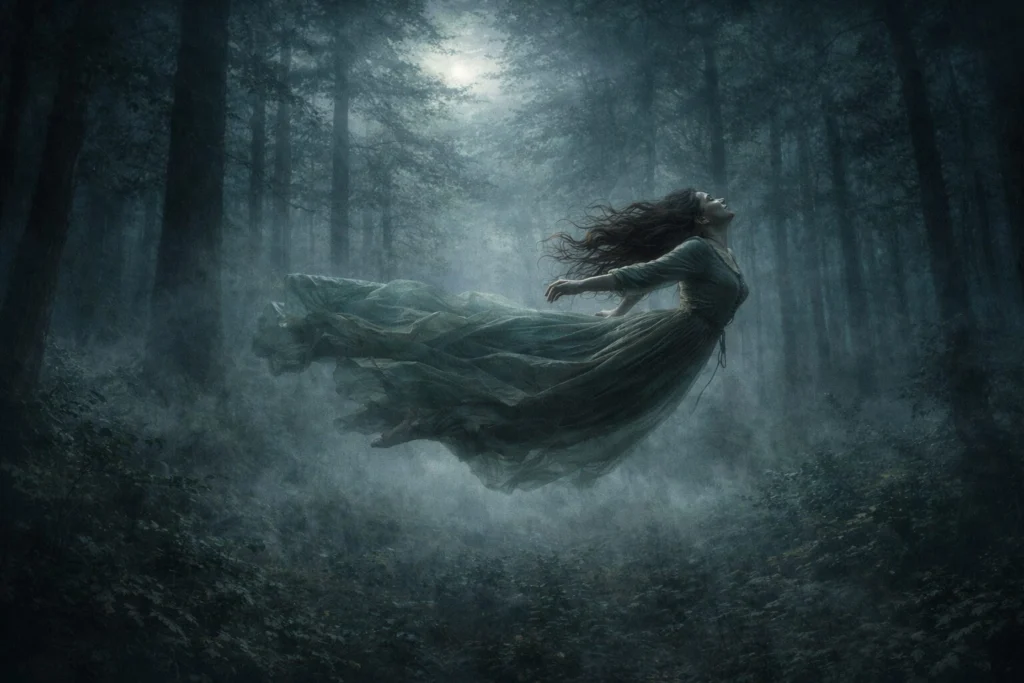
The supernatural exaggeration matters because fairy tales are not court records or manuals of magical practice. A witch who flies through a forest may tell us very little about what a historical practitioner actually did.
But she can tell us a great deal about what the story needs the witch to represent.
The forest becomes more than trees. The strange cottage becomes more than a house. The animal companion becomes more than a pet. Objects, places, bodies, and ordinary actions become charged with possibility.
That is where witch lore becomes aesthetic as well as narrative.
Open the motifs below to see some of the figures that keep returning.
The Hag in the Woods
The old witch beyond the village is one of the most durable figures in Western fairy tale.
Age, isolation, female independence, bodily difference, and knowledge accumulated outside ordinary institutions can all become unsettling when concentrated into one figure.
Yet the old woman in the woods is not always merely a monster. She may also possess the answer, object, warning, or knowledge the traveler needs. The danger is sometimes inseparable from the wisdom.
The House Beyond the Path
The witch’s home is rarely neutral.
It may stand beyond the village, deep in the forest, at the end of a forbidden road, or in a place that does not obey ordinary rules. Sometimes the house itself appears alive, enchanted, hidden, tempting, or dangerous.
Crossing its threshold means entering the witch’s territory, where the assumptions of the ordinary world may no longer protect the visitor.
Night Flight
Few images announce “witch” as quickly as impossible flight.
In story, the witch leaves ordinary geography behind. She moves over walls, roads, fields, and boundaries that constrain everyone else.
The image is frightening because it imagines a person who cannot easily be contained. It is also exhilarating—which may help explain why modern witches have so enthusiastically reclaimed the flying witch as an image of freedom.
The Poisoned Gift
Witch stories often make ordinary things uncertain.
Food, drink, jewelry, flowers, mirrors, combs, clothing, or household objects can become enchanted, poisoned, cursed, or transformed.
The motif works because gifts require trust. The witch turns that trust unstable and asks whether appearances can be believed.
The Witch Who Tests You
Not every frightening magical figure exists only to destroy the traveler.
Sometimes the strange old woman, mysterious stranger, or dangerous figure tests hospitality, courage, humility, generosity, cleverness, or the ability to recognize what others dismiss.
In such stories, surviving the encounter may depend less on defeating the witch than on understanding what kind of story you have entered.
The Familiar at Her Side
Cats, birds, hares, toads, dogs, and other animals repeatedly appear beside witches in folklore, accusation, illustration, and later popular culture.
Their meanings vary enormously: companion, spirit, omen, helper, disguise, supernatural intermediary, or simply part of the visual vocabulary later attached to witchcraft.
Modern witch imagery has inherited this so thoroughly that the black cat can suggest witchcraft even when no witch is visible.
The Cauldron and Impossible Transformation
The storybook witch transforms things.
Bodies become animals. Youth becomes age. Food becomes danger. A potion changes desire, memory, sleep, beauty, or form. The cauldron becomes a perfect symbol because it hides the process: separate things enter, something different emerges.
Transformation may be the most fundamental witch motif of all. The witch knows that what something is now may not be what it remains.
These motifs are only part of the larger story tradition. MCC explores witches, hags, enchanted figures, fairy tales, and related folklore more deeply in Tales & Folklore.
The Witch’s Body and the Places She Haunts
Lore does not only tell us what the witch does. It tells us what the witch is supposed to look like and where we expect to find them.
Bodies and landscapes become part of the story.
The witch may be made old or unnaturally young, beautiful or grotesque, scarred or marked, fertile or barren, seductive or frightening. Likewise, the witch is continually pushed toward certain places: the hedge, forest, crossroads, graveyard, well, lonely cottage, mountain, ruined place, or edge of cultivated land.
Neither pattern is accidental.
The Witch Written on the Skin
Witch lore has repeatedly turned the body into evidence.
Age can become ugliness. Beauty can become seduction. A mole, scar, birthmark, unusual body, disability, or other physical difference can be made suspicious. Hair, blood, sexuality, fertility, menstruation, pregnancy, menopause, nakedness, and bodily transformation have all accumulated magical meanings in different stories and periods.
This tells us less about what a witch’s body actually is than about what societies have feared or desired in bodies they could not easily control.
The hag and the enchantress look like opposites, but both can carry the same anxiety: a person whose body does not exist for ordinary social approval.
Modern witches inherit some of these images, reject others, and sometimes deliberately reclaim what was once meant as insult.
Where the Witch Appears
The witch is rarely placed somewhere meaningless.
Hedge, forest, crossroads, well, graveyard, shoreline, mountain, garden, ruined building, field edge, and lonely cottage all occupy some kind of boundary between conditions: cultivated and wild, living and dead, known and unknown, traveled and abandoned.
Folklore uses these landscapes because they already feel charged before the witch arrives.
Put a magical figure at a crossroads and the story gains choice. Put one beside a grave and it gains death. Put one beyond the hedge and the witch belongs to what lies outside ordinary ordering.
For practitioners who understand land as relational or spiritually alive, these places may carry significance beyond symbolism. But on this page, their importance is simpler: the landscape helps tell us what kind of witch we are about to meet.
For deeper exploration of living landscape and sacred relationship, visit Animism & Sacred Ecology. MCC also explores charged locations more directly through Places and related threshold practices elsewhere on the site.
We Inherited the Costume, Too
The witch is one of those rare cultural figures who can be recognized before anyone says the word.
A pointed hat. A black cat. Moonlight. Herbs hanging from a beam. A broom against the wall. Candles around an old book. A cauldron, raven, crooked cottage, dark forest, silver jewelry, black clothing, or a figure standing at the crossroads.
None of these things, by themselves, define witchcraft.
Together, however, they have become a visual language.
And modern witches inherited it.
Some elements grew from actual magical or domestic practice. Some developed through folklore. Some were exaggerated by hostile writers and artists. Some were sharpened by theater, children’s stories, Halloween, film, television, advertising, and fantasy.
The result is not a historically pure costume. It is a cultural collage.
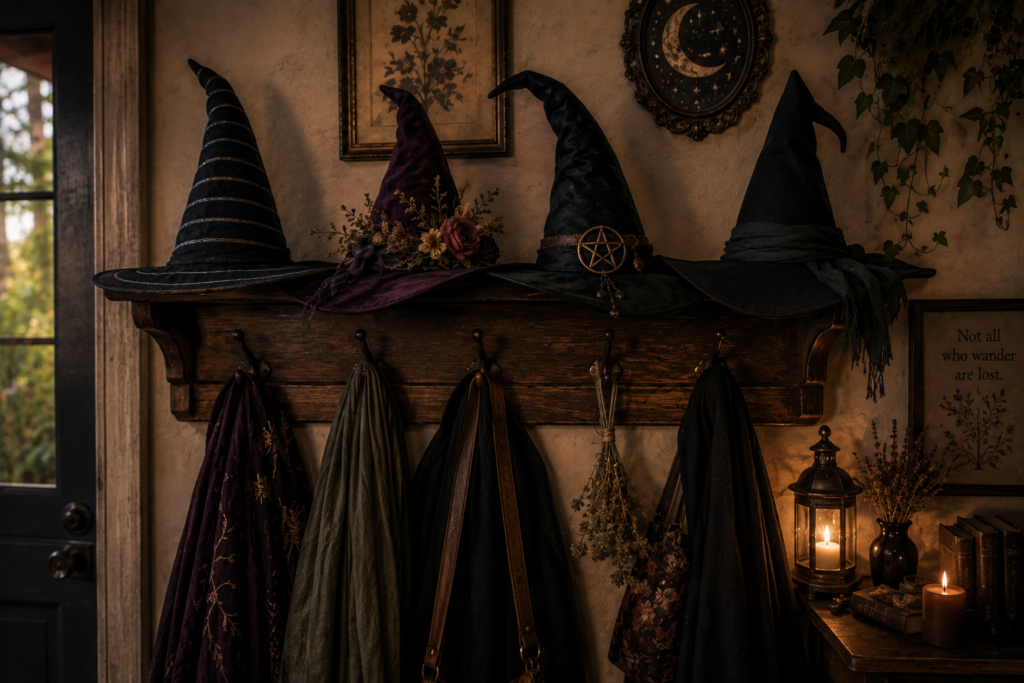
What makes this inheritance interesting is that symbols can change meaning when the people represented by them begin using them for themselves.
The pointed witch hat is a good example. Modern witches did not need to prove that every historical practitioner wore one before deciding that the image belonged to us. Its power now comes partly from recognition. Put on the hat and nearly everyone knows what you are invoking.
The same can be true of the broom.
A broom is an ordinary household object with genuine historical connections to domestic work, household symbolism, fertility imagery, magical folklore, and later fantasies of witch flight. Over centuries those strands became so tightly bound to the witch that the broom eventually became an emblem.
Black cats underwent a similar transformation. Associations among witches, familiars, supernatural animals, nighttime creatures, and later visual culture eventually made the black cat one of witchcraft’s most recognizable companions—even though no historical rule says a witch requires one.
The cauldron carries perhaps an even older symbolic appeal. It is domestic and transformative at once. Ingredients enter separately and emerge changed. Food, medicine, poison, potion, nourishment, chemistry, and mystery can all occupy the same vessel.
Books became part of the visual language too: grimoires, notebooks, spell books, herbals, astrological texts, mysterious manuscripts, and the imagined book of secret knowledge.
And then there is the landscape itself.
Moonlight. Forest. Cottage. Hedge. Crossroads. Graveyard. Garden. Firelight.
We have already seen why those places appear so often in lore. Once repeated across stories and art, they became part of what a witch is expected to look like before any spell is ever performed.
Reclamation does not require pretending every stereotype was secretly accurate.
Sometimes reclaiming a symbol means doing something more defiant:
taking an image once used to ridicule, frighten, or marginalize us and deciding that we like it anyway.
Modern witch aesthetics can be serious, playful, devotional, theatrical, practical, camp, beautiful, intimidating, earthy, glamorous, queer, traditional, contemporary—or some combination of them all.
A pointed hat does not make someone a witch.
But a witch is certainly allowed to enjoy the hat.
And that may be one of the stranger victories of witch lore: the caricature survived long enough for some of the people it once mocked to inherit it, alter it, and wear it deliberately.
The Witch on Screen
By the twentieth century, the witch no longer needed a village rumor or a demonologist to travel. She had mass media.
Film, television, illustration, advertising, children’s entertainment, horror, fantasy, and eventually social media carried the witch into millions of homes. Older folklore supplied much of the raw material—the hat, broom, familiar, spell, cauldron, dangerous woman, enchanted house, night flight—but popular culture continually rewrote what those things meant.
At first, the visual witch often remained monstrous.
The green-skinned Wicked Witch of the West in The Wizard of Oz became one of the most recognizable witches ever created for the screen. Her appearance was so influential that green skin, black clothing, hooked features, a pointed hat, and a broom became cultural shorthand for “witch” even in stories having nothing to do with Oz.
But another witch soon began appearing beside the monster:
the witch we might actually like.
Television programs such as Bewitched placed magic inside an ordinary modern household. The witch could be attractive, funny, loving, frustrated, powerful, and recognizably human. Magic was no longer confined to the frightening hut beyond the woods.
It could live next door.
That shift mattered.
Once audiences were invited to identify with the witch rather than merely fear her, the old figure became available for entirely new stories.
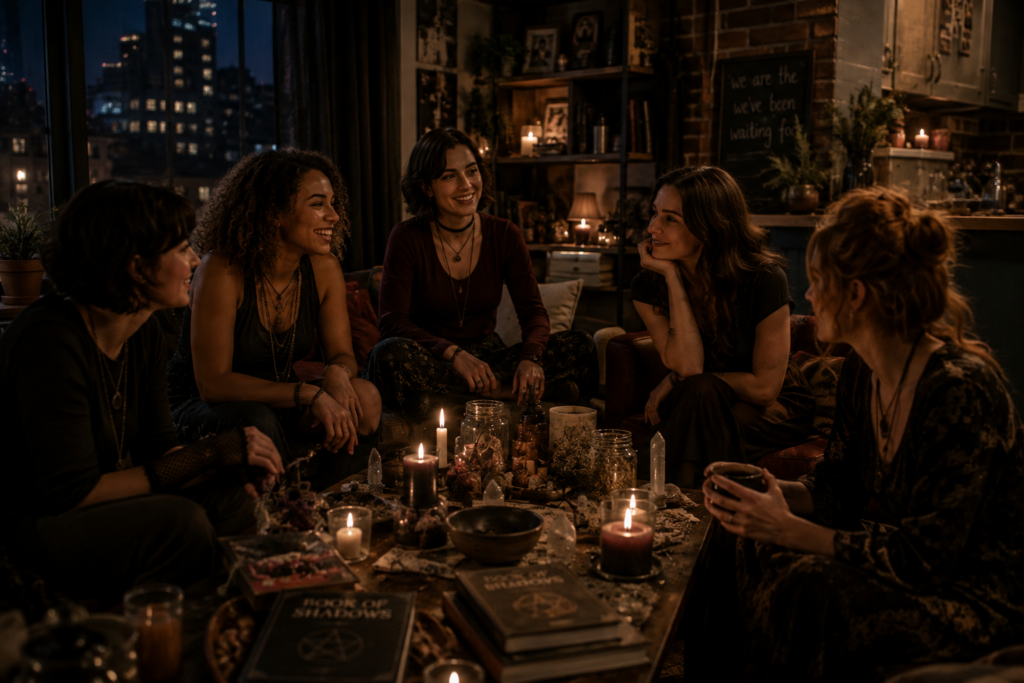
By the late twentieth century, witches increasingly became protagonists rather than obstacles.
The Craft gave the witch adolescent anger, friendship, outsider identity, power, danger, and consequence. Practical Magic placed witchcraft inside family, inheritance, love, trauma, and domestic life. Charmed made magical women heroes whose witchcraft existed alongside careers, relationships, family conflict, and ordinary responsibilities.
None of these portrayals accurately describe witchcraft as a whole.
They were never supposed to.
But representation does not have to be instruction in order to affect a community.
For many people, fictional witches provided the first moment in which the word witch did not mean only ugly, evil, ridiculous, or doomed.
Someone watching might recognize independence. Queerness. Outsiderhood. Sisterhood or brotherhood. Anger at unjust authority. Spiritual longing. Fascination with nature. A desire for hidden knowledge. The possibility that being different might carry power rather than merely shame.
Sometimes fiction opened a door.
And some people eventually walked through it into actual Paganism, witchcraft, occultism, folk practice, ceremonial magic, or other spiritual paths.
The Witch as Instant Danger
Horror, fairy-tale adaptation, and fantasy inherited the hag, curse, broom, cauldron, forbidden spell, and threatening magical woman. The witch could be recognized almost immediately because centuries of lore had already taught the audience what to expect.
Magic Moves Into the House
With portrayals such as Bewitched, the witch became domestic, humorous, attractive, and sympathetic. Magic could coexist with marriage, work, family, and everyday life rather than existing only beyond the edge of society.
The Witch as Rebellion and Belonging
Later stories increasingly connected witchcraft with outsider identity, friendship, adolescent power, sexuality, anger, independence, and finding others who understood you. Works such as The Craft helped make the witch especially compelling to people who already felt outside ordinary expectations.
Inheritance, Community and Everyday Magic
Practical Magic, Charmed, and related portrayals helped normalize another idea: magical people could have families, histories, communities, responsibilities, grief, love, and ordinary problems. Witchcraft became part of a life rather than the whole explanation for a character.
The Monster Gets to Tell Her Side
Modern reinterpretations such as Wicked ask what happens when the supposedly evil witch is allowed a history, motive, politics, relationships, and point of view. The cultural witch becomes not simply something to fear, but someone whose story may have been told by the people who defeated her.
Popular culture has also created problems for real witch communities.
Entertainment can turn invented practices into supposed ancient traditions. It can encourage the expectation that magic produces immediate cinematic results. It can reduce witchcraft to clothing and décor, or suggest that every practitioner works with the same gods, tools, rules, ethics, powers, or supernatural experiences.
Aesthetic witchcraft can be mistaken for practiced witchcraft.
Commercial culture can package spiritual traditions as products.
And dramatic fictional ideas sometimes return to real communities as if practitioners themselves had originally taught them.
But it would be equally simplistic to say that popular witch culture merely damaged witchcraft.
It invigorated it too.
Books, films, television, music, art, and later online communities gave people a vocabulary for interests they may already have felt but could not name. They made the witch visible. They helped people find one another. They created curiosity about Pagan traditions, occult history, divination, herbal practice, ritual, folklore, and magic.
Some people came because they saw a fictional witch.
They stayed because they discovered an actual practice.
That does not make the fiction a tradition.
It makes fiction part of the story of how modern witch identity became culturally imaginable.
There was never, however, a simple progression from evil witch to sympathetic witch to empowered modern witch.
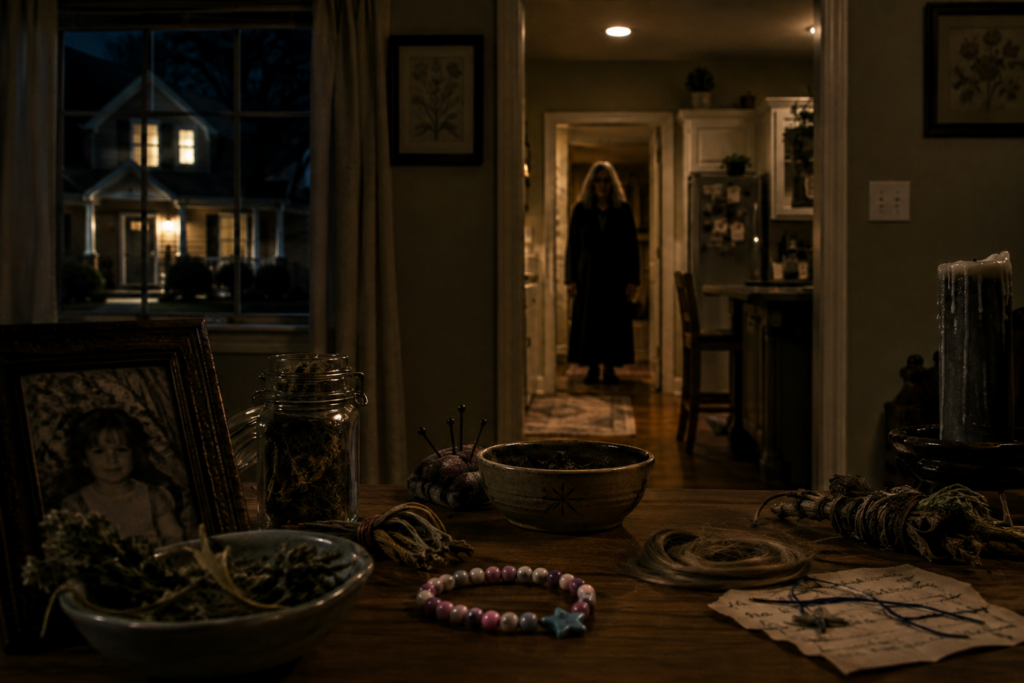
The frightening witch never went away.
Contemporary horror continues to return to some of the oldest territory in witch lore: threatening households, strange relatives, inherited knowledge, ritual, coercion, personal objects used magically, harm directed at children or families, isolated communities, uncanny landscapes, and the fear that someone understands forces the rest of us cannot see.
The 2025 film Weapons is a particularly modern example. Its witch-like antagonist does not wait in a distant fairy-tale forest. The threat enters an ordinary contemporary community and reaches directly into families, homes, and children. Old anxieties about dangerous magical knowledge, intimate materials, ritual control, predation, and the terrifying person who knows how to do something no one else understands are carried into a recognizably modern setting.
That matters.
After decades of comic, glamorous, romantic, rebellious, and empowering witches, audiences can still respond powerfully to the witch as something genuinely frightening.
The old hag has not vanished.
Neither has the dangerous outsider, the predatory magical relative, the person with forbidden knowledge, or the figure who can enter the safety of the household and make it unsafe.
We simply have more witches now.
Modern culture has not replaced one kind of witch with another; it has simply allowed more versions of the figure to exist at the same time. The frightening witch still stands beside the helpful one, the romantic witch beside the folk-horror witch, and the fictional witch beside people who actually practice witchcraft. What has changed is that audiences are more likely to question the story itself. Who decided this person was monstrous? Whose account survived? What fear, anxiety, or social conflict is the witch being asked to carry? Sometimes the answer is persecution or misunderstanding. Sometimes the figure has been distorted by the people telling the tale. And sometimes the witch really is meant to be dangerous.
The cultural witch has become more complicated without becoming harmless.
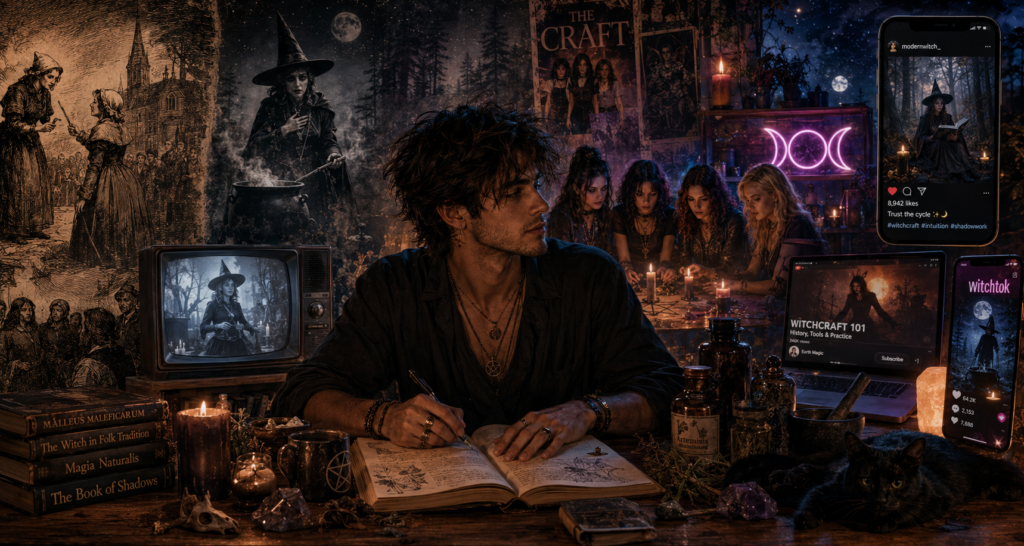
Popular culture therefore does more than borrow witch lore.
It creates new witch lore.
Film and television images enter Halloween, fashion, language, memes, spiritual communities, art, advertising, and eventually the way witches themselves imagine what a witch can look like.
The process we saw earlier has not stopped.
Stories create images.
Images create expectations.
Practitioners reclaim some of them, reject others, laugh at a few, and occasionally discover something unexpectedly meaningful inside a fiction that was never intended to become spiritual instruction.
The witch remains one of culture’s most flexible mirrors.
We keep changing what we see in it.
At first they wrote the witch for us.
Eventually, some of us took the pen.
When Witches Tell the Story
For centuries, the witch was overwhelmingly someone other people described.
Authorities defined the witch in legal and religious language. Neighbors supplied accusations and rumors. Folklore turned the witch into a warning. Artists gave the figure a face. Novelists, filmmakers, advertisers, and entertainers continued the process long after the witch trials themselves were over.
The witch had an enormous cultural presence while often having remarkably little control over the story.
Modern witchcraft changed that.
As people increasingly began to identify publicly as witches, Pagans, occultists, ritual practitioners, folk practitioners, and members of newly developing or revived magical traditions, the cultural witch acquired something she had rarely possessed before:
a public voice of her own.
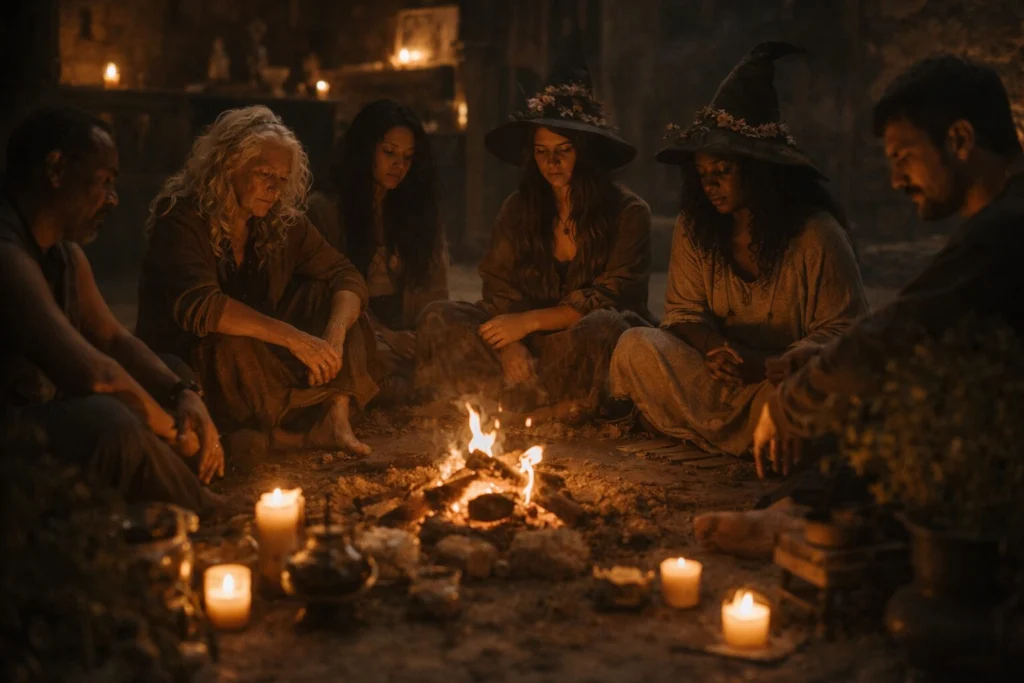
Modern witches write books, teach classes, form covens and informal circles, maintain solitary practices, create art, publish research, run community spaces, make films and podcasts, gather online, preserve family traditions, build new traditions, and argue endlessly among ourselves about what witchcraft is and is not.
That last part matters too.
There is no single modern witch voice waiting to replace the old stereotype with one approved definition.
Witches disagree about gods, spirits, magic, ethics, tradition, initiation, lineage, spellcraft, ritual, politics, history, culture, secrecy, public practice, and even whether witchcraft is primarily spiritual, religious, magical, cultural, or some combination of them.
In other words, once witches begin telling the story, the story becomes messier rather than simpler.
That is probably a good sign.
A living community should be more complicated than the caricature created about it.
One of the most interesting things modern witches have done is not simply reject old witch imagery, but selectively reclaim it.
Some of us wear the hat.
Some keep the cat.
Some love the broom, the cauldron, the moon, the dark clothing, the strange cottage aesthetic, the old books, the forest, the dramatic jewelry, and all the other pieces of imagery accumulated over centuries.
Others want nothing to do with them.
Some witches reclaim words once intended as accusations. Others prefer titles rooted in a specific tradition. Some keep their practice almost entirely private. Others use the word witch publicly and deliberately because the cultural weight of the name is part of what makes it meaningful.
Reclamation does not mean accepting everything previously said about us as true.
It means deciding for ourselves what, if anything, we wish to carry forward.
That freedom is still uneven.
Calling yourself a witch can be playful or ordinary in one setting and carry serious religious, family, professional, or social consequences in another. Some practitioners are completely open. Some tell only trusted people. Others describe essentially magical or Pagan practices using language that feels safer, more familiar, or more socially acceptable.
That does not make one person more authentic than another.
Visibility is a choice, and sometimes a privilege.
This is one reason the modern witch exists simultaneously as a very public cultural figure and a deeply private identity. The same century that produced witch-themed fashion, blockbuster films, social media accounts, festivals, and bestselling books also contains people who still practice quietly behind closed doors.
The witch has become visible without becoming universally safe to be.
Add a quiet contextual link directly afterward:
MCC explores that tension more fully in The Broom Closet.
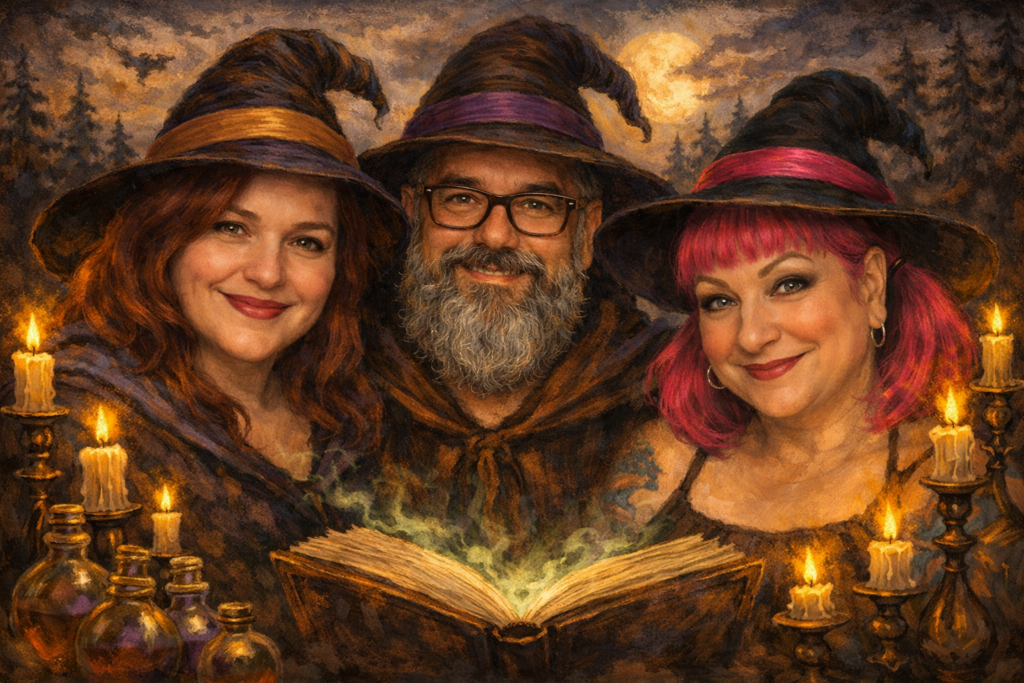
At My Cousin’s Coven, we use the word witch deliberately.
We are not using it only as an aesthetic, historical curiosity, or metaphor for independence. We practice witchcraft, and the identity carries meaning because of that practice.
At the same time, we recognize that the name has accumulated far more than one definition.
When we call ourselves witches, we inherit pieces of history, folklore, accusation, religious conflict, magical practice, modern Paganism, popular culture, rebellion, community, and personal experience.
We do not inherit all of those pieces equally.
We choose what we do with them.
That is one of the fundamental differences between being described as a witch and claiming Witch for yourself.
To see how MCC describes our own practice, coven, and community, visit About Us.
Once witches begin telling our own stories, the old figure can become something more than an accusation, stereotype, or character. It can become a mirror. The healer, seer, hedge-crosser, ritualist, protector, outsider, green witch, coven witch, or keeper of strange knowledge may reflect qualities a modern practitioner already recognizes in themselves.
That recognition is personal, and it does not happen in the same order for everyone. Some people are drawn to the image of the witch long before they begin practicing. Others practice magic for years before deciding that the word witch fits. Some never choose the identity at all, even when their practices overlap with what others would call witchcraft.
For those who do claim the name, identity and practice can gradually grow together. The stories do not dictate who we are, but they can give shape to something we were already beginning to recognize. Sometimes we encounter a witch in lore and realize that the figure feels less like a stranger than expected.
Seeing Ourselves in the Witch
For a modern practitioner, witch can describe what someone does, who someone understands themselves to be, or both.
Not everyone who practices magic chooses the identity. A folk practitioner, ceremonial magician, Pagan, diviner, healer, astrologer, spirit worker, or household practitioner may use entirely different language for their work. That choice deserves to be respected.
For others, however, witch becomes more than a description of particular techniques. The word can gather together practice, spirituality, community, worldview, aesthetics, values, experience, and a sense of belonging.
That is where lore becomes unexpectedly personal.
The figures passed down through story are not instructions for what a witch must become, but they can offer recognizable patterns. We may see something of ourselves in the person who tends the hearth, crosses the hedge, reads what others overlook, protects what matters, works deliberately with ritual, maintains relationship with land, or finds power in community.
These are not official categories.
They are mirrors, not boxes.
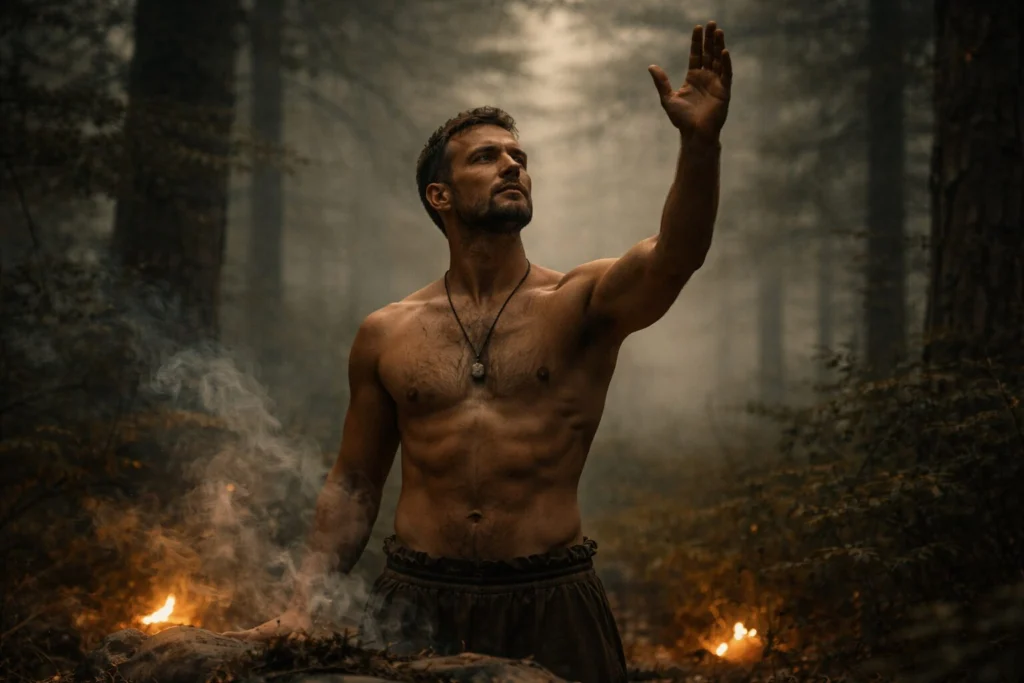
The patterns below are intentionally broad. A person may recognize several, move among them over time, or recognize none at all. They are not traditions, degrees, or claims of special ability.
They are simply some of the ways the old figure of the witch still reflects back into modern practice.
The Hearth Witch
You recognize magic in the home: food, fire, hospitality, household protection, family customs, everyday ritual, and the work of making a place feel inhabited and cared for. The hearth witch reminds us that magic does not have to happen somewhere exotic. Sometimes the center of the magical world is the room you are already standing in.
The Hedge Witch
You are drawn to edges: between cultivated and wild, ordinary and magical, waking and dream, solitary practice and the unseen world. The hedge is both boundary and crossing place. This mirror often appeals to practitioners who value independence, spirit relationship, liminality, and work that happens slightly beyond ordinary social expectations.
The Seer
You keep returning to questions of perception. Divination, omen, dream, scrying, intuition, pattern, and the disciplined attempt to notice what is not immediately obvious may form an important part of your practice. The seer is not someone who must know everything. The deeper skill may be learning how to look carefully.
The Protector
You are drawn toward boundaries, cleansing, warding, protection, uncrossing, defensive magic, and safeguarding people or places under your care. In lore, the same witch feared for knowing how harm works may also be the person sought to stop it. The protector recognizes that understanding danger can be part of learning how to resist it.
The Threshold Witch
You are fascinated by beginnings, endings, crossings, initiation, death, transformation, altered states, spirit, and the places where one condition becomes another. The threshold witch does not necessarily live outside ordinary life. Rather, they become attentive to the moments when ordinary life opens into something less certain.
The Green Witch
Plant life, seasons, gardens, weather, land, herbal knowledge, ecological relationship, and the intelligence of the more-than-human world continually draw your attention. The green witch may work practically, spiritually, magically, or through some combination of all three.
The Ritualist
Structure gives your magic shape. Timing, tools, gesture, words, correspondences, sacred space, repetition, ceremonial form, and deliberate preparation help you build a working rather than merely hope for one. The ritualist recognizes that imagination can be powerful precisely because it is given architecture.
The Story-Keeper
Myth, folklore, ancestry, local story, old books, oral tradition, symbols, songs, and the accumulated memory of magical culture matter to you. The story-keeper does not need to treat every old tale as literal history. Their work is to notice what survives in the telling and decide what deserves to be remembered.
The Shadow Worker
You are willing to look at material that is uncomfortable: fear, anger, grief, desire, shame, power, harmful behavior, taboo, and the parts of ourselves that spiritual language can sometimes make too easy to avoid. This mirror is not about cultivating darkness for its own sake. It is about refusing to mistake avoidance for healing.
The Coven Witch
Your practice gains meaning through relationship with other practitioners. Shared ritual, initiation, teaching, tradition, responsibility, friendship, disagreement, celebration, and collective magical work become part of what witchcraft means. The coven witch reminds us that the witch of lore may often be solitary, but living witchcraft has also always found ways to create community.
None of these mirrors determines what someone is.
A hearth witch may also be a ritualist. A seer may practice protective magic. A green witch may belong to a coven. Someone who works mainly through ceremonial structures may still feel deeply connected to folklore, spirits, or the land.
Real people resist neat categories.
That is partly why the witch remains such a useful identity. It has enough history to carry weight and enough openness to continue changing.
For some practitioners, saying “I practice witchcraft” is sufficient.
For others, saying “I am a witch” carries something additional: a declaration of relationship with the practice, with a community or tradition, with an inherited cultural figure, or simply with a name that finally describes something they have been trying to understand.
Neither form needs to invalidate the other.
The name survived the accusation.
Some of us chose it anyway.
Encountering the Myth
Witch lore becomes less interesting when every story is forced into only two categories: literal fact or meaningless invention.
Myth and folklore do something different.
A story can preserve memory, exaggerate a fear, encode a social boundary, give shape to an experience, warn against danger, express desire, or carry an image forward long after the circumstances that first produced it have disappeared. None of that requires us to mistake the story for a historical transcript.
This is particularly important with witches.
We do not have to prove that a woman physically flew over the village in order to ask why flight became such a persistent part of witch lore. We do not need to believe that every forest cottage belonged to a magical practitioner to notice how often the witch is placed beyond the limits of ordinary settlement. And an enchanted transformation may be impossible as literal biology while remaining enormously powerful as a story about identity, danger, freedom, aging, sexuality, or change.
The question becomes larger than simply:
“Did this happen exactly as the story says?”
Sometimes the better question is why the story needed the witch at all.
Those questions allow us to take lore seriously without becoming careless about history.
At MCC, we are comfortable allowing myth to remain myth. Something does not need to be a literal report to possess spiritual, cultural, psychological, or magical significance. Likewise, treating a story symbolically does not require us to assume that every unusual experience behind it was imaginary.
There is room between credulity and dismissal.
That middle ground is particularly useful for witchcraft because so much of our inherited imagery lives there. Lore can contain distorted history, genuine practice, social anxiety, religious polemic, imagination, visionary experience, entertainment, and symbolism at the same time.
Part of learning to encounter myth is learning not to demand that it become only one of those things.
Witch lore sits at the intersection of history, folklore, religion, gender, magical practice, persecution, literature, and modern identity. No single source can explain all of it.
The selections below are not intended as an exhaustive bibliography. They are starting points for readers who want to look beyond popular claims and explore how historians and scholars have approached the witch, witchcraft accusations, everyday magic, cultural representation, and the emergence of modern self-identified witches.
Where possible, links lead to university presses, academic publications, or archival collections rather than secondary summaries.
Good Places to Begin
A broad scholarly examination of how the feared witch developed across cultures and periods, with particular attention to the European witch figure and the history of witchcraft belief.
A wide-ranging scholarly history of witchcraft and magic, useful for separating changing magical practices from changing cultural ideas about witches.
Witch Trials, Demonology & the Historical Record
A collection of historical scholarship examining accusations, witch hunting, social conditions, stereotypes, state power, and regional differences across early modern Europe.
Digitized historical books, manuscripts, trial material, demonological works, illustrations, and other sources related to witchcraft and persecution. Particularly useful for seeing what historical sources actually say rather than relying only on later summaries.
A focused study of one of witch lore’s most persistent images: the witches’ sabbath, and the ways scholars, occultists, literature, film, and television have continued to reinterpret it.
Folk Magic, Cunning Practice & Everyday Magic
Examines popular magical practices including protection, healing, charms, cunning-folk, astrology, amulets, grimoires, and other forms of everyday magic that existed alongside fear of witches.
Explores the continuing belief in harmful magic, witchcraft, counter-magic, and magical protection into comparatively recent British history, complicating the idea that such beliefs simply disappeared with the witch trials.
Gender, Men & the Witch
A book devoted specifically to men accused as witches and to the ways gender has shaped both historical accusations and later scholarly interpretations of witchcraft.
Useful for examining gender in witch accusations while also showing why the relationship among women, men, magical specialists, and witchcraft cannot be reduced to a single universal pattern.
Modern Witchcraft & Witch Identity
A major scholarly history of modern Pagan witchcraft, examining the cultural, occult, literary, ritual, and religious currents from which modern Wicca and related witch identities developed.
A concise academic treatment of modern people and traditions that consciously identify with the witch, including the changing meanings attached to the words witch and witchcraft.
Lore, Imagery & Cultural Representation
Particularly useful for tracing how magical beliefs, persecution, ritual practice, illustration, folklore, and later cultural representations developed alongside one another.
A useful example of how historians, journalists, antiquarians, writers, and other cultural storytellers can reshape the memory of historical witchcraft and magic long after the original events.
Included again here because it directly bridges historical witch imagery with modern occultism, literature, film, television, and continuing cultural reinvention.
The Witch Remains
After everything that has been said about the witch, the figure remains remarkably difficult to contain.
The witch has been made into a criminal, healer, heretic, neighbor, seducer, hag, magician, spirit-worker, monster, outsider, comic figure, feminist symbol, horror villain, spiritual identity, fashion image, and practitioner of an actual living craft. Some of those images contradict one another completely, yet they continue to occupy the same cultural space.
Perhaps that is part of why the witch survives.
The figure can hold what a culture is uncertain about. Forbidden knowledge, uncontrolled power, aging, sexuality, illness, death, wilderness, intuition, outsiders, religious difference, spirits, anger, independence, and the possibility that ordinary explanations are not always sufficient have all found their way into witch lore. At other times, the witch carries hope: healing when ordinary remedies fail, protection when institutions offer none, knowledge when answers are hidden, transformation when circumstances seem fixed, and the possibility of power for people who otherwise possess very little.
Stories rarely preserve those tensions neatly. They exaggerate them.
The frightening witch may contain echoes of genuine magical practice mixed with prejudice, theology, rumor, fantasy, and social conflict. The benevolent witch can be romanticized just as easily, polished into a harmless healer who bears little resemblance to the morally complicated magical practitioners who actually appear across history and tradition.
Neither simplification serves us especially well.
What remains more interesting is the contradiction we have followed throughout this page: the witch is repeatedly imagined as dangerous enough to fear and useful enough to seek. The person at the edge of acceptable knowledge may be distrusted precisely because they are believed capable of doing something others cannot.
That pattern persists because the questions underneath it persist.
Human beings still face uncertainty. We still grieve, desire, fear, become ill, search for meaning, encounter coincidence, experience things we cannot immediately explain, wonder about death, seek protection, and attempt to influence futures that are never entirely under our control. The cultural forms change, but the impulse to approach the uncertain has not disappeared.
For MCC, that is where the old stories become especially interesting.
We do not need to imagine one uninterrupted secret witch religion stretching intact across thousands of years. History does not support so simple a story, and the people of the past deserve to be understood within their own cultures rather than automatically renamed as versions of us.
But neither do we think modern witchcraft appeared from an empty landscape.
Magic, divination, household practice, ritual, charms, spirit relations, healing, harmful workings, sacred relationship, altered states, astrology, folk belief, and the effort to engage with unseen or uncertain forces all long predate the modern reclamation of the word witch. The traditions change. The explanations change. The social position of the practitioner changes.
The current keeps finding new forms.
Modern witches inherit that older magical landscape alongside something else: the enormous body of stories created about the witch.
We can examine those stories critically without abandoning them. We can recognize persecution without turning every victim into a secret practitioner. We can enjoy fairy tales without mistaking them for history. We can reclaim the hat without claiming that our ancestors all wore one. We can recognize genuine darkness within magical lore without accepting the idea that witchcraft itself belongs naturally to evil.
And we can choose the name consciously.
To call oneself a witch today may mean practice, identity, tradition, community, spiritual orientation, or several of those things woven together. It does not mean accepting every definition other people have attached to the word. In some ways, claiming the identity is precisely the opposite: it is participating in the continuing argument over what the witch means.
That does not erase the old witch.
The figure in the forest is still there. So is the neighbor with the charm, the accused woman before the court, the learned magician given another title, the frightening hag, the witch on the television screen, the person quietly practicing at home, and the modern coven gathering deliberately under the same name.
They are not all the same person.
But they have become part of the same inheritance.
We are not every witch they imagined, but neither are we entirely unrelated to the figure that kept returning. We inherited the name, some of the practices, many of the symbols, and an extraordinary collection of stories about what might happen when someone steps beyond the boundaries of ordinary knowledge.
What we do with that inheritance belongs to us.
And perhaps that is why the witch remains: not because the story has ever been settled, but because it still has somewhere to go.
Where the Story Continues
The lore of the witch opens into many different paths: practice, tradition, folklore, myth, research, and the living communities that continue to reshape what the word means. Choose the direction that interests you, or reach out to MCC if your question has become personal.