Mystical & Ecstatic Paths
Magic through personal experience, energy work, and inner vision.

Within the landscape of witchcraft, some traditions are organized around lineage, liturgy, and formal transmission. Others are organized around states of consciousness. The mystical and ecstatic paths belong to the latter category. They are defined not by institutional structure but by method: practices designed to alter perception in sustained and intentional ways so that the sacred may be encountered directly.
If initiatory traditions resemble architectural systems — temples built to preserve ritual language — mystical practice is ecological. It operates through the body, the nervous system, and the subtle capacities of attention. Altered states are not incidental to the work; they are its primary terrain. Breath, rhythm, posture, sound, and sensory modulation function as technologies through which consciousness becomes permeable. The practitioner does not merely perform ritual; they enter it.
In these paths, gnosis is experiential. Knowledge arises through trance, vision, and embodied presence rather than through hierarchical instruction alone. This orientation places mystical witchcraft in dialogue with broader traditions explored under Mysticism and the study of altered states within Psychology. Yet the goal is not abstraction. The work remains rooted in lived magical practice: spirit contact, land relationship, animistic perception, and the cultivation of energy as a tangible current moving through the body.
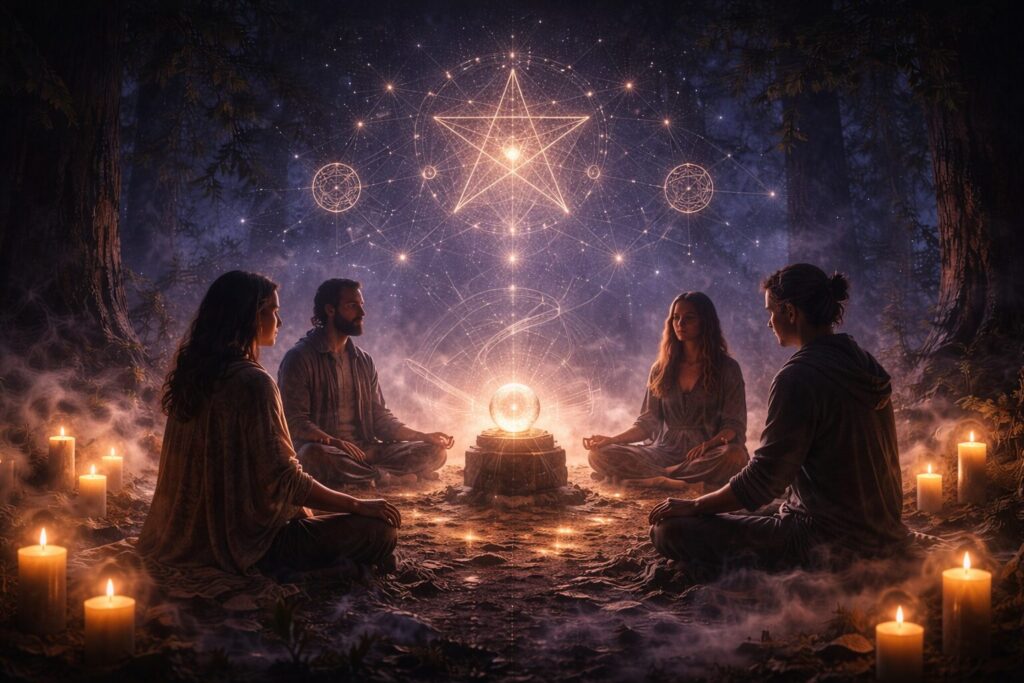
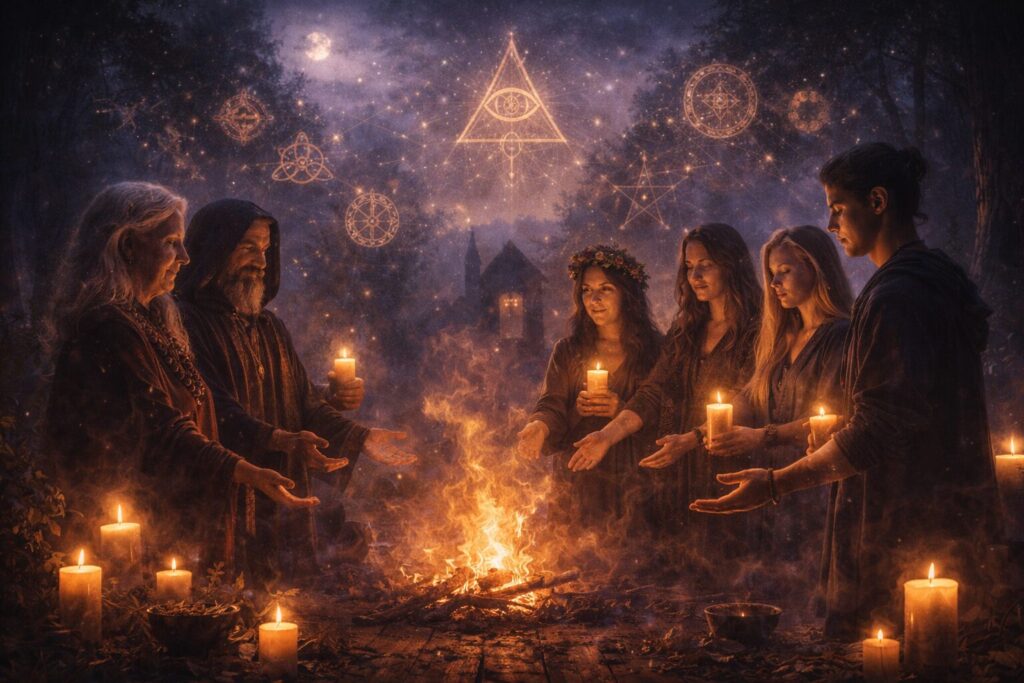
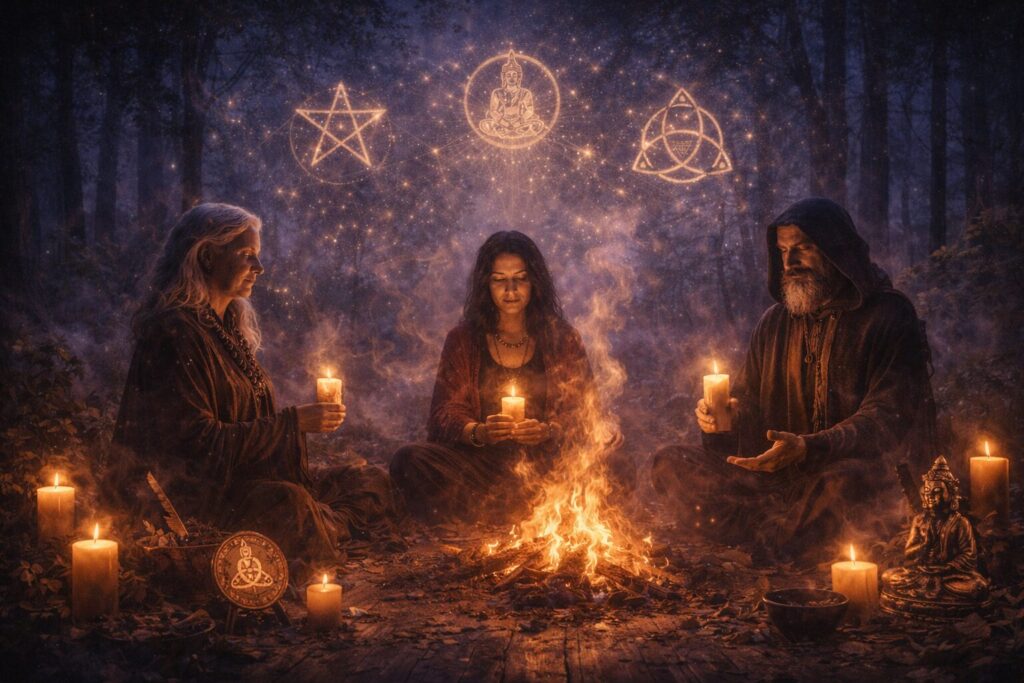
Practices such as drumming, trance dance, breathwork, and sensory narrowing are best understood as cognitive disciplines. They narrow ordinary perception in order to widen inner perception. In a candlelit room, in rhythmic movement, or in the quiet suspension between breaths, the boundary between self and world becomes negotiable. It is within this negotiable space that witches speak of meeting spirit, walking the hedge, or dissolving briefly into ecstatic awareness. These descriptions are not metaphors for emotional intensity; they are reports of altered modes of perception treated as spiritually meaningful realities.

Mystical paths are often contrasted with formal liturgical systems, but the distinction is methodological rather than oppositional. Where initiatory witchcraft emphasizes continuity through structure, ecstatic traditions emphasize continuity through practice. Discipline remains essential. The absence of rigid hierarchy does not imply formlessness; it implies that responsibility is internalized. Ethics emerge through relationship — to land, to body, to community, and to the psychological terrain examined in Psychology. This grounded orientation separates mature ecstatic practice from the aesthetic spirituality critiqued in discussions of New Age belief. The aim is transformation, not sensation.
Although expressed through witchcraft, ecstatic technique is not unique to it. Devotional trance appears in Sufi ritual, Christian visionary mysticism, Dionysian rites, and numerous indigenous spirit-flight traditions. Recognizing this continuity situates mystical witchcraft within a cross-cultural human technology: a recurrent method by which societies cultivate contact with what they understand as spirit, deity, or underlying reality. Witchcraft participates in this lineage while shaping it through its own cosmology — particularly its animistic and land-centered worldview (see Animism).
To walk a mystical path is to treat consciousness itself as ritual ground. Experience becomes curriculum. Vision, trance, and ecstatic encounter are not ends in themselves but instruments that refine perception and ethical orientation. The work demands surrender and discernment in equal measure: the willingness to cross thresholds, and the discipline to return carrying meaning rather than fragmentation. Properly held, ecstatic practice does not remove the practitioner from the world. It deepens their participation in it.
For those drawn to these currents, the invitation is not spectacle but attention. Mystical witchcraft begins in the decision to enter altered presence deliberately, to train the senses until perception itself becomes a gateway. What follows is not escape, but encounter — a spiral of departure and return through which the practitioner gradually learns to inhabit the sacred as a lived condition rather than a distant idea.
Altered consciousness as magical method
Mystical and ecstatic paths operate through deliberate changes in consciousness. These changes are neither accidents nor theatrics; they are cultivated states in which perception is reorganized so that normally background aspects of experience move into the foreground. The witch does not abandon awareness in ecstasy. They refine it.
From a physiological perspective, trance techniques act on breath, rhythm, and attention. Repetitive sound entrains neural patterns. Controlled breathing alters the balance of oxygen and carbon dioxide, shifting the nervous system toward states associated with absorption and focused dissociation. Movement, especially rhythmic swaying or dance, reorganizes proprioception — the body’s sense of itself in space — loosening the rigid boundary between inner sensation and outer environment. These are measurable effects. They are also, in mystical practice, interpreted as openings through which spirit becomes perceptible.
What matters is not the mechanism alone but the meaning assigned to it. In mystical witchcraft, altered states are not treated as neurological curiosities. They are treated as interfaces. The practitioner understands the body as instrument and threshold simultaneously: a biological system capable of entering patterns of awareness that allow contact with realities experienced as autonomous, relational, and spiritually significant. Whether one describes these encounters as spirits, archetypal intelligences, ancestors, or dimensions of consciousness, the experiential claim remains consistent — something is met that exceeds ordinary ego structure.
Breath, sound, and movement therefore function as ritual grammar. They are repeatable methods that allow practitioners to enter similar states across time. Like circle casting in initiatory traditions, trance induction is a structure — one that stabilizes experience so that ecstasy becomes navigable rather than chaotic. Skilled practitioners learn to modulate depth: to approach altered presence gradually, to remain partially anchored, and to return intentionally. The return is as important as the entry. Without integration, ecstasy fragments. With integration, it instructs.

This balance between surrender and control defines mature ecstatic practice. The witch yields to the state while maintaining a witnessing faculty — an observing awareness that records, interprets, and later reflects. In this sense, mystical work is disciplined. It demands training in attention comparable to meditation or contemplative prayer. Over time, practitioners report not only visionary encounters but lasting shifts in perception: increased sensitivity to symbolic meaning, heightened empathy, and a felt continuity between psyche, body, land, and spirit.
Importantly, mystical traditions distinguish between experience and authority. A powerful vision is not automatically a command. Discernment remains central. Practitioners test their encounters against ethical frameworks, community dialogue, and psychological insight. This is where mystical witchcraft intersects with reflective traditions explored in Psychology: altered states are honored without surrendering critical awareness. The aim is not belief without examination, but experience refined through practice.
Seen this way, ecstasy is not an escape from reality. It is a disciplined expansion of it. The practitioner enters altered presence to gather insight, healing, or relational knowledge, and then returns carrying that insight back into ordinary life. The mystical path is therefore cyclical: descent, encounter, integration, return. Each cycle strengthens the capacity to move between worlds without losing coherence in either.
How Ecstasy Works
Altered consciousness as magical method.
Altered consciousness as magical method
Mystical and ecstatic paths operate through deliberate changes in consciousness. These changes are neither accidents nor theatrics; they are cultivated states in which perception is reorganized so that normally background aspects of experience move into the foreground. The witch does not abandon awareness in ecstasy. They refine it.
From a physiological perspective, trance techniques act on breath, rhythm, and attention. Repetitive sound entrains neural patterns. Controlled breathing alters the balance of oxygen and carbon dioxide, shifting the nervous system toward states associated with absorption and focused dissociation. Movement, especially rhythmic swaying or dance, reorganizes proprioception — the body’s sense of itself in space — loosening the rigid boundary between inner sensation and outer environment.
What matters is not the mechanism alone but the meaning assigned to it. In mystical witchcraft, altered states are treated as interfaces. This overlaps with broader reflections on mysticism and the study of consciousness on our psychology page, while remaining rooted in lived craft.
Breath, sound, and movement therefore function as ritual grammar. They are repeatable methods that allow practitioners to enter similar states across time. Skilled practitioners learn to modulate depth: to approach altered presence gradually, to remain partially anchored, and to return intentionally.
Discernment remains central. A powerful vision is not automatically a command. Practitioners test encounters against ethical frameworks, community dialogue, and psychological insight — a distinction that also helps separate grounded practice from “vibes-only” spirituality discussed under New Age belief.
Seen this way, ecstasy is not an escape from reality. It is a disciplined expansion of it — and the return matters as much as the entry.
MCC note: ecstatic ≠ chaoticCore Principles of Mystical Practice
The architecture beneath ecstatic work.
Gnosis & Vision
Direct experience becomes knowledge. Insight arises through trance, dream, and visionary perception—then is interpreted through symbolic literacy and reflective practice, often alongside divination.
Energy as Current
Energy is approached experientially—as warmth, pressure, vibration, or flow. Breath, posture, and attention cultivate sensitivity and allow the current to be raised, shaped, and grounded (see Embrace the Magic).
Body as Temple
Ecstasy is embodied, not abstract. Trance is reached by entering the body more fully—heartbeat, breath, sensation—treating matter itself as sacred and relational, as in animism & sacred ecology.
Spirit Contact
Encounters are treated as relationships, not curiosities. Many practitioners frame this through Embrace the Magic—and through the strange edges explored in Ghosts.
Liminal Technique
Threshold states are cultivated deliberately—darkness, rhythm, repetition, sensory narrowing. This often overlaps with inner work like shadow work.
Deity Encounter
Mystical practice often includes meeting gods as presences—through devotion, trance, and relationship. See Paganism and Finding Gods.
Astral & Spirit-Flight
Some traditions treat journeying as a learnable skill: controlled trance, navigation, return, and integration. For a focused entry point, see Astral Projection.
Integration & Ethics
Return is part of the ritual. Grounding, reflection, consent, and discernment ensure ecstasy deepens life rather than fragments it (see our ethics and about us).
Traditions & Expressions
Major currents within mystical and ecstatic witchcraft.
Reclaiming Tradition
The Reclaiming Tradition emerged in the late twentieth century as a synthesis of witchcraft, political consciousness, and ecstatic ritual. Associated most visibly with the work of Starhawk, it blends elements of Wiccan liturgy with feminist spirituality, land activism, and collective trance work. Hierarchy is deliberately minimized. Authority circulates through the group rather than resting in fixed leadership.
Ecstasy in Reclaiming is communal. Energy is raised through chant, rhythm, and synchronized movement — bodies moving together until individual boundaries soften and a shared field of awareness forms. Ritual becomes both magical act and social statement: transformation of the self is inseparable from transformation of the world. Many workings explicitly address ecological healing, social justice, or communal resilience.
Tools tend to be temporary and situational: banners painted for a single rite, drums carried into protest, talismans woven from branches or cloth rather than preserved as permanent temple objects. This impermanence reflects a philosophy in which magic is lived in time rather than stored in artifacts. Reclaiming therefore occupies a liminal position — fully witchcraft in its ritual language, yet openly adjacent to activist spirituality and community mysticism.
• The Spiral Dance — Starhawk
• Dreaming the Dark — Starhawk

Feri Tradition
The Feri Tradition, shaped through the teachings of Victor Anderson and Cora Anderson, is often described as both sensual and spiritually intense. It centers direct experience over rigid dogma and treats the cultivation of “Feri power” as a disciplined art: a raw, embodied awareness of divine presence felt through breath, gaze, and energetic current.
Where some Wicca-leaning systems emphasize a clear polarity dyad, Feri cosmology is often more fluid and multi-layered. Many practitioners approach deity as intimate, ecstatic, and psychologically transformative at once—devotional without being confined to a single binary. In MCC terms, Feri is a vivid example of mystical practice as interface: the body becomes the threshold through which spirit and psyche meet.
Methodologically, Feri trains perception. Practitioners work with energy as a living current: breathing it in, shaping it with the hands, and directing it through attention. Trance here is frequently quiet rather than theatrical—an intensification of presence reached through stillness, chanting, erotic vitality, or the focused “brightening” of awareness. As with any ecstatic technique, the mark of maturity is not intensity but integration: the ability to return grounded, coherent, and ethically aligned.
Two symbolic systems often associated with Feri training are the Iron Pentacle and the Pearl Pentacle, used as meditative maps for spiritual development. Rather than functioning as abstract doctrine, these symbols operate as experiential prompts—ways of refining self-knowledge, ethical orientation, and energetic coherence through repeated practice.
• Anderson-lineage introductions & anthologies (choose edition/publisher)
• Practitioner guides discussing the Iron/ Pearl Pentacle (choose edition/publisher)

Visionary Witchcraft (Witchcraft-Adjacent)
Alongside named modern traditions runs a wider current that is less a “school” than a recurring human method: visionary practice aimed at spirit contact through trance, dream, and intentional journey. In European folklore this appears as night-flight, otherworld travel, and encounters with ambiguous spirit beings—what later narratives sometimes flattened into sensationalized “sabbath” imagery. Read with care, these accounts can also be approached as records of altered-state practice embedded in cultural memory.
In contemporary witchcraft, “visionary witchcraft” often refers to practitioners who treat trance journeying as central rather than occasional. The work may include dream incubation, guided spirit-flight, ancestor encounter, or contact with land intelligences. The point is not performance but perception: methods that shift consciousness so that the practitioner can gather information, healing, or instruction, then return to integrate it into ordinary life. This emphasis on return and meaning-making aligns with MCC’s broader approach to mysticism as lived encounter rather than aesthetic posture.
Because visionary practice exists across cultures—including many indigenous and initiatory contexts—MCC treats this domain as adjacent rather than proprietary. Contemporary witches may participate in trance and journey methods, but should do so with intellectual humility and ethical clarity: avoiding the collapse of indigenous traditions into generic “shamanism,” and recognizing that similar techniques can arise independently across human societies. When this page discusses visionary practice, it refers to modern witchcraft expressions and to scholarly discussion of European visionary lore—not to the ownership of closed cultural rites.
Practically, visionary work relies on the same foundations described earlier: rhythmic induction, breath modulation, sensory narrowing, and disciplined attention. It also requires interpretive literacy. Images and encounters are not self-explanatory; they must be tested through reflection, ethical consequence, and symbolic skill—often alongside tools of divination. This is where visionary practice can blend naturally with hedge work, and where it also touches broader occult and psychological frameworks (see occult and psychology).
• Scholarship on visionary witch-lore and spirit-flight traditions (retailer search link)
• Comparative studies of ecstasy and altered states (retailer search link)
Spirit Plants & Ecstatic Perception
Many mystical traditions understand plants not only as materials but as presences. Certain herbs have long been treated as mediators between worlds — teachers that sharpen perception, deepen dream, or anchor trance in the body. In animistic frameworks, plants are approached as allies: intelligences that participate in ritual and vision rather than passive ingredients. You can explore these relationships more deeply in MCC’s dedicated Herbs & Sacred Plants resource.
Within mystical witchcraft, plant work ranges from subtle to atmospheric. A cup of tea before dreamwork, smoke used to shift atmosphere, or the quiet presence of a growing herb beside an altar can function as thresholds just as effectively as more dramatic methods. The emphasis is relational rather than consumptive: learning how to listen to plant spirits, how to approach them ethically, and how to integrate their influence into daily perception.
Entheogens & Altered States (Adjacency Note)
Across human history, some cultures have used plant medicines and sacramental substances to cultivate visionary states. Because mystical and ecstatic witchcraft is also concerned with altered consciousness, readers sometimes assume that “mystical practice” implies chemical induction. MCC does not treat entheogens as a required (or even primary) method of witchcraft. Most of the techniques described on this page—breath, rhythm, movement, sensory modulation, prayer, trance—are sufficient to produce deep altered states without substances.
Where entheogenic practice appears in contemporary spiritual culture, it belongs in the category of witchcraft-adjacent methods rather than a default witchcraft tradition. It also carries serious legal, medical, and ethical considerations, and is best approached (if at all) within appropriate cultural context and responsible container. In MCC’s framework, the key question is not “how intense was the experience,” but “did it produce clarity, coherence, and ethical transformation over time?”—a discernment lens that connects to our broader reflections on psychology and the critique of ungrounded spiritual consumerism on New Age belief.
MCC stance: not glamorized, not required
Integration & Aftercare
Ecstatic practice is incomplete without return. Altered states can open perception, but their meaning is shaped by how they are integrated into ordinary life. Grounding is not a rejection of mystical experience; it is the act that allows the experience to mature. Rest, nourishment, hydration, journaling, gentle movement, and quiet time in nature are not “mundane”—they are the practical half of the rite.
MCC coven note: in our own practice, we’ve found that certain altered states can support spirit-connection — especially trance through breath, rhythm, stillness, prayer, or sensory narrowing. But we do not treat being “high” as a magical method. In our experience, magic approached with sober intent and focused attention is more reliable, more ethical, and far easier to integrate. Substances are not all the same, and they do not affect the work in the same way — some scatter attention, some distort memory, and some can blur the line between perception and projection. If a method weakens discernment, it weakens the work.
Discernment is equally important. Not every image is prophecy, and not every intensity carries instruction. Mature practitioners evaluate encounters through consequence: does the experience increase clarity, compassion, and coherence over time? If it fragments the self or isolates the practitioner from community, it calls for reflection and recalibration. This reflective discipline connects mystical work directly to psychological frameworks.
Herbal allies and simple closure rites can support the return phase as well — especially gentle plant relationships that steady sleep, soothe the nervous system, and strengthen dream recall. If you’re exploring that path, approach it relationally: as listening and learning, not consumption. Mystical work is sustainable when it deepens life rather than displacing it. The goal is not escape, but expanded participation in the world.
(If a reader feels unmoored, distressed, or unsafe after trance work, MCC’s guidance is simple: pause the work, ground, seek support, and rebuild slowly.)
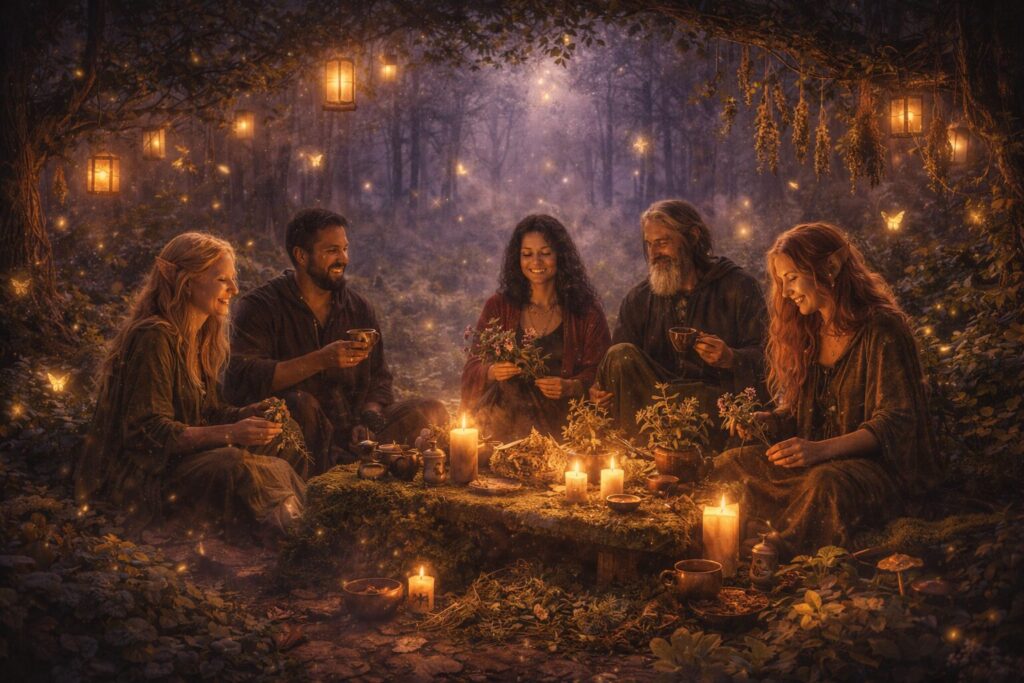
Mystical practice is not a straight line toward transcendence. It is a spiral of approach and return. Each descent into altered presence reshapes perception slightly; each return integrates that reshaping into ordinary life. Over time, the boundary between sacred and mundane grows more permeable. The practitioner does not live in trance, but carries its imprint into waking reality.
What defines the mystical path is not intensity but continuity. The sacred is encountered repeatedly — in breath, rhythm, land, and the quiet shift of attention that reveals depth inside the ordinary. Experience becomes curriculum. The witch learns not to chase spectacle, but to refine perception until meaning becomes audible beneath the noise of the world.
For those called to this current, the work is lifelong. There is no final revelation that ends the journey. There is only the ongoing practice of listening, crossing thresholds carefully, and returning with insight that enriches both self and community. Mystical witchcraft is not an escape from reality. It is a discipline of presence — a commitment to inhabit the sacred as something lived rather than imagined.