On the Gods
Light, Shadow, and the Corridor Between
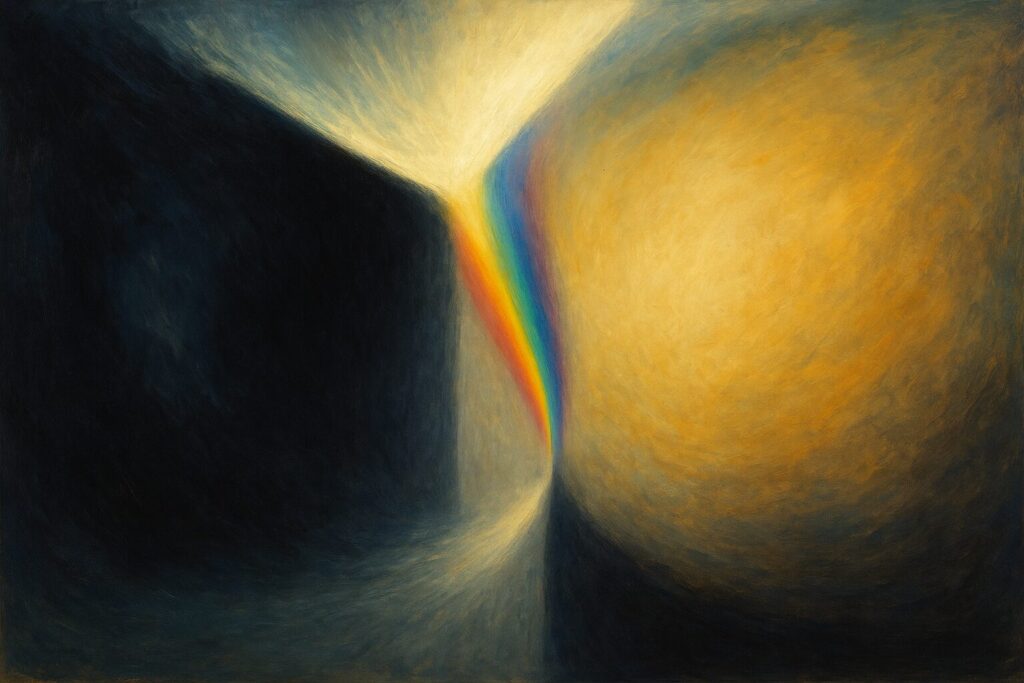
Where creation refracts, consciousness gathers; where consciousness deepens, the gods appear.
Across human history, people have spoken of gods in many ways: as creators, rulers of nature, archetypes of the psyche, or symbols of cultural imagination. The Coven of the Veiled Moon approaches the question differently. For us, the gods are not distant monarchs standing outside the universe, nor projections of the human mind. They are real presences within a living cosmos — intelligences emerging from the deeper structure of creation itself.
Our cosmology begins with the Universal Constant, the generative field from which existence unfolds. When difference first appears within that unity — the tension of light and dark — a threshold forms. In that liminal region the first creative articulation emerges, what we call the Finger of Light. Through this unfolding, patterns of increasing complexity arise, and with sufficient complexity comes consciousness. From that living process emerge many orders of awareness: spirits, ancestors, humans, and among them the beings we call gods.
The gods are therefore neither the ultimate source of existence nor inventions of belief. They are enduring personalities arising near the deeper currents of creation, shaped by the domains through which they move and the relationships they cultivate across the worlds. Some stand close to thresholds of magic and perception, some to wild life, storm, sovereignty, knowledge, fertility, or death. They reveal themselves across cultures, translated through language and myth, yet retaining recognizable character through time.
Because humans share the same originating field of consciousness, contact between these orders of being is possible. Through ritual, devotion, symbol, dream, and disciplined perception, the witch may encounter and learn to recognize these presences. Relationship does not create the gods, but it can deepen the clarity with which they are known.
The reflections that follow explore this living theology: how the cosmos gives rise to divine personalities, how gods differ from spirits and ancestors, and how relationship between human and divine may be approached with discernment, respect, and wonder.
“The gods are not outside the world; they are present throughout it, and the world itself is filled with them.” — Plotinus
The gods honored within the Coven of the Veiled Moon are not presented as a complete pantheon, nor as the only divine beings worthy of reverence. The sacred world is far larger than any list, and the traditions of humanity have named the divine in countless forms. The figures gathered here instead reflect several of the deeper currents of the sacred through which our coven most often encounters the living presence of the divine within the craft and the world.
We speak of them through the familiar names of Gaia, Hekate, Hermes, and Pan because those names carry long histories of myth, devotion, and recognition. Yet what we encounter through them are enduring intelligences within the living fabric of creation — presences that have appeared in many cultures under many names. Through these figures we glimpse great movements within the cosmos itself: the grounding body of the earth, the thresholds between worlds, the roads of mind and communication, and the wild living breath that animates nature.
These powers often appear in complementary relationships, reflecting the polarity through which creation continually unfolds. Not opposing forces, but creative tensions that generate life and change — the dance of stillness and motion, mystery and revelation, wilderness and awareness. Witches have long met such presences at liminal places, where worlds touch and the currents of magic run strongest.
Alongside these stand two great archetypal patterns of sacred time: the Triple Goddess and the Rising God, who reflect the turning of the seasons, the rhythm of death and renewal, and the continual rebirth of vitality within the world.
Within our coven, practice varies. Not all members regularly engage in deity work, invocation, or evocation; many focus primarily on the craft itself — the practice of magic, the cycles of nature, and the cultivation of personal power. Our path is first and foremost witchcraft-oriented, with pagan leanings that include influences from several traditions, including some Ásatrú practitioners among us. Yet when members of the coven do work with gods, these presences are most often the ones encountered and honored — including by Kael and Roen.
Taken together, they form not a closed pantheon but something closer to a map of divine currents within the craft — enduring presences through which witches encounter the sacred within the living cosmos.
The gods are not outside creation, but among its brightest refractions.
These figures represent several of the great currents through which witches most often encounter the sacred within the living cosmos.
Where place awakens reverence and story gives voice to the sacred – gods are encountered.
The gods rarely appear as voices from beyond the world. More often they speak through the patterns already woven into it — through landscapes that stir reverence, through recurring seasons and cycles, and through the myths and symbols that cultures have used for generations to give those experiences meaning. When we learn to notice these patterns, the world itself becomes a kind of language. Place, sacred encounter, and myth are not separate paths, but three ways the same presence reveals itself.
“Myth is the secret opening through which the inexhaustible energies of the cosmos pour into human cultural manifestation.” —Joseph Campbell
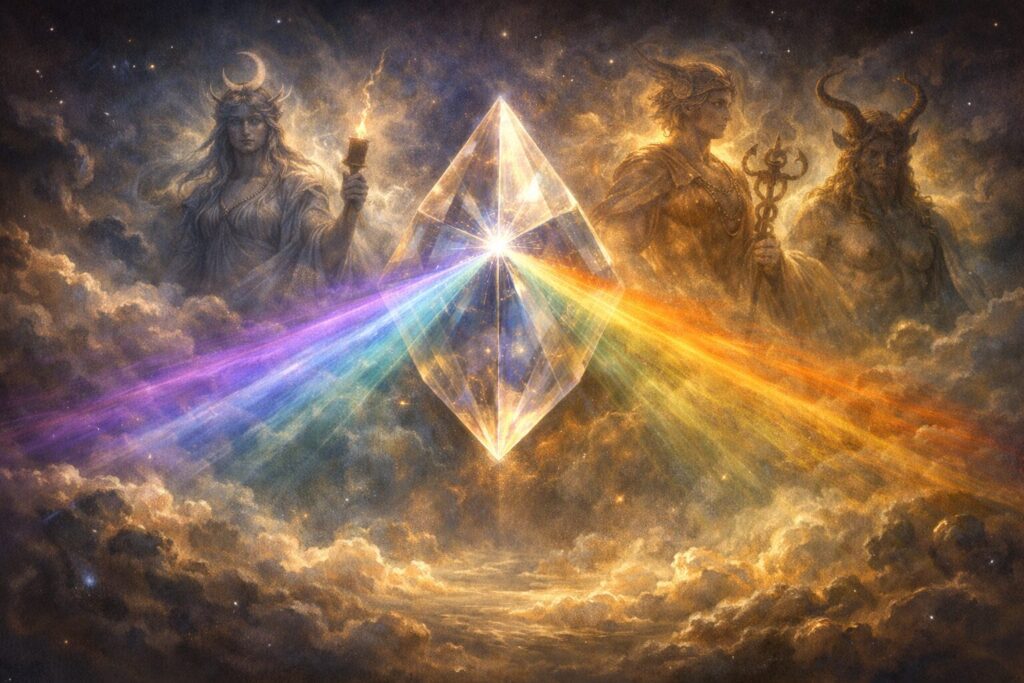
Divinity is not a distant throne, but a living spectrum within the world.
Cosmology — The Prism of Creation
Every spiritual tradition eventually asks the same question: what is the structure of reality itself?
Before gods, spirits, or magic can be understood, one must consider the deeper architecture of existence — the conditions that allow consciousness, matter, and meaning to arise at all.
The Coven of the Veiled Moon describes this structure through the language of threshold, polarity, and refraction. Creation unfolds not from chaos alone, nor from a rigid design, but from a living field of possibility in which difference generates motion and motion generates form. From that unfolding emerge the many layers of existence in which spirit, mind, and world interact.
“The world is not a machine but a living symbol.”
— Owen Barfield
Before stars, before form, before time itself could be measured, there existed what the Coven of the Veiled Moon calls the Universal Constant. This is not a god in the ordinary mythic sense, nor a ruler seated outside the cosmos issuing commands into emptiness. It is the underlying field of reality itself: the deep grammar of existence, the root structure from which matter, spirit, order, motion, and possibility arise.
The Constant contains all potential, yet in its pure state it remains undifferentiated. Creation begins when distinction appears. The coven speaks of this symbolically as the meeting of light and dark. These are not moral enemies, but primordial conditions of contrast. Without difference, nothing can be perceived. Without polarity, nothing can move. Where light and dark encounter one another, a third state emerges: shadow. Shadow gives depth, contour, ambiguity, and threshold. It is the first sign that reality has become textured enough to hold worlds.
From this first threshold flows what we call the Finger of Light: the mediating current through which the Universal Constant begins to express itself within becoming. It is not itself a deity, but a generative ray — the active movement through which unity opens into multiplicity. If the Constant is pure source, then the Finger of Light is the first articulation of source into cosmos.
When this current passes through the threshold, it does not remain singular. It refracts. Much like light through crystal, it divides into frequencies. These frequencies are not merely symbolic colors, but modes of pattern, direction, force, and becoming. From frequency emerge dimensions; within dimensions, energy gathers into increasingly stable forms; and where form grows sufficiently complex, it begins to interact with the field of consciousness itself.
At that point, spirit appears. In our theology, spirit is not something dropped into matter from elsewhere, but the emergence of aware relationality within patterned existence. When information becomes responsive, gathered, and self-expressive, consciousness comes forward more actively. This allows the universe to become populated by many orders of intelligence: divine beings, spirits of place, ancestral presences, elemental currents, and embodied living minds.
Some concentrations of awareness arise close to the primal threshold itself. These immense and enduring presences are what human traditions often recognize as gods. Others emerge more deeply within layered reality — among land, history, weather, memory, bloodline, instinct, and region. These we encounter as spirits, ancestors, and local intelligences. Reality is therefore neither a dead machine nor a flat symbolic map. It is a living spectrum of beings and powers, all shaped by their relation to source, pattern, and world.
Human beings stand in a particularly strange and potent position within this arrangement. We are embodied enough to be rooted in matter, but conscious enough to perceive beyond immediate material surfaces. Because of this, humans occupy a kind of mediating station between worlds. We can participate in land, symbol, devotion, imagination, ritual, and directed will. We can notice currents and answer them. We can shape relationship consciously. This is one of the foundations of witchcraft.
The Finger of Light therefore remains present in every act of magic. Ritual does not create power from nothing; it focuses power. Intention does not invent the living cosmos; it aligns with its available currents. Symbols, gestures, offerings, prayer, names, and crafted acts work because reality is already structured, responsive, and alive. Magic is the disciplined art of entering that responsiveness without fantasy, domination, or confusion.
Thus the cosmos is best understood not as a machine of inert parts, but as a living prism. Unity continues to shine through every form of existence while refracting into a spectrum of intelligences, relationships, and possibilities. Creation remains one in origin, yet richly many in expression. To practice witchcraft, then, is to learn how to perceive that spectrum, move within it, and respond to it with clarity, reverence, and skill.
Gods, Spirits, and the Living Cosmos
If reality is a living structure rather than a mechanical one, then it naturally gives rise to many forms of intelligence. Human traditions have long described these presences as gods, spirits, ancestors, and powers of place. Though cultures name and understand them differently, they appear again and again wherever human beings encounter the sacred depth of the world.
For the Coven of the Veiled Moon, these presences form a kind of spiritual ecology — a spectrum of consciousness ranging from local spirits and ancestral memory to the vast divine personalities that arise close to the creative threshold itself.
“The gods are not far away. They are the powers through which the world becomes visible.”
— Sallustius
If cosmology explains how creation unfolds, the next theological question is what kinds of beings arise within that unfolding. The Coven of the Veiled Moon understands the universe as a living ecology of consciousness: one radiant source refracted into many orders of intelligence, each shaped by its depth of pattern, its proximity to the primal threshold, and its mode of participation in the worlds it inhabits.
Within this living cosmos, gods, spirits, ancestors, and human souls do not stand as utterly alien categories sealed off from one another. They arise from the same deep font of existence, the same originating field of being, and that shared origin is one reason contact between them is possible at all. Yet shared source does not mean sameness. These are not identical beings, nor are they interchangeable labels for one undifferentiated mass of spirit. They are different orders of consciousness within one living creation.
Because they share origin within the same creative field, these presences may recognize and interact with one another. The unseen worlds are not wholly foreign to human consciousness. They are neighboring dimensions of a common reality. This is why encounter can occur in ritual, dream, symbol, trance, devotion, omen, or sudden insight. Recognition becomes possible not because humans invent the divine, but because consciousness can sometimes perceive what was already there.
In our understanding, the gods are not impersonal forces, nor are they merely metaphors for human psychology. They are real personalities: enduring intelligences with agency, attention, temperament, interests, priorities, and modes of self-expression. Like any long-lived consciousness, they may be stern or generous, patient or quick, protective or dangerous, curious or distant. They are not interchangeable energies but distinct presences whose nature becomes clearer through repeated encounter and disciplined relationship.
This is why the coven speaks of the gods as relational beings rather than static concepts. Relationship with them is not merely symbolic. It is genuinely interpersonal, though not human in scale. Gods possess their own concerns and fields of focus. Some appear strongly concerned with threshold, death, fertility, sovereignty, storm, speech, healing, wildness, law, memory, craft, or fate. Because they are personalities, they must be approached with discernment. One should not ask a war god for maternal nurture, nor assume that a deity of deep crossroads magic will respond in the same way as a household or healing power.
Gods are often curious, though generally not in the same restless manner one sometimes sees among lesser spirits. Spirits often display a more immediate inquisitiveness, while gods tend to move with broader and slower attention, shaped by the scale of the currents they inhabit. Still, many gods appear to value relationship. They are not fed into existence by devotion, but many do seem to seek, welcome, or intensify meaningful reciprocal contact with conscious beings. We are already in relationship because we share a cosmos. Devotion simply makes that relationship more conscious.
At the same time, we do not believe that the gods are identical with the natural phenomena associated with them. The moon itself is not literally a goddess, nor is the storm itself literally a god. Rather, divine personalities move through and influence domains of reality that resonate with their nature. Moon goddesses, for example, may be understood as divine intelligences strongly aligned with lunar patterns: illumination within darkness, hidden knowledge, cycles, magic, reflective power, and the subtle shaping of inner life. The natural phenomenon becomes a gateway, mirror, and field of expression, not the full totality of the being.
Because gods are living intelligences rather than static abstractions, they are not entirely fixed for all time. Their essential character remains recognizable, yet the way they appear in the world may shift across centuries. Gods can develop, change, and reveal themselves differently as cultures, languages, landscapes, and spiritual conditions change. They do not mutate rapidly in the manner of human moods or fashions, but neither are they frozen icons outside history. They are living beings within a living cosmos.
This also means that divine presences may become translated through culture. Human societies do not create the gods, but they do create the symbolic, ritual, linguistic, and mythic forms through which the gods are perceived. What survives in religion is therefore not the god itself in pure naked essence, but the record of encounter: names, epithets, stories, symbols, rites, and devotional patterns through which divine character becomes visible in time.
Over time, repeated encounters between human consciousness and divine presence give rise to stable symbolic patterns. This is one reason archetypal language appears at all. Archetypes do not arise merely because humans invent spiritual projections out of psychological need. Rather, human consciousness recognizes recurring forms through which divine powers reveal themselves in nature, culture, and experience. Pattern-recognition follows encounter. The symbol is the trace left by repeated contact.
Because divine powers are translated through culture, gods may at times appear to overlap or even become confused with one another. Similar domains—storm, fertility, love, wilderness, wisdom, sovereignty, death, sea, moon, crossroads— may generate similar symbolic forms in different civilizations. Over generations, names merge, attributes drift, and distinct beings may be mistaken for one another. Similarity, however, does not always mean identity. Shared symbolism does not erase real difference. Discernment remains necessary.
Religious history shows this complexity clearly. A well-known example appears in the development of the ancient Hebrew storm god who would later become identified as the singular god of Israel. Early strata reveal a regional storm deity sharing traits with neighboring Levantine powers; later traditions elevate that figure into a universal sovereign of dramatically wider scope and different theological character. Even within the textual record, shifts in personality, emphasis, and symbolism can be traced over time. Such changes do not necessarily mean a god has been invented from nothing. Rather, they show the complex interaction between divine presence, human interpretation, and historical circumstance.
The gods are also not equal in scale, intensity, or reach. Some divine beings appear to stand much nearer to the creative threshold itself, while others emerge further outward within the unfolding layers of the cosmos. Their magnitude, range, and force reflect that position. One might imagine this not as a simple ladder, but as something like a dimmer on a lamp: the current remains present, yet the brightness with which it fills a room can vary. When a divine presence shines strongly through a culture, region, or age, its personality may become vivid and historically visible. At other times it may seem dimmer, though not absent.
This does not mean that gods are powered by human belief. The Coven of the Veiled Moon rejects the idea that divine beings somehow depend on worship for their existence or strength. Their vitality derives from their place within the deeper generative structure of reality—how near they stand to the originating currents of creation—not from how many people happen to believe in them. Human attention may sharpen perception, devotion, and relationship, but it does not manufacture divine power.
The familiar example of competing prayers makes this plain. If two armies pray to the same god for opposite outcomes and only one prevails, that does not mean the god’s strength was generated by whichever side believed more intensely. It means that divine agency operates within a far larger web of conditions, relationships, and realities than human petition alone. Attention may affect what humans notice and how clearly they receive, but it is not the battery of the divine.
Devotion still matters, however, because relationship matters. Many gods appear to crave, welcome, or cultivate reciprocal bond with conscious beings. Offerings, prayer, ritual attention, remembrance, and ethical alignment do not feed a god into existence; they help open the channels of recognition between beings who are already participating in a shared cosmos. Devotion is therefore not a power source for the gods, but a mode of entering more consciously into the relationship that already exists.
Beneath the scale of the gods exist many other orders of being: spirits, ancestors, elemental intelligences, land powers, local guardians, and the many consciousnesses that gather around place, memory, object, weather, lineage, pattern, and region. These beings are not unreal or beneath respect. A land spirit may be ancient, a local god may be potent, an ancestor may be wise, and some presences may be dangerous. Category is not the same as value. To say that a spirit is not a god is not to demean it, but to classify the relationship more carefully.
In the wider theology of the coven, many local spirits and nature beings appear to be associated with deeper structural principles woven into the universe itself: patterns of element, place, force, law, and energetic architecture that may one day be explored more fully elsewhere in our teachings. Gods stand within this same living cosmos, but usually at a much larger scale of personality and influence than local or attached spirits.
For the Coven of the Veiled Moon, two deities stand especially near the corridor through which magic, contact, and perception move: Hekate and Hermes. They are not the only powers we honor, but they are the two who most clearly illuminate threshold-work itself. Hekate reveals discernment, liminality, protection, and keys to the hidden crossings. Hermes governs motion, translation, speech, symbol, exchange, and the skill of moving meaning across boundaries without destroying difference.
Yet our devotional world does not end there. We also recognize the wild and ecstatic currents of Pan and the Green Man, as well as the grounding maternal presence of Gaia and many other divine personalities whose forms vary across culture and time. The gods are many, the currents are many, and sacred relationship is never exhausted by a single image.
In this way the gods are neither creators outside the cosmos nor inventions of human imagination, but enduring personalities emerging within the living structure of creation itself.
Sacred Relationship — Devotion, Contact, and Discernment
Knowing that such presences exist is only the beginning. The deeper question is how humans should relate to them.
Throughout history, witches, mystics, priests, and philosophers have developed many ways of approaching the sacred: devotion, invocation, ritual partnership, and contemplative insight. Yet these relationships require care. Not every presence is divine, not every contact is wise, and not every tradition speaks with the same voice.
For the Coven of the Veiled Moon, sacred relationship rests on three foundations: discernment, respect, and reciprocity.
“The divine is not commanded. It is encountered.”
— Iamblichus
If the first question is how the cosmos unfolds, and the second is what kinds of beings arise within it, the third is how human beings ought to relate to those presences. For the Coven of the Veiled Moon, this is where theology becomes practice. Gods, spirits, and sacred powers are not merely ideas to be discussed; they are beings and currents with whom one may enter into relationship. That relationship, however, should never be approached carelessly. The craft requires not only wonder, but reverence, clarity, and discipline.
We do not understand devotion as self-erasure, nor worship as theatrical submission. To honor a deity is not to become intellectually passive or spiritually gullible. Rather, devotion is a cultivated form of relationship: attention given repeatedly, offerings made with intention, symbols carried with meaning, prayers spoken with sincerity, and contact deepened over time through consistency. In this way devotion is less like flattery and more like spiritual literacy. One learns the character, language, moods, and thresholds of a power by returning to it with respect.
This means that not every magical act is devotional, and not every devotional act is magical in the narrow technical sense. A witch can cast successfully without entering deep deity relationship. A person can pray sincerely without seeking operative magic. Yet where devotion and craft do meet well, the result can be profound. Relationship refines perception. Familiarity strengthens discernment. Repeated reverence can open forms of protection, clarity, symbolic fluency, and power that casual contact rarely achieves.
The coven therefore distinguishes carefully between different modes of approach. Invocation is the act of calling a presence inward or near in a participatory, relational way: opening oneself, one’s rite, or one’s space to a divine or spiritual current. Evocation, by contrast, is a more formal act of calling forth a presence to appearance, boundary, or encounter. Neither mode is automatically superior. Each has its own context, risks, tone, and required skills. But both require etiquette, preparation, and a clear sense of whom or what one is engaging.
We reject the fantasy that sacred contact is simply emotional intensity. A powerful feeling is not automatically a god. A strange sign is not automatically a mandate. An evocative dream is not automatically revelation. The witch must learn to test experience: through pattern, repetition, symbolism, outcomes, cross-checking, historical context, and mature self-examination. Discernment is not the enemy of enchantment. It is what makes enchantment survivable, meaningful, and ethically grounded.
This is especially important because contact can occur on many levels. One may be encountering a deity, a spirit of place, an ancestor, an elemental pattern, one’s own subconscious imagery, a symbolic resonance, or a mixture of several at once. Human beings are interpretive creatures. We are capable of genuine contact, but also of projection, wishful thinking, inflation, fear, and spiritual vanity. Serious practice therefore requires the humility to say I do not yet know what this is.
For this reason, the coven places strong emphasis on boundaries, classification, and spiritual manners. Do not assume permission where none has been given. Do not demand intimacy from a power you have not learned to approach. Do not speak as though every symbol belongs equally to everyone. Do not treat gods as costume pieces, aesthetic moods, or collectible archetypes. Relationship deepens through honor, patience, and right approach, not through entitled consumption.
We are also cautious of the modern spiritual habit of saying that all gods are really the same being in different outfits. Although this claim often presents itself as generous or universal, it can become deeply flattening. It blurs cultural identity, erases theological difference, and often turns living traditions into a vague metaphysical paste. We do recognize resemblance, overlap, kinship, and recurring currents across cultures. But resemblance is not sameness, and kinship is not collapse.
This is one reason the coven has strong concerns about Oneism: the tendency to dissolve all distinction into a single spiritually satisfying but ultimately flattening unity. A healthy theology can affirm shared source without denying meaningful differentiation. The prism is not less beautiful because it has many colors. It is beautiful precisely because the one light does not erase the many expressions it gives rise to.
Thus we encourage a way of relating that is both mystical and specific. If one approaches Hekate, let Hekate remain Hekate, rather than a placeholder for “every dark goddess.” If one approaches Hermes, let Hermes remain Hermes, rather than a generic symbol of communication. If one honors Pan, Gaia, ancestors, or spirits of place, let each be encountered through their own patterns, histories, and domains. Specificity is not a limitation of devotion; it is one of its highest forms of respect.
This specificity also protects the practitioner from confusion. Gods, spirits, and cultural forms are not interchangeable tools. Some beings are proper to devotion. Some are proper to offerings. Some are proper to petition. Some are best approached through reverent observation rather than direct contact. Some doors open only through time, and some should remain closed. Right practice is not simply about power, but about fitness of relationship.
In the life of witchcraft, this means that contact should be cultivated with seriousness. Cleanse when needed. Prepare the mind. Learn the symbols. Study the stories. Understand the difference between inspiration and command. Keep records. Notice patterns over time. Let offerings mean something. Let prayer be honest. Let ritual be shaped by both beauty and structure. The sacred is not honored by carelessness masquerading as freedom.
At the same time, relationship with the divine should not become sterile, academic, or bloodless. Gods are not only topics; they are presences. Spirits are not only taxonomies; they are encounters. Ancestors are not only concepts; they are remembered dead with ongoing relational significance. The goal is not a cold distance, but a living balance of awe and steadiness: enough openness to be moved, enough discipline not to be fooled, enough devotion to listen, and enough self-possession not to disappear into fantasy.
For the Coven of the Veiled Moon, sacred relationship is therefore neither blind surrender nor proud command. It is reciprocal, discerning, and ethically formed contact. Humans come neither as masters of the unseen nor as helpless spectators before it. We come as participants: embodied minds capable of reverence, skill, caution, symbol, and response.
This is the heart of the matter. The gods are not ornaments to add drama to a ritual life already centered elsewhere. Spirits are not vague atmosphere. The living cosmos invites relationship, but relationship must be rightly made. Where such contact is genuine, tested, and well-tended, it can transform perception, deepen magic, strengthen ethics, and bring the practitioner into a more mature participation with the sacred world.
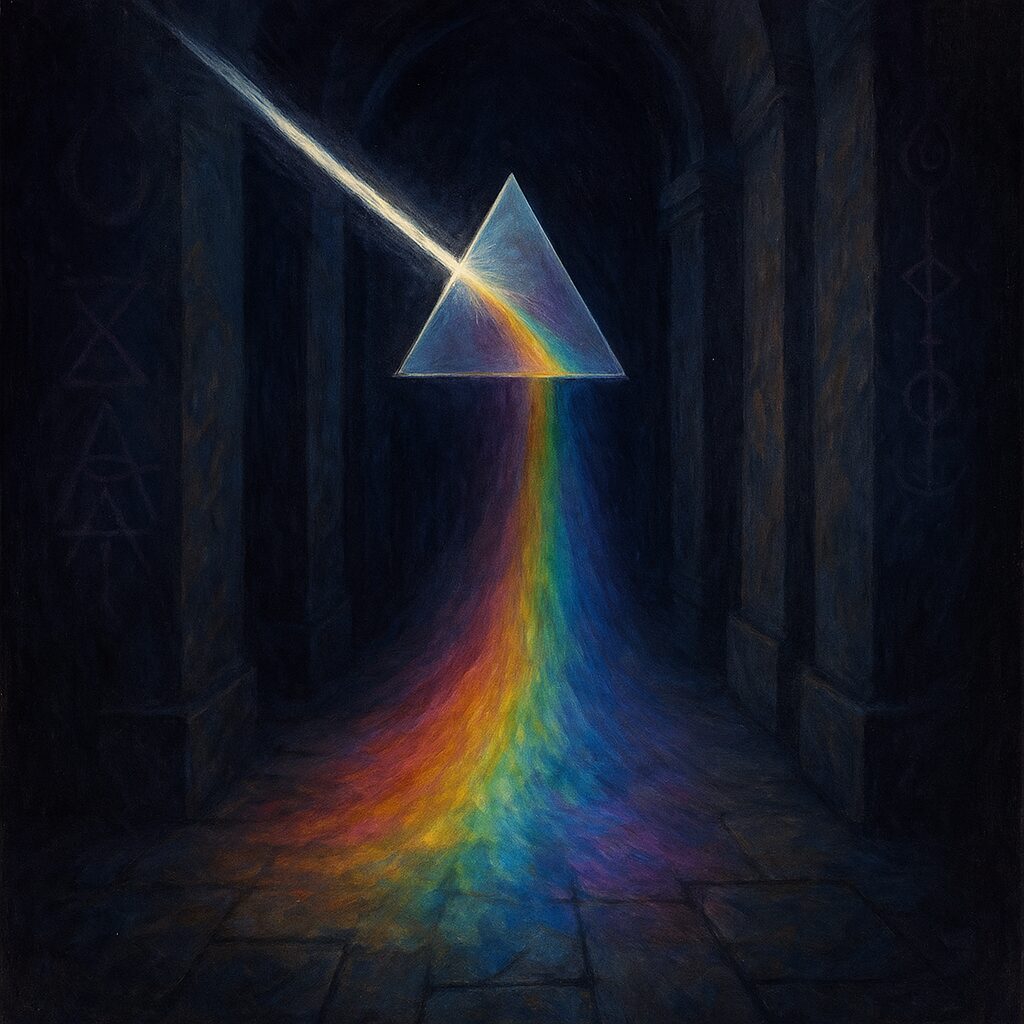
The world described here is not a universe emptied of wonder nor one ruled by distant and unreachable powers. It is a living cosmos in which consciousness unfolds in many forms, each shaped by its place within the great architecture of creation. Gods, spirits, ancestors, and human beings all arise from the same originating field, yet each occupies a different role within that unfolding pattern.
To recognize the gods, then, is not to abandon reason or surrender human responsibility. It is simply to acknowledge that intelligence and agency do not end at the boundaries of the human mind. The universe is richer, more populated, and more relational than modern habits of thought sometimes allow us to imagine.
For the witch, this recognition invites both humility and curiosity. Not every presence encountered is divine. Not every mystery must be solved immediately. Discernment, patience, and ethical relationship remain essential companions to devotion. The practice of witchcraft is not the domination of unseen powers but the art of learning how to stand within the living currents of creation with awareness and respect.
Some witches walk this path through quiet inner attunement alone. Others form deeper devotional relationships with particular gods. Neither path invalidates the other. Magic can flow through many channels, yet when a genuine relationship with the divine is formed, the work often becomes clearer, steadier, and more luminous.
The gods do not need our belief in order to exist. They were present before our words for them, and they will remain long after our languages change. Yet when humans learn to notice them — through symbol, ritual, dream, and attentive living — the world itself begins to reveal a deeper texture.
Creation becomes less like an empty machine and more like a great prism of living intelligence.
Within that spectrum the gods continue to move, speak, and reveal themselves to those willing to listen.
“The whole world is full of gods.” — Marsilio Ficino
Lexicon of the Living Cosmos
This glossary gathers the key terms used throughout the Gods page and reflects the theological language of the Coven of the Veiled Moon. It is meant as a guide to the page’s cosmology, divine relationship, liminality, sacred perception, and ritual practice.
The underlying dimension of reality from which all existence unfolds. The Universal Constant is not a deity but the fundamental pattern of emergence itself—the field in which matter, consciousness, and possibility arise.
The primal polarity through which creation becomes possible. Light and dark are not moral opposites but complementary forces whose tension generates shadow. In MCC cosmology shadow is the first fertile threshold where differentiation and creative articulation begin.
A boundary-state where one form of being opens into another. Thresholds carry tension and possibility, making them natural sites of transformation, magic, and contact with the unseen.
The charged condition of standing within a threshold where difference has not yet resolved into fixed form. In the theology of the Coven of the Veiled Moon, the first liminal field is shadow, born from the tension of light and dark. From this tension emerges the Finger of Light, the creative current through which becoming, consciousness, and articulated reality begin to unfold.
The symbolic passage where contact between worlds becomes possible. The corridor represents the stable pathway through which perception, spirit, and magic may move safely between dimensions of experience.
The coven’s devotional image of the liminal corridor guided by Hekate and Hermes. Hekate guards the threshold through discernment and protection, while Hermes governs passage, translation, and movement across boundaries.
The mediating current through which the Universal Constant becomes articulated within creation. Like a beam passing through a prism, the Finger of Light refracts unity into multiplicity, giving rise to the many intelligences and patterns of existence.
A theological model in which divine reality appears as a spectrum rather than a hierarchy. The many gods are distinct expressions—like colors refracted through a prism—arising from a shared source of sacred radiance.
The idea that divine beings represent distinct yet related expressions of sacred power. Like neighboring colors in a spectrum, gods may overlap in function or symbolism while remaining fully real and culturally embodied presences.
A vast, self-aware concentration of consciousness arising near the creative threshold of existence. In the Coven of the Veiled Moon’s understanding, gods are not abstractions or metaphors but relational intelligences whose currents shape nature, psyche, culture, and sacred perception.
A recognizable pattern of consciousness and influence associated with a particular deity. Practitioners experience divine currents through recurring symbols, emotional tone, mythic imagery, and the distinctive atmosphere of a god’s presence.
The understanding that gods, spirits, ancestors, land beings, and humans exist within a relational spiritual environment rather than a rigid hierarchy. Each order of intelligence occupies its own scale of awareness while interacting within the living cosmos.
A conscious presence associated with place, element, lineage, or pattern. Spirits may inhabit landscapes, natural forces, cultural traditions, or ancestral memory, and generally operate closer to human experience than the vast cosmological scope of gods.
Human spirits who continue to participate in the relational fabric of the worlds after death. Ancestors often remain connected to family, land, and cultural memory, forming an important bridge between human life and the unseen realms.
The understanding that gods are not abstract forces but conscious presences capable of relationship. Divine personhood expresses itself through temperament, myth, symbol, and interaction with human practitioners.
A guide who mediates passage between worlds or states of being. Classical examples include Hermes and Hekate, who assist movement between the realms of life, death, spirit, and transformation.
Deities associated with thresholds and safe passage between worlds. Within the Coven of the Veiled Moon’s theology, Hekate and Hermes function as the primary guardians of the corridor through which magical perception and contact unfold.
The understanding that consciousness or personhood may appear throughout nature—in animals, landscapes, weather patterns, rivers, forests, and other forms of life. Animism recognizes that the world itself participates in the field of awareness.
Sacred naming as a way of tuning perception and relationship. Epithets—such as “key-bearer,” “torch-bearer,” or “swift-footed”—do not merely decorate a deity, but call attention to a specific mode of presence, power, or function.
Dissonance created by imprecise naming, mixed signals, or contradictory symbolic cues during spiritual work. Energetic confusion can blur distinct currents and weaken clarity in ritual, divination, or devotional contact.
The act of inviting a deity or sacred presence inward or near in a participatory way. Invocation primarily transforms the practitioner by opening the self to a divine current, allowing one to become more deeply aligned with the presence invoked.
The act of calling a deity or spirit to stand forth in the ritual space rather than within the self. Evocation primarily transforms the environment, making presence and relationship more external, bounded, and encounter-based.
Ritual cooperation with divine powers in order to align human consciousness with sacred pattern. Theurgy is not manipulation of the gods, but disciplined participation in divine order through symbol, offering, rite, and resonance.
The understanding that ritual is structured but not mechanical. Form provides the vessel, but living attention, sincerity, and responsiveness allow the rite to remain spiritually alive rather than empty repetition.
The devotional manners of sacred approach: clearing the space, offering welcome, speaking truthfully, making offerings with care, and dismissing presences respectfully. Hospitality keeps the corridor polished and relationally sound.
A pattern of exchange in which value is recognized and responded to. In devotional life, reciprocity means that offerings, prayer, remembrance, and ethical attention help sustain right relationship rather than functioning as appeasement or transaction alone.
A long-term, formative alliance between a practitioner and a particular deity. Patronage often shapes magical method, symbolic language, devotional habits, and the overall character of a witch’s path.
A sacred but time-bounded relationship with a deity or current tied to a season, sabbat, project, or phase of life. Seasonal alliance is participatory and meaningful without necessarily becoming permanent patronage.
A sustained relational practice of honoring a deity through attention, offerings, prayer, ritual, memory, and ethical alignment. Devotion is less a single act than an ongoing shaping of the soul toward sacred relationship.
The gradual attunement of a practitioner’s perception, conduct, ritual life, and symbolic vocabulary to the character of a chosen deity or current. Alignment deepens relationship by making recognition more stable and contact more coherent.
The adjustment of awareness—through trance, breath, symbol, concentration, empathy, or ritual technique—to meet a chosen band of spiritual vibration. Resonance forms the link that allows contact to become clearer and more stable.
A god-optional form of witchcraft emphasizing inner attunement, will, stillness, and quiet perception while still moving within the same living currents of creation. The silent corridor is not godless, but less explicitly devotional in method.
The idea that gods teach by participation rather than domination. Divine contact may awaken capacities already latent within the practitioner, refining perception without overriding will or erasing personal agency.
The practice of testing and interpreting spiritual contact with humility and care. True presence tends to clarify, steady, and integrate; false or distorted presence often agitates, inflates, fragments, or obscures.
The return to embodied ordinary life after spiritual work. Food, rest, touch, stillness, humor, and practical tasks help integrate radiance and prevent psychic overexposure or imbalance.
A theological pattern in which divine femininity appears through three neighboring modes of sacred life—often read as newness, stewardship, and wisdom-at-threshold. In some traditions these are united in one goddess; in others they are distributed among several named deities.
A wild, balancing masculine current associated with pursuit, instinct, nourishment, animal vitality, and the sacred cost of life. The hunter god teaches reciprocity, restraint, and gratitude within the living world.
A grounding maternal current associated with fertility, nourishment, endurance, repair, and the seasonal body of the world. Earth mother figures remind practitioners that sacred life includes feeding, mending, ripening, and the wisdom of fallow times.
A place or moment of converging paths where currents are especially negotiable and spiritually active. Crossroads are traditional sites of offering, encounter, choice, and informed passage.
The understanding that gifts—incense, water, song, bread, craft, labor, prayer, or honest remembrance—function as relational speech. An offering says, in effect: I remember you; may this bond be rightly tended.