THE BELIEFS OF WICCA: COSMOLOGY, PHILOSOPHY, AND THE SACRED WORLDVIEW OF THE CRAFT
Wicca is often described as a nature religion, but this only hints at the depth of its worldview. To speak of Wiccan belief is to enter a cosmology shaped by ritual, intuition, poetic understanding, and a sense of the sacred woven through the natural world. Wicca does not rely on a formal creed or doctrinal authority. Instead, it offers a framework through which practitioners experience the divine in the turning of the seasons, the rhythms of the body, and the unfolding of inner life.
It is a religion of relationship — with nature, with the gods, with the unseen, and with one’s own evolving spirit.
1. A World Alive With Presence
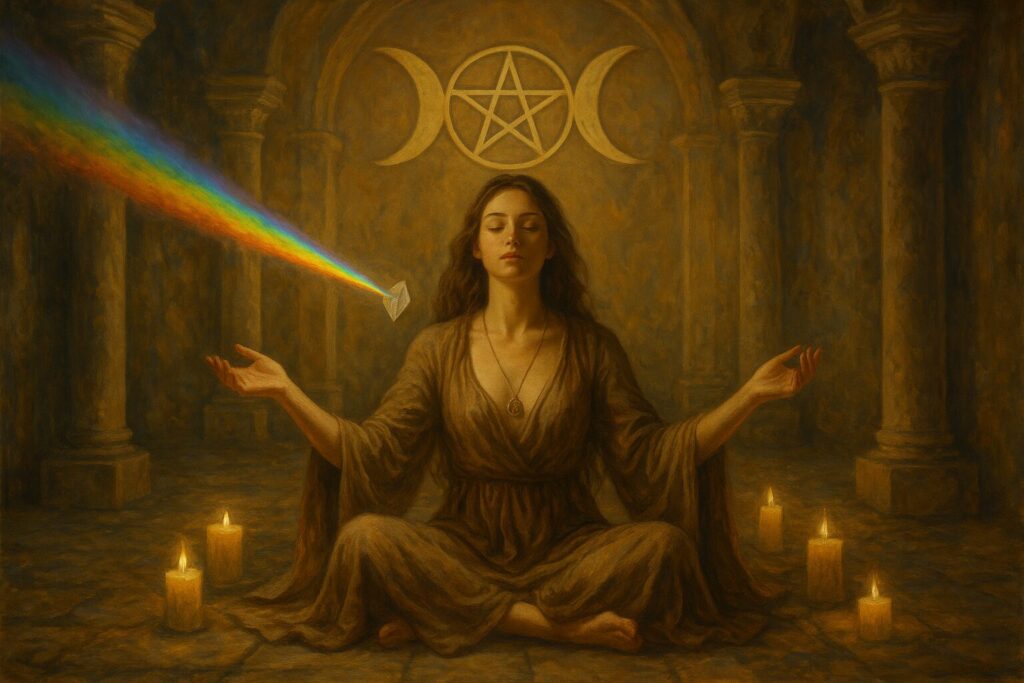
At the heart of Wiccan belief is the conviction that the universe is alive and interconnected. Divinity is not distant or abstract; it is immanent, dwelling within earth, sky, wind, flame, water, and the human soul. This worldview is both animistic and panentheistic: the sacred exists within the world even as it transcends it.
Wicca teaches that everything participates in a web of life. Stones have patience, rivers have memory, fire has will, and the human mind can attune itself to these rhythms. This sense of an enchanted world is not childish fancy but a philosophical stance: that consciousness and life move through all things, creating a cosmos that is relational rather than mechanical.
2. The Goddess and the God: Two Faces of the Sacred
Most Wiccan traditions honor the divine in dual form — the Goddess and the God — though these figures are understood symbolically rather than dogmatically. The Goddess often embodies moon, earth, waters, birth, death, and renewal; the God manifests in sun, forests, animals, and the cycles of life and transformation.
This polarity is not a division but a dance, a way of expressing the dynamic forces that shape existence: expansion and contraction, light and darkness, growth and decline. Behind the two lies an ultimate unity sometimes called the One, the Divine, or the All — the source from which all forms arise.
The divine in Wicca is therefore both personal and archetypal, both immanent and transcendent, both many and one.
3. Sacred History, Ancestral Memory, and Origin Narratives
While Wicca emerged in the mid-20th century, its belief system is shaped by sacred history and ancestral memory — stories and images that carry spiritual truth even in the absence of literal antiquity. These narratives express continuity with ancient pagan sensibilities: reverence for nature, ritual rhythm, and the feminine divine.
Practitioners often describe feeling as though Wicca reawakened something already present within them — an “old knowing” or a recognition of something long forgotten yet familiar. This sense of intuitive lineage is not about bloodlines or provable survival of ancient cults; it is about remembering, in a spiritual sense, how humans have always related to the sacred world.
4. Cyclical Time and the Sacred Year
Wiccan cosmology understands time as cyclical rather than linear. The Wheel of the Year — the eight sabbats marking solstices, equinoxes, and cross-quarter days — is a ritual mandala that mirrors the generative patterns of life. Through its celebrations, practitioners attune to:
- the waxing and declining sun,
- the life and death of the land,
- the turning seasons of the soul.
Likewise, the phases of the moon shape magical and devotional practice: waxing for growth, waning for release, the full moon for communion and heightened awareness. These rhythms teach that all things move through cycles of creation, fruition, dissolution, and rebirth.
In this worldview, time is sacred because it reflects cosmic intelligence — a choreography of forces both visible and unseen.
5. Magic as Participation in the Living World
Wiccan magic is not manipulation or spectacle. It is a form of participation in the energetic currents of the world. Magic operates through:
- intention,
- symbolic action,
- alignment with natural cycles,
- focused imagination,
- communion with unseen forces.
In Wiccan philosophy, magic works because consciousness and reality are interwoven. When the practitioner enters ritual space — grounding, centering, casting the circle — they step into a state where inner and outer worlds correspond. Tools such as the athame, chalice, wand, or pentacle do not command power; they focus attention and embody elemental principles.
Magic is therefore an art of relationship and co-creation, practiced with humility and ethical awareness.
6. The Afterlife and the Journey of the Soul
Wicca holds no single formal doctrine of the afterlife, yet many traditions speak of the Summerland: a place of rest, reflection, and renewal before reincarnation. This vision is not punitive or moralistic. It views the soul’s journey as cyclical and educative, with each life offering lessons and opportunities for growth.
Some Wiccans emphasize reincarnation within a soul-group or spiritual family; others hold a more mystical view in which the soul periodically dissolves back into the Divine before re-emerging. In all of these understandings, human life is framed as meaningful and evolving, with each incarnation contributing to the soul’s unfolding wisdom.
7. Ethical Philosophy Grounded in Interconnection
While Wicca has widely recognized ethical principles — most famously the Wiccan Rede — its ethics arise from metaphysics rather than mandate. Because all things are connected, actions reverberate through the web of being. Because the divine is immanent, to harm others is to harm oneself, the earth, and the sacred.
This ethical view is relational, not authoritarian. It teaches responsibility, mindfulness, and respect for life. It is less about rules and more about recognizing one’s place within an animate, interconnected cosmos.
(Our dedicated Wiccan ethics page explores this in much greater depth.)
8. Covens, Solitaries, and the Shape of Wiccan Community
Wicca is both initiatory and decentralized. Traditional lineaged groups like Gardnerian and Alexandrian Wicca maintain priesthood, degrees, and ritual structure. Modern Wicca also thrives through solitary practitioners, who approach the Craft through personal study, nature-based devotion, and private ritual.
Covens function as small spiritual communities, often with a priestess and priest guiding work. Solitaries create their own paths, guided by intuition and experience. Both forms are considered valid and complete.
This flexibility is part of Wicca’s genius: it honors tradition without requiring uniformity.
9. A Religion of Experience, Mystery, and Embodied Knowing
Ultimately, Wicca is a religion of doing, experiencing, and becoming. Its beliefs are not abstract propositions but truths revealed through lived practice. Theology is carried in ritual language, seasonal observances, and the shared silence of the circle as much as in any written text.
Wicca invites practitioners to step into sacred space, feel the shift in the air, sense the presence of the gods, and discover the magic that arises when one stands in harmony with the living world. Understanding comes as much from casting circles, calling the quarters, and working spells as from reading about them. It is a path of orthopraxy — right practice — as much as orthodoxy.
In this sense, Wicca is a mystery religion in the older sense of the term: it offers experiences that transform perception, deepen relationship with the sacred, and invite an ongoing unfolding of meaning. Its cosmology is not enforced; it is encountered. Its philosophy is not imposed; it is lived. Its sacred history is not literal chronicle; it is ancestral memory woven into modern practice.
10. Wicca in the Life of Our Coven
For the Coven of the Veiled Moon, Wicca provides a vital part of our foundation: a framework of cosmology, ritual structure, and reverence for the living world. Not all of our members identify as Wiccan, yet all honor the tradition and respect its gods, its mysteries, and its contributions to modern Pagan practice.
We are Wiccan in our roots and architecture, eclectic in our expressions, and united in our gratitude for the paths the Craft has opened. The work we do — in study, service, and shared ritual — is shaped in part by those who kept the witch-flame alive and helped bring it back into the open.
For the Coven of the Veiled Moon, Wicca forms part of our foundational inheritance: a framework of cosmology, ritual, and reverence that shapes our approach to practice. Not all our members are Wiccan, yet all honor the tradition and respect its teachings. Our structure is Wiccan; our practice is eclectic; our reverence for the Craft is wholehearted.
Wicca gave the modern world a renewed sense of sacred nature, ethical magic, and the freedom for witches to practice openly again. Whatever paths the Craft continues to take, it remains a living tradition — new in form, ancient in resonance, and continually reawakened in those who feel its call.