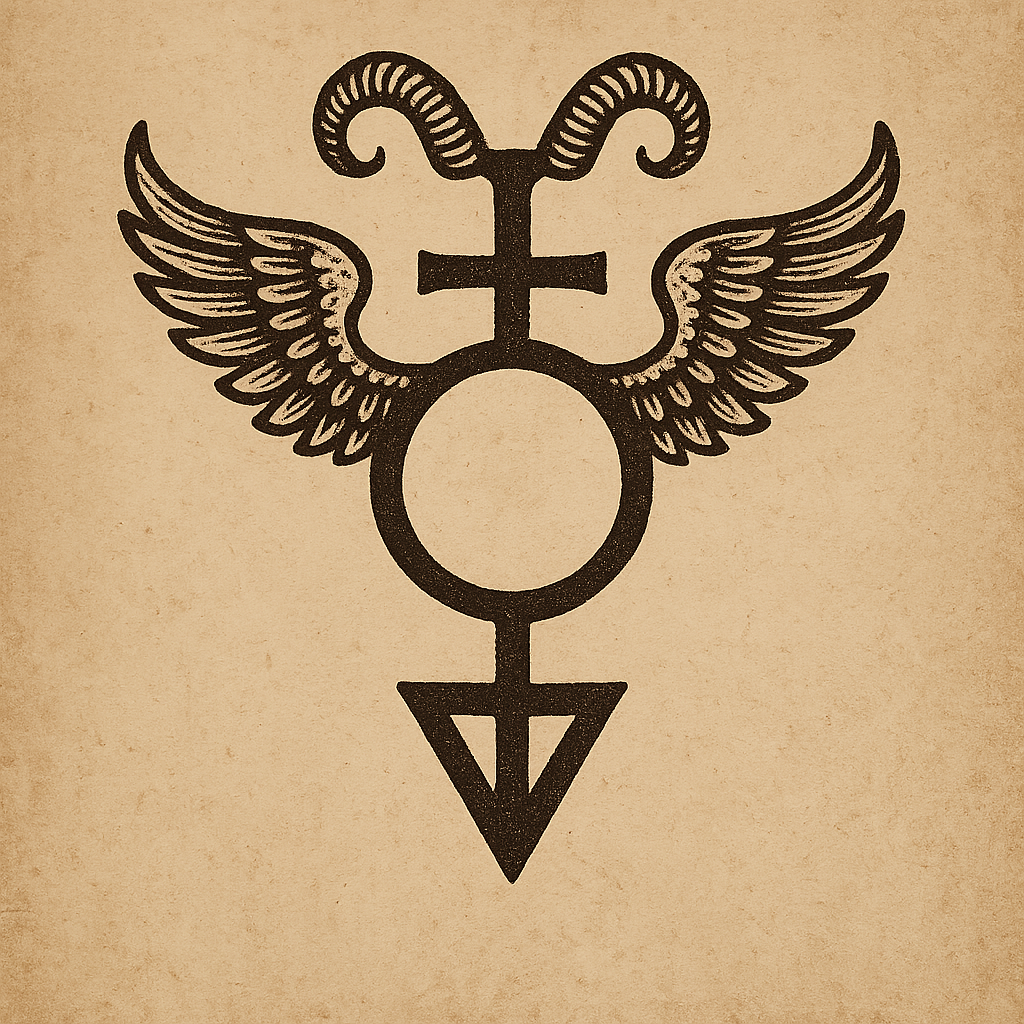
When the Gods Begin to Feel Close
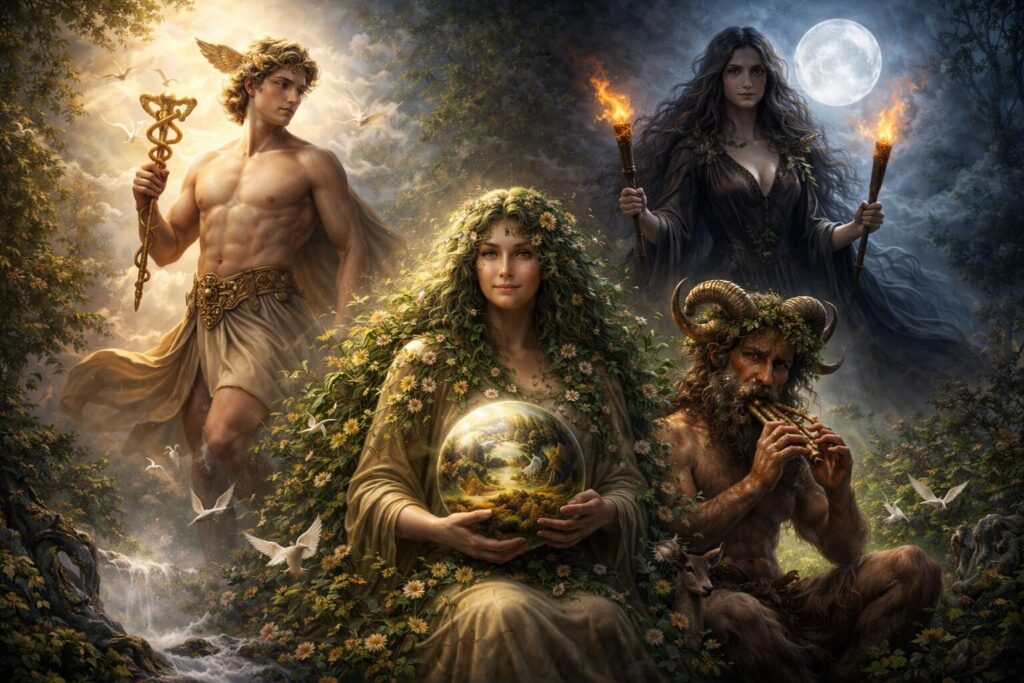
Finding a god is often spoken about as if it were a single dramatic revelation — a lightning strike of certainty that resolves doubt and assigns identity in one moment. In practice, especially for those entering witchcraft from mixed or strained religious backgrounds, the experience is rarely so clean. Many arrive carrying echoes of incompatible teachings: warnings against devotion on one side, pressure toward total surrender on the other. Some were told the divine must be singular and exclusive; others were told it is distant, abstract, or inaccessible. The result is a peculiar spiritual tension — a longing for relationship paired with a fear of choosing wrongly, believing incorrectly, or repeating old wounds under a new name.
Witchcraft approaches deity from a different angle. It does not assume that divine relationship must mirror monotheistic devotion, nor that reverence requires submission or obedience. In many traditions, gods are not rulers demanding allegiance but presences encountered through resonance. A deity relationship in witchcraft is less about pledging eternal loyalty and more about recognizing a current that runs alongside one’s own life. Some practitioners never formalize that relationship at all; others cultivate it into something deeply intimate. Both paths are valid. The key distinction is that witchcraft allows divinity to be relational rather than hierarchical — a dialogue rather than a command structure.

For those who do choose to work with a deity closely, the experience can become profoundly stabilizing. A god or goddess may function as a spiritual anchor: a voice that steadies the mind during ritual, a mythic mirror that reflects hidden strengths, a presence that helps “check the current” when intuition feels uncertain. This is not dependency in the fragile sense, but companionship in practice. The deity becomes a reference point — a way of orienting magical work, emotional processing, and ethical reflection. Many describe it as having a trusted elder, teacher, or witness standing just beyond the veil, not to control the path but to walk it alongside them.
The anxiety around choosing, naming, or even believing softens when understood this way. Witchcraft does not demand a final answer about the nature of the gods. It invites experimentation, observation, and personal meaning. A relationship may evolve, fade, or transform without betrayal. One may work with multiple presences, or none at all, and remain fully within the craft. The search itself is part of the initiation: learning to listen, to notice attraction and resistance, to sit with uncertainty without rushing to close it. In that space, the divine is not a test to pass but a conversation already in progress — one that unfolds at the pace of trust.
Finding Gods — relationship, revelation, and the language of the sacred
People often arrive with a single question — How do I find a deity? — but underneath it live deeper questions: what gods are, how they meet us, and whether you need deity work at all.
In a craft perspective, gods are not fictional characters waiting to be selected. They are intelligences of nature and cosmos—vast presences that existed long before any single culture gave them names. Myth and tradition do not “invent” the divine so much as translate it: a deity reveals itself through symbols a human life can understand—dream, story, devotion, and the felt texture of presence.
That means deity work is best approached as relationship, not recruitment. You may be drawn through personal interests, ancestral or cultural proximity, or a quiet sense of recognition that repeats over time. Some witches work within a pantheon; others meet the divine through dual or triple forms; others relate to unnamed presences shaped more by land and season than by a single face. And many practice witchcraft without deity relationship at all. The craft does not require worship.
For many modern practitioners, this question is also a question of balance. Reclaiming the feminine divine is not a campaign to cancel masculine presence—it is a corrective to centuries of spiritual lopsidedness. Some find that devotion to the Goddess (or goddess-forms) restores wholeness where the world has been overweighted toward the masculine. Others find their equilibrium through partnership: goddess and god, dark and light, wild and orderly, mercy and boundary. The point is not a political identity—it’s a spiritual ecology.
When deity work is part of a witch’s practice, it can add real power: clarity of symbolism, sharpened focus, protection, and sometimes a steadier “container” when workings misfire. But it remains an optional layer—an enrichment, not a requirement. If a god meets you, it will be through patterns that deepen over time, not a single dramatic moment. And if no god meets you, you are not behind.
“If you see God as something outside the world, the world becomes subtly and not-so-subtly devalued.”
“A religion without a goddess is halfway to atheism.”
“We take spiritual initiation when we become conscious of the Divine within us.”
If you’d like an example of how this looks in practice, see our deity pages for Hekate and Hermes.
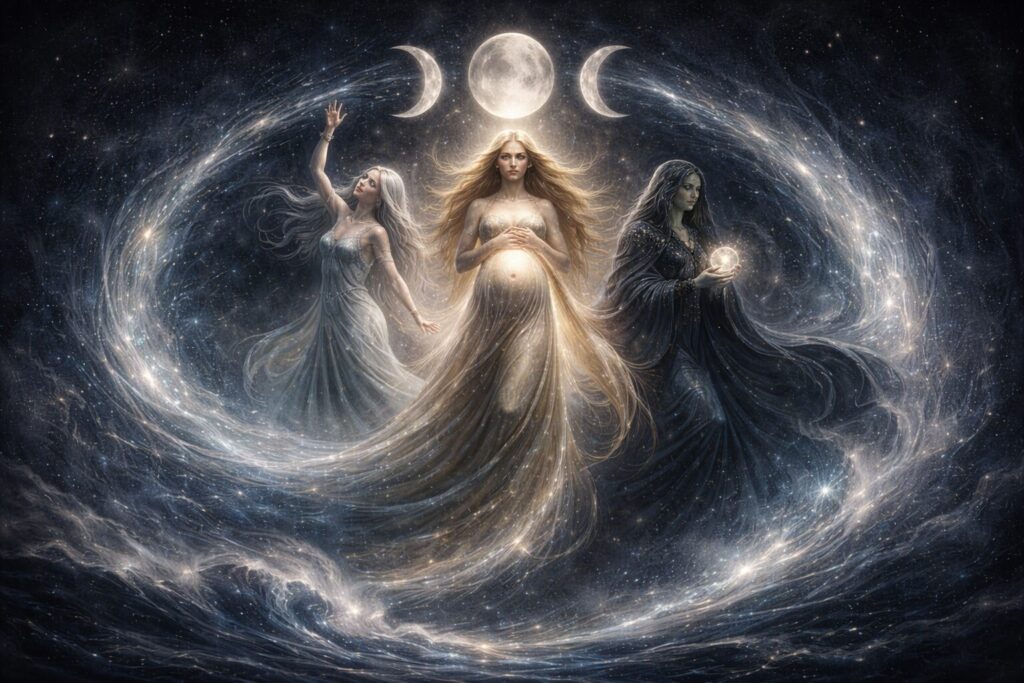
☾ Deity work, safely — relationship, discernment, and steady beginnings ▾
A gentle note: you don’t have to “pick a god” to be a real witch. Deity work is one way of relating to the sacred — and when it’s healthy, it feels less like recruitment and more like companionship: a steady presence, a trusted current-check, a comfort when your practice gets noisy. This section is designed to help you begin warmly — and also wisely.
What deity work is (and what it isn’t) ▾
- Not required: many witches remain non-devotional, animistic, or simply “craft-first.”
- Not monotheistic pledging by default: you can honor a deity without swearing lifelong exclusivity.
- Not a cosplay identity: the goal isn’t to collect names — it’s to build relationship, meaning, and clarity.
- Often practical: a deity can act like a stabilizer — an ally who helps you “check the current” when intuition is muddy.
How to start without overcommitting ▾
- Start small: a candle, clean water, simple words, and a short weekly rhythm beats dramatic vows.
- Lead with study: learn the myths, symbols, and cultural contours. Relationship deepens through literacy.
- Offer what’s sustainable: consistency is more sacred than intensity.
- Track patterns: repetition over time matters more than a one-off “sign.”
Discernment: agendas, discomfort, and safety ▾
This matters: gods are not always “nice,” and they are not always aligned with your comfort — but the sacred should never demand your harm. Deities can be protective, challenging, even sharp-edged. They can also have their own agendas. That doesn’t make them evil — it makes them other. Still, discernment is part of devotion.
- Red flag: anything that pressures you toward danger, isolation, cruelty, or self-destruction.
- Red flag: “prove it” tasks that cost your safety, sanity, relationships, or livelihood.
- Red flag: instructions that feel selfish in the worst way — humiliating others, harming animals, coercing consent, or escalating conflict.
- Yellow flag: urgency + fear + flattery (“only you are chosen,” “don’t tell anyone,” “act now or lose it”).
- Green flag: clarity over time — the relationship steadies your mind, strengthens your ethics, and improves your boundaries.
“Is it a god… or something else?” ▾
People do sometimes mistake other unseen powers for gods — especially early on, when a strong presence shows up and the mind reaches for the biggest label it knows. Not every spirit is a deity. Not every “voice” deserves trust. Discernment is not cynicism; it’s spiritual hygiene.
- Deities tend to feel vast, coherent, and consistent across time — even when they’re complex.
- Spirits can be helpful or chaotic; some are local, ancestral, land-bound, or opportunistic.
- Thought-forms (intentional or accidental) can mimic “presence” without having real autonomy.
- Malevolent forces are described in many traditions — but fear alone isn’t proof; look for coercion, deception, and harm.
What to do if you feel “called” ▾
- Ground first: sleep, eat, hydrate, touch the earth. Don’t interpret from depletion.
- Clean the signal: cleanse your space; return to baseline before escalating contact.
- Ask for clarity: request that any contact come in a way that is calm, consistent, and non-harmful.
- Move slowly: a real relationship can handle patience.
- Reality-check: if the message makes you afraid to tell anyone, that’s a sign to pause and seek counsel.
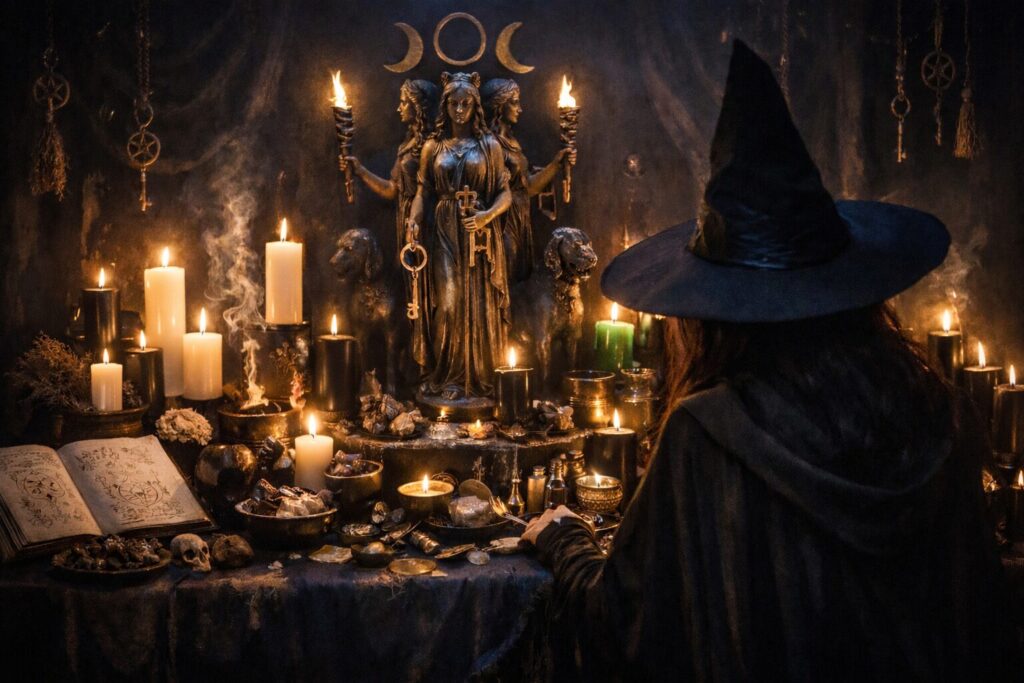
| Current | Common faces (clickable) | How witches receive this current |
|---|---|---|
| Liminal & Threshold | Hekate MCC, Hermes MCC | Met at edges: doors, roads, initiations, endings that become beginnings. Often received as a clarifying presence—strong on boundaries, protection, and “right timing.” Many witches experience this current while deepening craft, navigating transitions, or learning spirit etiquette. |
| Underworld & Return | Persephone, Anubis, Morrigan, Hekate MCC, Hermes MCC | Not “morbid”—initiatory. This current shows up around grief, transformation, shadow integration, ancestor contact, and the strange wisdom that follows honest endings. Witches often describe it as steadying and protective when approached with respect and clean boundaries. |
| Lunar & Triple-Form | Triple Goddess, Selene, Luna, Artemis, Diana | Often received through rhythm: intuition, boundaries, sovereignty, and the long arc of becoming. For many witches this current is less a single “person” than a cycle experienced in dreams, timing, and the body’s knowing—especially in lunar practice and self-reclamation work. |
| Great Mother & Earth-Body | Gaia MCC, Demeter | Received as grounding and encompassing: the living world as sacred, the body of ecology, the sense that magic is relationship with what is real. Witches often turn here for stability, healing, protection of home/land, and durable spiritual alignment. |
| Wild & Ecstatic Nature | Pan MCC, Cernunnos, Horned God, Green Man | Met in forests, trance, music, instinct, and the honest body. This current is often described as liberating and potent—good for vitality and courage— but it also presses for integrity. Witches receive it as a call to the real self, not the curated self. |
| Fate-Work & Deep Knowing | Odin, Freyja | Often received through divination, disciplined seeking, and the willingness to change in exchange for insight. Many witches describe this current as demanding but rewarding: it strengthens skill, attention, and the capacity to hold complex truths without flinching. |
| Protection & Warding Force | Thor | A boundary-maker current: fierce protection, home defense, and storm-clearing energy. Witches often turn here when they need strength without ambiguity— to reinforce wards, cut through fear, and “hold the line.” |
| Fire, Craft, Inspiration | Brigid | Received as brightening and skillful: the sacredness of making—poetry, healing, smithwork, devotion expressed through craft. Many witches meet this current while building a practice that must be lived daily, not merely imagined. |
| Restoration & Magical Authority | Isis | Often received as composed power: protection, reassembly after loss, and the sense that magic can restore what was broken—without denying what happened. Witches frequently describe this current as regal, steady, and deeply competent. |
| Autonomy & Shadow-Feminine | Lilith | Met where boundaries are reclaimed: identity, refusal, self-possession, and the costs of truth. Witches often receive this current when shedding imposed narratives— especially around desire, shame, and the right to define one’s own life. |
“Deity work isn’t about collecting names; it’s about learning a relationship that changes you—slowly, honestly, and over time.”
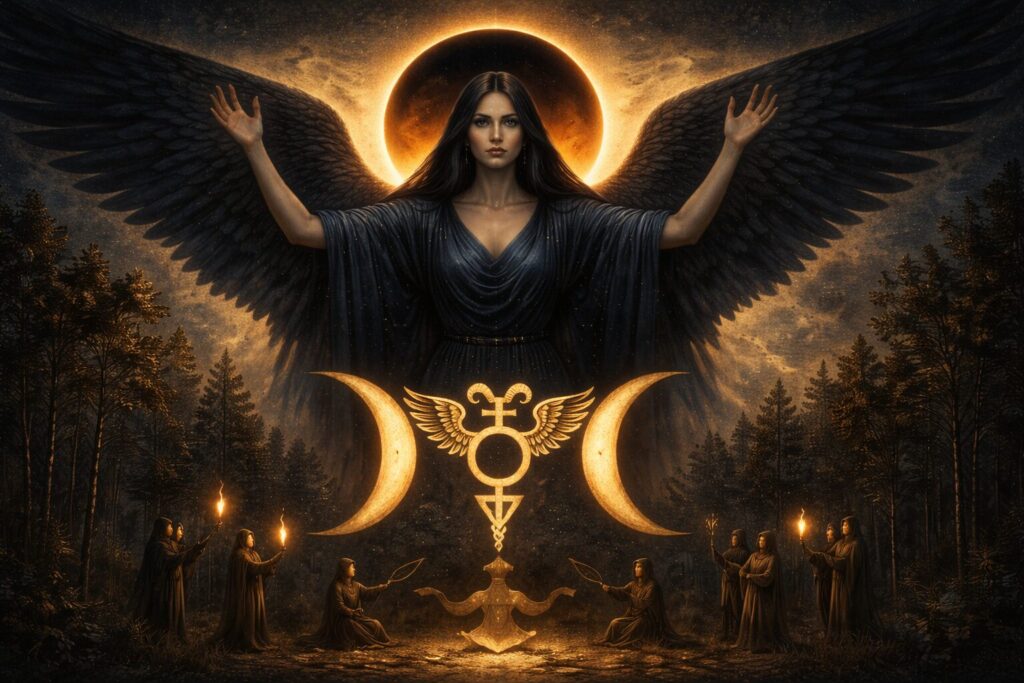
Closing — relationship, not recruitment
If you take one thing from this page, let it be this: deity work is a relationship, not a personality test and not a shopping list. Some people feel a clear call early; others never do—and both are valid. Witchcraft does not require deity devotion to be real, effective, or meaningful. What matters is integrity: the steadiness of your practice, the clarity of your boundaries, and the respect you bring to whatever you approach.
When a presence does come forward, it often arrives through alignment—through recurring symbols, the shape of your questions, the work you’re already doing, or the kind of protection and refinement your life is asking for. The healthiest approach is slow: listen, learn, and give your intuition room to mature. Let patterns repeat before you declare certainty, and remember that gods are not dependent on our belief; they meet us in forms we can understand.
At the Coven of the Veiled Moon, part of our mission is transparency and education. Everything shared here is offered “as is” from our coven lens: a comparative map meant to reduce confusion and encourage thoughtful practice. Use what helps, set aside what doesn’t, and choose your own path with discernment.
Continue exploring
These links are arranged by theme so you can move from foundations → worldview → practice → specific deities and related paths.