
Household Protection: The Guarded Hearth
Traditional Practices for Protecting the Living Home
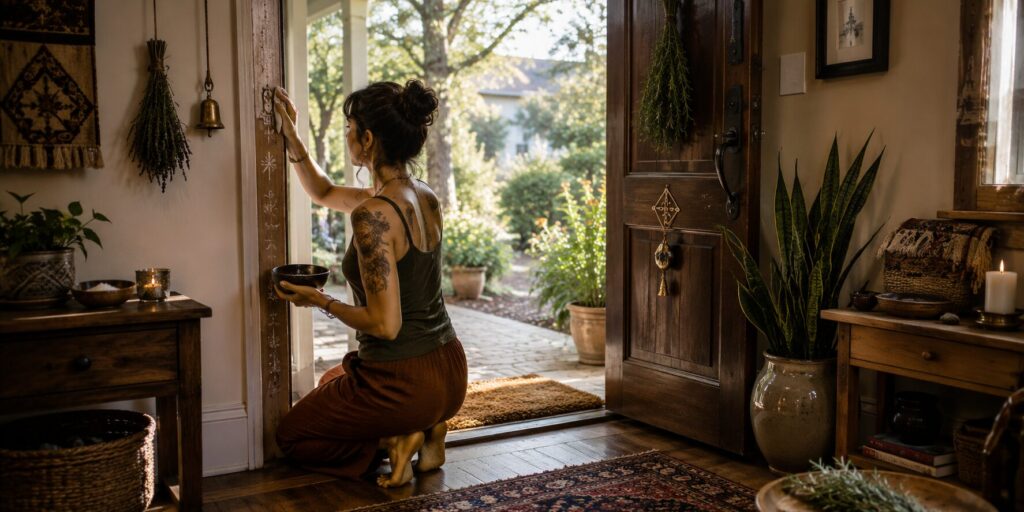
Protection Magic presents MCC’s broader framework for magical and spiritual protection. Household Protection Magic applies that framework specifically to the home: its property, rooms, residents, animals, possessions, spirits, and daily routines.
Hearth & Hedge Magic explores the wider magical life of cooking, gardening, herbs, land, and everyday domestic practice. Threshold Magic and Threshold Protection focus more closely upon crossings, doors, windows, gates, and other points of entry. This page considers how all of those boundaries work together as one living system of household protection.
Our homes are more than walls, rooms, and a roof. They are shaped by repetition: the footsteps that cross their floors, the meals prepared within them, the conversations held behind their doors, and the patterns of rest, conflict, celebration, grief, healing, and ordinary life that unfold there. Over time, a home gathers an atmosphere of its own.
As witches, we may understand that atmosphere as an accumulation of memory, emotion, habit, intention, spiritual activity, and relationship with place. Previous occupants may leave impressions upon a house. Objects brought inside may carry histories and associations from elsewhere. Repeated conflict can make a room feel unsettled, just as laughter, prayer, ritual, music, hospitality, and attentive care can help a home feel warmer and more secure.
The property matters as well. The structure stands upon land with its own history, and the household continues to form a relationship with that land whether it is owned, rented, shared, or occupied only temporarily. Renovations, neglect, major life changes, previous uses of the property, and the removal or addition of important features can all change how a place is experienced. Sometimes a disturbance seems connected to a particular room, object, doorway, outbuilding, or area of the grounds rather than to the household as a whole.
This does not mean that every uncomfortable room is haunted or that every difficult period has a spiritual cause. Strange sounds may come from plumbing, animals, appliances, or the natural movement of a building. A heavy atmosphere may be influenced by poor light, stale air, clutter, mold, stress, illness, grief, exhaustion, or unresolved tension among the people living there. Sometimes what lingers is emotional residue or an established household pattern rather than a spirit.
At other times, we may reasonably suspect that something more is occurring: a passing presence, a lingering spirit, an object carrying unwanted influence, an unsettled area of land, or a household boundary that has become unclear. Protection begins with discernment. We notice what is happening without immediately dismissing it, exaggerating it, or allowing fear to supply the explanation before we have examined the situation.
Household protection is therefore not simply the act of keeping everything out. A healthy home must still be able to breathe. Friends should be able to visit. Children should be able to play. Animals should be able to rest. Love, creativity, healing, prayer, magic, and welcomed spiritual relationships should be able to move through the space without every doorway becoming a point of suspicion.
A protected home is not a sealed fortress. It is a well-kept boundary that knows what to welcome and what to refuse.
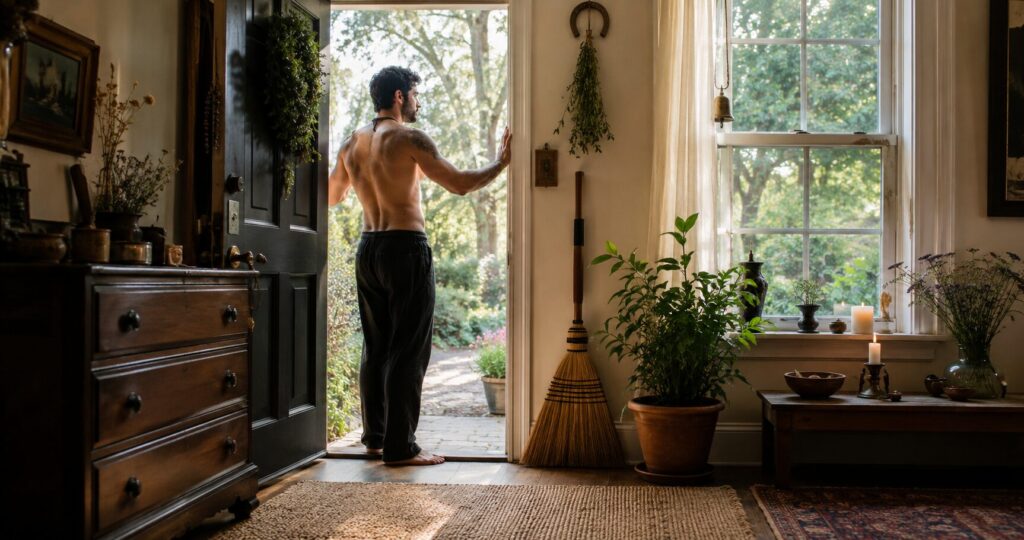
Healthy protection creates order rather than isolation. It defines what belongs within the household, what may enter by invitation, what must remain outside, and what should be removed when it no longer supports the well-being of the home. Stability and harmony are part of protection because a home that is cared for, clearly bounded, and regularly maintained is less vulnerable to confusion, neglect, spiritual stagnation, and disruptive influence.
This work often begins with ordinary acts of stewardship. We clean what has become stagnant. We repair what is broken. We open what needs air and light. We close what has been left physically or spiritually exposed. We speak clearly about what is permitted within our space. We refresh the plants, charms, marks, wards, and household customs that reinforce its boundaries.
A bell at the door, rosemary beside the path, a carefully placed broom, a protective bundle, a horseshoe above an entrance, or a ward renewed during seasonal cleaning can become part of the home’s continuing language of protection. None of these methods must be dramatic to matter. Household magic is often strongest when it becomes part of ordinary life—not performed once and forgotten, but maintained through cleaning, tending, blessing, observing, and renewing.
These repeated actions remind us of what we are protecting and why. They also reinforce the identity of the home itself: the values held within it, the relationships welcomed there, and the conditions under which people, energies, and spirits may enter or remain.
In the sections ahead, we will work from the edges of the property inward: through boundaries, gates, paths, gardens, doors, windows, shared rooms, private rooms, and the quieter spaces that are easily overlooked. We will consider protections suitable for homeowners, renters, apartments, shared households, temporary rooms, and anyone seeking to create a home that feels not locked down, but securely held.
The Home You Have
Household protection does not depend upon owning an old house, tending acres of land, or being free to paint symbols above every doorway. We begin with the home we actually have, the authority we genuinely hold within it, and the methods we can maintain with care.
The Rooted Home
A home and property under our long-term care offer the widest range of protective choices. We may plant along boundaries, place markers at gates or property corners, paint a door intentionally, install bells or ironwork, conceal marks during repairs, and establish wards that become part of the structure itself.
Permanent methods still require attention. A buried charm can be disturbed, a protective plant can die, a fence can fall, and an old ward can outlive the purpose for which it was made. Rooted protection should grow with the household rather than remain frozen in an earlier chapter of its life.
The Rented Home
Renters can create strong household protection without making permanent changes. Planters may guard a porch, balcony, or windowsill. A removable sigil can be placed behind a picture, beneath a mat, or inside a closet. Bells, bundles, curtains, floor washes, protective objects, and carefully positioned furniture can all help define the home.
The lease may limit what we can paint, plant, nail, bury, or burn, but it does not prevent us from tending the atmosphere of the space. A method does not become weaker simply because it is discreet or removable. Clear intention, thoughtful placement, and regular maintenance matter more than permanence.
The Shared Home
In a shared household, our authority may be strongest in our own room, altar space, or personal belongings. Common areas can still be protected through ordinary cleaning, respectful household agreements, unobtrusive charms, plants, sound, and practices that do not require every resident to share the same spiritual beliefs.
Consent matters, but it need not turn every household practice into a debate. We can protect the space without attempting to spiritually govern the people who live there. A ward around a bedroom establishes a personal boundary; a working intended to control a housemate crosses into something else entirely.
The Temporary Home
Dormitories, hotel rooms, hospital rooms, shelters, guest rooms, temporary housing, and places occupied during travel can all benefit from simple protection. These spaces often carry the movement, emotions, and routines of many people, so the goal is usually to create a clear personal boundary rather than claim spiritual ownership of the entire location.
A small cloth, a piece of jewelry, a key, a spoken boundary, a travel candle used only where permitted, a bell sounded softly, or a protective symbol kept inside a bag can establish a temporary center. When we leave, the protection should be easy to gather, close, and carry away with us.
The strength of household protection is not measured by how much property we control. It is measured by how clearly we understand our space, how consistently we care for it, and how well the method fits the life actually being lived there.
The Five Acts of Household Protection
Cleansing, blessing, warding, sealing, and maintenance support one another, but they do not perform the same task. Understanding the difference helps us choose the right action instead of repeating one familiar practice and expecting it to accomplish everything.
A household working often follows a natural movement: first we remove what does not belong, then establish what should remain, set the boundary, close the completed work, and continue caring for it. Not every situation requires all five acts, but each answers a different need within the protected home.
Cleanse
Removes residue, stagnation, confusion, and influences that no longer belong in the space.
At Home Sweep, wash, open the windows, use sound or smoke where appropriate, clear clutter, and move the unwanted atmosphere outward.
Bless
Names and invites the qualities the household is meant to hold after the space has been cleared.
At Home Speak peace, steadiness, health, mutual respect, safety, and welcome into the rooms rather than leaving an empty space behind.
Ward
Establishes an ongoing protective instruction that filters, redirects, blocks, contains, or alerts.
At Home Place a sigil, bell, horseshoe, charm, boundary marker, protective plant, or spoken condition at an entrance or vulnerable point.
Seal
Marks a boundary, opening, container, or completed working as closed until it is intentionally reopened.
At Home Close a ritual, secure a cleansed object, finish a threshold working, or declare that an unwanted presence may no longer cross or remain.
Maintain
Keeps the household’s protections clear, current, and connected to the life presently being lived there.
At Home Clean the charm, refresh the herbs, repeat the spoken boundary, inspect the property, and retire protections whose purpose has ended.
How the Five Acts Work Together
Imagine that a difficult visitor has left the house feeling tense and unsettled. A complete response might move through the five acts like this:
- Cleanse: physically straighten the room, open a window, sweep, wash, or use sound to move out the residue of the encounter.
- Bless: name what the room is returning to—calm, clarity, mutual respect, safety, and ease.
- Ward: renew the protection at the door or entryway so that future visitors cross under the household’s established conditions.
- Seal: close the immediate working and state that the conflict has no continuing claim upon the home.
- Maintain: observe the room over the following days and refresh the protection only if it needs attention.
The order can change when circumstances require it. An urgent boundary may need to be stated before a full cleansing can be performed. A long-established home may only need maintenance. A room cleared after illness may need blessing more than stronger defense. Good household practice responds to the condition of the home rather than following a sequence mechanically.

A home rarely begins with us. Even a newly built house stands upon land that had a life before the foundation was poured. An older home may have passed through many households, renovations, losses, celebrations, disputes, illnesses, occupations, and periods of neglect. Furniture, tools, artwork, building materials, and personal belongings may also arrive carrying histories from somewhere else.
As witches, we may describe this as the memory of the house and land: the accumulated atmosphere created by people, events, repeated patterns, spiritual relationships, and the physical place itself. Some practitioners experience that memory as emotional residue. Others understand it as a deeper impression held within the structure or property. At times, what appears to linger may be connected to a conscious spirit, a household presence, an object, or a relationship with the land.
These possibilities should be approached with curiosity rather than immediate certainty. Learning that someone died in a house does not prove that the person remains there. Discovering that a property once held a hospital, tavern, church, farm, burial ground, factory, or scene of conflict may provide useful context, but history alone does not establish a haunting. Nearly every long-inhabited place has known grief, illness, disagreement, and death.
The history becomes most useful when it helps us recognize a pattern.
Did the disturbance begin after a renovation, excavation, or major repair? Was an old tree removed, a well filled, or an outbuilding demolished? Did the atmosphere change after antique furniture, inherited belongings, ritual objects, or secondhand items were brought inside? Does the experience remain in one room, follow one object, gather at a particular boundary, or seem to move with one person?
We should begin by observing what is happening before searching for a dramatic explanation. Record where the experience occurs, when it began, who notices it, what seems to precede it, and whether it responds to attention. Researching the property afterward allows us to compare the observed pattern with the known history instead of allowing an old story to tell us what we are supposed to experience.
Property records, deeds, building permits, historic maps, archived newspapers, local libraries, historical societies, previous residents, and longtime neighbors may all provide useful information. Older maps can reveal former structures, roads, wells, rail lines, waterways, businesses, or changes to the boundaries of the land. Renovation records may explain sealed doors, altered stairways, removed fireplaces, additions, and rooms whose present function differs from their original use.
Objects deserve the same discernment. An inherited cabinet associated with years of family conflict may change the emotional atmosphere of a room without containing a spirit. A ritual tool may still feel connected to its earlier use. An antique may carry no unusual influence at all, despite the mystery of its history. We observe the object, its placement, and any pattern surrounding it before deciding that it requires cleansing, removal, containment, or nothing more than ordinary care.
The same is true of the land. A disturbance concentrated near one boundary, old tree, garden bed, shed, water source, or disturbed patch of ground may call for a different response than activity occurring throughout the house. It may suggest a damaged ward, an overlooked physical problem, a relationship with a spirit of place, or simply an area that has become neglected and stagnant.
Before settling upon a spiritual explanation, we also check the structure itself. Pipes knock. Heating systems shift. Animals enter walls and attics. Houses settle. Wind moves through vents, chimneys, and loose windows. Moisture, mold, electrical problems, poor ventilation, carbon monoxide, sleep disruption, stress, and illness can all affect how a place feels and how we feel within it. Checking these possibilities does not diminish our belief in magic or spirits. It protects the household and gives any spiritual response a clearer foundation.
When something genuinely unusual appears to remain, knowing its pattern helps us choose the right action. Emotional or ritual residue may need cleansing. A weakened boundary may need warding. An object may need to be isolated and examined. A welcomed household or land spirit may need acknowledgment and clearer terms. A disruptive presence may require a direct boundary, banishing, divination, or experienced assistance.
The past may explain a pattern, but it does not receive permanent authority over the present.
We can respect the history of a place without surrendering the home to it. The living household has the right to establish safety, peace, privacy, and spiritual order. Whatever came before may be acknowledged, understood, cleansed, redirected, welcomed under appropriate conditions, or firmly refused according to its nature and behavior.
The purpose of researching a house or property is therefore not to gather frightening stories. It is to better understand the place we are protecting.
Read the Pattern Before Naming It
An unusual experience becomes easier to understand when we examine its beginning, location, repetition, and behavior. These questions do not prove a spiritual cause; they help us decide what deserves attention and what kind of response may be appropriate.
What Changed?
Consider recent renovations, excavation, illness, conflict, ritual work, new occupants, difficult visitors, inherited belongings, antiques, removed trees, new furniture, or changes in the household’s routines.
Where Is It Rooted?
Does the experience remain in one room, doorway, object, outbuilding, property corner, garden bed, or section of the land? Does it follow a person when they leave the house?
What Repeats?
Note recurring times, sounds, dreams, odors, weather conditions, anniversaries, household activities, emotional states, or movements through the property.
Does It Respond?
A repeating impression may not react to us at all. An interactive presence may appear to notice attention, boundaries, changes in the room, or particular members of the household.
Observe First
- Write down the experience before researching the property.
- Record dates, times, locations, witnesses, and conditions.
- Look for consistency rather than relying upon one dramatic event.
- Note what changes after cleaning, repairs, rest, or grounding.
- Avoid interpreting every unrelated problem as part of one cause.
Research Second
- County assessor records and property deeds
- Building permits, additions, and renovation records
- Historic maps, street plans, and former property boundaries
- Libraries, newspaper archives, and local historical societies
- Previous residents and longtime neighbors, approached neutrally
- History of inherited objects, antiques, and building materials
Where the Pattern May Point
These are practical possibilities to investigate, not automatic diagnoses.
Household protection begins before we reach the front door. The property line, gate, pathway, balcony, driveway, yard, and outbuildings form the first layers through which people, objects, animals, energies, and spiritual influences approach the home.
For those who own land, that boundary may be marked by fences, hedges, trees, stones, gates, or surveyed corners. For renters and apartment dwellers, the meaningful boundary may begin at a balcony rail, exterior wall, assigned parking space, hallway door, or windowsill. The size of the space matters less than knowing where our care and authority genuinely begin.
We do not need to claim every place around us as magical territory. Good protection respects neighboring property, shared spaces, public paths, wildlife, utility access, and the rights of others. Our wards should follow the responsibility we actually hold. In a shared building, we may protect our apartment without attempting to govern the entire complex. On rented land, we may tend a porch or container garden without burying objects or altering the grounds without permission.
A property boundary is not necessarily a hard wall. It may function more like a filter: allowing friends, support, opportunity, necessary workers, emergency services, and ordinary life to approach while interrupting what arrives with harmful intent. This is why we define both what is refused and what remains welcome.
Before adding charms or spiritual markers, we begin with the physical condition of the property. A broken gate cannot reliably symbolize a firm boundary. An unlit walkway, loose railing, obscured address, damaged lock, dead plant, or overgrown path may need ordinary attention before magical reinforcement. Repair, visibility, cleanliness, and care are themselves protective acts.
We can then examine how the property is arranged. Where do people naturally enter? Which paths are rarely used? Are there side gates, basement steps, garage doors, vents, drains, pet entrances, or access points that receive little attention? Do packages, mail, tools, borrowed objects, or secondhand furniture enter through a different route than guests? The most obvious front entrance is not always the only meaningful threshold.
The corners and outer edges of a property can be treated as anchors. Some practitioners place stones, living plants, discreet symbols, or prepared markers at these points. Others walk the boundary while speaking its purpose aloud. The intention is not to create a frightened perimeter, but to help the household recognize its own shape.
Gardens and established trees may become living participants in that protection. Thorned plants can reinforce a firm outer boundary. Evergreens can represent continuity and watchfulness. Aromatic herbs near an entrance may be tended for cleansing, blessing, and household protection. Plants near windows can soften the movement between the inner and outer home while still marking that the opening is cared for.
We should also notice what already lives upon the land. A mature tree, spring, stone, old hedge, nesting place, or long-established garden may hold practical, emotional, and spiritual significance. Pagan household practice often includes respect for spirits of place, but respect does not require surrendering authority over the home. A relationship can be courteous and reciprocal while remaining clearly bounded.
If we choose to acknowledge a land or household spirit, we might begin through tending rather than elaborate offerings: removing litter, caring for a tree, refreshing water where appropriate, planting responsibly, or simply introducing ourselves and stating our intentions for the property. Offerings should not attract pests, endanger wildlife, damage soil, or create obligations we are unwilling to maintain.
Protection of the property works best when it is layered. A repaired gate establishes a physical boundary. A plant or stone gives that boundary a living or material anchor. A spoken statement defines its spiritual purpose. Regular observation keeps the arrangement current. Each layer supports the others.
The edge of the property should not feel like a line drawn in fear. It should feel like the place where the home begins to know itself.
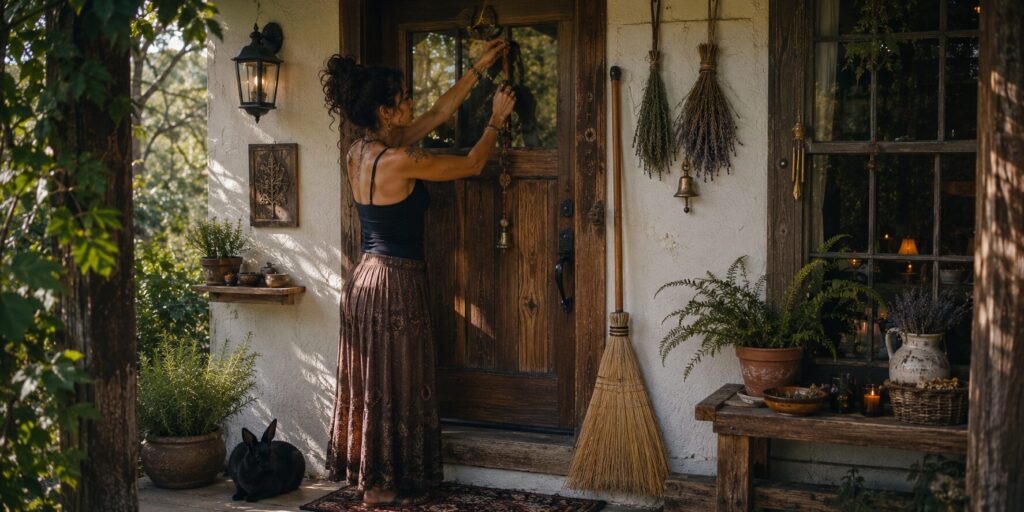
A Map of the Protected Property
Every property has several points of approach. We protect them according to their actual purpose, condition, and use rather than placing the same charm everywhere and assuming every boundary needs the same instruction.
Corners and Property Lines
Corners help define the shape of a property and can serve as anchors for a larger household ward. Walk the actual boundary first. Notice broken fencing, standing water, neglected areas, animal paths, old markers, and places where neighboring activity crosses naturally.
A corner may be marked with a stone, established plant, discreet symbol, prepared stake, or other durable object. The marker should identify and strengthen the boundary rather than threaten anyone who approaches it.
Practical tip: Record where hidden or buried protections are placed. Avoid glass, loose sharp metal, salt, plastic waste, or anything that could injure people, animals, roots, or future gardeners.
Gates and Fences
A gate is both an entrance and a declaration that the land beyond it is tended. Keep hinges, latches, and locks in working order before adding magical protection. A bell, small charm, planted guardian, or concealed mark may then reinforce the purpose of the gate.
Fences can carry protection through repetition: a symbol placed at intervals, a hedge growing alongside the line, or a boundary spoken while walking its length. The working should remain open to welcome and necessary passage.
Practical tip: Mark the gate people actually use. An elaborate ward on a decorative front gate will not address the side entrance through which everyone comes and goes.
Paths, Steps, and Driveways
Paths direct movement toward the home. Lighting, sweeping, repairing cracks, clearing ice or debris, and trimming overgrowth are practical protections that can be paired with intentional stones, plants, symbols, or a spoken welcome.
A path can be asked to guide helpful visitors safely inward and turn harmful intention away before it reaches the door. Stepping stones, planters, lanterns, or discreet marks can create several gentle points of filtering along the approach.
Practical tip: Keep magical objects away from tires, snow removal, lawn equipment, drainage channels, and places where they could become tripping hazards.
Mailbox, Deliveries, and House Number
Mail, messages, packages, official notices, gifts, and purchased objects enter the household through these ordinary points of exchange. A small sigil beneath a mailbox lid, a discreet mark inside a parcel area, or a spoken practice when bringing items indoors can establish a moment of discernment.
The house number itself can be cleaned, tended, or blessed as the public name by which the location is found. It should remain clearly visible to guests, delivery workers, and emergency services.
Practical tip: Protection should never obscure an address, block a utility meter, interfere with mail delivery, or make necessary access unsafe.
Balconies, Patios, and Small Outdoor Spaces
A balcony or small patio can serve as the entire protective garden of an apartment. Containers placed near the outer corners, a weather-safe charm, an intentionally chosen mat, or a quiet bell where permitted can establish the edge without altering shared property.
The railing may be treated as the outer line, while the door or window remains the inner threshold. This creates layered protection even within a very small space.
Practical tip: Secure pots and hanging items against wind. Follow building rules, weight limits, fire codes, and restrictions on anything that could fall or drip onto the space below.
Sheds, Garages, and Outbuildings
Outbuildings often hold tools, stored belongings, vehicles, fuel, inherited objects, seasonal decorations, and items removed from the main house but not fully released. They deserve their own locks, thresholds, maintenance, and periodic clearing.
A small mark inside the door, an iron object placed safely, a guardian charm, or a boundary spoken while organizing the space can help keep its purpose clear.
Practical tip: Avoid candles, incense, smoldering herbs, or heated ritual tools near fuel, paint, solvents, dry materials, vehicles, or poorly ventilated storage.
Drains, Wells, Vents, Trees, and Overlooked Openings
Not every point of movement resembles a doorway. Water, air, roots, animals, sound, and utility lines all cross the apparent boundary of a property. These areas should first be maintained according to their physical function.
An old tree, well, drain, spring, cellar opening, or established stone may also have a strong relationship with the identity of the place. Approach it through observation and respectful care before deciding it requires offerings, cleansing, warding, or removal.
Practical tip: Never block ventilation, drainage, animal escape routes, fire access, utilities, or structural openings with magical objects.
Shared and Unclear Boundaries
Apartment halls, shared yards, adjoining porches, communal gardens, driveways, and duplex spaces may not belong spiritually or legally to one household alone. We can protect our entrance and personal area without claiming authority over everyone who shares the space.
In these settings, portable and inward-facing methods usually work best: planters, interior marks, window protections, personal charms, clean thresholds, spoken boundaries, and wards anchored within the portion we occupy.
Practical tip: When the outer boundary is uncertain, strengthen the next boundary inward rather than pushing a working into space we do not control.
A Simple Boundary Walk
A boundary walk helps us observe the property before deciding what it needs. It may be used when moving in, after a major change, at the beginning of a season, or whenever the outer protection feels unclear.
Apartment dwellers can adapt the practice by walking the interior perimeter of the apartment, tending the balcony, and pausing at each door and window.
- Begin at the primary entrance. Ground yourself and name the household or space you are tending.
- Move around the boundary slowly. Follow the direction that feels natural and allows you to inspect the entire edge without crossing unsafe or neighboring property.
- Observe before acting. Notice damage, neglect, unusual activity, dead plants, hidden access points, and markers that no longer feel connected to their purpose.
- Pause at significant points. Acknowledge corners, gates, paths, large trees, outbuildings, balconies, and the places through which most movement occurs.
- State the boundary clearly. Speak what the property welcomes, what it refuses, and what authority the living household holds within it.
- Return to the entrance. Close the walk, note any repairs or changes needed, and complete those practical tasks rather than assuming the spoken work replaces them.
“From this edge to the rooms within, let what supports this home find peaceful passage. Let honest guests, necessary help, love, health, and good purpose enter freely. Let harm lose its direction, let deception be revealed, and let what comes without right or welcome turn away. This household knows its boundaries, and within them we remain securely held.”

Gardening for Protection
A protective garden does not need to be large or visibly “witchy.” A single rosemary plant beside an apartment door may serve its purpose as well as a full hedge around a rural property. Placement, relationship, and regular care matter more than the number of plants we collect.
We choose plants for the work they perform in the living landscape. Thorned growth can reinforce an outer boundary. Aromatic herbs may support cleansing and clarity near an entrance. Evergreens can represent continuity. Plants associated with peace and rest may protect the atmosphere around windows or gathering places.
Where Protective Planting Works Best
Think first about the function of the location. We are not simply scattering correspondences across the yard; we are matching a living ally to a part of the property that benefits from its presence.
Near the Main Entrance
Use approachable, aromatic, or container-friendly plants such as rosemary, lavender, bay, or juniper to mark the transition from the public approach into the household.
Along the Outer Boundary
Hedges, thorned plants, rowan, hawthorn, holly, or established shrubs may symbolize a firmer protective edge when safely and appropriately placed.
Near Windows
Fragrant and calming plants can support privacy and peaceful atmosphere. Thorned plants may also reinforce vulnerable ground-level windows, provided they do not obstruct emergency escape.
Beside Paths and Gates
Choose plants that visually guide movement while marking the passage. Two matching containers can act like living gatekeepers on either side of a doorway or path.
At Property Corners
A durable plant, tree, stone-set container, or established shrub can anchor a corner without requiring buried jars or materials that may later become hazardous.
On Balconies and Windowsills
Containers allow renters and apartment dwellers to create a portable protective garden. The pots themselves may be marked or blessed without altering the building.
Protective Plants to Consider
These associations come from overlapping strands of European household custom, traditional plant lore, and modern witchcraft. They are practical starting points rather than rigid laws.
Rosemary
Best placement: Pots beside doors, kitchen entrances, windows, paths, or balconies.
Protective role: Cleansing, remembrance, household continuity, and general protection.
Use: Tend it as a living guardian, harvest small amounts for bundles or washes, and remove dead growth rather than leaving the plant neglected beside the entrance.
Juniper
Best placement: Gates, pathways, containers, boundaries, or the approach to an entrance.
Protective role: Purification, firm defense, resilience, and evergreen watchfulness.
Use: Allow its strong scent and durable growth to mark a clear outer layer. Do not assume every juniper species is edible or safe for the same uses.
Rowan
Best placement: Near a gate, front approach, property boundary, or as a significant tree within the grounds.
Protective role: Traditionally associated with guarding homes, livestock, travelers, and property from harmful supernatural influence.
Use: Treat the living tree as a long-term relationship. A rowan is not necessary for every garden, and a mature tree should not be cut simply to manufacture charms.
Hawthorn
Best placement: Hedges, outer boundaries, gates, or areas where a dense living barrier is appropriate.
Protective role: Firm boundaries, guardianship, respect for liminal places, and protection through its dense thorned growth.
Use: Place it where thorns will not injure children, animals, visitors, or people maintaining the property.
Holly
Best placement: Property edges, near entrances, established hedges, or seasonal containers and decorations.
Protective role: Endurance, watchfulness, winter continuity, and a firm evergreen boundary.
Use: Its prickled leaves naturally communicate defense, but its berries should be kept away from children and animals likely to eat them.
Bay Laurel
Best placement: Containers beside doors, windows, balconies, patios, or gathering spaces.
Protective role: Clarity, victory, blessing, household authority, and protection.
Use: A potted bay can be moved with a renter and pruned for bundles or household workings. Keep loose leaves and plant material away from pets that may chew them.
Rose
Best placement: Fences, boundaries, below appropriate windows, gates, or places where protection and welcome should remain in balance.
Protective role: Love defended by thorns, household harmony, privacy, and the ability to welcome without becoming unguarded.
Use: Choose placement carefully so the thorns reinforce the property rather than obstruct paths or emergency exits.
Lavender
Best placement: Paths, windows, seating areas, balconies, and near rooms intended for rest.
Protective role: Peace, cleansing, calm sleep, and the reduction of household tension.
Use: Lavender protects indirectly by helping establish the atmosphere we want the home to maintain. It pairs well with firmer boundary plants rather than replacing them.
Yarrow
Best placement: Mixed borders, sunny garden areas, containers, or near the outer edge of a cultivated space.
Protective role: Traditional protection, resilience, courage, and strengthening the integrity of a working.
Use: Harvest responsibly for dried bundles or charms while leaving enough growth for the plant and visiting pollinators.
Rue
Best placement: A controlled container or protected garden area where it will not be brushed against casually.
Protective role: Strong cleansing, uncrossing, refusal, and traditional household defense.
Use: Rue deserves caution. Its sap can irritate skin and may cause a stronger reaction after sun exposure. Wear gloves and avoid it where children or animals may handle the plant.
Tending the Garden as a Protective Practice
Planting establishes the relationship; tending keeps it alive. A dead or neglected plant is not necessarily a supernatural warning, but it is a practical sign that the placement, soil, water, weather, disease, or care routine needs attention.
Plant With a Clear Purpose
State what part of the property the plant is helping to hold: doorway, boundary, window, resting place, or household center.
Learn the Living Plant
Magical correspondence does not override sunlight, water, drainage, mature size, root behavior, or the needs of the species.
Prune and Harvest Respectfully
Take only what the plant can sustain. Use healthy trimmings for bundles, washes, sachets, or seasonal protections rather than stripping the plant for supplies.
Retire What Has Ended
Remove diseased growth, replace failed container plantings, and thank a plant whose life has ended. Do not keep dead matter at an entrance solely because it was once part of a ward.
Children, Pets, Thorns, and Plant Safety
Know the Exact Plant
Common names can refer to different species. Keep labels and identify plants correctly before using, ingesting, burning, or recommending them.
Do Not Assume “Natural” Means Harmless
Leaves, berries, seeds, sap, roots, and smoke may carry different risks. A plant safe to touch may not be safe to eat or burn.
Place Thorns Intentionally
Thorned plants should not narrow walkways, block emergency exits, injure visiting children, catch clothing, or create hazards for animals and maintenance workers.
Check Pet-Specific Safety
Cats, dogs, birds, livestock, and small animals do not respond to plants in the same way. Confirm safety for the animals actually living on or visiting the property.
The outer property may establish where the home begins, but its doors and windows decide how the household meets the world. They are points of passage: places where people, air, light, sound, objects, animals, messages, and spiritual influences move between outside and within.
The front door usually receives the greatest attention because it is the ceremonial face of the home. It is where we welcome guests, accept deliveries, return after being away, and announce ourselves before entering someone else’s space. Yet the front door is not always the entrance most often used. Family members may come through a garage, mudroom, side door, balcony, or basement. Groceries may enter through the kitchen. Pets may have their own door. Packages may be carried in from the porch while secondhand objects arrive through a workshop or storage area.
Household protection should follow the life actually being lived there.
We begin, as always, with physical care. Doors should close properly. Locks, hinges, latches, screens, and weather stripping should work. Windows should open when needed and secure when closed. Vents, chimneys, drains, and pet doors should remain clear enough to perform their practical purpose safely. A magical boundary is strengthened—not diminished—when the physical opening is well maintained.
We can then give each opening a clear spiritual function. A primary entrance may carry a broad household ward: welcome for honest guests, refusal of harmful intent, and protection for those who live within. A bedroom window may be treated more gently, emphasizing privacy, rest, and quiet. A garage door may focus upon safe arrival, vehicles, tools, and objects entering the household. The methods need not be identical simply because all are forms of entry.
Traditional household protections are often placed at openings because a boundary is easiest to tend where crossing occurs. Iron, horseshoes, bells, brooms, bundles, reflective glass, protective marks, washes, plants, knots, and spoken charms all give the threshold a visible or physical reminder of its purpose.
Some old buildings contain marks near doors, windows, fireplaces, and beams that have been interpreted as protective or apotropaic—intended to turn harm aside. The meaning of individual historical marks is not always certain, however, and current scholarship continues to debate whether some common forms were magical protections, religious signs, craft exercises, or ordinary marks made by builders. We do not need to copy an old symbol of uncertain meaning simply because it looks mysterious. A personal sigil, deliberately created and clearly instructed, may serve our home more honestly.
The same principle applies to every object we place. A horseshoe is not protective merely because it has been nailed above a door. A broom is not a guardian simply because it leans in a corner. A bell that is never heard, a dead bundle left gathering dust, or a ward whose purpose we no longer remember has become decoration rather than maintained magic.
Placement gives an object context. Preparation gives it purpose. Repetition builds relationship. Maintenance allows it to continue working with the household rather than becoming part of the spiritual clutter it was meant to prevent.
A threshold becomes protective when it knows the difference between passage and permission.
Hospitality does not mean unrestricted access. A visitor may be welcome for an evening without receiving an enduring spiritual claim upon the home. A repair worker may enter because their work is necessary without becoming part of the household’s intimate life. A loved one may still be expected to respect the atmosphere, people, animals, privacy, and boundaries held within the space.
When someone leaves behind conflict, grief, agitation, or an uncomfortable presence, we may reset the entrance without accusing that person of deliberate magical harm. We simply return the threshold to its established condition. We clean, open the air, sweep outward, speak the household boundary, and renew whatever object or mark stands guard there.
Doors and windows should not become places of anxiety. Their purpose is movement. Good threshold protection allows that movement to occur under clear conditions so that the home remains connected to the world without becoming spiritually unguarded.

Threshold Methods in Practice
The strongest entrance protection is rarely the most crowded. Choose methods that fit the opening, give each one a clear purpose, and leave enough space for the doorway or window to remain safe, useful, and welcoming.
Repair Before Reinforcing
Fix the lock, latch, screen, hinge, draft, leak, or broken frame before asking a charm to represent a secure boundary.
Match the Method to the Opening
A front door, bedroom window, garage entrance, fireplace, and pet door do not all need the same instruction or level of defense.
Name Welcome as Well as Refusal
State what may enter—love, honest guests, aid, health, and peaceful passage—alongside what the household turns away.
Doors, Frames, Mats, Marks, and Color
The primary entrance is often the broadest expression of household authority. Clean the door and frame, confirm that the hardware works, and notice what people encounter as they approach. Protection may be placed visibly as decoration, hidden beneath or behind something, or worked directly into the act of cleaning.
Doorframe Marks
A personal sigil may be drawn in chalk, traced with water or prepared oil, placed beneath paint, attached behind trim, or written on removable paper above the inner frame.
Best practice: Use a symbol whose instruction you understand. Hidden does not have to mean vague.
Mats and the Ground Below
A removable mark beneath a doormat can establish the condition under which visitors cross. The mat itself may be cleaned, shaken outward, or replaced when worn.
Avoid loose powders where they create slipping hazards, damage flooring, blow into shared halls, or may be licked by animals.
Threshold Washes
Clean the surface first, then use a properly diluted wash suited to the material. Rosemary, bay, or other protective herbs may be steeped in water, strained, cooled, and used where the finish safely permits.
Test painted wood, stone, metal, and flooring before applying oils, salt, vinegar, citrus, or strongly colored preparations.
Visible Guardians
Wreaths, bundles, bells, keys, horseshoes, plaques, planters, and talismans can protect without advertising every detail of the working.
Secure everything well and keep door viewers, locks, handles, emergency access, and house numbers clear.
Historical caution: marks found on old buildings are sometimes interpreted as protective, but not every carved wheel, line, cross, or burn mark had a magical purpose. For contemporary household work, a deliberate personal sigil usually gives clearer instruction than copying an uncertain historical design.
Choosing a Protective Door Color
No door color carries one universal magical meaning. These are practical correspondences we can use intentionally. Renters can create the same effect through a wreath, hanging cloth, planter, ribbon, sign, or removable panel.
Purple
Spiritual awareness, magical identity, intuition, psychic discernment, and a home conscious of its unseen relationships.
Blue
Peace, calm communication, cleansing, emotional steadiness, and a gentle but clearly held boundary.
Red
Active defense, vitality, courage, warning, warmth, and the strength to refuse what approaches with harmful intent.
Green
Stability, household continuity, health, rootedness, growth, and protection through a strong relationship with place.
Black
Firm limits, concealment, absorption, banishing, sovereignty, and a boundary that does not require explanation.
White
Purification, clarity, blessing, spiritual order, and a home that seeks openness without confusion.
Brown
Grounding, endurance, practical security, physical care, and protection tied to the body and structure of the home.
Gold or Yellow
Illumination, visibility, confidence, warmth, welcome, and the revealing of deception before it enters.
Horseshoes, Iron, Nails, and Keys
Horseshoes combine the protective reputation of iron with the symbolism of travel, labor, endurance, luck, and safe return. They have long been placed upon houses, barns, stables, doors, windows, and gates, although households have never fully agreed upon which direction is correct.
Points Up
The upward horseshoe is commonly understood as a vessel that gathers and holds luck, blessing, and protection. This is the most familiar general placement within MCC practice when the intention is to keep the household’s good fortune securely held.
Points Down
The downward horseshoe may be understood as pouring protection or blessing over those who pass beneath it. Other customs warn that this lets the luck run out. The difference is symbolic, so decide which instruction you are actually giving.
- Above the outer door: creates a visible guardian over everyone who crosses.
- Above the inner frame: keeps the working discreet and places it within the household’s side of the threshold.
- Beside the door: acts as a standing iron guardian without placing a heavy object directly overhead.
- At a barn, shed, or garage: extends the symbolism of protection to animals, tools, vehicles, work, and safe return.
An actual iron horseshoe carries the physical and traditional qualities of worked iron. A decorative horseshoe-shaped charm can still be enchanted as a talisman, but we should understand that its material and symbolism are not exactly the same.
Keys, iron nails, washers, old hardware, and small forged objects may also serve as threshold protections. Keys guard access and authority; nails fasten and hold; iron establishes a firm refusal. Rusted metal should be handled carefully and kept away from children, animals, bare feet, fabrics, and places where it may stain or injure.
MCC practice: we generally favor points upward for a household horseshoe meant to hold protection and good fortune. Points downward remain appropriate when the practitioner deliberately intends blessing or protection to pour over the passage. Neither orientation should be used without knowing why it was chosen.
Brooms and Besoms: Above, Behind, or Across the Door?
The broom connects household cleaning with magical removal. It gathers what is loose, directs what must leave, and restores order to the floor beneath our feet. For this reason, brooms and ritual besoms are natural threshold guardians.
There is no single universal rule for how a broom must be displayed. The position should agree with the work being asked of it.
For active cleansing, begin at the back or quietest part of the affected area and sweep toward an exterior door. Physical sweeping may be followed by a ritual pass slightly above the floor if using a dedicated besom. Sweep inward only when deliberately drawing something beneficial into the household.
A dedicated ritual besom can keep the magical function distinct, but an ordinary household broom may also carry protection when it is cleaned, respected, and intentionally used. What matters is knowing whether the broom is currently removing dust, carrying a spiritual instruction, or doing both.
MCC practice: we generally store a protective broom with the bristles up when possible, sweep unwanted influence outward, and use a broom across a threshold only as a temporary and deliberate closure. If a hanging broom falls, check the hook before interpreting it as an omen.
Bells, Chimes, and Protective Sound
Sound announces that a crossing has occurred. A bell at the door can serve three practical magical functions: it alerts, interrupts, and resets. It makes entry audible, breaks the stillness surrounding an unwanted influence, and gives the household a repeatable sound with which to renew the threshold.
A Bell on the Door
Rings when the entrance moves, allowing the ward to respond to an actual crossing. It can be dedicated to welcome honest visitors and interrupt concealed or harmful intent.
A Bell Beside the Door
Gives the practitioner control over when it sounds. Ring it after cleaning, before receiving guests, after conflict, or when renewing the entrance ward.
Outdoor Chimes
Can extend sound into a porch, garden, or balcony. Choose a placement that will not disturb neighbors, household members, sleep, wildlife, or anyone sensitive to repeated sound.
Keys, Metal, and Sound Together
A small arrangement of bells, keys, knots, and iron can combine access, alert, binding, and protection within one doorway charm.
Modern “witch bells” are one contemporary form of this practice. They do not require a particular number of bells or a commercially purchased design. One bell, clearly dedicated and regularly heard, may serve better than an elaborate charm whose purpose is unknown.
“With this sound, the crossing is known. Let welcome enter openly, let deception reveal itself, and let what approaches with harmful purpose lose its passage here.”
Windows, Mirrors, Curtains, and Witch Balls
Windows carry light, air, sound, sight, and attention. They connect us to weather, neighbors, streets, gardens, and the night beyond the walls. Their protection should preserve these benefits while supporting privacy and spiritual clarity.
- Clean the glass and tracks: dirt, condensation, mold, broken screens, and damaged locks should be addressed before adding magical protections.
- Mark the frame rather than the glass: a sigil traced in water, removable chalk, oil suited to the material, or paper tucked behind trim is easier to maintain.
- Use curtains and blinds intentionally: opening them can invite light and movement; closing them can mark privacy, rest, weather protection, or the end of the household day.
- Place plants safely: a living guardian may sit near a window without blocking escape, ventilation, or necessary light.
Reflective Mirrors
Some practitioners place a small mirror near an entrance or window to reflect harmful attention away. Others avoid pointing a mirror directly outward because they do not want the ward to return everything indiscriminately.
A mirror may instead be instructed to reveal, clarify, or refuse harmful intent without reflecting ordinary emotion back at neighbors and visitors.
Witch Balls
Glass spheres known as witch balls have been hung in windows and homes as protective objects. Explanations vary: they may reflect harmful influence, attract and confuse it, or hold it within the twisting glass.
A modern witch ball can be dedicated as a watchful household charm without pretending that every decorative glass ornament has the same history or purpose.
Fire safety: do not place clear crystal balls, curved glass ornaments, magnifying mirrors, glass paperweights, or similar objects where direct sunlight can be concentrated onto curtains, paper, bedding, furniture, or other combustible material. A protective object should never create a physical hazard.
Bundles and Hanging Doorway Guardians
A doorway bundle gathers several correspondences into one visible, renewable household charm. It can be made from herbs, branches, cord, keys, bells, iron, cloth, or seasonal materials. The bundle should have one coherent purpose rather than becoming a collection of everything considered “protective.”
General Doorway Protection
Combine: rosemary, bay, and a small amount of juniper.
Purpose: cleansing, household continuity, clarity, and firm protection.
Placement: above or beside the interior doorframe, secured where dried pieces cannot fall into food, flames, or animal reach.
Peace at the Entrance
Combine: lavender, rosemary, and chamomile in a cloth sachet or tied bundle.
Purpose: a calmer transition into the home, especially after stressful travel, work, conflict, or frequent visitors.
Placement: inside the entryway rather than exposed to rain and weather.
Firm Boundary Guardian
Combine: bay, juniper, a safely enclosed iron key or washer, and dark protective cord.
Purpose: refusal of harmful passage, household authority, and the keeping of access under clear conditions.
Placement: beside the primary entrance or inside a shared-space door.
Key-and-Bell Guardian
Combine: an unused key, one or more small bells, cord, and a removable written or stitched sigil.
Purpose: authority over entry, awareness of crossing, and protection without dried plant material.
Placement: hang from a secure hook beside the door or upon the inner handle where it will not prevent operation.
Refresh plant bundles when they become dusty, brittle, damp, moldy, faded, or disconnected from their purpose. Their decline is usually ordinary material aging, not proof that they absorbed an attack. Retire them respectfully and prepare a new one when the household still needs the work.
More later on this page: Section 9 will provide fuller protective-bundle recipes, construction steps, renewal periods, spoken wording, and dismantling methods.
Resetting the Threshold After a Difficult Visitor
A tense visit can leave the household unsettled without involving a curse, attachment, or deliberate magical act. Conversation, conflict, grief, fear, illness, intoxication, and strong emotion can all affect the atmosphere of a room. A reset restores the home without turning the visitor into a supernatural threat.
A Simple Visitor Reset
- Close and secure the door. Give the household a few quiet minutes before beginning.
- Gather cups, dishes, trash, and objects left from the visit. Return the room to its ordinary physical order.
- Open a safe window or create air movement if appropriate.
- Sweep or move through the gathering area toward the entrance, directing the remaining tension outward.
- Clean the inner handle, threshold, or mat using a preparation safe for the surface.
- Ring the doorway bell, sound a chime, clap, or use another established household sound.
- Restate the boundary and refresh the doorway charm only if it actually needs attention.
“The visit has ended and this home returns to itself. What belongs to our guests leaves peacefully with them. What belongs to this household remains whole. Conflict has no claim here, agitation has no room to root, and this threshold again holds the peace and integrity of the home.”
If the same person repeatedly ignores household boundaries, the answer may not be a stronger charm. It may be a clearer conversation, restricted access, practical safety planning, or a decision not to invite them back.
Once we cross the threshold, household protection becomes more particular. The outer boundary guards the home as a whole, but the rooms within it do not all perform the same work. A kitchen nourishes. A bedroom restores. A living room receives people and holds conversation. A bathroom releases and cleanses. A study concentrates thought. An altar or working space deliberately opens toward spiritual activity.
Each room should be protected in a way that strengthens its actual purpose.
This does not mean filling every corner with wards, charms, salt, mirrors, and protective herbs. Too many overlapping instructions can make a room feel crowded, restless, or difficult to read. A bedroom surrounded by aggressive defensive objects may no longer feel restful. A gathering room warded as though every visitor is a threat may become unwelcoming. A kitchen filled with hanging materials, loose powders, and candles may become physically unsafe.
Good room protection is usually simple enough to understand at a glance. We should know what the room is for, what commonly enters it, what tends to collect there, and what condition we want it to return to after use.
A room’s atmosphere is shaped by more than magic. Light, ventilation, temperature, sound, furniture placement, cleanliness, privacy, scent, moisture, and the habits repeated there all influence how the space feels. Magical protection works best when it is built upon these physical conditions rather than used to conceal them.
The living room where every disagreement takes place may need more than a cleansing charm. The household may also need to change how conflict is handled. A bedroom that feels oppressive may need fresh air, clean bedding, less clutter, better sleep habits, or attention to an uncomfortable object before it needs a stronger ward. A bathroom that continually feels stagnant may have a moisture, ventilation, or drainage problem. A neglected basement may require lighting, repairs, pest control, and organization before any spiritual conclusion is reached.
Protection does not replace household care. It gives that care spiritual direction.
Rooms also hold different degrees of privacy. An entryway and living room meet the public side of the household. Bedrooms, bathrooms, personal altars, private offices, and children’s rooms belong to a more intimate layer. As we move inward, our protections may become quieter, more personal, and more specific.
In a shared home, we protect our room and belongings without attempting to control the thoughts, emotions, dreams, or spiritual lives of everyone under the roof. A household ward may establish that violence, cruelty, deliberate harm, or spiritual disruption are not welcome. It should not require every resident to feel the same way, honor the same gods, or participate in the same practice.
Children and other household members may also need room to develop their own relationship with the space. A protective object can be explained as a sign of safety, family care, or cultural practice without placing frightening ideas into the room. Protection should help a child sleep securely, not convince them that something terrible is waiting outside the ward.
Pets shape rooms as well. They move objects, chew plants, investigate powders, climb furniture, react to sound, and choose sleeping places according to their own senses. Their behavior may be worth noticing, but one animal staring at a wall is not proof of a spirit. They may hear pipes, insects, rodents, neighboring animals, or movement outside the range of our own attention.
The rooms within a home are connected. Air travels through them. Sound carries. Family tension moves from one space into another. Objects migrate. Guests pass through several areas. Magic performed in one room may affect the atmosphere beyond it, particularly when the working is intense, left open, or never properly closed.
For this reason, an altar room should not remain spiritually active without limit simply because it is sacred. A kitchen protection should not depend upon a candle left burning near cooking materials. A bedroom ward should not trap difficult dreams or emotional residue inside the room. Containment must always be paired with an appropriate way to release, close, clean, or renew.
A protected room should become more fully itself—not more defensive than its purpose requires.
We are not trying to make the entire house feel like a ritual chamber. We are helping each room hold its proper rhythm: welcome at the entrance, honest connection in gathering spaces, nourishment at the hearth, privacy in the bedroom, release in the bathroom, clarity in the study, and spiritual order where magic is practiced.
When each space knows what it is meant to hold, the home becomes easier to read. We notice more quickly when a room has become neglected, overwhelmed, unsettled, or disconnected from its purpose. We can then respond specifically rather than cleansing the entire house every time one corner needs attention.

What Each Room Is Meant to Hold
Room protection works best when it supports the life already taking place there. Begin with the room’s purpose, correct what has become physically neglected, and then choose the lightest magical structure that can hold the space clearly.
Protect the Purpose
Ask what the room should make possible: welcome, nourishment, rest, release, concentration, privacy, play, prayer, or magical work.
Clear Before Adding
Repair, clean, ventilate, organize, and remove what no longer belongs before surrounding a troubled room with more objects and instructions.
Use the Boundary Inward
As rooms become more private, protections can become more personal. The ward around a bedroom or altar need not govern the entire home.
Entryways, Hallways, Stairs, and Transitional Rooms
The entryway receives what has already crossed the exterior threshold and helps determine how far it will move into the home. Coats, shoes, bags, packages, keys, umbrellas, and the residue of the day often collect here. A crowded entrance may feel spiritually confused simply because nothing can arrive or leave cleanly.
Create a Place to Arrive
Give keys, shoes, bags, mail, and deliveries a clear temporary location. Objects entering the home are easier to notice when they are not immediately scattered through several rooms.
Use a Quiet Inner Guardian
A bell, plant, sigil, small bowl for keys, protective image, or hanging charm can establish that the public world ends here and the more intimate household begins.
Keep Movement Clear
Hallways and stairs should remain passable. Avoid placing bowls, candles, loose crystals, cords, bundles, or ritual objects where they create tripping hazards or obstruct evacuation.
Tend Secondary Transitions
Mudrooms, interior garage doors, basement stairs, and passages between shared and private areas may require more attention than a decorative front foyer that is rarely used.
Keep this layer simple. The entryway has already received detailed treatment through the property and threshold sections. Inside the home, its main task is to help people and objects arrive without carrying the entire outside world through every room.
Living Rooms and Gathering Spaces
Living rooms, family rooms, dining rooms, and other gathering spaces hold conversation, entertainment, hospitality, disagreement, grief, celebration, and the repeated emotional life of the household. Their protection should support honest connection without demanding constant harmony or suppressing necessary conflict.
- Give the room a center: a table, hearth, rug, lamp, shared artwork, plant, or household object can act as a stable visual and magical anchor.
- Allow the room to reset: straighten furniture, remove dishes and rubbish, open the air, fold blankets, and restore the shared arrangement after visitors or conflict.
- Protect without surveilling: a ward may refuse cruelty, manipulation, or deliberate harm without attempting to read or control every private thought of those who gather.
- Notice repeated patterns: if every argument occurs in one seating arrangement or around one subject, changing the household behavior may matter more than strengthening a charm.
A Harmony Anchor
Choose one stable object already natural to the room: a lamp, bowl, stone, plant, framed image, or central candle used only when attended.
Dedicate it to honesty, mutual respect, recovery after conflict, and the ability to speak without cruelty.
After Guests Leave
Restore the furniture, gather abandoned objects, wipe the table, open safe airflow, and use the household’s established sound or spoken boundary.
A reset does not imply that the guests were spiritually harmful. It simply returns the shared room to its household rhythm.
“Let truth be spoken here without cruelty, let disagreement pass without taking root, and let all who gather remember the dignity of those beside them. May this room hold welcome without surrender and peace without silence.”
The Kitchen, Hearth, Pantry, and Dining Table
The kitchen protects the household most directly through nourishment, clean water, safe food, warmth, storage, and the repeated work of preparing what sustains life. Household protection here should strengthen those functions rather than turn every meal into a spell.
Keep the stove, oven, sink, refrigerator, pantry, knives, electrical appliances, and food-storage areas physically safe and clean. Protection placed near heat should be especially restrained. Dried bundles, paper sigils, cloth, oils, loose herbs, candles, and wooden charms must remain away from burners, vents, toaster elements, and other ignition sources.
The Stove or Hearth
Keep it clean and unobstructed. A symbol may be placed on a nearby backsplash, shelf, wall, or removable tile rather than where grease, flame, or heat can reach it.
Its protection centers upon nourishment, continuity, warmth, safe preparation, and the responsible use of fire.
The Sink
The sink supports washing, release, and renewal. Clear standing dishes and address leaks, clogs, odors, or damage before treating the area as spiritually stagnant.
Do not send wax, oil, herbs, powders, salt, or ritual debris through the plumbing.
The Pantry
Rotate old food, clean spills, check dates, prevent pests, and discard spoiled ingredients. A bay leaf, small sigil, labeled charm, or intentional container may guard continuity without being mixed accidentally into food.
The Table
A dining table may serve as a center of hospitality, family discussion, study, craft, and ritual. Clear it between purposes so unfinished conflict, paperwork, magical tools, and meals do not remain layered indefinitely.
“May what is prepared here strengthen rather than diminish. May this fire be governed, this water remain clean, and this table hold enough. Let nourishment enter the household in safety, care, and gratitude.”
Bedrooms, Sleep, Dreams, and Personal Privacy
A bedroom is one of the most private rooms in the home. Its first protective purpose is rest. Protection here should quiet unnecessary movement, establish privacy, support the body, and help the sleeper return to themselves.
Avoid making the bedroom spiritually overactive. Large collections of charged objects, divination tools, unfinished spells, spirit vessels, constant candle work, and several competing dream charms may work against the stillness the room is meant to provide.
Protect the Bed
Clean bedding regularly, keep the frame stable, and examine what is stored underneath or immediately around the bed. A small charm, protective stone, sachet, or sigil may be placed where it will not interfere with sleep or create a choking or entanglement hazard.
Protect the Window
Use functioning locks, curtains or blinds, and a light ward focused on privacy and quiet. Keep the window usable for fresh air and emergency escape.
Close Dream Work
Dream journals, divination, ancestor work, and intentional dream practice should be opened and closed clearly. Not every unusual dream requires interpretation, cleansing, or a stronger ward.
Children’s Sleeping Rooms
Keep the language reassuring. A charm may represent family care, courage, safe sleep, or a loving guardian without telling a child that unseen dangers are trying to enter.
Secure furniture, cords, hanging objects, small charms, candles, plants, and anything that could be pulled down or swallowed.
Night disturbance deserves discernment. Restless sleep may be influenced by stress, illness, medication, sound, light, temperature, grief, substances, sleep disorders, or household conditions. Check the body and the room before assuming spiritual intrusion.
“Within this room, the body may release its watch. Let what belongs to the day remain outside the hours of rest. Let dreams pass with clarity, let the sleeper remain their own, and let morning find this space peaceful and whole.”
Bathrooms, Laundry, Water, and Release
Bathrooms are places of privacy, physical cleansing, bodily release, recovery, and water. Their magical function may feel naturally cleansing, but the room itself can quickly become stagnant when moisture, poor ventilation, clutter, leaks, drains, or damp textiles are neglected.
Ventilate and Dry
Use the exhaust fan or appropriate ventilation, dry wet surfaces, wash towels and bathmats, and address recurring moisture rather than attempting to scent or smoke the problem away.
Keep Release Moving
Maintain drains and plumbing. A spoken cleansing may accompany washing, but wax, oils, herbs, powders, salt, and ritual remains should not be sent into pipes.
Protect Personal Privacy
Locks, curtains, household rules, and respectful boundaries are central protections here. A small sigil inside a cabinet or behind a mirror may support privacy without crowding the room.
Laundry as Renewal
Washing household textiles helps reset the atmosphere carried by clothing, bedding, towels, altar cloths, curtains, and blankets. Magical ingredients should be used only when safe for the person, machine, fabric, plumbing, and animals exposed to them.
“What has served its moment may now be released. Let this water carry away what the body and household no longer need, leaving clarity without emptiness and cleanliness without harm.”
Home Offices, Studies, Creative Rooms, and Technology
A home office or study may receive work stress, financial concerns, difficult messages, private information, creative frustration, and the constant movement of the outside world through screens. Its protection should support concentration, privacy, truthful communication, and a clear end to the working day.
- Protect information practically: use strong passwords, updates, backups, secure storage, and appropriate privacy settings alongside any magical protection.
- Separate open work from finished work: close documents, clear the desk, put away confidential materials, and mark when the room is returning to household use.
- Manage cords and devices: avoid placing candles, liquids, herbs, oils, powders, or metal charms where they may damage electronics or create fire hazards.
- Protect creative work without imprisoning it: a ward can reduce distraction and harmful interference while still allowing criticism, collaboration, research, and change.
A Focus Marker
Choose one object that signals deliberate work: a stone, lamp, pen, cloth, plant, or small sigil. Activate it when beginning and put it away, cover it, or turn it off when the work ends.
A Closing Practice
Save the work, clear the most immediate clutter, close the computer, wash your hands, and say plainly that the workday has ended. This prevents the room’s demands from spreading through the rest of the home.
“The work of this day is contained. What remains unfinished may wait without pursuing me through the house. Let knowledge remain secure, communication remain clear, and this room rest until I return.”
Closets, Attics, Basements, Garages, and Storage
Storage spaces hold the things we are not presently using but have not released. They may contain family history, grief, unfinished projects, seasonal objects, tools, inherited belongings, ritual supplies, and items removed from other rooms because we did not know what else to do with them.
These spaces can feel heavy without being haunted. Darkness, moisture, pests, dust, poor airflow, structural noise, inaccessible corners, and the emotional weight of stored possessions all affect how they are experienced.
Know What Is Stored
Label containers, separate ritual materials from household chemicals, and avoid keeping unknown powders, herbs, liquids, oils, or unlabeled magical preparations.
Inspect the Physical Space
Check for leaks, mold, pests, damaged wiring, unstable shelving, spoiled materials, blocked exits, and belongings resting against heat sources or appliances.
Examine Inherited Objects
Research and observe an item before deciding it carries a spirit or harmful influence. Emotional association and family history may be significant without requiring banishment.
Do Not Create a Magical Dumping Ground
Failed spells, old offerings, broken charms, ritual remains, and objects we fear should not be pushed into storage indefinitely. Close, clean, dismantle, repair, or dispose of them appropriately.
Avoid open flame and smoke in storage areas. Boxes, paper, fabric, wood, fuel, paint, solvents, dry herbs, and poor ventilation can turn a spiritual cleaning into a physical emergency.
Altars, Shrines, Spirit Spaces, and Working Areas
Magical spaces deliberately concentrate attention, symbolism, offerings, prayer, divination, spirit contact, and ritual activity. They therefore require clearer opening and closing practices than ordinary household decoration.
An altar may be permanent, but not everything done upon it should remain open permanently. Candles are extinguished. Offerings are refreshed or removed. Tools are cleaned and returned. Invited presences are thanked or dismissed according to the relationship. The working boundary is released or sealed.
Define the Working Area
Use an altar cloth, tray, shelf, cabinet, circle, candle arrangement, or spoken declaration to establish where the magical work begins and ends.
Separate Incompatible Work
Several workings can share an altar when their purposes and correspondences cooperate. Conflicting, unfinished, or highly active workings may be clearer when given separate times, surfaces, containers, or spaces.
Maintain Offerings and Vessels
Do not leave food to spoil, water to stagnate, wax to collect dangerously, or spirit vessels to remain active after their purpose has ended.
Return the Room to Ordinary Life
When the kitchen table, bedroom corner, or living room is used temporarily for magic, close the work and restore the household function afterward.
A sacred space is protected by clarity. More tools, spirits, symbols, offerings, and wards do not automatically create greater power. The space should remain readable enough that we know what is active, what is resting, and what has ended.
Shared Rooms, Personal Rooms, and Consent
In a shared home, protection should follow the authority we actually hold. We may establish a broad household expectation of safety, honesty, nonviolence, respect for privacy, and refusal of deliberate spiritual harm. More personal spiritual instructions belong within our own room, altar, belongings, or practice.
Shared Protection
Cleaning, working locks, clear exits, household agreements, maintained common areas, plants, neutral symbols, and discreet protections can benefit everyone without requiring shared belief.
Personal Protection
A bedroom, desk, cabinet, jewelry box, altar, or personal threshold may hold more specific wards connected to the practitioner’s deities, spirits, tradition, or private needs.
Do Not Ward People Into Compliance
A working meant to force a housemate’s emotions, beliefs, relationships, behavior, or departure is not ordinary household protection simply because it takes place within the home.
Strengthen the Next Boundary Inward
When we cannot control a shared hall, yard, living room, or building entrance, we can strengthen our own doorway, room, belongings, and spiritual hygiene instead.
Consent matters, but the point is practical rather than complicated: protect what is yours to protect, do not impose devotional or magical relationships upon others, and use ordinary communication when the problem is an ordinary household disagreement.
A Five-Minute Room Reset
This brief practice can be used after conflict, illness, visitors, intense work, restless sleep, or whenever one room no longer feels connected to its purpose. It is maintenance rather than a full household rite.
- Name the room’s purpose. Say plainly what this space is meant to hold: rest, nourishment, connection, privacy, focus, play, prayer, or another clear function.
- Remove what obviously does not belong. Gather rubbish, dishes, laundry, tools, paperwork, ritual remains, or objects that have migrated from elsewhere.
- Restore one physical condition. Open safe airflow, adjust the light, wipe a surface, straighten the bed, clear the table, or repair something small.
- Move the atmosphere. Use breath, sound, a cloth, sweeping, water, prayer, or another method appropriate to the room.
- Restate the room’s boundary. Name what may remain, what must leave, and how the space is expected to function when the reset is complete.
“This room returns to its purpose. What does not support that purpose is released, what belongs here is restored, and what enters from this moment forward must meet the order and protection of this home.”
The Householder’s Protective Cabinet
The householder’s protective cabinet does not have to be a literal cupboard filled with magical supplies. It is the collection of materials, objects, habits, and methods we understand well enough to use within the home. Some may live in a drawer or upon an altar. Others may already be part of the household: a broom, bell, mirror, key, curtain, cleaning cloth, garden stone, or bowl beside the door.
A protective object is not effective simply because it appears on a traditional list. Salt, iron, bells, mirrors, herbs, stones, and horseshoes have each carried protective meaning in different times and places, but no material is universally appropriate for every household or every purpose. The object must be placed where its function makes sense, given a clear instruction, and maintained as part of the living home.
We do not need to use everything in this cabinet.
Too many protections can make the house difficult to read. A doorway covered with several sigils, multiple bundles, bells, mirrors, salt, iron, and overlapping charms may contain so many instructions that we no longer know what each object is doing. More objects do not automatically create a stronger boundary. Often, one well-chosen and consistently maintained protection is better than a crowded collection added through worry.
Before placing an object, we ask:
- What is this meant to do?
- Where does that work need to happen?
- What is it permitted to welcome, refuse, redirect, reveal, contain, or alert us to?
- How will we know when it needs attention?
- How will we close or remove it when its work is finished?
The physical qualities of the material are part of the magic. Iron may establish a firm boundary, but a rusted nail can injure someone. Salt may mark a contained line, but it can damage soil, flooring, metal, and living plants. A candle may carry blessing and watchfulness, but it cannot safely remain burning without attention. A hanging cord may hold knots and charms while also creating a danger for children or animals.
Maintenance does not have to become constant vigilance. We dust, wash, inspect, retie, recharge, replace, or retire an object when there is a reason to do so. A faded ribbon, dusty witch ball, dry bundle, cracked jar, fallen broom, or dead plant is usually showing ordinary age, weather, poor placement, or failed hardware—not necessarily evidence that it has absorbed a spiritual attack.
Traditional methods can be preserved while still being adapted responsibly. Historical protective bottles sometimes contained bodily material, sharp metal, or substances we may not want decaying inside a modern home. We can understand the older logic of trapping, confusing, turning, or containing harmful influence without reproducing every ingredient.
The purpose of this cabinet is not to tell us what every protected home must contain. It is to help us select the right tool, understand why we are using it, and keep its work clear.
A useful protective cabinet is not the one with the most objects. It is the one in which every object has a known purpose.
Protective Materials and Household Methods
Open each entry for placement, purpose, renewal, and safety guidance. This is a selection guide rather than a list of objects every protected home is expected to contain.
Give It One Clear Job
An object may welcome, refuse, reveal, redirect, contain, alert, or anchor. Avoid assigning every protective function to one item.
Place It Where the Job Happens
Door protections belong near crossings. Sleep protections belong near rest. Property wards belong at boundaries we actually control.
Know How It Is Renewed
Decide whether it will be cleaned, spoken over, recharged, replaced, retied, replanted, relit, or simply inspected.
Know How It Ends
Every protection should be removable, releasable, dismantled, or reassigned when its purpose or the household changes.
Salt
Primary roles: boundary, purification, preservation, absorption, and refusal.
Best Placement
Use salt in a contained dish, sealed sachet, prepared jar, removable tray, or carefully tended interior threshold.
How and Why
A modest amount can define a line, symbolically absorb or hold residue, support cleansing, or mark that a crossing is under household authority.
Refresh or Retire
Replace it when damp, dirty, spilled, contaminated, or when the working ends. Clean the container before refilling it.
Caution
Do not scatter salt into gardens or around trees. It can damage plants, soil, metal, stone, wood finishes, and flooring. Keep it away from children and animals likely to eat it.
Protective Powders
Examples: chalk, ash, clean sand, powdered shell, brick dust, and prepared formulas used to mark, absorb, confuse, reveal, or reinforce.
Best Placement
Beneath a removable mat, inside a sealed sachet, along a contained interior line, or within a jar or controlled vessel.
How and Why
Powders may mark a boundary, absorb or reveal disturbance, confuse unwanted passage, or carry the correspondences of their ingredients. Match the formula to one coherent purpose.
Refresh or Retire
Remove them when scattered, tracked, damp, moldy, discolored, or no longer connected to a clear working.
Caution
Avoid inhalation, slipping, staining, allergies, and accidental ingestion. Do not expose children, pets, food, vents, or shared hallways to unknown formulas.
Iron, Keys, Nails, and Horseshoes
Primary roles: firm defense, household authority, fastening, endurance, safe passage, and safe return.
Best Placement
Above or beside doors, at gates, within an outbuilding, near tools or vehicles, or safely incorporated into a doorway charm.
How and Why
Iron establishes a firm material boundary. Keys govern access, nails fasten and hold, while horseshoes combine iron protection with luck, labor, travel, endurance, and return.
Refresh or Retire
Dust the object, inspect its mounting, clean it safely, and replace anything dangerously corroded, loose, cracked, or damaged.
Caution
Secure heavy objects and cover sharp points. Rust may stain or injure. A decorative horseshoe can be prepared as a talisman, but it is not materially identical to forged iron.
MCC generally favors a horseshoe with the points upward when the intention is to hold protection and good fortune. Points downward may be chosen when protection is meant to pour over the passage.
Brooms and Besoms
Primary roles: removal, direction, household order, readiness, and threshold guardianship.
Best Placement
Behind or above a door, in a cleaning area, near the working space, or temporarily across an entrance during a deliberate closure.
How and Why
Sweep unwanted influence outward. Store the broom as a quiet guardian, or use a ritual besom slightly above the floor to direct the atmosphere after physical cleaning.
Refresh or Retire
Clean the handle and bristles, remove caught debris, repair the hanging point, and replace a broom whose bristles are badly damaged.
Caution
Do not block exits. Store bristles up when practical to avoid crushing them. Sweep inward only when deliberately drawing something beneficial.
Bells, Chimes, and Protective Sound
Primary roles: alert, interruption, clearing, announcement, and renewal.
Best Placement
On or beside a door, near an altar, at a gate or balcony where permitted, or kept as a handheld household tool.
How and Why
Sound marks that a crossing or change has occurred. It may welcome honest entry, interrupt an unsettled atmosphere, clear a room, or signal that a ward is being renewed.
Refresh or Retire
Clean the bell, check cords and fasteners, sound it intentionally, and replace or repair anything damaged.
Caution
Consider neighbors, sleeping household members, animals, sensory needs, and trauma responses. Louder is not automatically stronger.
Mirrors and Reflective Surfaces
Primary roles: revelation, redirection, refusal, clarification, and the returning of attention.
Best Placement
Near a door, window, altar, hallway, or private room where the angle and reflection can be controlled.
How and Why
A mirror can be instructed to reveal harmful intent, turn unwanted attention aside, or remind the household that what approaches its boundary is seen clearly.
Refresh or Retire
Clean the surface and frame, restate its purpose, cover it when inactive if that suits the practice, and replace cracked glass.
Caution
Avoid indiscriminately reflecting every emotion back toward neighbors and guests. Secure heavy mirrors and keep curved or magnifying surfaces away from concentrated sunlight.
Witch Balls and Glass Guardians
Primary roles: reflection, attraction, confusion, watchfulness, and symbolic containment.
Best Placement
In a window, entryway, dark corner, near a hearth, or another stable location associated with watching the room.
How and Why
Reflective or internally patterned glass may be instructed to turn ill-wishing away, attract and confuse it, or hold disruptive influence away from the household.
Refresh or Retire
Dust or wipe it regularly, inspect its hanging hardware, and close the working before discarding or repurposing it.
Caution
Hang glass securely and away from beds, play areas, and direct sunlight capable of focusing heat onto curtains, paper, wood, or furniture.
Sigils, Signs, and Concealed Marks
Primary roles: precise instruction, identification, sealing, filtering, and boundary definition.
Best Placement
Doorframes, windows, beneath mats, behind pictures, inside cabinets, on planters, under furniture, or within the structure when alteration is permitted.
How and Why
Create or choose a symbol with a known meaning. State its instruction clearly, place it where that instruction applies, and activate it according to the practitioner’s method.
Refresh or Retire
Redraw, retrace, clean, uncover, repaint, or formally release it when the household or purpose changes.
Caution
Do not copy an old mark merely because it appears mysterious. Avoid damaging rented, historic, shared, or structurally important surfaces.
Plants and Herb Bundles
Primary roles: living guardianship, cleansing, peace, continuity, resilience, and defense.
Best Placement
Doors, windows, paths, balconies, gathering rooms, bedrooms, and boundaries suited to the particular living plant or dried bundle.
How and Why
Match the plant to the location: rosemary near an entrance, lavender near rest, thorned growth at an appropriate outer edge, or a focused bundle above an interior door.
Refresh or Retire
Water, prune, repot, harvest responsibly, replace moldy or brittle bundles, and remove dead plants rather than leaving them as failed guardians.
Caution
Identify plants correctly. Check toxicity, allergies, thorns, smoke, oils, and access by children or animals. Magical meaning does not override a plant’s physical needs.
Washes and Prepared Water
Primary roles: cleansing, blessing, restoration, and renewing the purpose of household surfaces.
Best Placement
Floors, doors, frames, steps, windowsills, walls, tools, and objects whose materials safely tolerate the preparation.
How and Why
Clean physically first. A strained herbal infusion, blessed water, or surface-safe preparation can carry the desired household condition into the act of washing.
Refresh or Retire
Prepare only what is needed, label anything stored, refrigerate perishable infusions when appropriate, and discard them at the first sign of spoilage.
Caution
Test surfaces. Never mix household chemicals. Avoid slippery residue and do not pour wax, oils, herbs, powders, or ritual debris into plumbing.
Candles and Household Flame
Primary roles: watchfulness, blessing, transformation, visibility, and sacred presence.
Best Placement
On a stable altar, hearth surface, or protected table while a responsible adult remains present.
How and Why
Flame may mark the opening of a blessing, illuminate a household intention, witness a ward renewal, or represent the continuing life of the hearth.
Refresh or Retire
Trim and inspect the wick, clean the holder, extinguish after use, and remove unstable, cracked, tunneled, or contaminated candles.
Caution
Never leave flame unattended. Keep it away from herbs, bundles, paper, curtains, shelves, children, animals, drafts, and anything that may ignite or knock it over.
Knots, Cords, and Woven Charms
Primary roles: binding an instruction, holding intention, filtering, delaying, and maintaining continuity.
Best Placement
Doorway charms, bundles, curtain ties, altar cloths, sewn sachets, portable wards, or securely attached household textiles.
How and Why
Tie each knot with a specific statement or build the working through repetition. Threads may hold, delay, confuse, filter, or keep several protective elements working together.
Refresh or Retire
Inspect for fraying, dust, moisture, fading, and loosened knots. Untie deliberately when releasing the work if the construction allows it.
Caution
Long cords, loops, ribbons, and strands can entangle children and animals. Keep them away from cribs, beds, fans, flames, and moving doors.
Stones and Naturally Holed Stones
Primary roles: anchoring, endurance, watching, grounding, and stable boundaries.
Best Placement
Property corners, planters, windows, doorways, shelves, altars, outbuildings, or carried as portable protection.
How and Why
Choose a stone whose physical form and relationship with the place support the work. A naturally holed stone may be hung as a watcher or used as a protective charm.
Refresh or Retire
Clean it according to the actual mineral, inspect cords and placement, and return or relocate it respectfully when the work ends.
Caution
Do not remove stones from protected sites, monuments, graves, sacred places, or private land without permission. Secure heavy stones where they cannot fall.
Amulets and Talismans
Primary roles: carried or placed protection prepared for a particular person, location, or function.
Best Placement
Worn on the body, carried in a bag, placed near a bed or door, attached to keys, kept in a vehicle, or anchored within a room.
How and Why
An amulet is commonly understood as protective, while a talisman is prepared to draw or enact a particular influence. Either can support household safety and integrity.
Refresh or Retire
Clean it according to its material, inspect clasps and cords, repeat its dedication when needed, and formally close it before changing its purpose.
Caution
Avoid claiming an unfamiliar cultural or religious symbol merely because it is marketed as protective. Learn what the object means and who traditionally uses it.
Jars, Bottles, and Sealed Containers
Primary roles: anchoring, holding a formula, containing, confusing, watching, and defining limits.
Best Placement
A stable shelf, protected cabinet, doorway area, hearth, altar, outbuilding, or another location chosen for the container’s exact purpose.
How and Why
A container may hold tangled threads, written protections, herbs, safe metal objects, salt, or other coherent ingredients. Define whether it anchors, watches, filters, or contains.
Refresh or Retire
Inspect seals, labels, moisture, rust, pressure, odor, pests, and deterioration. Close the working before opening, cleaning, dismantling, or discarding it.
Caution
Avoid bodily fluids, rotting material, reactive mixtures, unlabeled liquids, hidden sharps, sealed fermentation, or anything that may leak, burst, injure, or become a biohazard.
Mats, Rugs, Curtains, and Household Textiles
Primary roles: filtering, privacy, comfort, concealment, and repeated household order.
Best Placement
Entrances, windows, beds, tables, altars, gathering rooms, and boundaries between shared and private spaces.
How and Why
A mark can be placed beneath a mat, protection stitched into a hanging, or a curtain intentionally opened and closed to regulate privacy, light, rest, and access.
Refresh or Retire
Shake, vacuum, wash, mend, inspect stitching, replace worn backing, and remove textiles retaining mold, pests, smoke, or persistent contamination.
Caution
Keep rugs flat and exits clear. Use safe window coverings around children. Keep cloth away from candles, heaters, stoves, and fireplaces.
Ordinary Household Tools
Examples: cloths, brushes, bowls, baskets, key dishes, lamps, cleaning tools, and other objects already natural to the home.
Best Placement
Wherever the object naturally performs its household function. The magic should strengthen its ordinary usefulness rather than remove it from household life.
How and Why
A cloth can reset a threshold, a key bowl can govern what enters, a basket can contain incoming objects, and a lamp can mark safe return and household presence.
Refresh or Retire
Wash, sanitize, repair, restock, and replace according to the object’s ordinary use. Reaffirm its magical purpose only when needed.
Caution
Label preparations, separate food tools from hazardous substances, and do not let magical use interfere with sanitation, safe operation, or manufacturer instructions.
Household protection does not require specialized purchases. An object already understood, used, and cared for often makes the clearest protective tool.
Choosing the Lightest Method That Will Do the Work
Begin with the condition of the home rather than the contents of the cabinet. A simple response that directly fits the problem is usually easier to understand, maintain, and close than a complicated working assembled from fear.
For Residue or Stagnation
Begin with cleaning, airflow, washing, sound, sweeping, light, and the removal of what has physically accumulated. Clear before adding a permanent ward.
For a Weak Boundary
Use a sigil, iron object, bell, horseshoe, spoken condition, plant, or doorway guardian placed at the actual crossing that needs reinforcement.
For Privacy and Rest
Use curtains, a quiet charm, calming plants, a personal sigil, or a light ward that filters without making the room feel defensive.
For Persistent Disruption
Document the pattern, check physical causes, strengthen the appropriate boundary, and use discernment before escalating to containment, banishing, or confrontation.
“Do not trap what only needs to leave, reflect what only needs to be refused, or attack what only needs to be understood.”
Working With the Protective Cabinet
The materials above describe what may be used. These entries explain how to give a household object its purpose, maintain the work, and close it responsibly.
Dedicating an Ordinary Object for Household Protection
An object does not require an elaborate consecration to become part of household practice. Clean it, hold or touch it deliberately, name the location it serves, state its function, define what it welcomes and refuses, and place it where that work can occur.
- Name the object: “This bell,” “this key,” “this stone,” or “this broom.”
- Name its place: the front entrance, sleeping room, property corner, or altar.
- Name its job: alert, filter, protect, reveal, hold, redirect, or anchor.
- Name its limits: it should not obstruct welcome, trap the household, or govern people beyond the practitioner’s authority.
- Name its ending: the instruction remains until renewed, released, removed, or replaced.
“I place you here with a clear purpose. Stand within this home as a guardian of its peace and integrity. Recognize honest welcome, necessary passage, love, aid, and good intention. Refuse what approaches to harm, deceive, dominate, or disturb. Perform this work without binding those who belong here, and remain in this purpose until I release or renew you.”
Speaking aloud gives the instruction breath, sound, order, and a definite beginning. Practitioners may address the home itself, their own will, a deity, protective spirits, ancestors, or another spiritual relationship according to their path.
Should the Protection Block, Redirect, Reveal, or Contain?
These instructions are not interchangeable. Choosing the direction of the work helps prevent vague or contradictory wards.
Block or Refuse
Appropriate for a firm threshold, private room, unsafe visitor, or influence that has no legitimate reason to cross.
Redirect
Turns harmful attention, conflict, ill-wishing, or intrusive movement away without necessarily returning it toward a particular person.
Reveal or Alert
Bells, mirrors, divination, or watchful charms may disclose a crossing, inconsistency, deception, or meaningful change without attempting to stop everything in advance.
Contain
Holds an influence, object, residue, or working within defined limits. Containment requires a plan for observation, release, disposal, or continuing care.
Anchoring, Holding, and Trapping Are Not the Same
A sealed container can anchor a larger household ward, hold a prepared formula, create a tangled symbolic maze, collect written intentions, or represent the containment of a particular problem. We should know which one we are making.
A bottle intended to anchor the household’s continuing protection does not need to be treated like a prison. A container meant to hold disruptive residue should have a clear closing and disposal plan. A spirit vessel creates an ongoing relationship and belongs within deliberate spirit work rather than casual household decoration.
- Label or record it: note the date, purpose, contents, placement, and method for closing.
- Keep the contents stable: dry materials are generally easier to maintain than decaying liquids or reactive mixtures.
- Do not hide hazards: no one should discover concealed needles, broken glass, bodily material, or unknown liquid without warning.
- Inspect the seal: watch for moisture, gas pressure, rust, pests, mold, leaking wax, and cracking glass.
“A small bottle containing tangled threads, a written household boundary, rosemary, bay, and one safely enclosed iron washer may be dedicated as a doorway guardian. Its purpose is to confuse harmful intention and anchor the household ward—not to imprison a spirit or retaliate against a named person.”
A Sustainable Rhythm of Maintenance
Not every protection requires the same schedule. A frequently used doorway may need more attention than a quiet property marker. A seasonal bundle ages faster than an iron object. We choose a rhythm that keeps the work clear without making protection a constant source of anxiety.
As Used
Return brooms, bells, tools, keys, altar objects, and cleaning supplies to their intended place after active use.
Monthly
Dust or wash visible charms, inspect cords and mounting, tend plants, and check whether each protection still has a clear job.
Seasonally
Walk the property, renew major wards, replace dried materials, clean windows and thresholds, and adapt to changes in weather.
After Major Change
Reassess after moving, renovation, illness, conflict, death, intense ritual work, a new household member, or a significant change in spiritual practice.
Some households prefer lunar, solar, or seasonal timing. Others renew protections during ordinary cleaning. The schedule matters less than whether it can be sustained.
Retiring, Releasing, or Reassigning a Protective Object
A protection may end because the danger has passed, the household has moved, the object has worn out, the practitioner’s path has changed, or the method no longer suits the people living there. Ending the work is part of responsible practice.
- Acknowledge the ending: state that the object’s protective instruction is complete.
- Release the relationship: thank the object, deity, spirit, ancestor, plant, or household practice involved where appropriate.
- Disassemble safely: untie cords, empty dry contents, remove sharp pieces, and clean reusable materials.
- Dispose according to the material: recycle, compost only safe plant matter, discard contaminated contents, or return an object to ordinary use.
- Do not abandon hazards outdoors: burial is not appropriate for glass, metal, salt, wax, plastics, toxic plants, chemicals, or anything likely to injure or pollute.
“The purpose for which you were placed has ended. I release the instruction held here and close this work without remainder. Whatever may be cleaned and used again returns to ordinary life; whatever has reached its end may now be dismantled and removed.”
Children, Pets, Fire, Scent, and Accessibility
A protection that endangers someone in the home contradicts its own purpose. The method should be adjusted for the actual bodies, animals, abilities, allergies, medical needs, and living conditions within the household.
Children and Small Objects
Secure bells, keys, stones, beads, jars, cords, pins, dried plants, candles, and charms where they cannot be swallowed, pulled down, or wrapped around the body.
Pets and Plants
Check the exact plant and animal species. Keep loose powders, essential oils, salt, sharp metal, toxic leaves, berries, and hanging materials beyond reach.
Smoke and Scent
Smoke, incense, diffusers, essential oils, and fragrance may affect breathing, migraines, allergies, children, animals, and household members taking medication.
Mobility and Accessibility
Keep walkways, handles, switches, doors, rails, windows, alarms, and exits usable. A ward may be placed beside a necessary feature without obstructing it.
A Household Protection Inventory
Once or twice a year, walk through the home and identify what is actively working, what is only decorative, what has been forgotten, and what should be retired.
Where Is It?
Can we locate each active ward, charm, bottle, mark, or buried protection?
What Does It Do?
Can we state its purpose in one or two clear sentences?
When Was It Last Tended?
Has it been cleaned, inspected, renewed, repaired, or physically maintained?
Does It Still Belong?
Does it serve the household as it exists now rather than the household we once had?
Is It Physically Safe?
Check flame, glass, cords, rust, moisture, toxicity, mounting, access, and structural condition.
How Would We Close It?
A protection whose ending we cannot explain may need to be understood before it is strengthened further.
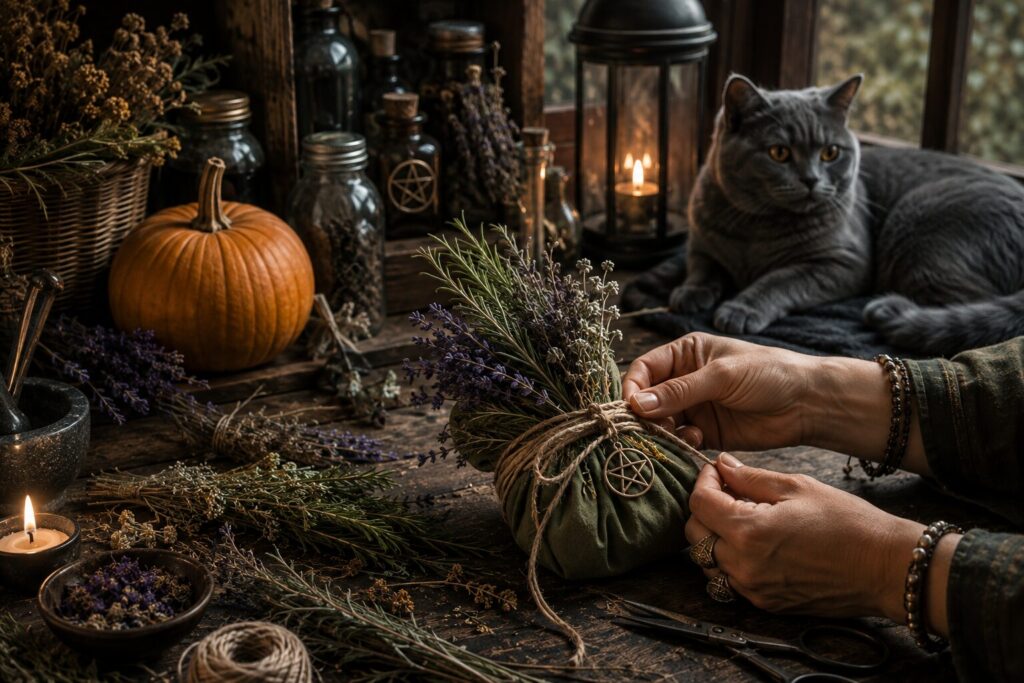
Protective Bundles
A protective bundle is a small working brought together in physical form. It may contain herbs, branches, cord, a written charm, a key, bell, piece of iron, or another carefully chosen object. Hung near a door, window, bed, hearth, or private space, it gives the household’s intention a visible and renewable anchor.
The value of a bundle does not come from how many ingredients we can fit inside it. It comes from whether those ingredients are working toward the same purpose.
In correspondence-based practice, every material adds its own quality and instruction. Some qualities reinforce one another naturally. Rosemary may cleanse and protect while bay adds authority and juniper strengthens the outer boundary. Other combinations may become muddled or actively work against one another when their purposes are not defined.
A bundle intended to calm a bedroom may not benefit from several sharp, confrontational, or aggressively banishing ingredients. A working designed to drive something out should not simultaneously contain materials instructed to draw, welcome, bind, or hold it close. A charm meant to keep an influence from entering is not quite the same as one meant to reveal it after it crosses.
This does not mean every ingredient must have an identical correspondence. Different qualities can cooperate when each has a clear role. Lavender may calm the interior while iron guards the boundary. A bell may alert while rosemary clears what the bell has disturbed. The issue is not variety; it is contradiction without structure.
A bundle should speak with several supporting voices—not argue with itself.
Before assembling one, we decide upon a single governing sentence. For example:
- “Guard this entrance while allowing honest welcome.”
- “Keep this sleeping room quiet, private, and protected.”
- “Clear the atmosphere left by conflict and return this room to peace.”
- “Hold the household steady through the winter season.”
Every ingredient should be able to answer that sentence. We may choose one primary material that carries the central purpose, one or two supporting materials, and an anchor such as cord, a key, bell, sigil, or written charm. When an ingredient does not clearly support the working, we leave it out.
Bundles are also meant to age. Plant material dries, scent fades, cord loosens, dust gathers, and seasonal work eventually reaches its end. This is not failure. A bundle is a living part of household maintenance, not a permanent object that must remain hanging long after we have forgotten why it was made.
Building a Coherent Protective Bundle
These examples are adaptable household workings rather than fixed formulas. Keep the central purpose clear, learn the materials you use, and leave out any ingredient whose role cannot be explained.
When Ingredients Support—or Work Against—One Another
A bundle can hold several qualities, but those qualities need a hierarchy. Decide what the bundle does first, then assign each ingredient a supporting role.
Drawing and Banishing
A bundle cannot clearly draw something inward while also driving that same influence away. Define what is welcomed and what is refused instead of giving the whole working opposite directions.
Calm and Aggressive Defense
Gentle sleep or harmony work may become restless when crowded with forceful reversal, alarm, thorn, or confrontation symbolism. Keep stronger defense at the outer boundary when possible.
Holding and Releasing
Materials instructed to bind, preserve, or hold may conflict with a working whose purpose is to release residue and move it out. A clearing bundle should not accidentally preserve what it is meant to remove.
Opening and Sealing
A spirit-facing, divinatory, or invitation-based working should not be combined casually with a bundle meant to seal all spiritual movement. Decide which relationships remain welcome before closing.
Temporary and Continuing Work
A short-term clearing bundle should have an ending. A continuing doorway guardian should be built from materials and instructions that can be maintained without holding a crisis in place forever.
Different Does Not Always Mean Conflicting
Lavender may calm the room while iron guards its boundary. A bell may alert while rosemary clears. Different functions can cooperate when each ingredient knows its place within the larger instruction.
“Choose one governing purpose, one primary material, one or two supporting materials, and an anchor. When the bundle needs a long explanation to reconcile its ingredients, simplify it.”
Protective Bundles for the Living Home
Each example includes a coherent purpose, suggested materials, placement, renewal, and words that may be adapted to the household.
General Doorway Protection
A balanced entrance bundle that protects without making the doorway feel hostile or closed to ordinary welcome.
Suggested Materials
- Rosemary: cleansing, protection, continuity, and remembrance.
- Bay: household authority, clarity, blessing, and firm intention.
- Juniper: purification, resilience, and defense at the outer edge.
- Green or natural cord: stability and an ongoing relationship with the home.
- Optional iron washer: a small material anchor for firmness.
Construction and Placement
Arrange the stems together, wrap the iron securely if used, and tie the bundle firmly without crushing the plant material. Hang it above or beside the inner doorframe.
Renewal
Inspect monthly and replace when the bundle becomes brittle, dusty, damp, moldy, insect-damaged, or disconnected from its purpose.
Sample Words
“Guard this entrance with clarity and steadiness. Let honest welcome pass beneath you, and let what approaches to harm, deceive, or disturb lose its way before crossing.”
Peaceful Threshold Bundle
For homes that need a gentler transition after work, travel, conflict, overstimulation, or frequent visitors.
Suggested Materials
- Lavender: calm, rest, peaceful atmosphere, and softened tension.
- Rosemary: cleansing and protection so calm does not become passivity.
- Dried rose petals: care, hospitality, and peace held with boundaries.
- Blue, cream, or pale-green cord: calm communication and steadiness.
Construction and Placement
Use a small cloth sachet if loose petals would fall. Hang the bundle inside the entryway, where the household transitions from public activity into private life.
Avoid Conflicting Additions
Do not crowd this bundle with forceful reversal materials, exposed thorns, loud alarm bells, or ingredients instructed to intensify conflict. A separate outer ward can carry firmer defense.
Sample Words
“Let those who enter in good faith find peace here. Let the strain of the road fall away, let harshness soften before it takes root, and let this household keep its calm without giving up its boundaries.”
Firm Boundary Guardian
For an entrance requiring a stronger statement of household authority without directing retaliation toward anyone.
Suggested Materials
- Bay: authority, clarity, and a declared household rule.
- Juniper: firm purification and resilient defense.
- An unused iron key or washer: control of access and material refusal.
- Dark green, brown, or black cord: rooted and clearly held limits.
- Optional written sigil: the exact condition of entry.
Construction and Placement
Wrap the metal securely so it cannot fall. Place the sigil against the stems or inside a small fabric pouch. Hang beside the primary door or the entrance that actually needs reinforcement.
Correspondence Check
Keep this bundle focused upon refusal and household authority. Avoid adding ingredients whose principal instruction is to draw people, opportunities, spirits, or attention inward.
Sample Words
“This household governs its own threshold. Honest need and welcome may enter; domination, deception, deliberate harm, and unlawful claim may not. What has no right here finds no passage.”
Quiet Sleeping-Room Bundle
A gentle protection for rest, privacy, calm dreams, and returning the sleeper to themselves.
Suggested Materials
- Lavender: quiet, rest, and the easing of household tension.
- Rosemary: protection, clarity, and personal integrity.
- Dried rose petals: care, emotional safety, and gentle privacy.
- Violet, blue, or soft-gray cord: quiet spiritual boundaries.
Construction and Placement
Place the ingredients inside a securely closed cloth sachet. Hang it near the bedroom door or upon a stable wall hook—not directly above the sleeper, inside bedding, or where it can fall.
Avoid Overworking the Room
Do not combine a quiet sleep bundle with several active spirit invitations, alarm charms, aggressive reversal materials, or constant divinatory work. Keep firmer defense nearer the outer household boundary.
Sample Words
“Let this room remain private, quiet, and securely held. Let the body release its watch, let dreams pass without taking possession, and let the sleeper wake clear, rested, and wholly their own.”
After Conflict or Illness
A short-term bundle for helping a room release strain and return to its ordinary purpose after a difficult period.
Suggested Materials
- Rosemary: cleansing, restoration, and household continuity.
- Bay: clarity, order, and the reestablishment of authority.
- Yarrow: resilience, courage, and repair after strain.
- White or natural cord: reset, clarity, and return to ordinary life.
Construction and Placement
Make the bundle after physically cleaning and airing the room. Place it near the room’s door for a defined period—commonly several days or until the room feels returned to its purpose.
Give It an Ending
This is not meant to preserve the crisis. Date the bundle and dismantle it once the reset is complete rather than leaving the illness or conflict symbolically enshrined in the room.
Sample Words
“The difficult moment has passed. Let strain, fear, illness, and conflict release their hold upon this room. Let what has been learned remain, while the burden itself is carried away.”
Cleansing and Uncrossing Bundle
For a location that needs a firmer period of clearing before a new blessing or continuing ward is established.
Suggested Materials
- Rosemary: cleansing and protective restoration.
- Juniper: strong purification and refusal.
- Bay: command, clarity, and the authority to end a condition.
- Optional rue: traditional uncrossing and firm rejection.
- Black-and-white cord: removal followed by clarity and reset.
Construction and Placement
Prepare this after physical cleaning. Hang it inside the affected room near the route through which the unwanted condition is being directed outward. Give the working a fixed ending.
Follow With Something Constructive
Clearing creates space. Once this bundle is removed, bless the room or establish the gentler continuing ward that should replace it. Do not leave the household permanently defined by banishment.
Rue Caution
Rue is optional. Its fresh sap can irritate skin and may produce a stronger reaction after sunlight exposure. Wear gloves when handling it, keep it away from children and animals, and substitute additional juniper when rue is inappropriate.
Sample Words
“What has crossed this home without right is released and refused. What has attached without welcome loosens and departs. The way out is open; the way back is closed. This room returns to clarity.”
Seasonal Hearth Bundle
A household protection centered upon continuity, warmth, resilience, and steady passage through seasonal change.
Suggested Materials
- Evergreen sprig or juniper: endurance and continuing protection.
- Rosemary: household memory, cleansing, and continuity.
- Bay: blessing, authority, and a clear household intention.
- Dried orange peel: warmth, light, and vitality within the home.
- Gold, green, or natural cord: continuity and the turning season.
Construction and Placement
Make the bundle near the beginning of the household’s chosen season and place it near the hearth, kitchen entrance, or main gathering room—well away from heat and flame.
Renewal
Replace it at the next seasonal turning or when the materials deteriorate. Do not allow a seasonal protection to become faded decoration that remains throughout the year without intention.
Sample Words
“Through the turning season, let this home remain warm, steady, and protected. Let what must change do so cleanly, and let what sustains us endure.”
Key-and-Bell Guardian
A durable doorway bundle for homes where dried herbs, scent, shedding plant material, or botanical allergens are unsuitable.
Suggested Materials
- Unused key: household authority and the governing of access.
- Small bell: alert, announcement, and interruption.
- Iron washer: firm material defense and stability.
- Written or stitched sigil: the specific instruction of the ward.
- Strong cord: joins the separate functions into one working.
Construction and Placement
Tie each item securely so that metal cannot strike glass or damage the door. Hang the guardian beside the inner frame or from a fixed hook where it does not interfere with locks, handles, or movement.
Correspondence Structure
The key governs access, the bell announces crossing, the iron refuses harmful entry, and the sigil defines the household’s exact terms. Each component performs a different but cooperating role.
Sample Words
“By key, this household governs its own access. By bell, each crossing is known. By iron, harmful passage is refused. By this sign, the terms of welcome and protection remain clear.”
Constructing, Speaking, and Maintaining the Bundle
A bundle becomes more than arranged materials when its purpose, relationships, boundaries, and ending are made clear.
Choose the Purpose Before the Ingredients
Write the bundle’s purpose in one sentence. Then ask what kind of action the sentence requires: welcoming, refusing, clearing, calming, alerting, anchoring, or maintaining.
Primary Material
Carries the central action. Rosemary may lead cleansing; juniper may lead firm defense; lavender may lead calm.
Supporting Materials
Add one or two qualities needed to complete the work—clarity, continuity, authority, resilience, or emotional steadiness.
Anchor
Cord, a key, bell, iron piece, written charm, or sigil gives the working structure and connects it to the chosen location.
Ending
Decide whether the bundle is temporary, seasonal, or continuing before hanging it. Every working needs a known point of review.
Preparing and Tying the Bundle
- Inspect the materials. Use clean, correctly identified plant material free of mold, pests, rot, or chemical residue.
- Clean the non-plant objects. Wipe keys, bells, iron, charms, and tools according to their material.
- Arrange according to purpose. Place the primary material at the center and supporting materials around it.
- Speak each role. As an ingredient is added, state what it contributes rather than relying upon silent assumption.
- Wrap securely. Tie firmly enough to hold the bundle as it dries without crushing stems or leaving long dangerous loops.
- Add the anchor. Attach the key, bell, sigil, tag, or iron only after confirming that it cannot fall, cut, catch, or injure.
- Dedicate the whole. Restate the governing sentence and place the bundle where its work is meant to occur.
Direction, Orientation, and Placement
Orientation is symbolic rather than universal. Choose an arrangement that supports the instruction and remain consistent about what it means within the working.
Upward
May represent holding, lifting, watchfulness, continuity, and the preservation of household protection.
Downward
May represent pouring blessing, grounding, or directing an influence toward the threshold below.
Toward the Exterior
Suits removal, refusal, and the direction of unwanted influence away from the interior.
Toward the Interior
Use only when intentionally drawing welcome, calm, healing, continuity, or another beneficial quality into the home.
Do not place a bundle where it obstructs a door, blocks an exit, brushes constantly against people, hangs over food, catches moisture, or sits close to a burner, fireplace, heater, candle, vent, or moving fan.
Why Speaking the Working Aloud Matters
Spoken words give the bundle an ordered instruction. They engage breath, sound, attention, and the physical body while making vague or contradictory intentions easier to notice.
We do not need elaborate poetry. A direct statement is often stronger because every part can be understood and remembered.
A useful dedication names the object, its location, its job, what it welcomes, what it refuses, its limits, and how long the instruction remains active.
When to Refresh or Replace a Bundle
Material Change
Replace bundles that become moldy, damp, insect-damaged, crumbling, badly faded, or unsafe.
Purpose Change
Rebuild when the entrance, room, household members, spiritual relationships, or protective need changes.
Seasonal Renewal
Seasonal bundles should be reviewed or replaced at the next meaningful turning rather than left indefinitely.
After a Major Event
Reassess after renovation, illness, conflict, moving, intense ritual work, or a significant change in the household.
Ordinary deterioration is not automatically evidence of magical attack. Check moisture, insects, sunlight, airflow, the hook, and the condition of the materials before assigning spiritual meaning.
Dismantling and Releasing the Bundle
- State that the working is ending. Release its instruction before taking it apart.
- Remove reusable objects. Clean keys, bells, iron, stones, or charms before returning them to ordinary use or another working.
- Separate the materials. Untie cord, remove written tags, and identify what can be safely composted, recycled, retained, or discarded.
- Dispose according to physical reality. Do not burn unknown or irritating plants. Do not bury metal, glass, cord, salt, wax, plastic, or unsafe botanical material.
- Clean the placement. Dust or wash the hook, doorway, wall, shelf, or frame before hanging a replacement.
“The work held here is complete. I release these materials from the purpose they carried. What may serve again returns cleanly to ordinary use; what has reached its end may leave without remainder.”
Fire, Mold, Allergies, Children, and Animals
Do Not Treat It as Incense
A hanging bundle is not automatically safe to burn. Plant identity, smoke sensitivity, oils, pesticides, mold, and fire risk all matter.
Keep It Dry
Do not hang plant bundles where steam, rain, cooking grease, bathroom moisture, or condensation will encourage mold.
Secure Loose Material
Use a cloth sachet when petals, seeds, brittle leaves, or small pieces may fall into food, bedding, pet areas, or walkways.
Check the Exact Household
Consider allergies, pregnancy, medications, breathing conditions, children, cats, dogs, birds, and other animals before choosing ingredients or scent.
Essential oils are not required. Concentrated oils can increase scent, skin, pet, and fire concerns without making the magical instruction clearer.
Deities and Spiritual Powers of the Home
Household protection does not require deity work. A home can be cleansed, blessed, warded, and maintained through the practitioner’s own power, household customs, ancestors, spirits of place, prayer, or non-devotional magic. The gods are not a missing ingredient that must be added before protection becomes real.
When we do involve a deity, we are entering a relationship rather than selecting another correspondence from a chart.
A god is not a decorative symbol or a magical employee assigned to guard the door. Deities possess their own histories, personalities, domains, devotional customs, and ways of relating. We approach them through study, recognition, respect, offerings where appropriate, and sustained attention—not by placing a statue upon a shelf and assuming a contract has been created.
The deity should also fit the work.
A threshold concern naturally aligns with a power connected to gates, roads, crossings, or protected passage. A kitchen or hearth blessing may be better suited to a deity of sacred fire, nourishment, continuity, or domestic order. A working focused upon direct defense may call for a power of strength and guardianship, while a household recovering from conflict may benefit more from healing, peace, or restored relationship.
Calling upon a powerful deity whose domain does not match the need may make the working less coherent rather than more impressive.
The same caution applies when several deities are honored together. Different gods do not automatically conflict merely because they come from different cultures, and many modern Pagans maintain meaningful relationships across pantheons. The problem arises when we combine them without understanding their roles or give the rite contradictory instructions.
A deity approached for calm and reconciliation should not be crowded into the same undifferentiated call as a power being asked for confrontation, aggressive reversal, or destructive force. Hekate may guard the threshold while Hermes carries the message beyond it, but their functions should be named rather than blended into a vague idea of “more protection.” Thor may establish a firm outer defense while Frigg is honored for the integrity of the household within. Different powers can cooperate when each relationship and purpose remains distinct.
A household pantheon should be a relationship of powers with understood roles—not a collection of divine names added for intensity.
Prayer, petition, offering, invocation, and aspecting are also different levels of engagement. We may respectfully ask a deity to watch over a household without inviting that deity into embodiment or calling their full presence into ritual space. Invocation is a deeper opening and requires preparation, boundaries, discernment, and deliberate closure. Most ordinary household protections do not require it.
Within the Coven of the Veiled Moon, Hekate and Hermes hold particular importance. Both are associated with thresholds and passage, yet they are not interchangeable. Hekate stands at the meeting of roads and realms, governing access, boundaries, hidden ways, and the transformation that occurs at a crossing. Hermes moves between those places, carrying messages, guiding travelers, negotiating exchange, interpreting signs, and keeping roads of communication open.
For household protection, this makes them natural but distinct allies: Hekate at the gate; Hermes upon the road.

The Divine Household
These figures are not a required pantheon or a list of interchangeable protective correspondences. They represent several divine relationships practitioners may find naturally aligned with the hearth, threshold, family, passage, household integrity, and defense.
Hekate
Keeper of Thresholds, Keys, Crossroads, and Hidden WaysHekate is particularly fitting where the home meets the unseen: doors, gates, property edges, crossroads, spirit boundaries, periods of transition, and situations in which the household needs both protection and discernment.
Her protection is not merely a wall. It concerns rightful access: what may cross, what must remain outside, what may be revealed, and when a passage should be opened or closed.
Household work with Hekate may use keys, lamps or candles, threefold arrangements, a clean threshold, a crossroads symbol, or prayer spoken at the doorway. Offerings and devotional practices should follow the relationship and the practitioner’s understanding rather than a copied list.
Threshold wards, spirit discernment, protection during major change, closing unwanted roads, guiding the household through uncertain transitions, and establishing clear terms of spiritual access.
Hermes
Guide of Roads, Messages, Exchange, and Protected PassageHermes is naturally connected to the movement surrounding a home: arrivals and departures, travel, deliveries, messages, negotiations, trade, guests, communication, and the roads by which people and opportunities reach the household.
Where Hekate governs the charged threshold, Hermes guides movement across it. He is well suited to protections that should keep roads open without allowing confusion, deception, poor communication, or harmful exchange to enter unchecked.
Household symbols may include a key, coin, feather, road marker, writing tool, small cairn, travel charm, or clearly spoken agreement. Fair dealing, fulfilled promises, messages carried faithfully, and practical aid to travelers may themselves become devotional acts.
Safe travel and return, household communication, deliveries and exchange, boundary negotiation, messages between realms, road opening, and the clear movement of help or opportunity.
Other Divine Relationships of Hearth and Home
These gods come from different religious worlds and should be approached within their own stories and traditions. Their household relevance does not make them interchangeable.
Hestia & Vesta
Hearth • Sacred Fire • Continuity • NourishmentHestia and Vesta belong to related Greek and Roman hearth traditions, but they should not be flattened into one undifferentiated goddess. Both center sacred fire, household continuity, nourishment, and the stable heart around which communal life gathers.
Household use: hearth blessings, kitchen protection, family meals, continuity during change, tending the household center, and restoring warmth after disruption.
Janus
Doors • Gates • Beginnings • Departures • TransitionsJanus is especially suited to doors and passages because his Roman domain includes beginnings, endings, entrances, departures, and the two directions held by every threshold.
Household use: moving into or leaving a home, opening and closing a rite, guarding the primary door, beginning a new household chapter, and marking a change in who or what may enter.
Brigid
Healing • Craft • Poetry • Inspiration • Transforming FireBrigid’s early Irish divine associations include healing, poetry, inspiration, smithcraft, fertility, and sacred fire. Modern Pagan practice frequently honors her at the hearth, though we should not reduce her broad divine identity to a generic domestic goddess.
Household use: healing after hardship, inspired household craft, protection through skilled work, peaceful restoration, creative life, and the fire that transforms rather than merely destroys.
Bes
Household Defense • Family • Children • Joyful Apotropaic PowerBes imagery belonged strongly to the ancient Egyptian household. His fierce appearance, music, movement, and weapons expressed protective force directed against harmful influences, particularly around women, children, birth, and intimate family spaces.
Household use: family protection, bedrooms and children’s spaces, courageous joy, loud interruption of harmful influence, and guardianship that is both fierce and life-affirming.
Thor
Strength • Direct Defense • Hallowing • Storm • Holding the LineThor carries a direct protective current: the defender who confronts threats rather than negotiating with them. His hammer is associated with strength, protection, power, fertility, and the hallowing of people, objects, and significant occasions.
Household use: strengthening outer wards, protecting family and property, courage during crisis, hallowing a home, and establishing a defense that is clear rather than subtle.
Frigg
Marriage • Motherhood • Foresight • Household IntegrityFrigg is associated with marriage, motherhood, foresight, and her queenly place within Asgard. She may be approached for the integrity of household relationships, long-term care, family responsibility, and the protection that comes through wise preparation.
Household use: strengthening marriage or family bonds, protecting the household’s continuity, foresight in domestic decisions, and holding care together through difficult circumstances.
Match the Power to the Work
The strongest divine name is not necessarily the right name. Begin with the actual household need, the deity’s domain, and the relationship already present.
Begin With the Domain
Thresholds suggest Hekate or Janus. Roads and communication suggest Hermes. Hearth continuity suggests Hestia or Vesta. Direct defense may align with Thor. Household relationship and foresight may align with Frigg.
Relationship Outweighs a List
A deity with whom we have an established relationship may be more appropriate than the theoretically perfect name found in a book. Existing trust and devotional literacy matter.
Clarify Several Roles
When more than one deity is involved, state who guards, who guides, who heals, who blesses, and who carries the request. Do not ask every power to perform every function.
Do Not Invoke for Display
A household blessing rarely needs full invocation or aspecting. Prayer, offering, petition, or respectful acknowledgment may provide the appropriate level of relationship.
“Call the power whose nature belongs to the work, and give that power a role clear enough to honor.”
Approaching Divine Household Protection
These practices move from simple acknowledgment toward deeper ritual engagement. Use only the level supported by the relationship and the practitioner’s experience.
Honor, Prayer, Petition, and Invocation Are Different
Honor or Acknowledgment
Recognize the deity through a clean space, symbol, light, spoken name, study, devotional act, or brief expression of gratitude. No request is required.
Prayer
Address the deity directly with gratitude, praise, concern, or a request for attention. Prayer does not necessarily open ritual space or invite embodiment.
Petition
Ask for a defined form of aid: guard this threshold, guide this traveler, restore this hearth, strengthen this family, or reveal what threatens household integrity.
Invocation or Aspecting
Invite the deity into shared ritual space or embodied relationship. This requires stronger preparation, protection, consent, discernment, containment, and closure.
“Do not open a deeper gate merely because a respectful request would have been enough.”
Offerings, Reciprocity, and Sustainable Devotion
An offering recognizes relationship; it is not a bribe or payment that forces a deity to perform. The most appropriate offering often reflects the deity’s domain and the practitioner’s ability to remain consistent.
- Give within the deity’s language: light at a threshold, fair exchange, crafted work, clean water, poetry, household care, protection of the vulnerable, or another fitting act.
- Promise only what can be kept: one small act completed faithfully is better than a dramatic vow abandoned after the crisis.
- Keep offerings physically safe: do not allow food to rot, liquids to stagnate, candles to burn unattended, or outdoor gifts to harm wildlife and land.
- Do not assume every deity wants the same thing: study the tradition and allow the relationship to teach its own rhythm.
“I place this gift in gratitude and recognition. It is freely given, without demand or hidden bargain. May the relationship between this household and the power honored here remain clear, respectful, and rightly bounded.”
Working With More Than One Deity
Several deities may be honored within one home, and distinct pantheons do not automatically cancel one another. The practical concern is whether the ritual gives each power a comprehensible role and whether the practitioner understands the relationships being brought together.
Complementary Example
Hekate guards the threshold, Hermes carries the household’s message and protects the road, while Hestia or Vesta holds the hearth within.
Layered Example
Thor strengthens the outer defense while Frigg is honored for wise household order, care, foresight, and the integrity of family relationships.
Potential Conflict
A call for gentleness, reconciliation, and quiet should not be mixed carelessly with undirected commands for confrontation, reversal, punishment, or escalating force.
Separate When Needed
Use separate prayers, altar areas, stages of the rite, offerings, or days when the relationships do not belong inside one blended working.
“Each power is honored according to their nature. Let the guardian guard, the guide carry, the healer restore, and the keeper of the hearth preserve what belongs within. Let no role obscure another.”
Boundaries, Discernment, and Closing the Relationship
Reverence does not eliminate boundaries. A healthy devotional relationship should deepen clarity and responsibility rather than create constant fear, urgency, flattery, isolation, or pressure to perform dangerous acts.
- Name who is being addressed: avoid vague invitations to “any god” or “whatever power is here.”
- Define the location and duration: this doorway, this rite, this period of transition, or this continuing devotional shrine.
- Maintain the household’s authority: divine relationship does not require surrendering ordinary safety, consent, health, or responsibility.
- Close deliberate openings: give thanks, end the petition, extinguish or secure ritual lights, remove temporary offerings, and return attention to ordinary life.
- Observe over time: recurring clarity matters more than one dramatic sign, dream, or coincidence.
“With gratitude, this deliberate meeting is now complete. Let the blessing and protection rightly given remain, while the opened ritual space closes. May the boundary between divine and household return to its proper shape until we meet again.”
When No Deity Is Needed
A practitioner may protect the home through their own authority, household tradition, elemental work, prayer without a named deity, ancestral practice, relationship with land, protective spirits, sigils, cleaning, warding, or ordinary stewardship.
We should not approach a deity solely because we fear our own work is insufficient. Calling a god into a situation can deepen the relationship, but it can also add devotional responsibility and complexity that the household did not need.
“This home possesses boundaries because those who tend it possess the right and responsibility to define them. We cleanse, bless, protect, and maintain this place through the authority of care, relationship, and deliberate practice.”
Ancestors, Household Spirits, and Spirits of the Land
Not every protective spiritual relationship is divine. Some homes are held through quieter relationships with the dead, the place itself, or spirits connected to the household. These relationships remain optional and require the same clarity, respect, and boundaries as deity work.
Ancestors and Beloved Dead
Ancestors may be asked to watch over descendants, family continuity, memory, and the household line. Ancestral connection is not required, and harmful or unwanted family relationships do not gain access merely because they are part of the bloodline.
Household Spirits
Some practitioners understand a home as developing or hosting a distinct household presence. Relationship may be built through cleaning, warmth, hospitality, regular acknowledgment, and respect for the home’s continuing purpose rather than dramatic spirit invitation.
Land and Place Spirits
Spirits associated with the property may be approached through observation, tending, litter removal, responsible planting, water, gratitude, and clear terms. Respect for place does not remove the living household’s right to safety and boundaries.
When Something Lingers

Most household disturbances do not begin dramatically. A room feels heavier than it did before. Sleep becomes restless in one part of the house. An object repeatedly draws uncomfortable attention. A sound returns at the same time each night. The atmosphere changes after a visitor, renovation, illness, loss, ritual, or new possession enters the home.
Sometimes the cause is ordinary and physical. Sometimes emotional or ritual residue has accumulated. Sometimes the boundary of the home has become unclear. At other times, we may reasonably suspect an interactive presence, attachment, or spirit relationship requiring closer discernment.
The first task is not to name the cause. It is to understand the pattern.
Fear encourages us to connect every strange event into one story. A light flickers, an animal stares at the wall, a dream becomes vivid, and a sound comes from another room—suddenly all four events are treated as proof of the same spirit. Good discernment slows that process down. We record what happened, where it occurred, who noticed it, what changed beforehand, and whether the events repeat under similar conditions.
We also check the home itself. Repairs, ventilation, plumbing, pests, appliances, electrical problems, moisture, exterior noise, sleep disruption, medication, stress, grief, and conflict can all affect how a place is experienced. Investigating those causes does not deny spiritual possibility. It prevents us from directing ritual attention toward the wrong problem.
When the disturbance follows one object, isolate the object before cleansing the entire property. When it follows one person into other locations, examine personal spiritual hygiene, stress, belongings, and individual boundaries. When it remains attached to one doorway, room, tree, outbuilding, or section of ground, focus first upon that location.
Not everything that lingers is conscious. Emotional residue, repeated household behavior, ritual atmosphere, and what some practitioners call a residual echo may repeat without awareness or intention. These conditions often respond to cleaning, airflow, sound, rearrangement, blessing, and a renewed household rhythm.
An interactive presence behaves differently. It may appear to notice attention, respond to questions or boundaries, change its behavior when objects are moved, or repeatedly engage particular members of the household. Interaction still does not tell us who or what it is. A presence claiming a familiar name, divine identity, ancestral connection, or urgent purpose should not be accepted without discernment.
We should also distinguish unfamiliar from harmful. A household or land spirit may be strange without being hostile. A passing presence may need only a clear direction to continue onward. A welcomed ancestor may require better-defined limits. Protection is not improved by treating every spirit as an enemy.
At the same time, courtesy does not require surrendering household authority. A presence that frightens residents, disrupts sleep, targets vulnerable people, repeatedly ignores stated limits, imitates trusted figures, pressures us toward dangerous behavior, or escalates when challenged should not be encouraged through casual conversation or improvised invitation.
We do not need to understand everything completely before stating that it may not harm, frighten, control, or remain without welcome.
A household boundary can be stated before the cause is known. We may require all spiritual activity to remain peaceful, truthful, nonintrusive, and subject to the authority of those who live there. We can close access to bedrooms, children’s rooms, bathrooms, dreams, bodies, and private spiritual spaces while continuing to investigate what is occurring.
Response should be gradual. We begin with safety and observation. We clean and repair. We cleanse and restore the atmosphere. We state the boundary. We ward the appropriate point and watch what changes. Only then do we move toward divination, communication, banishing, containment, or outside assistance.
Escalation should answer evidence—not fear.
A Measured Response to Unexplained Household Activity
We begin with safety, pattern, and the least forceful response likely to resolve the problem. Stronger action becomes appropriate only when the evidence and behavior justify it.
Is Anyone in Immediate Danger?
Leave the area and contact appropriate emergency, medical, utility, fire, or law-enforcement services when there is smoke, gas, structural danger, violence, forced entry, alarming physical symptoms, or another urgent real-world threat.
What Changed Before It Began?
Note renovations, illness, grief, conflict, visitors, ritual work, sleep changes, new medication, new occupants, inherited belongings, antiques, removed trees, excavation, or altered household routines.
Where Does It Remain?
Determine whether the pattern centers upon one room, object, doorway, person, outbuilding, property edge, dream state, or the entire household.
Does It Repeat or Respond?
Repetition without interaction may suggest residue, habit, or a physical condition. Apparent response deserves closer observation, but it still does not establish identity or intention.
The Household Response Ladder
Begin at the first appropriate step. Do not jump directly to confrontation, spirit communication, containment, or aggressive banishing when cleaning, repair, and a clear boundary have not yet been attempted.
Observe and Record
Write down what happened before researching the property or discussing possible identities. Record the date, time, location, witnesses, sounds, sensations, weather, household activity, and anything that changed beforehand.
Purpose: to separate a repeating pattern from unrelated events and the expectations created by a frightening story.
Inspect, Repair, and Stabilize
Check locks, plumbing, wiring, ventilation, moisture, pests, appliances, windows, roof spaces, foundations, exterior noise, sleep conditions, and other physical explanations relevant to the pattern.
Purpose: to protect the household and remove conditions that may create, imitate, or intensify an unsettling atmosphere.
Clean, Cleanse, and Restore the Room
Remove clutter and rubbish, wash the area, create safe airflow, adjust light, change bedding or textiles, move stagnant objects, and use sound, sweeping, prepared water, prayer, or another appropriate cleansing practice.
Purpose: to release residue and return the room to its ordinary household function before assuming a conscious presence must be confronted.
State the Household Boundary
Speak clearly about what may and may not occur. Close access to bodies, sleep, dreams, children’s rooms, bathrooms, private altars, and other intimate spaces. Do not negotiate from fear.
Purpose: to establish authority and conditions before communication, divination, or stronger intervention is considered.
Ward the Relevant Point and Observe
Strengthen the specific doorway, window, object, room, property edge, or personal boundary connected to the pattern. Avoid surrounding the entire household with aggressive defenses when only one point requires attention.
Purpose: to learn whether a clearer boundary changes, limits, redirects, or ends the activity.
Use Divination and Experienced Discernment
When the pattern continues, use a grounded method of divination, compare more than one reading, and seek an experienced practitioner who does not begin by declaring a curse, demon, possession, or expensive emergency.
Purpose: to test interpretations, identify the likely level of response, and prevent fear or confirmation bias from directing the work.
Seek Help or Escalate Deliberately
Experienced assistance may be appropriate when boundaries are repeatedly ignored, activity intensifies, several household members are affected, a dangerous object or ritual is involved, or the practitioner lacks training in spirit removal, containment, banishing, or psychopomp work.
Purpose: to bring in the right form of help without improvising beyond our knowledge, safety, or authority.
Match the Response to the Pattern
These categories are working interpretations, not automatic diagnoses. More than one cause may be present, and the understanding may change as new information becomes available.
Residual Atmosphere or Emotional Echo
A room may seem to repeat an old mood, sound, sensation, or pattern without responding to attention. Repeated conflict, grief, illness, ritual work, or intense emotion can also shape the atmosphere without producing a conscious spirit.
Begin With
Physical cleaning, ventilation, light, sound, rearrangement, fresh textiles, cleansing, blessing, and the restoration of the room’s intended purpose.
Avoid
Questioning the atmosphere as though it were a person, repeatedly provoking it, or escalating directly to spirit confrontation.
Residual conditions often weaken when the physical and emotional rhythm of the room changes consistently over time.
Activity Centered Upon an Object
If the disturbance began after an antique, inherited possession, ritual tool, secondhand item, artwork, or unknown object entered the house, isolate it safely before cleansing the entire property.
Begin With
Move it to a calm, secure location; record what changes; inspect it physically; research its history; and determine whether the response follows the object.
Avoid
Burning, breaking, burying, opening, or angrily confronting an unfamiliar object before knowing whether it contains hazardous materials or whether the problem is actually connected to it.
Emotional and family associations may be powerful without indicating that a spirit lives inside the object.
Activity at a Doorway, Window, Gate, or Property Edge
A disturbance focused upon a crossing may suggest a poorly defined threshold, frequent traffic, neglected physical access point, changing relationship with the land, or spiritual activity that has not moved fully into the home.
Begin With
Repair and clean the opening, state the household boundary, renew the threshold ward, and observe whether the activity remains outside, diminishes, or shifts elsewhere.
Avoid
Inviting the activity inward for easier communication or opening a broader spiritual gateway simply to discover what is present.
An Apparently Interactive but Nonaggressive Presence
Apparent interaction may include changes following a spoken boundary, repeated behavior around particular objects or people, or responses that seem connected to attention. Interaction does not establish identity, honesty, or right of access.
Begin With
State peaceful terms, restrict private areas, document changes, and use divination or experienced discernment before making promises, offerings, invitations, or devotional claims.
Avoid
Accepting a claimed identity immediately, inviting embodiment, offering unrestricted access, or treating every coincidence as confirmation.
Courtesy is appropriate when behavior remains peaceful, but courtesy does not remove the household’s right to set terms or ask a presence to leave.
A Disruptive Presence or Repeated Boundary Violation
Stronger action may be justified when activity repeatedly frightens residents, targets sleep or vulnerable people, imitates trusted figures, pressures dangerous behavior, interferes with daily life, escalates after reasonable boundaries, or refuses to leave private areas.
Begin With
End casual communication, reinforce personal and household protection, document the escalation, close devotional and ritual openings, and seek experienced help.
Possible Next Steps
Structured banishing, spirit removal, object containment, psychopomp work, or another specialized response may be appropriate when performed by someone trained for it.
Do not provoke, threaten, bargain with, challenge, summon, or repeatedly test an apparently disruptive presence for proof.
Words for an Uncertain Presence
This statement can be used before we know whether the cause is a spirit, residue, attachment, or something ordinary. It establishes conditions without naming or provoking what has not yet been understood.
“This is a living home, and its boundaries are held by those who dwell and care for it. No presence, spirit, influence, memory, or attachment may frighten, harm, deceive, control, imitate, drain, touch, follow, or disturb anyone here. Bedrooms, bodies, dreams, children, animals, private spaces, and sacred workings remain closed without clear and conscious invitation. What is peaceful may remain only under these conditions. What cannot respect them must leave now and continue onward. This boundary is stated clearly, and it stands.”
Speak Calmly
Volume is not authority. Use a steady voice, remain grounded, and avoid insulting or challenging what has not been identified.
Do Not Create an Invitation
A boundary statement does not need questions, requests for signs, promises, names, offerings, or permission for the presence to move closer.
When to Seek Experienced Help
Assistance should reduce fear, increase clarity, and leave the household with stronger boundaries. Be cautious of anyone who creates panic, guarantees a dramatic identity, demands secrecy, or claims that only repeated expensive work can keep the household safe.
Seek Practical Help
Contact qualified repair, utility, pest, environmental, medical, safety, or emergency professionals when the pattern may involve the building, health, unlawful entry, violence, or another physical danger.
Seek Spiritual Help
Look for an experienced practitioner who begins with questions, documentation, ordinary causes, consent, and proportionate response rather than immediately declaring possession or attack.
Ask About Their Method
They should be able to explain what they believe is occurring, what they propose to do, what risks are involved, how the work will be closed, and what the household must maintain afterward.
Keep Household Authority
Outside assistance should not create a permanent dependence upon the practitioner or give them unrestricted spiritual, physical, or financial access to the household.
Leave first when the environment may be unsafe. Ritual investigation can wait. Do not remain inside to complete a cleansing, collect magical tools, communicate with a presence, or protect an altar when alarms, smoke, gas, structural damage, violence, or sudden illness indicate immediate danger.
Household Rites
Household protection becomes most durable when it is woven into repeated care. A single powerful working may establish the boundary, but ordinary attention keeps that boundary connected to the people, rooms, and life it is meant to protect.
A household rite does not need to be theatrical. It may involve cleaning the entrance, lighting one attended candle, carrying a bell through the rooms, touching each doorway, speaking the household’s terms aloud, and then returning the home to ordinary use. The strength comes from sequence, clarity, and participation—not from the number of tools used.
The larger rites in this section follow the five acts introduced earlier:
cleanse, bless, ward, seal, and maintain.
They can be adapted for a house, apartment, shared home, dormitory, temporary room, or other living space. Renters may use removable marks and portable protections. Those in shared homes may focus upon their own room and the common areas where consent and household responsibility are genuinely shared.
No deity is required. The practitioner may work through personal authority, prayer, elemental powers, ancestors, household spirits, land relationships, or a deity already known through an established practice. We should not introduce a new spiritual relationship simply because we are performing a house rite.
The materials should also correspond with the purpose of the rite. A blessing intended to create calm, hospitality, and household continuity should not be crowded with aggressive reversal or confrontation materials. A rite intended to clear and release should not simultaneously bind the same influence into the home. Firm protection may be included without allowing fear to become the governing atmosphere.
Speaking aloud matters because it gives the working order. Breath carries intention into the physical space. Sound reaches the rooms, thresholds, objects, and people participating. Spoken wording also exposes confusion: when we hear ourselves asking a ward to welcome, repel, bind, release, conceal, and reveal everything at once, we recognize that the instruction needs to be simplified.
The words do not need to be memorized or poetic. They need to be honest, understandable, and aligned with the work.
A household rite should leave the home clearer than it found it—spiritually, physically, and emotionally.

Establishing and Maintaining the Guarded Hearth
These rites provide complete structures that may be adapted to the household’s tradition, authority, physical limitations, spiritual relationships, and actual living conditions.
Prepare the Home First
Complete necessary cleaning, repairs, ventilation, and safety checks before beginning. Ritual should strengthen household care rather than delay it.
Keep the Purpose Coherent
Choose materials and words that support the same governing purpose. Do not combine drawing, holding, releasing, and banishing without giving each action a clear place in the sequence.
Close What Was Opened
End deliberate spirit contact, extinguish or secure ritual lights, remove temporary materials, release the working space, and return the home to ordinary life.
Establishing the Guarded Hearth
Use this rite when moving into a home, formally beginning household protection, returning after a major disruption, or replacing a system of wards that no longer fits the people living there.
Best Timing
After the space is physically clean and major repairs or hazards have been addressed. Lunar, solar, or seasonal timing is optional.
Movement
Begin at the household center, move through the rooms and outer boundaries, then return to the center to seal and close.
Governing Purpose
“This home welcomes what sustains its life and refuses what seeks to harm, deceive, dominate, or disturb.”
Suggested Tools
A central light: one attended candle, electric candle, lamp, or hearth light representing the living center of the home.
A cleansing tool: broom, cloth, bell, prepared water, sound, or another method safe for the household.
A boundary tool: key, sigil, iron object, household charm, or portable ward to be placed at the primary entrance.
A blessing symbol: bread, clean water, salt in a contained dish, a plant, household object, or another sign of continuity and care.
-
Prepare the Household
Remove rubbish, spoiled offerings, broken protections, and ritual remains whose purpose has ended. Tidy the main pathways, secure animals as needed, silence avoidable interruptions, and gather everyone who has chosen to participate.
In a shared home, explain what will occur in common areas and keep private devotional or spirit work within the practitioner’s own space unless others have agreed.
-
Establish the Living Center
Place the central light in the kitchen, living room, dining area, hearth, or another location that genuinely functions as the household center. Light or activate it safely.
Words at the Center“Here is the living center of this home. From this place we nourish, rest, gather, recover, create, and return. Let the life of this household be held with warmth, clarity, dignity, and protection.”
-
Cleanse From the Center Outward
Carry the chosen cleansing method through each room. Open safe airflow where appropriate. Move clutter, wipe a doorway, sound the bell, sweep, or lightly apply prepared water according to the room’s materials and purpose.
Direct residue toward the outer door. Do not ask a clearing method to preserve, bind, or hold what the rite is trying to release.
Words While Cleansing“What has become stagnant may move. What has completed its purpose may leave. What does not belong to the present life of this household is released without attachment or return.”
-
Bless the Rooms According to Their Purpose
Pause briefly in each room and name what it is meant to hold: nourishment in the kitchen, rest in the bedroom, release in the bathroom, truthful connection in gathering spaces, privacy in personal rooms, and clarity in magical spaces.
Blessing prevents the cleansed home from being left symbolically empty.
Adaptable Room Blessing“Let this room become fully itself. Let it hold what supports its purpose, release what weakens that purpose, and remain part of the balanced life of this home.”
-
Walk and Define the Outer Boundary
Walk the property line where safely and legally possible. In an apartment or temporary space, walk the interior perimeter and pause at windows, exterior walls, the balcony, and the primary entrance.
Acknowledge the edges without claiming neighboring or shared property beyond the authority of the household.
Words at the Boundary“This is the boundary entrusted to our care. Let what supports this household approach in peace. Let harm, deception, domination, intrusion, and unlawful spiritual claim lose their direction before crossing.”
-
Establish the Primary Ward
Return to the entrance most often used. Place or activate the chosen sigil, key, iron object, bell, plant, bundle, or other household guardian. Give it one understandable job.
Words for the Guardian“Stand here as guardian of this crossing. Recognize honest welcome, necessary aid, love, health, opportunity, and peaceful passage. Refuse what comes to harm, deceive, control, drain, or disturb. Perform this work without trapping those who belong here or closing the home against what is good.”
-
Seal the Household Structure
Move back toward the center, briefly touching or acknowledging the important thresholds along the way. Confirm that the outer ward, room blessings, and household center belong to one protective structure rather than several disconnected spells.
Words of Sealing“From the outer edge to the rooms within, this household now knows its shape. Its center is living, its rooms are ordered, its thresholds are guarded, and its terms are clear. What has been established is sealed without imprisonment and held without fear.”
-
Close and Return to Ordinary Life
Thank any deity, ancestor, spirit, or power deliberately addressed. Close ritual space, dismiss or release invited presences according to the relationship, extinguish the candle or secure the light, and put tools away.
Share food, water, tea, or a simple household activity afterward. This grounds the rite in the living home rather than leaving the space suspended in ceremony.
Aftercare
Record the date, primary ward, tools used, promises made, and chosen renewal rhythm. Over the following days, observe the household without repeatedly testing the protection or treating every ordinary event as a sign.
Renewing the Household Wards
Use this rite seasonally, annually, after major change, or whenever the household’s protections have become physically neglected, symbolically unclear, or disconnected from present needs.
Best Timing
During ordinary household cleaning or at a meaningful seasonal, lunar, solar, or household anniversary that can be sustained.
Movement
Inspect first. Clean and repair second. Renew only what still has a purpose. Retire what no longer belongs.
Governing Purpose
“Let every protection serve the household as it exists now—not as it existed when the object was first placed.”
Suggested Tools
Cleaning supplies: cloth, broom, vacuum, surface-safe wash, rubbish bag, labels, repair tools, and whatever ordinary care the wards require.
Renewal tool: bell, prepared water, candle, prayer, breath, sigil ink, cord, or another method already natural to the practice.
Replacement materials: fresh herbs, secure cord, new labels, clean containers, safe mounting hardware, or another physical repair.
A written inventory: record where protections are located, what they do, and whether they are renewed, altered, or retired.
-
Begin at the Household Center
Light or activate the central household symbol. State that the purpose of the rite is maintenance, not emergency escalation.
Opening Words“We tend what protects this home. We strengthen what remains useful, repair what has weakened, release what has ended, and bring every household ward back into clear relationship with the life being lived here.”
-
Inspect Before Recharging
Walk through the home and examine each active protection. Check dust, mold, rust, cracks, loose cord, dead plants, damaged glass, spoiled contents, fading marks, weakened hooks, and blocked access.
Do not recharge a physically unsafe object. Repair or replace it first.
-
Ask Whether Each Protection Still Belongs
State the purpose of each object in one or two sentences. When the purpose cannot be remembered, examine the object before renewing it. When the need has ended, release the protection rather than preserving an old crisis.
Question for Each Ward“What place do you guard, what work do you perform, and does that work still serve this household now?”
-
Clean, Repair, Replace, or Retire
Dust bells and witch balls, wash safe surfaces, retie bundles, redraw faded marks, tend plants, replace damaged hardware, and empty or dismantle containers whose purpose has ended.
Dispose according to the physical material. Do not bury glass, metal, salt, wax, plastic, toxic plants, unknown liquids, or other hazards merely because the object was magical.
-
Renew the Outer Boundary
Walk the perimeter or interior apartment boundary. Check gates, doors, windows, balconies, property corners, sheds, garages, and other points of approach. Repair practical weaknesses and restate the household terms.
Boundary Renewal“The shape of this household remains known. What is welcome may approach under peaceful terms. What comes to harm, deceive, dominate, or intrude finds no rightful passage.”
-
Renew the Primary Guardian
Clean and touch the entrance ward. Ring the bell, trace the sigil, hold the key, tend the plant, or use the method appropriate to the object.
Repeat its established instruction rather than assigning several new functions during every renewal.
-
Restore the Rooms
Visit the major rooms and briefly name their purpose. Pay particular attention to rooms that have changed use, gained a new occupant, become neglected, or hold a new altar, office, sleeping arrangement, or spiritual practice.
Room Renewal“This room is renewed in the purpose it now serves. Let its protection support the people who use it, remain proportionate to its needs, and release any instruction that no longer belongs.”
-
Seal and Record the Renewal
Return to the center. Confirm that the household structure is intact without becoming rigid. Close the rite, put tools away, and update the household protection inventory.
Closing Words“The wards of this home are clean, clear, and current. They protect without imprisoning, alert without feeding fear, and remain connected to the care of those who live here. This renewal is complete.”
Aftercare
Note anything requiring later repair, research, or replacement. Maintenance is not complete when the words are spoken if a broken lock, moldy bundle, damaged railing, exposed wire, or leaking pipe still needs attention.
Why We Speak the Household Boundary Aloud
Spoken language gives a household working sequence and physical presence. It is not the only valid form of magic, but it is especially useful where several rooms, participants, spirits, or protective objects need to receive the same clear instruction.
It Clarifies the Instruction
Hearing the words makes contradictions easier to recognize. We can revise a ward that accidentally welcomes and refuses the same thing.
It Marks a Beginning and Ending
The first words open the deliberate work; the final words close it. This helps prevent ritual attention from remaining indefinitely active.
It Includes the Physical Home
Breath and sound move through the room. The body participates rather than leaving the working entirely inside silent thought.
It Creates Shared Understanding
In a group or household rite, participants hear the same terms, limits, and purpose instead of silently assuming different outcomes.
Short Household Practices
These are maintenance rites rather than replacements for repairs, communication, personal boundaries, or a full response to persistent disturbance.
A Weekly Doorway Reset
Use this brief practice at the entrance most often used. It keeps the threshold connected to ordinary household traffic without repeatedly rebuilding the ward from the beginning.
Use
A cleaning cloth or broom, the established doorway guardian, and a bell, breath, prepared water, or spoken renewal.
Method
- Clear shoes, rubbish, packages, and objects blocking the entrance.
- Clean the inner handle, frame, mat, or threshold safely.
- Inspect the bell, bundle, plant, horseshoe, sigil, or other guardian.
- Ring, touch, trace, or acknowledge the ward once.
- Restate its existing purpose without adding new instructions.
“This threshold is clean, known, and attended. Let welcome cross honestly, let necessary passage remain open, and let harmful intention turn away before entering.”
After a Difficult Visitor
Use this after an emotionally difficult visit without assuming the guest deliberately left a curse, attachment, or spiritual attack.
Use
Ordinary cleaning supplies, safe airflow, a broom or cloth, and the household’s established sound or doorway protection.
Method
- Secure the door and allow the household a few quiet minutes.
- Gather dishes, rubbish, and items left from the visit.
- Restore the gathering room and open safe airflow.
- Move the remaining tension toward the outer door.
- Clean the threshold and restate the household boundary.
“The visit has ended and this home returns to itself. What belongs to our guests leaves peacefully with them. What belongs to this household remains whole. Conflict has no continuing claim here.”
A Sleeping-Room Protection
Use this after restless sleep, emotional strain, illness, intense dream work, or whenever the bedroom needs to return to quiet rather than become more heavily defended.
Use
Clean bedding, adjusted lighting, safe ventilation, a quiet personal charm, and optional calming sound or prepared water.
Method
- Remove dishes, work, ritual remains, and objects that do not belong.
- Change or straighten the bedding and restore comfortable temperature and light.
- Close unfinished divination, spirit, or dream work.
- Touch the bedroom door, window, and personal charm.
- State that rest and bodily privacy are the governing conditions.
“Within this room, the body may release its watch. Dreams may pass without possession, the night may remain quiet, and no presence or influence may touch, frighten, drain, or disturb the sleeper.”
A Portable Rite for a Temporary Room
Use this in a hotel, dormitory, guest room, hospital room, shelter, temporary residence, or other space that is occupied but not spiritually claimed as permanent property.
Use
A clean cloth, portable charm, key, small bell, piece of jewelry, folded protective cloth, or written sigil kept inside personal belongings.
Method
- Inspect the room, locks, exits, alarms, and obvious safety concerns.
- Tidy the area being used and create safe airflow where permitted.
- Place the portable protection near the bed or personal belongings.
- Set a boundary around your body, rest, possessions, and immediate space.
- Gather the protection and formally release the room before leaving.
“I occupy this room peacefully and temporarily. My body, sleep, dreams, belongings, and personal space remain my own. What belongs to this place remains outside my boundary, and what belongs to me leaves with me when I depart.”
A Spoken Household Boundary
This may be spoken during maintenance, before receiving guests, after conflict, during uncertainty, or whenever the household needs one clear statement of its governing terms.
“This is a living home, held by those who dwell in and care for it. Let love, honest friendship, health, necessary aid, good opportunity, peaceful exchange, and rightful spiritual relationship find welcome here. Let harm, cruelty, deception, domination, intrusion, deliberate ill-wishing, and unlawful claim find no place to root. No person, spirit, influence, memory, or attachment may frighten, control, drain, imitate, follow, touch, or disturb those who live here. Our bodies, dreams, children, animals, private rooms, and sacred spaces remain closed without clear consent. This household welcomes without surrendering, protects without imprisoning, and stands securely within its own authority.”
Adapting the Rites to the Home You Have
A rite should fit the household rather than forcing the household to resemble an imagined ideal.
Renters and Apartments
Use removable marks, planters, portable charms, washable surfaces, bells, keys, textiles, and interior boundary walks. Do not damage the building or claim shared property.
Shared Homes
Keep common-area wording centered upon safety, respect, privacy, and household integrity. Place more specific devotional or spirit work within personal space.
Limited Mobility or Energy
Perform the rite seated at the household center, use a floor plan or symbolic keys for each room, divide the work across several days, or ask trusted participants to carry the tools.
Practical Safety and Household Care
The most immediate purpose of household protection is to protect the people and animals who live within the home. No charm, ward, blessing, spirit relationship, or ritual system should make the building less safe, harder to leave, more difficult to maintain, or more dangerous to inhabit.
Ordinary household care is not separate from magical protection. It is its physical foundation.
A working lock establishes a real boundary. A visible house number allows emergency help to find us. A maintained smoke alarm gives warning. A repaired railing prevents injury. A clear hallway preserves safe passage. Clean air, controlled moisture, secure windows, stable furniture, and reliable lighting all strengthen the home before a single spiritual protection is added.
As witches, we should be wary of using spiritual explanations to postpone necessary action. A room that smells damp may need inspection for water damage. Repeated headaches or sudden illness in several occupants may require immediate medical, utility, or environmental attention. Flickering lights may need an electrician. Scratching in a wall may be caused by pests. A door that opens by itself may have a damaged latch, uneven frame, airflow problem, or structural movement.
Investigating these causes does not weaken belief. It allows our magic to address the part of the situation that is actually magical.
Ritual materials also become ordinary household objects once they enter the home. Candles remain flame. Herbs can mold or trigger allergies. Glass can break. Iron can rust and cut. Cord can entangle. Salt can damage surfaces and poison soil. Oils may stain, irritate skin, affect breathing, or be unsafe around particular animals. A protective object does not stop obeying physical law because it has been consecrated.
The method must therefore fit the household.
A home containing children may require stitched or enclosed protections rather than loose stones, herbs, bells, and pins. A household with animals may need plant-free or scent-free methods. Someone with limited mobility may need all thresholds and walkways kept entirely clear. A person with breathing concerns may use water, sound, light, prayer, or visualization instead of smoke. A renter may report repairs and use removable protections rather than alter wiring, alarms, doors, or the building itself.
Adaptation is not lesser magic. It is skilled practice.
Safety also includes emotional conditions. Protection should not make household members afraid to touch objects, cross doorways, open windows, move furniture, clean rooms, or question a spiritual interpretation. A working that depends upon secrecy, constant vigilance, or fear of accidental failure may need to be simplified.
Household members should understand the physical protections that affect them. Everyone should know how to unlock doors, recognize alarms, reach an exit, locate necessary medication or mobility equipment, and respond during an emergency. Children should receive calm, age-appropriate instruction rather than frightening stories about what magical protections are keeping away.
The same applies to visitors, caregivers, repair workers, and emergency responders. A ward may govern spiritual access without obstructing the practical access needed to maintain or save the household.
The first household ward is the one that keeps the living safe.
We do not prove our faith by remaining in danger to finish a ritual. When an alarm sounds, smoke appears, gas is suspected, someone becomes seriously ill, violence occurs, or the structure becomes unsafe, we leave and seek appropriate help. Candles can be extinguished. Circles can be closed later. Tools can be replaced. Altars can be rebuilt.
People cannot.
The Safety Beneath the Spell
Use this framework to inspect the physical conditions supporting the household’s magical protections. Correct hazards first, then adapt the spiritual method to the home and the people who actually live there.
Repair Before Interpreting
Check the structure, utilities, environment, and household routines before treating unexplained sounds, smells, movement, illness, or discomfort as spiritual activity.
Adapt Without Apology
Replace smoke, flame, sharp iron, loose powders, toxic plants, or hanging cords whenever the household requires a safer method.
Leave When Danger Is Real
An alarm, fire, suspected gas, structural danger, violence, or serious illness takes priority over closing a ritual perfectly or recovering magical belongings.
The Household Safety Ledger
Open each category during seasonal ward renewal, after moving, following renovation, or whenever the household’s physical needs change.
Doors, Locks, Windows, Lighting, and Visible Access
The practical entrance and the magical threshold should support one another. Protection is weakened when a doorway is symbolically guarded but physically broken, dark, hidden, obstructed, or difficult to operate.
Inspect
Locks, latches, hinges, handles, doorframes, window locks, screens, gates, railings, exterior lighting, steps, and the visibility of the address.
Keep Clear
Door viewers, handles, exit windows, stairs, walkways, ramps, fire escapes, building alarms, utility access, and routes used by emergency responders.
Adapt the Magic
Place sigils, bells, bundles, keys, and other guardians beside necessary hardware rather than across it. Use removable methods on rented or shared property.
A heavy horseshoe, mirror, planter, bell arrangement, or hanging charm should be securely mounted and should never fall into the doorway or onto someone passing beneath it.
Smoke Alarms, Carbon-Monoxide Alarms, and Escape Routes
Alarms provide the household with warning that magical senses cannot be expected to replace. Follow current local requirements and the manufacturer’s instructions for placement, testing, maintenance, replacement, and accessibility.
- Do not cover, decorate, paint, remove, silence permanently, or spiritually “seal” an alarm.
- Keep smoke and carbon-monoxide alarms where they can be heard or otherwise perceived by the people who live in the home.
- Replace batteries and alarms according to their instructions and respond promptly to warning signals or repeated malfunction.
- Keep doors, windows, and pathways needed for evacuation clear of altars, furniture, storage, floor powders, cords, and ritual tools.
Plan Two Routes
Identify more than one usable way out of sleeping rooms and gathering areas where possible. Do not assume the usual doorway will remain accessible.
Choose a Meeting Place
Agree upon a location outside where household members gather after leaving so no one reenters while trying to determine who is missing.
Practice the Plan
Include children, older adults, people with disabilities, animals where practical, and anyone who may need assistance hearing, seeing, unlocking, or moving toward an exit.
Candles, Cooking, Incense, Smoke, and Household Heat
Ritual fire remains fire. It should be treated with the same care whether it represents a deity, ancestor, hearth, spirit, spell, or simple household blessing.
Stable and Attended
Place candles in stable holders on clear, heat-safe surfaces. Extinguish them before leaving the room, becoming drowsy, or ending active supervision.
Clear of Combustibles
Keep flame and high heat away from herbs, bundles, paper, petitions, altar cloths, curtains, shelves, dried flowers, cooking grease, hair, clothing, and decorations.
Smoke Is Optional
Incense and burning herbs are not required for cleansing. Substitute sound, water, light, prayer, sweeping, wiping, ventilation, or a non-burning charm when smoke is unsuitable.
Do not leave candles burning to “finish the spell” while asleep or away. Extinguishing the flame safely does not erase the working; the ritual can include deliberate relighting when continued flame is truly necessary.
Electricity, Cords, Batteries, Devices, and Ritual Displays
Altars and protective displays often gather lamps, electric candles, diffusers, heaters, chargers, speakers, and decorative lights in one small area. The arrangement must remain physically appropriate for the outlets, devices, furniture, and room.
- Replace damaged plugs, hot or discolored cords, unstable connections, and malfunctioning devices rather than blessing them and continuing to use them.
- Do not hide heat-producing devices beneath cloth, herbs, books, baskets, cushions, altar coverings, or enclosed shelves.
- Keep cords away from water, walkways, pet access, doors, moving furniture, and places where they may be pinched or frayed.
- Do not attach metal charms, pins, chains, wire, or liquid-filled vessels where they can contact outlets, plugs, batteries, or exposed electrical components.
Flickering lamps, repeated power loss, burning odors, sparks, unusual heat, or frequently tripped protection should be treated as an electrical concern rather than interpreted first as spirit activity.
Water, Moisture, Mold, Ventilation, and Indoor Air
Dampness can change the smell, appearance, comfort, and perceived atmosphere of a room. It can also damage herbs, cloth, paper, wood, altars, stored objects, walls, and the building itself.
Find the Source
Check plumbing, roofs, windows, foundations, condensation, bathrooms, laundry areas, ventilation, standing water, and damaged seals before covering an odor with incense or oils.
Dry and Ventilate
Use appropriate ventilation and dry wet materials promptly. Remove moldy bundles, sachets, papers, food offerings, fabrics, and porous ritual materials rather than attempting to cleanse and keep them indefinitely.
Protect Breathing
Consider asthma, allergies, migraines, illness, medication, children, older adults, and animals before using smoke, fragrance, essential oils, powders, or airborne preparations.
A “heavy” or oppressive room may be influenced by stale air, excessive humidity, temperature, darkness, contamination, or water damage. Correcting those conditions may be both the physical and magical reset the room needs.
Children, Animals, Plants, Glass, Salt, and Sharp Materials
Every household protection must be designed around those most likely to touch, pull, taste, climb, knock over, chew, or investigate it.
Small and Sharp Objects
Secure keys, bells, stones, beads, nails, pins, broken glass, washers, charms, crystals, jars, and other small materials where they cannot be swallowed or cause injury.
Plants and Preparations
Identify plants correctly and check the safety of leaves, berries, seeds, sap, smoke, oils, and infusions for the specific humans and animal species exposed to them.
Cords and Hanging Charms
Keep loops, ribbons, chains, bundles, window cords, and hanging decorations away from cribs, beds, play spaces, climbing furniture, pet areas, fans, and moving doors.
- Use contained salt rather than loose lines where it can be eaten, tracked, spilled, or rubbed into paws and floors.
- Keep thorned plants away from narrow paths, exits, play areas, and places where visitors or animals brush against them.
- Anchor unstable shelves, altars, statues, mirrors, cabinets, and furniture that may be climbed or pulled.
- Explain household charms to children as signs of safety and care rather than proof that frightening forces are pursuing them.
Accessibility, Sensory Needs, Health, and Shared Communication
A household should be protected in ways its residents can physically use and emotionally tolerate. Accessibility belongs inside ritual design from the beginning rather than being treated as an exception.
Mobility
Keep routes wide and uncluttered. Place wards beside ramps, rails, handles, mobility equipment, chairs, and exits rather than where they obstruct their use.
Sensory Access
Choose alarms and household signals that residents can perceive. Avoid bells, chimes, bright flashing light, strong fragrance, or repeated sound when they create distress or disorientation.
Health and Medication
Keep necessary medication, glasses, hearing devices, phones, mobility aids, and emergency information accessible. Magical tools should not crowd or disguise essential care items.
A seated rite, silent rite, scent-free cleansing, electric candle, recorded boundary statement, or protection carried by another trusted participant remains a complete form of practice.
Emergency Plans, Contacts, Supplies, and Leaving the Home
A protected household knows how to leave when remaining is unsafe. Prepare the plan before an emergency, when decisions can be made calmly and access needs can be addressed.
The Plan
Identify exits, an outdoor meeting place, emergency contacts, local hazards, building procedures, and who assists children, animals, older adults, or residents requiring help.
The Supplies
Maintain practical emergency supplies appropriate to the household, location, weather, medication needs, communication, animals, and the possibility of leaving quickly.
The Communication
Make sure household members know where to meet, whom to contact, what alarms mean, and which doors, stairs, or building exits should be used.
- Renters and apartment residents should learn the building’s evacuation procedures and locate usable stair exits.
- Keep emergency contacts, identification, medication information, and necessary instructions where they can be found quickly.
- Plan for animals without returning to a dangerous structure after leaving.
- Once outside during an emergency, remain outside until appropriate authorities say it is safe to return.
The altar, ritual tools, devotional objects, journals, and magical supplies are possessions. Do not delay evacuation or reenter a dangerous home to retrieve them.
Safer Magical Substitutions
The correspondence can often be preserved without keeping the hazardous form. Choose the safer method that still communicates the work clearly.
An unattended candle or open flame.
An electric candle, lamp, reflective object, sun symbol, brief attended lighting, or spoken invocation of protective light.
Smoke, incense, or burning herbs.
Sound, prayer, sweeping, safe airflow, a cloth, prepared water, visualization, bells, or a non-burning herb sachet.
Loose salt or protective powder on the floor.
A sealed sachet, contained dish, written salt symbol, removable mat mark, pale stone, or safely enclosed protective jar.
Exposed nails, pins, blades, or broken glass.
A safely enclosed iron washer, key, forged charm, stitched symbol, printed image, smooth stone, or sealed container without hidden sharps.
Long hanging cords, chains, and loose bundles.
A flat stitched charm, short secured loop, framed sigil, wall plaque, enclosed sachet, or symbol placed inside a cabinet.
A toxic, thorned, or unsuitable protective plant.
A verified household-safe plant, botanical image, dried material sealed out of reach, symbolic color, stone, or non-plant guardian.
When to Stop the Rite Immediately
Ritual closure can be completed later. Stop the working and respond to the physical situation when any of the following occurs.
An Alarm Sounds
Treat smoke, carbon-monoxide, security, medical, and building alarms according to their emergency purpose rather than assuming ritual activity triggered them harmlessly.
Smoke, Fire, Gas, or Dangerous Heat Appears
Extinguish only when immediately safe to do so. Leave and contact appropriate emergency or utility services when danger may be present.
Someone Becomes Seriously Unwell
Stop the rite, move to safety, and seek appropriate medical or emergency assistance. Do not interpret serious symptoms through divination before obtaining care.
The Space Becomes Physically Unsafe
Leave when there is violence, structural damage, forced entry, flooding near electricity, falling objects, blocked exits, or another danger beyond the practitioner’s control.
“The rite serves the living. When the living are endangered, safety becomes the rite.”
A protected home is not a home in which nothing difficult ever happens.
People become ill. Relationships change. Grief crosses the threshold. Arguments occur. Objects break. Rooms fall into disorder. Visitors bring the weight of their own lives with them. The seasons alter the light, the land, and the way the building settles around those who live within it.
Protection does not remove the home from life. It helps the household move through life without losing its center.
The guarded hearth is therefore not a fortress built against the world. It is a living structure of welcome, refusal, restoration, and care. It knows that some doors should open, some should remain closed, and some must be opened only under clear conditions.
Throughout this page, we have moved from the broadest edge of the property toward the intimate center of the home. We have considered the history of the land, the condition of fences and gates, the meaning of doors and windows, the different purposes held by rooms, the materials stored in the protective cabinet, the construction of bundles, relationships with spiritual powers, the discernment required when something lingers, and the rites by which a household is established and renewed.
Yet the work does not end when the final words are spoken.
A home continues to change. New people arrive. Others leave. Children grow. Animals age. Altars move. Rooms change purpose. Trees are planted or removed. Repairs open walls that have not been seen in decades. Spiritual relationships deepen, loosen, or take a different shape. A protection that once served the household well may eventually need to be cleaned, altered, or released.
This is why maintenance matters.
The most durable household protections are not always the oldest or most elaborate. They are the ones that remain connected to the life actually being lived. A ward remembered, understood, and cared for has greater integrity than a powerful object whose purpose has been forgotten. A weekly doorway cleaning may serve the household more faithfully than a complicated rite performed once and never revisited.
Consistency gives the home memory.
When we sweep the same threshold with purpose, ring the same bell after conflict, tend the same plant beside the door, speak the same boundary during uncertain moments, or renew the same household blessing at each seasonal turning, we create a recognizable rhythm. The protection becomes part of how the home knows itself.
That rhythm should not become fear or compulsion. Missing a weekly practice does not cause every ward to collapse. A charm moved during cleaning has not necessarily been spiritually damaged. A bundle falling from a failed hook is usually a reminder to repair the hook. Maintenance is relationship, not anxious obedience.
A protected home also remains capable of hospitality.
The goal is not to reject every stranger, unfamiliar spirit, strong emotion, or unexpected change. Growth often arrives through what we did not plan. Friendship, opportunity, love, healing, learning, and inspiration all cross thresholds from somewhere beyond the household’s present boundaries.
The purpose of protection is to allow those crossings to occur without surrendering discernment.
We may welcome a guest without giving them permanent access. We may listen to a spirit without permitting intrusion. We may honor the history of a place without allowing that history to govern the present. We may care for family while refusing cruelty. We may open ritual space without leaving it permanently open. We may love a home deeply while still repairing, changing, or eventually leaving it.
Healthy boundaries make relationship possible because they allow both welcome and refusal to have meaning.
The household itself also deserves respect. Even when we understand the personality or spirit of a home metaphorically, treating the space as a relationship can change how we inhabit it. We notice what has been neglected. We become more careful about what we bring inside. We consider what an object contributes before assigning it a permanent place. We stop treating rooms as empty containers and begin recognizing the patterns created through repeated life.
A home that is listened to is easier to protect.
We learn where the air becomes stagnant, which door is actually used, where conflict gathers, where people naturally rest, what parts of the property feel exposed, and which objects hold the household’s strongest memories. These observations guide the magic more honestly than a generic formula copied from somewhere else.
The same principle applies to the people within the home. Protection should support their bodies, relationships, privacy, beliefs, and practical needs. It should not make one resident’s spiritual practice the unquestioned law of everyone else. Shared protection can establish safety, respect, honesty, and refusal of deliberate harm while leaving room for different paths, doubts, and forms of participation.
A home does not need unanimous belief in order to benefit from care.
Nor does a practitioner need ownership of a building to establish meaningful protection. Renters, dorm residents, people in temporary housing, those living with family, and anyone occupying only one room can still create boundaries around their body, belongings, sleep, immediate space, and spiritual practice.
Authority begins with what is genuinely ours to tend.
Sometimes that is an entire property. Sometimes it is one bedroom, one doorway, one bag containing our belongings, or the space immediately surrounding the body. The size of the boundary does not determine the seriousness of the protection.
What matters is clarity.
A home that knows its boundaries knows what belongs within it. It recognizes the people, relationships, rhythms, objects, memories, and spiritual connections that make up its living identity. It also recognizes that belonging does not grant permission for harm. Family, history, ancestry, love, long residence, or previous access do not override the right of the household to establish new terms.
The home is allowed to change its answer.
It may once have welcomed someone who is no longer safe. It may once have held a spiritual practice that has now ended. It may contain inherited objects that no longer fit the life being built there. It may stand upon land marked by difficult history while becoming, under present care, a place of peace and restoration.
History is context, not destiny.
The past may explain part of a household’s atmosphere, but it does not own the future. Through repair, cleansing, blessing, warding, relationship, and repeated life, the home can be taught a different rhythm.
This is the deeper work of the guarded hearth.
We are not merely driving danger away. We are preserving the conditions in which life can continue: rest, nourishment, honest connection, privacy, joy, creativity, devotion, recovery, and safe return.
The strongest household protection is not the fear that watches every shadow. It is the care that keeps the light worth returning to.
The Guarded Hearth
Household protection is the continuing practice of knowing what we are responsible for, tending it with care, and establishing the conditions under which people, powers, memories, and opportunities may enter and remain.
Belonging
Know the people, relationships, objects, spiritual connections, and ordinary rhythms that form the living identity of the household.
Boundary
State clearly what may enter, what must remain outside, what requires permission, and what loses access when it causes harm.
Care
Clean, repair, nourish, listen, communicate, rest, and protect the bodies and relationships through which the home remains alive.
Renewal
Revisit protections as the household changes. Strengthen what still serves, adapt what must change, and release what has completed its work.
What the Guarded Hearth Is—and What It Is Not
The distinction matters. Healthy household protection creates the conditions for life rather than turning the home into a permanent response to danger.
The Guarded Hearth Is
- A home with clear terms of welcome and refusal.
- A household whose physical and spiritual protections cooperate.
- A living structure that can adapt as people and circumstances change.
- A place where rooms support their intended purpose.
- A boundary maintained through care rather than panic.
- A home capable of hospitality without surrendering discernment.
- A practice grounded in responsibility, relationship, and safe return.
The Guarded Hearth Is Not
- A fortress sealed against every unfamiliar influence.
- A collection of charms placed without known purpose.
- A reason to neglect repairs, health, safety, or communication.
- A system for controlling everyone who lives within the home.
- A constant search for curses, spirits, enemies, or signs of failure.
- A ritual structure so rigid that ordinary life cannot move through it.
- A promise that grief, conflict, illness, or change will never arrive.
May This Home Know Itself
These words may be spoken at the center of the home, at the primary entrance, during seasonal renewal, after moving, or whenever the household needs to remember its purpose.
“May this home know its own shape: the ground beneath it, the walls that hold it, the doors through which life passes, and the center to which its people return.
May its foundations remain steady, its structure remain sound, its water run cleanly, its fire remain governed, its air remain clear, and every necessary path remain open and safe.
May those who belong here find rest without fear, privacy without isolation, nourishment without scarcity, truth without cruelty, and welcome without surrender.
May honest guests cross this threshold in peace. May love, aid, healing, friendship, opportunity, learning, laughter, and rightful spiritual relationship find room within.
May harm lose its direction before arriving. May deception reveal itself. May domination find no hold. May cruelty, deliberate ill-wishing, intrusion, and unlawful claim find neither root nor passage here.
May every room remember what it is meant to hold. May the kitchen nourish, the gathering place connect, the bedroom restore, the bathroom release, the working space remain ordered, and the threshold know when to open and when to close.
May the history of this land be acknowledged without ruling the present. May what lingers without purpose be released, what remains in peace be rightly bounded, and what belongs to another road continue onward.
May the wards of this household protect without imprisoning, alert without feeding fear, and endure through care rather than anxiety.
May those who tend this home possess the wisdom to repair before interpreting, cleanse before escalating, listen before assuming, and leave when remaining is unsafe.
May this home change when it must, release what has ended, welcome what serves its life, and remain securely held through every season.
The hearth is living. The boundary is known. The welcome is honest. The refusal is clear. This home stands within its own authority, and those who return here may return in safety.”
Adapt the wording to the household. Name the people, animals, land, gods, ancestors, or protective relationships that genuinely belong to the practice. Leave out anything that does not.
Continue Through the Protection Paths
Return to the larger protection framework, explore a related practice, or reach out to the coven when a household concern requires further perspective.
Continue From the Guarded Hearth
Explore connected forms of protection and domestic practice, or reach directly into the Coven when guidance, divination, or magical assistance would be useful.